
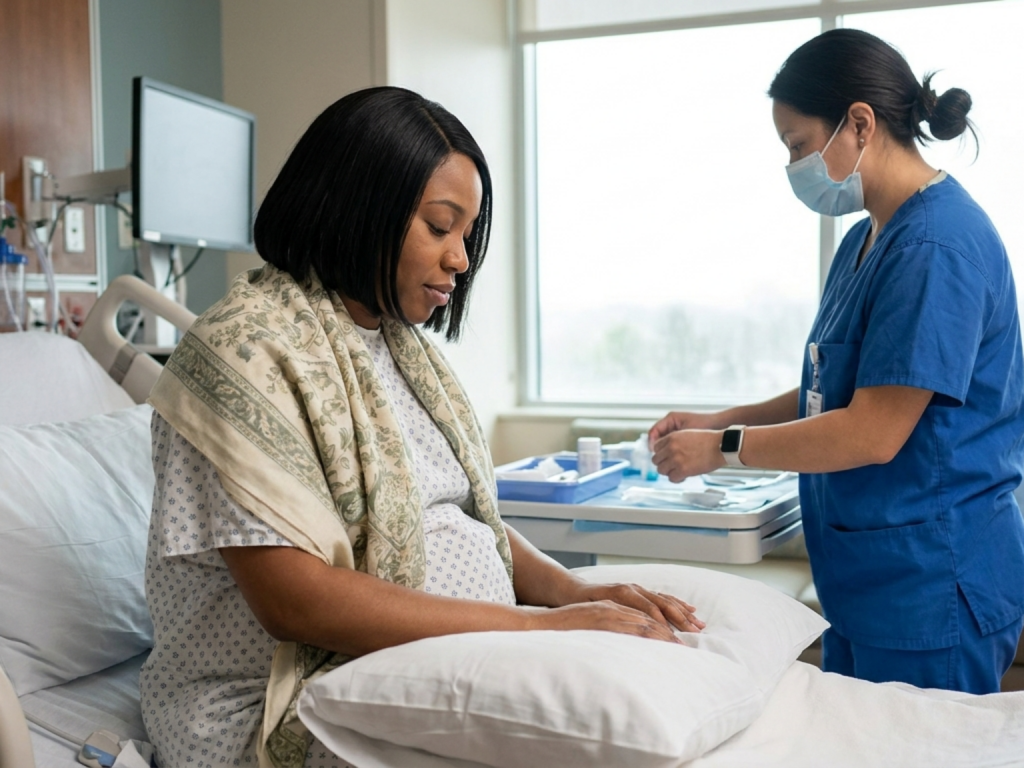
Intro
An epidural can change labor from something you are trying to endure into something you can work through more deliberately, but it does not erase the importance of position. The way you sit, lean, rest, and push can affect comfort, circulation, monitoring, and how easily you can recover between contractions.
This article explains the positions most commonly used with epidural analgesia, what they are for, and where the evidence is still limited. The emphasis is practical: choose positions that are safe, comfortable, and workable for your labor team, and ask your midwife or anesthesiologist to adapt them to your situation.
Highlights
The usual epidural insertion positions are sitting and leaning forward, or lying on the side with the knees drawn up. Both aim to make the lower back stable and accessible.
After the epidural is working, many people can still use side-lying, supported sitting, or a gentle tilt to rest and labor more comfortably.
In the second stage, research does not clearly prove that upright positions are better than recumbent ones for people with epidurals. Comfort and safety remain the practical guide.
Position choice often depends on leg strength, blood pressure, fetal monitoring, and how dense the block feels on each side.
If a position becomes painful, dizzying, or impossible to hold, the team should reassess it rather than forcing it.
Positioning for epidural placement
For epidural catheter placement, the clinician usually wants the lumbar spine as still and as open as possible. The two standard positions are sitting upright and leaning forward, or lying on the side with the knees drawn up. Both help create space between the vertebrae and make the procedure technically easier.
The goal is controlled stillness, not a rigid pose. Many people are asked to curl forward gently, relax the shoulders, and breathe through contractions while the anesthetic is placed. If the contraction pattern, pain, or fetal monitoring makes sitting difficult, the side-lying option is often used instead. The exact setup depends on the delivery room, the staff, and your comfort at that moment.
This is one place where preparation helps. Knowing in advance that you may be asked to stay still for a short time can make the procedure feel less abrupt. If you have back pain, limited mobility, or a prior difficult experience, raise it early so the team can plan the most workable position.
What you can do once the epidural starts working
After the epidural begins to take effect, most people do not need to remain in the exact insertion posture. The practical question becomes how to rest without flattening blood flow or creating pressure points. Side-lying with pillows, a slight lateral tilt, and supported sitting are all common because they help you recover between contractions while keeping you comfortable.
Many labor rooms also use equipment that influences position. An IV line, fetal monitor, blood pressure cuff, and epidural tubing all have to stay secure. That is why movement is usually slower and more deliberate than in an unmedicated labor, but it is not necessarily absent. Small adjustments are often enough: a pillow between the knees, a turn from one side to the other, or a gentle recline with the torso slightly elevated.
A useful way to think about this stage is that position is being used for rest as much as for labor progress. If you can sleep, reduce back pressure, or ease leg strain for a while, that can matter more than trying to stay upright all the time.
First-stage labor positions that may still work
An epidural does not always mean complete immobility. If the block is light enough and the unit allows movement, you may still be able to shift side to side, sit up more fully, or lean forward over a bedside table or peanut ball. These birth positions during labor can improve comfort and sometimes help the pelvis stay open enough for descent.
Side-lying is often the easiest option because it needs less leg strength and is stable when sensations are changing. Supported sitting can also be useful, especially if you prefer a more upright torso but do not want full weight on your legs. Some people tolerate a semi-recumbent posture better than flat supine positioning, particularly if they feel lightheaded or have back pressure.
There is no prize for finding the most active-looking posture. With epidural analgesia, the better question is whether the position is sustainable, safe, and not making you tense or exhausted. A position that lets you relax the jaw, soften the shoulders, and stay oriented is usually better than one that looks technically ideal but feels hard to hold.
Second stage and pushing with an epidural
The second stage of labor positioning question is more nuanced than many birth plans suggest. In the Cochrane review of women with epidurals, the evidence was not strong enough to show a clear winner between upright and recumbent positions for outcomes such as operative birth or labor duration. The practical takeaway is not that position does not matter, but that evidence is limited and comfort should lead the choice.
That is why second-stage pushing with epidural often looks different from person to person. Some people do well in a side-lying pushing position, especially if the block is stronger on one side or if they need more stability. Others prefer semi-sitting or supported kneeling over the bed. If the team thinks it is safe, a more upright posture may help you feel pressure and coordinate pushing, but it is not automatically superior.
What matters clinically is whether you can follow the urge, keep the pelvis accessible, and avoid strain. The sensation you feel may be more like pressure during second-stage pushing than the sharp intensity of contraction pain, and that is normal. Your team can coach you on whether to rest, bear down, or change angle as descent progresses.
What limits positions during epidural labor
Several factors can narrow the menu of usable positions. A dense block can make the legs feel heavy or unreliable. A blood pressure drop, common enough that staff monitor for it closely, may make upright positions briefly less comfortable. Continuous fetal monitoring, a urinary catheter, or even the way the epidural tubing is secured can also limit how far you can turn or how long you can stay in one posture.
If you notice one-sided numbness, uneven support, or a patchy epidural block, position alone may not solve the problem. The anesthesia team may need to assess catheter placement or adjust the medication. The same is true if you are being asked to labor in a position that is supposed to help, but you cannot tolerate it because your back, hips, or legs feel unstable.
Labor epidural analgesia works best when the bedside plan is realistic. That means choosing positions that fit the equipment, the stage of labor, and your neurological response rather than trying to force a generic posture onto every laboring person.
When a position change is not enough
Not every discomfort issue is solved by shifting your body. If you have sudden severe pain, new weakness, trouble breathing, marked dizziness, fever, redness at the insertion site, or a headache that becomes intense after birth, tell the clinical team promptly. Those symptoms need medical review rather than a trial of a new position.
Even outside the emergency setting, it is appropriate to ask for help if a posture starts to create pressure, strain, or anxiety. A good labor position should feel like support, not a test of endurance. If you are laboring with an epidural and cannot tell whether a position is safe, ask your midwife, obstetric team, or anesthesiologist before staying there for long.
In practice, the best position with an epidural is the one that keeps you comfortable enough to labor well, lets the staff monitor you appropriately, and can be changed without delay if your body or baby needs something different.
When to get urgent help
- Sudden severe headache, especially after birth or after a difficult epidural
- Trouble breathing, chest tightness, or feeling faint
- New fever, redness, swelling, or drainage near the insertion site
- Marked weakness, numbness, or loss of movement that does not fit the expected block
- Severe pain that persists despite position changes and staff review
Tools & Assistance
- Ask the labor nurse which positions fit your monitor, IV line, and epidural tubing.
- Request pillows, a peanut ball, or side supports if your unit uses them.
- Ask the anesthesia team to review any one-sided numbness or weak block.
- Use the call bell early if a position becomes dizzying, painful, or unstable.
FAQ
Can I move around at all after an epidural?
Often yes, but movement depends on the dose, your leg strength, and the monitoring setup. Small, supervised shifts are more common than walking.
Is side-lying a good position with an epidural?
Yes. Side-lying is commonly used because it is stable, comfortable, and easy to support with pillows.
Are upright positions better for birth with an epidural?
The evidence does not clearly show one best second-stage position for people with epidurals. Comfort, safety, and monitoring needs guide the choice.
What if I feel pain on one side only?
Tell the clinical team. Uneven numbness may need assessment, and a position change alone may not be enough.
Sources
- PubMed / Cochrane Database of Systematic Reviews — Position in the second stage of labour for women with epidural analgesia
- NHS — Epidural
- Mayo Clinic — Labor positions
Disclaimer
This article is for general information only and is not a substitute for advice from your obstetric or anesthesia team. Seek urgent medical care for severe symptoms or any concern about you or your baby.


















Please log in to leave a comment.