
Intro
A home birth story can be deeply reassuring, but it is never a template. Every labor unfolds through a unique combination of physiology, preparation, support, risk assessment, and chance. A real experience may include calm stretches, intense contractions, careful clinical observation, and moments when plans change quickly.
This article shares a composite-style, realistic home birth narrative informed by published home birth stories and birth narratives, while also explaining the medical decisions that often sit quietly behind the experience. It is written for readers who value both emotional honesty and clinical caution.
Highlights
A positive home birth experience usually depends on careful screening, a qualified midwife, and a clear transfer plan rather than atmosphere alone.
Real stories often include both beauty and unpredictability: slow early labor, intense transition, fetal heart checks, postpartum monitoring, and newborn assessment.
Home birth is generally discussed in the context of low-risk pregnancies, but eligibility can change before or during labor.
The safest stories are not always the most dramatic ones; sometimes the best outcome is an early decision to transfer for additional care.
The decision to plan a home birth
In many real home birth stories, the decision begins long before labor. The pregnant person is not simply choosing a cozy room over a hospital bed; they are weighing risk, values, prior experiences, and access to skilled maternity care. In one common scenario, a healthy person with a singleton pregnancy, cephalic presentation, spontaneous labor at term, normal blood pressure, and no major obstetric complications may ask whether a planned home birth could be appropriate.
The first meaningful conversation is usually clinical. A midwife or obstetric clinician reviews medical history, parity, previous births, placental location, fetal growth, gestational age, medications, group B streptococcus status, and any signs that the pregnancy may no longer be low risk. This is where home birth eligibility screening becomes central. A person may feel emotionally ready for home birth, but eligibility is not based on desire alone.
For the family in this story, the attraction was not an idealized version of birth. It was continuity: the same midwifery team had provided antenatal care, discussed informed consent, and explained the boundaries of safe out-of-hospital practice. They talked openly about postpartum hemorrhage, fetal distress, shoulder dystocia, meconium-stained fluid, prolonged rupture of membranes, and the possibility of transfer. Rather than making the parents more anxious, these conversations made the plan feel more grounded.
They created a home birth transfer plan, packed a small hospital bag, arranged childcare for an older child, checked the route to the hospital, and placed supplies in labeled birth bins. The emotional turning point came when the pregnant person realized that choosing home birth did not mean refusing hospital care. It meant beginning labor at home with qualified support, while keeping escalation available if needed.
Early labor: ordinary, uncertain, and still important
The first contractions arrived at 3:40 a.m., mild enough to doubt. They felt like menstrual cramps wrapping from the lower back to the front of the abdomen. For two hours, the birthing person alternated between sleep, hydration, and quiet pacing. This is a familiar theme in real birth stories: early labor can be emotionally enormous but clinically uneventful. The body is working, yet there may be no need for intervention.
The midwife advised rest, food if tolerated, and calling back if contractions became longer, stronger, and closer together; if membranes ruptured; if bleeding increased; if fetal movement changed; or if the mother felt something was wrong. This advice reflected a key principle: early labor is observed, not forced. There was no diagnosis made over the phone, only cautious triage.
By morning, contractions came every five minutes and required focused breathing. The room had been prepared with waterproof pads, clean towels, a birth pool still unfilled, dim lighting, and easy access to fluids. The partner timed contractions briefly, then stopped when timing became more distracting than helpful. The mother leaned over a kitchen counter during surges and rested on the sofa between them.
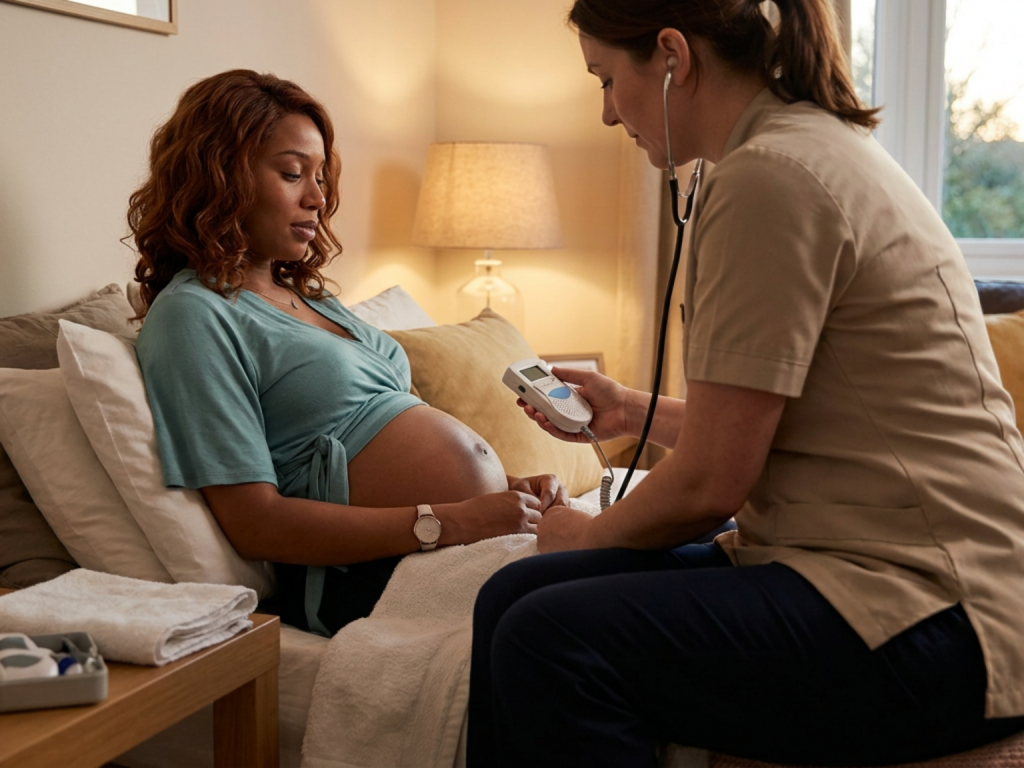
When the midwife arrived, she did not rush to perform a vaginal examination. Instead, she assessed the whole clinical picture: maternal pulse, blood pressure, temperature, contraction pattern, hydration, coping, and fetal heart rate. Intermittent fetal heart rate monitoring was performed with a handheld Doppler, especially after contractions. The baby’s heart rate was reassuring, and there were no red flags requiring immediate transfer.
This part of the story was not cinematic. It was slow, repetitive, and ordinary. Yet that ordinariness mattered. A calm early labor allowed the family to settle into the space, and it gave the midwife time to observe whether the labor pattern matched physiological progress.
Active labor: intensity, monitoring, and trust
By early afternoon, the atmosphere changed. The contractions demanded complete attention. The mother used low vocalization, hands-and-knees positioning, and warm water in the birth pool for comfort. She did not describe the pain as gentle or easy. She described it as powerful, consuming, and different from suffering because she felt supported and safe. That distinction appears often in positive birth narratives: pain may be intense, but fear can be reduced when information and support are consistent.
The midwife continued unobtrusive but deliberate observation. Maternal vital signs during labor were checked at appropriate intervals. The fetal heart rate was monitored intermittently according to local protocols and clinical judgment. The midwife watched for changes in the color of amniotic fluid, abnormal bleeding, maternal exhaustion, fever, or signs that contractions were not leading to progress.
At one point, the mother asked, “Can I still transfer?” The midwife answered yes. That answer was therapeutic. It confirmed that home birth was not a trap and that consent remained active. After a discussion of what she was feeling, how the baby was tolerating labor, and what options were available, she chose to stay home a little longer. No one framed this as bravery or failure. It was simply decision-making in real time.
Transition was the hardest phase. The mother shook, felt nauseated, and said she could not continue. The midwife recognized these as possible signs of rapid hormonal and cervical change, while still remaining alert to clinical concerns. A short time later, the mother began bearing down involuntarily. Because pushing sensations can occur before full dilation, the midwife assessed carefully rather than assuming. In this story, the findings were consistent with the second stage of labor.
Trust did not mean the midwife did nothing. It meant she knew when to observe, when to speak, when to check, and when to prepare. Neonatal resuscitation equipment was nearby, emergency medications were available according to the midwife’s scope and local regulation, and the transfer pathway remained open.
The birth itself: quiet moments and clinical readiness
The baby was born in the living room just before sunset. The final minutes were both primal and precise. The mother moved from the pool to a floor mat because that position felt more stable. The midwife used calm, direct language: breathe, pause, follow your body, let the head come slowly. The partner sat close enough to offer touch but not so close that the space felt crowded.
As the head crowned, the midwife assessed for restitution and the normal sequence of birth. There was no dramatic emergency, but everyone in the room understood that emergencies can arise suddenly. The shoulders delivered with the next contraction, and the baby was brought to the mother’s chest. For a few seconds, the room was silent. Then the baby cried, pinked up, and began making small searching movements.
The midwife performed a newborn transition assessment without unnecessarily separating mother and baby. She observed breathing, tone, color, heart rate, responsiveness, and temperature. Apgar scoring, if used, was part of a broader clinical assessment, not a judgment of the birth. The cord was left intact until pulsation had ceased, provided mother and baby remained stable.
The placenta delivered spontaneously after active or physiological third-stage management was discussed according to the family’s prior consent and the clinical situation. The midwife assessed uterine tone and measured bleeding visually and by clinical context. Postpartum hemorrhage is one of the major risks that home birth teams prepare for, so bleeding was not treated casually. The mother received fundal assessment, ongoing observation, and clear explanations of what was normal versus concerning.
What the parents remembered most was not only the baby’s first cry. It was the feeling that the room held both tenderness and competence. The home setting was personal, but the care was not informal. It was structured, documented, and responsive.
The first hours after birth
The first postpartum hours can be deceptively peaceful, but they are medically significant. In this story, the midwife stayed for several hours after birth. She monitored maternal blood pressure, pulse, uterine firmness, bleeding, bladder function, perineal trauma, pain, and overall alertness. She also checked the baby’s temperature, feeding cues, respiratory pattern, tone, color, and weight.
The baby latched within the first hour, though not perfectly. Early breastfeeding can be instinctive for some babies and difficult for others. The midwife offered positioning support without implying that one feed determined future success. The family was advised to watch wet and dirty nappies, jaundice, sleepiness, and feeding effectiveness, and to seek help promptly if concerns arose.
A perineal assessment showed a small tear that did not require urgent hospital management in this scenario, though tears should always be evaluated by a qualified clinician. The mother was helped to the bathroom and then back to bed. She was encouraged to eat, drink, and rest. The midwife reviewed postpartum bleeding warning signs before leaving: soaking pads rapidly, passing large clots, feeling faint, worsening abdominal pain, fever, or a racing pulse warranted urgent contact.
The newborn examination plan was also reviewed. Some assessments occur immediately, while others may be scheduled later depending on the healthcare system. The family understood that a calm baby at birth still needs appropriate newborn follow-up, including screening and evaluation for feeding, weight, jaundice, and congenital concerns.
Real home birth stories often end with a peaceful image: a baby asleep on a parent’s chest, the room dim, towels in a laundry basket. But the less visible ending is equally important: documentation completed, emergency signs explained, follow-up arranged, and the family knowing who to call.
What made this experience feel positive
The most positive part of this home birth was not that everything happened exactly as planned. In fact, several things changed: the mother moved out of the pool, declined a cervical check earlier in labor, considered transfer, and needed more breastfeeding support than expected. The experience felt positive because each decision was discussed respectfully.
Several factors contributed to safety and emotional wellbeing:
- Appropriate candidate selection: The pregnancy remained low risk at the onset of labor, with no known contraindication requiring hospital birth.
- Qualified support: A trained midwife brought clinical equipment, medications within scope, documentation tools, and experience with both physiological birth and complications.
- Clear escalation planning: The family had a rapid hospital transfer pathway and understood that transfer could be protective, not shameful.
- Continuous emotional support: The mother was not left alone with fear. Her partner and midwife helped maintain calm, hydration, rest, and position changes.
- Respect for consent: Monitoring, examinations, third-stage management, and newborn care were explained as choices within safe clinical boundaries.
This is why real experience matters. A home birth story is not just a soft-focus memory; it is a record of preparation meeting physiology. The warmth of home can support oxytocin, privacy, movement, and coping, but it cannot replace clinical skill or emergency access.
When a home birth story changes direction
Not every home birth ends at home, and a responsible story must make room for that. Transfer may be recommended for non-urgent reasons, such as prolonged labor, maternal exhaustion, request for epidural analgesia, or slow progress. It may also be urgent, such as suspected fetal compromise, significant hemorrhage, severe hypertension, cord prolapse, or a neonatal transition problem.
Families sometimes fear that transfer means they failed. Clinically, the opposite may be true. Timely transfer is one of the safeguards built into planned home birth. A midwife who recommends hospital evaluation is not abandoning the birth plan; they are using the birth plan’s safety net.
A medically literate reader may also recognize that home birth safety data can vary by country, integration of midwives into the health system, transfer distance, parity, risk status, and professional regulation. A planned home birth attended by a qualified maternity professional is not the same as an unassisted home birth. Nor is a low-risk second birth the same as a first birth with emerging complications.
The most balanced takeaway from real stories is this: home birth can be meaningful, calm, and empowering for carefully selected families with skilled care, but it is not risk-free. The goal is not to defend one birthplace for everyone. The goal is individualized, evidence-informed planning, with enough humility to change course when the mother’s or baby’s condition changes.
Seek urgent care if any of these occur
- Heavy vaginal bleeding, soaking pads rapidly, passing large clots, faintness, or a racing pulse.
- Reduced or absent fetal movements before birth, or concerning fetal heart rate findings during labor.
- Severe headache, visual symptoms, chest pain, shortness of breath, or high blood pressure concerns.
- Fever, foul-smelling fluid, prolonged rupture of membranes, or feeling seriously unwell.
- A newborn with poor tone, breathing difficulty, persistent blue color, poor feeding, or unusual lethargy.
Tools & Assistance
- Discuss home birth eligibility with a licensed midwife or obstetric clinician.
- Prepare a written transfer plan with transport route, hospital contact, and childcare backup.
- Keep a home birth go bag ready even if you strongly hope to remain at home.
- Ask what equipment and medications your birth professional brings for maternal or newborn emergencies.
- Arrange postpartum and newborn follow-up before labor begins.
FAQ
Is a home birth story useful for deciding whether I should have one?
It can help you understand the emotional and practical reality, but it cannot determine your individual risk. Review your medical history and local options with a qualified clinician.
Does planning a home birth mean avoiding all interventions?
No. Planned home birth may involve monitoring, maternal vital signs, newborn assessment, medications for bleeding when indicated, and transfer if needed.
What makes home birth different from unassisted birth?
Planned home birth is attended by a qualified maternity professional. Unassisted birth lacks professional monitoring and emergency response, which can increase risk.
Can I transfer to hospital during a planned home birth?
Yes. A transfer plan should be part of preparation. Transfer may be elective, non-urgent, or urgent depending on the situation.
What should happen after the baby is born at home?
Mother and baby need monitoring, documentation, feeding support, newborn assessment, and clear instructions for warning signs and follow-up care.
Sources
- Birmingham Women's and Children's NHS Foundation Trust — Home Birth Stories
- National Institutes of Health / PubMed Central — My Ordinary, Everyday, Boring Birth Story
- The Positive Birth Company — Live Now - homebirth — Positive Birth Stories From Our Community
Disclaimer
This article is for informational purposes only and does not replace medical advice, diagnosis, or care. Always consult a qualified maternity professional about pregnancy, birth setting, labor symptoms, and postpartum concerns.


















Please log in to leave a comment.