
Intro
Back pain during labor can feel intense, persistent, and different from the discomfort of contractions felt mainly in the abdomen. It may be concentrated over the lumbar spine, sacrum, or pelvis and can become especially tiring when it continues between contractions. Although no single position works for everyone, changing posture and using gravity, support, and movement may reduce discomfort for some people.
The most helpful approach is usually flexible rather than prescriptive: try a position briefly, notice how your body responds, and change it when it stops helping. Your midwife, obstetric clinician, nurse, or doula can help adapt positions to fetal monitoring, cervical examination findings, analgesia, balance, and any pregnancy or labor complications.
Highlights
Forward-leaning, upright, hands-and-knees, side-lying, and asymmetrical positions may offer different types of relief.
Vertical positions have been associated with less back pain than horizontal positions in research on maternal positioning during labor.
Frequent, supported position changes may be more useful than staying in one posture for a long time.
Epidural analgesia, intravenous equipment, fetal monitoring, fatigue, and medical conditions can affect which positions are safe.
Counterpressure, warmth or cooling, breathing techniques, and professional support can complement positional changes.
Why position can affect back pain
Labor pain is influenced by uterine contractions, cervical dilation, pelvic tissues, fetal position, muscle tension, and individual pain perception. When discomfort is felt predominantly in the lower back or sacral area, pressure may be affected by how the pelvis, spine, and surrounding muscles are loaded. A posture that reduces pressure in one area may make movement or breathing easier, even if it does not remove pain entirely.
Upright positions use gravity and may encourage mobility of the pelvis. They can include standing, walking, kneeling, sitting upright, or leaning over a stable surface. A clinical study indexed in PubMed found that vertical maternal positions reduced back pain compared with horizontal positions, although responses varied and the study does not mean that upright positioning is appropriate for every person or every stage of labor.
Back pain can also change as labor progresses. A position that feels comfortable during early labor may become too demanding during transition, while a posture that initially feels awkward may be useful later with skilled support. Treat position changes as an ongoing experiment guided by comfort, stability, and the advice of the birth team.
Forward-leaning and upright positions
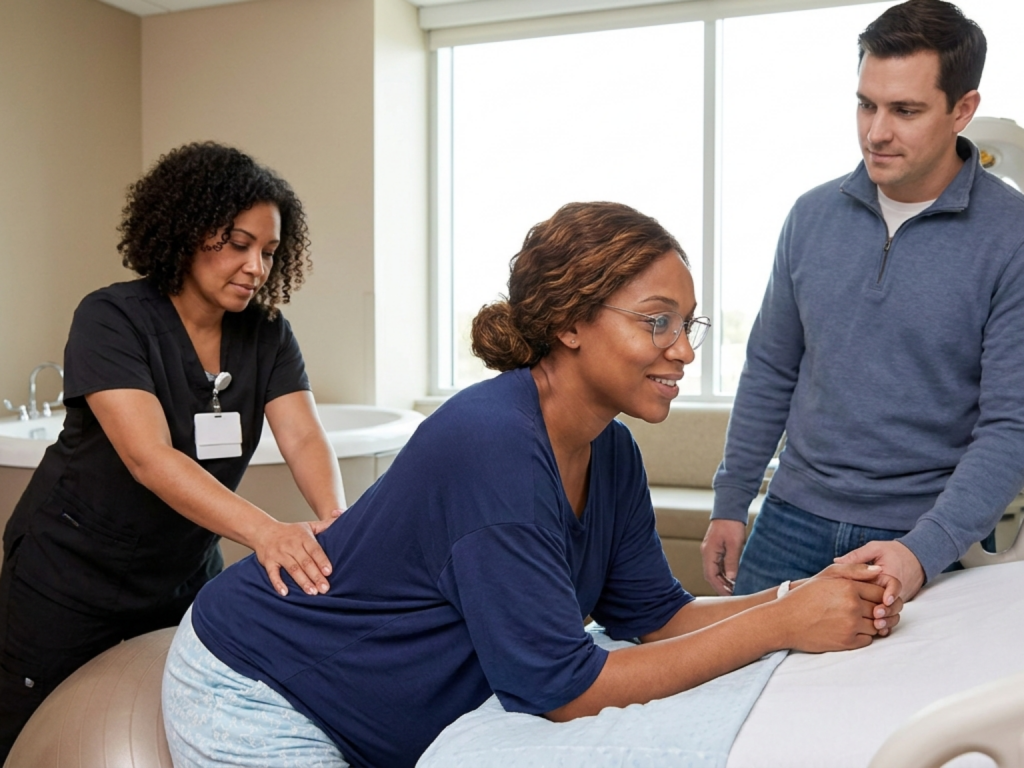
Forward-leaning positions are often practical because they allow the abdomen and pelvis to remain relatively free while the upper body is supported. You might stand facing the bed and lean over it, kneel against the raised back of a bed, rest your forearms on a birth ball placed securely on the bed, or lean over a partner while swaying. A chair can also provide a stable surface: straddling a chair backward lets you rest your arms and chest over its back while keeping the pelvis mobile.
During a contraction, try relaxing the jaw, shoulders, hands, and lower back while slowly rocking or circling the pelvis. Between contractions, sit or rest as needed to conserve energy. The support surface should be stable, dry, and positioned so that you cannot slide forward. A partner should support your trunk rather than pulling on your arms or abdomen.
Walking or standing with gentle weight shifts may help when movement feels tolerable. Some people find that alternating between standing and kneeling reduces muscular fatigue. Ask the clinical team before walking if you have an epidural, significant dizziness, heavy bleeding, concerning fetal monitoring, or another reason that mobility may be restricted.
Hands-and-knees and supported kneeling
The hands-and-knees position places weight through the hands and knees while reducing sustained pressure on the back. Use a padded surface, keep the wrists or forearms supported as needed, and allow the spine to remain in a comfortable neutral or gently flexed position. Slow pelvic rocking, small hip circles, or resting the chest on pillows can make the posture more sustainable.
A supported hands-and-knees posture may be especially useful when back pain is strongest during contractions. You can shift the hips backward toward the heels, widen the knees for comfort, or move from hands to forearms. A birth ball or stacked pillows may support the chest, but the equipment should be placed so it cannot roll or collapse. A clinician or support person can help you transition slowly, particularly if you are fatigued.
Kneeling while leaning forward over the bed or a ball provides a related option without requiring full weight-bearing through the wrists. You may also try one-knee kneeling, with the other foot planted for stability. Stop or change positions if you develop numbness, wrist pain, sharp pelvic pain, shortness of breath, or a sense of instability.
Side-lying and resting positions
Side-lying can provide meaningful rest when standing, walking, or kneeling becomes exhausting. Lie on either side with the upper leg supported by pillows, a peanut ball, or another device recommended by the clinical team. Keep the shoulders and hips comfortably aligned, and adjust the pillow height so the neck is not forced sideways. A slight forward tilt of the upper body may feel better than lying completely flat.
Some educational guidance on backache in labor suggests trying the side-lying position on the side toward which the baby’s back is facing. This is not a universal rule, and the appropriate position depends on fetal assessment, your symptoms, and the judgment of your maternity team. If one side increases discomfort, try the other side or return to a forward-leaning posture.
Side-lying may be particularly useful after analgesia, during periods of rest, or when continuous monitoring makes walking difficult. Ask for assistance before rolling if your legs feel heavy or numb. Avoid lying flat on your back for prolonged periods unless your clinician specifically recommends it, because some people experience reduced comfort or circulatory effects in that position.
Lunges, asymmetry, and pelvic movement
An asymmetrical position changes the loading of the two sides of the pelvis and may feel helpful when back pain is one-sided or when a symmetrical posture feels restricted. With support from the bed, a wall, or a partner, place one foot on a low, stable step or kneel with one knee forward. Gently shift your weight toward the supported side, then return to a neutral stance. Switch sides only if it feels safe and comfortable.
An asymmetrical lunge during labor should be supervised when balance is reduced, contractions are intense, or equipment is attached. The movement should be small and controlled rather than a deep stretch. Do not force the pelvis, hold your breath, or continue through sharp pain. A clinician can suggest modifications based on fetal position, pelvic comfort, and the stage of labor.
Pelvic tilts, slow swaying, and circular hip movements can be performed while standing, kneeling, sitting on a birth ball, or leaning over a support. These movements may reduce muscle guarding and help you maintain a sense of control. The goal is comfort and mobility, not achieving a particular posture or changing fetal position without professional guidance.
Combining position with hands-on comfort
Position changes often work best alongside other nonpharmacologic measures. A support person may apply firm, steady counterpressure to the sacrum during a contraction, using a broad hand or the heel of the hand. Some people prefer pressure that remains constant; others prefer massage, circular rubbing, or pressure from a tennis ball. Tell the support person immediately if the technique is unpleasant or increases pain.
Warm compresses over the lower back may promote relaxation and make movement easier. A cold compress may be preferable if warmth feels overwhelming or the skin becomes hot. Use a barrier between the compress and skin, check the temperature frequently, and follow the facility’s guidance. Hydrotherapy, if available and medically appropriate, may also provide comfort while allowing supported movement.
Slow breathing, vocalization, focused attention, music, and a calm environment can reduce muscle tension and help conserve energy. These techniques are complementary; they should not be presented as substitutes for analgesia or obstetric care. Request pain medication or an anesthesia consultation if pain becomes difficult to manage or if your preferences change during labor.
Adapting positions to monitoring and analgesia
Many people can change positions while receiving intermittent or wireless fetal monitoring, but the available options depend on the equipment, clinical situation, and local protocol. Ask the nurse or midwife to help you move before disconnecting, repositioning, or walking around attached tubing. A birth ball, bedside kneeling, side-lying, or a forward lean over the raised bed may preserve mobility when walking is not possible.
After epidural analgesia, leg strength and sensation may be reduced. Do not stand, transfer, or use a ball without direct assistance and explicit approval from the clinical team. Supported side-lying, semi-reclined side positions, and carefully assisted changes from one side to the other are commonly considered, but the safest option is individualized. Frequent repositioning may also require attention to blood pressure, urinary drainage, intravenous access, and fetal heart-rate tracing.
Medical recommendations take priority over a preferred labor position. Conditions such as significant bleeding, maternal instability, suspected fetal compromise, severe dizziness, or a need for urgent intervention may require a specific posture or limit movement temporarily. Ask what is possible and why, and tell the team clearly when a position worsens pain, causes pressure, or makes breathing difficult.
Creating a practical position plan
Before labor, discuss mobility, monitoring, analgesia, and back-pain preferences with your maternity clinician. A short plan can identify several options rather than one fixed position: standing and leaning forward, hands-and-knees, side-lying for rest, supported kneeling, and an asymmetrical lunge if approved. Include who will assist you, which equipment is available, and what should happen if an epidural or urgent monitoring becomes necessary.
During labor, reassess regularly. You might change position every few contractions or whenever discomfort, fatigue, numbness, or pressure changes. Keep transitions slow, especially after lying down. Drink fluids or receive them according to clinical advice, empty your bladder as recommended, and rest whenever your body asks for it.
There is no failure in needing medication, remaining in bed, or abandoning a position that no longer helps. Labor is dynamic, and comfort measures should support safety, informed choice, and your changing needs. Your birth team can help distinguish expected labor discomfort from symptoms that require assessment and can offer additional options when positioning alone is insufficient.
When to contact the clinical team
- Ask for prompt assessment for heavy vaginal bleeding, severe continuous pain, fainting, chest pain, or difficulty breathing.
- Report a sudden change in fetal movement, fluid leakage, fever, or symptoms that concern you.
- Request assistance before standing if you have an epidural, numbness, weakness, dizziness, or attached equipment.
- Stop a position that causes sharp pain, worsening numbness, severe pressure, or loss of balance.
- Follow individualized instructions if you have hypertension, bleeding, suspected fetal compromise, or another pregnancy complication.
Tools & Assistance
- A maternity clinician, midwife, labor nurse, or obstetric anesthesia team
- A stable bed, chair, wall rail, birth ball, pillows, or peanut ball as approved by the facility
- A trained support person or doula for positioning, counterpressure, and assisted transitions
- Warm or cool compresses used according to clinical and facility guidance
FAQ
What is often the first position to try for labor back pain?
A supported forward lean, hands-and-knees posture, or upright standing position may be a reasonable starting point if you are stable and your clinical team approves it. Comfort varies, so change positions when one stops helping.
Can lying on my side reduce back pain during labor?
Yes. Side-lying can reduce fatigue and may feel more comfortable when standing or kneeling is too demanding. Use pillows or approved support and ask for help if your legs are numb or weak.
Is hands-and-knees safe with fetal monitoring?
It may be possible with intermittent, wireless, or repositioned monitoring, but this depends on your clinical circumstances and equipment. Ask the nurse or midwife to help before moving.
Can I change positions after an epidural?
Often, assisted repositioning is possible, but standing or walking may be unsafe because sensation and leg strength can be reduced. Follow the anesthesia and maternity team’s instructions.
Does back pain always indicate a problem with labor?
Back pain can occur in uncomplicated labor, but severe, continuous, or unusual pain should be reported. Your clinical team can assess you and the baby and explain whether any additional evaluation is needed.
Sources
- Mayo Clinic — Labor positions
- PubMed — Labor pain: effect of maternal position on front and back pain
- University of Washington Health Online — Backache in Labor
Disclaimer
This article provides general educational information and is not a diagnosis or a substitute for individualized medical advice. Consult your obstetric clinician, midwife, labor nurse, or anesthesiology team for guidance specific to your labor and health.















Please log in to leave a comment.