
Intro
The first hours after birth combine recovery, observation, feeding, and a major physiologic transition for the newborn. Many parents imagine this period as still and quiet, yet gentle mobility, safe positioning, and responsive support can make breastfeeding more comfortable and clinically safer.
This article explains how movement, skin-to-skin contact, early breastfeeding, and postpartum monitoring can work together. It is written for medically literate readers who want practical, evidence-aligned guidance while recognizing that individual care should always be tailored by the maternity and newborn care team.
Highlights
Early, uninterrupted skin-to-skin contact supports newborn temperature regulation, transition, and breastfeeding behaviors when mother and baby are clinically stable.
Mobility after birth is not about exercise; it means safe position changes, assisted sitting, supported standing when appropriate, and comfort measures that protect recovery.
The first breastfeed may include rooting, licking, nuzzling, brief latching, or sleepiness; these behaviors can still be part of normal early adaptation.
After cesarean birth, neuraxial anesthesia, heavy bleeding, severe pain, or newborn concerns may change what movement and feeding support look like.
Parents should ask for help early if latch is painful, the baby is too sleepy to feed, bleeding increases, dizziness occurs, or separation is medically necessary.
The first hour is physiologically active
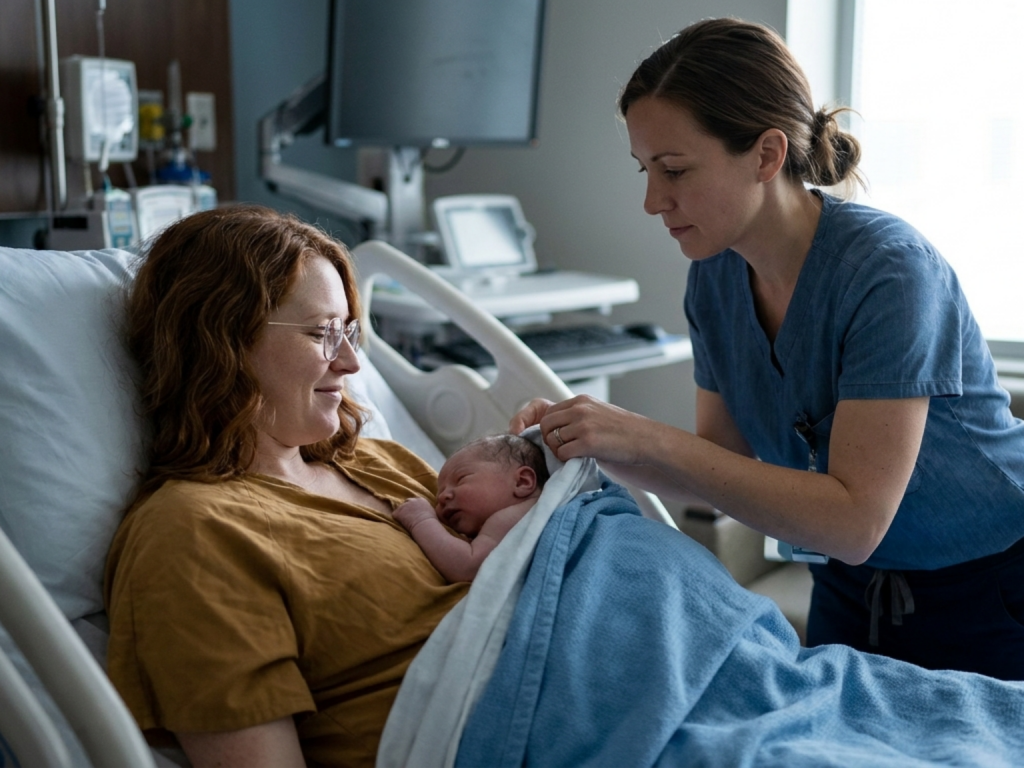
The first hour after birth is often described as a bonding window, but clinically it is also a period of rapid cardiopulmonary, thermal, metabolic, and hormonal transition. When the newborn is vigorous and the birthing parent is stable, many guidelines support early and uninterrupted skin-to-skin contact. The baby is usually placed prone on the parent’s bare chest, dried, covered with warm blankets, and observed closely while routine assessments continue at the bedside when possible.
This approach is not passive. Newborns may show a sequence of behaviors: brief crying, relaxation, small mouth movements, rooting, hand-to-mouth activity, crawling or bobbing toward the breast, licking, and eventually latching. Some babies latch within minutes, while others need more time. The goal is to protect the environment that allows these reflexes to unfold, while still maintaining appropriate clinical surveillance.
Early breastfeeding after birth also stimulates oxytocin release, which may support uterine contraction and parent-infant attachment. At the same time, the care team continues to assess maternal bleeding, uterine tone, pain, vital signs, and newborn color, tone, breathing, and temperature. Mobility breastfeeding and first hours after birth therefore require coordination: movement should help comfort and access to the breast without disrupting safe observation.
Mobility means supported movement, not rushing recovery
In the immediate postpartum period, mobility usually means carefully assisted position changes rather than independent walking. After a vaginal birth, a parent may be able to adjust the pelvis, elevate the head of the bed, roll slightly to one side, or sit more upright with support. These small movements can reduce perineal pressure, improve breathing mechanics, decrease shoulder and neck strain, and help the baby approach the breast at a better angle.
Safety comes first. Dizziness, hypotension, postpartum hemorrhage risk, neuraxial anesthesia effects, perineal trauma, magnesium sulfate therapy, opioid sedation, or exhaustion can make even minor movement unsafe without help. The first time standing or walking should usually occur with staff assistance, particularly after epidural anesthesia, significant blood loss, operative vaginal birth, or cesarean birth.
Mobility can still be meaningful even when the parent cannot get out of bed. A nurse, midwife, partner, doula, or lactation consultant can help adjust pillows, lower or raise the bed, support the baby’s shoulders and hips, or protect an incision. The practical aim is to create a stable feeding position where the parent can relax the arms and shoulders, see the baby’s face, and maintain airway visibility without needing to hold muscle tension for long periods.
Skin-to-skin contact supports breastfeeding and adaptation
Skin-to-skin contact after birth is more than a comforting ritual. Evidence reviews associate early skin-to-skin care with improved breastfeeding initiation and duration, better newborn temperature stability, and support for early physiologic adaptation in healthy term and near-term infants. The contact is generally most effective when it begins as soon as feasible after birth and continues at least until after the first breastfeeding attempt, unless clinical concerns require interruption.
Safe skin-to-skin contact requires intentional positioning. The newborn’s head should be turned to one side, with the nose and mouth visible, the neck not flexed tightly, and the chest in contact with the parent’s chest. Blankets can cover the baby’s back, but the face should remain unobstructed. A reclining parent position often helps because the baby rests against the torso rather than sliding downward.
Uninterrupted skin-to-skin contact should not mean unobserved care. Staff should continue regular checks, especially during the first hour, after medication exposure, following a difficult birth, or when the parent is extremely fatigued. If the parent feels faint, sleepy, nauseated, overwhelmed, or unable to keep the baby positioned safely, asking for hands-on help is appropriate. Support preserves the benefits of closeness while reducing avoidable risk.
Finding a safe early breastfeeding position
Effective early breastfeeding depends on both newborn reflexes and parental comfort. In the first hours, many families use a laid-back or biological nurturing position: the parent reclines, the baby lies chest-to-chest, and gravity helps stabilize the infant. This can be especially useful when the parent is tired, has perineal soreness, or wants to avoid leaning forward. A side-lying position may be considered later with professional guidance, but it requires particular attention to alertness, bedding, and airway visibility.
After cesarean birth, positioning often needs more planning. The baby can be placed across the upper chest, in a football hold, or supported beside the incision with pillows. The parent may need help turning, lifting the baby, or preventing pressure on the abdomen. If neuraxial anesthesia is still wearing off, staff support is important because leg weakness, itching, nausea, shaking, or sedation can interfere with safe handling.
Latch should feel like deep tugging rather than sharp nipple pain. Early discomfort can happen, but persistent pinching, blanching, creasing, bleeding, or severe pain deserves prompt assessment. The baby’s chin is usually close to the breast, the mouth opens wide, and more areola may be visible above than below the mouth. If the baby is sleepy, hand expression of colostrum may be discussed with the care team as a temporary supportive measure.
When monitoring or separation changes the plan
Some babies or parents need additional assessment during the first hours after birth. Prematurity, respiratory distress, low tone, hypoglycemia risk, fever, infection concerns, meconium exposure with symptoms, congenital anomalies, significant maternal hemorrhage, severe hypertension, or operative complications can alter the timing of breastfeeding and mobility. In these situations, the priority is stabilization, but feeding and bonding can often still be supported creatively.
Newborn procedures after birth, such as weighing, vitamin K administration, eye prophylaxis where used, glucose monitoring, or physical assessment, may sometimes be performed while the baby remains near the parent. When temporary newborn separation is necessary, parents can ask when skin-to-skin contact can resume, whether expressed colostrum can be offered, and who can help protect milk production if direct breastfeeding is delayed.
Maternal monitoring matters just as much. Heavy bleeding, passing large clots, increasing abdominal pain, chest pain, shortness of breath, severe headache, vision changes, or faintness should be reported immediately. Mobility should pause until the care team evaluates symptoms. The first hours after birth can be emotionally intense, and needing medical intervention is not a failure of bonding or feeding. A safer plan can still honor the parent’s goals while responding to clinical reality.
Working with your care team in the first day
Good early support is practical and specific. Before attempting to stand, shower, or carry the baby, ask whether your blood pressure, bleeding, anesthesia recovery, and pain control make it safe. Before a feed, ask for help positioning the baby so the airway is visible and your arms are supported. If breastfeeding is difficult, request a feeding assessment rather than waiting until nipples are damaged or the baby has missed several effective feeds.
Helpful questions include: Can routine assessments be done at the bedside? What signs show my baby is transferring colostrum? When should we wake the baby for feeding? Do we need blood glucose monitoring in newborns because of risk factors? Who can help if latching is painful overnight? These questions invite individualized guidance without assuming that one plan fits every birth.
By discharge, parents should understand expected feeding frequency, wet and stool diaper patterns, jaundice follow-up, weight monitoring, and when to call for urgent help. They should also know how to protect their own recovery: moving gradually, accepting assistance, managing pain as advised, and reporting concerning symptoms. The first day is not a performance test. It is a medically supervised transition in which comfort, mobility, breastfeeding, and safety should be integrated with compassion.
Seek urgent help if
- The parent has heavy bleeding, fainting, chest pain, shortness of breath, severe headache, or vision changes.
- The baby has breathing difficulty, persistent blue or gray color, poor tone, abnormal temperature, or cannot be awakened to feed.
- The baby’s face is covered, the neck is flexed, or airway visibility is poor during skin-to-skin contact.
- Latch pain is severe, nipples are bleeding, or the baby repeatedly cannot latch despite help.
- Separation, supplementation, or monitoring is recommended and the reason is unclear; ask the clinical team to explain the indication and plan.
Tools & Assistance
- Ask for bedside lactation support during the first feeding attempt.
- Request help before first standing, showering, or walking after birth.
- Use pillows, bed adjustment, and hands-on support to protect posture and incision or perineal comfort.
- Track early feeds, wet diapers, stools, weight checks, and jaundice follow-up as instructed.
- Clarify which newborn procedures can be done during skin-to-skin contact.
FAQ
Does every baby need to breastfeed within exactly one hour?
The first hour is an important goal when parent and baby are stable, but clinical needs may change timing. If direct breastfeeding is delayed, ask about skin-to-skin contact, hand expression, and lactation support.
Can I move around while doing skin-to-skin contact?
In the first hours, movement should usually be assisted and limited to safe position changes. Do not stand, walk, or carry the baby until staff confirm it is safe, especially after anesthesia, heavy bleeding, or cesarean birth.
What position is safest for early breastfeeding?
A supported reclining position often works well because the baby stays chest-to-chest and the airway can remain visible. The best position depends on birth mode, pain, alertness, and clinical stability.
What if breastfeeding hurts right away?
Some tenderness can occur, but sharp, persistent, or damaging pain should be assessed promptly. A lactation professional or trained clinician can evaluate latch, positioning, oral anatomy concerns, and feeding effectiveness.
Can newborn checks wait until after the first feed?
Some routine checks can often be done at the bedside, but urgent assessments should not be delayed. Ask your care team which procedures are time-sensitive and which can be coordinated with skin-to-skin contact.
Sources
- World Health Organization — Early initiation of breastfeeding to promote exclusive breastfeeding
- Cochrane Library — Early skin-to-skin contact for mothers and their healthy newborn infants
- PubMed Central — Skin-to-skin contact the first hour after birth, underlying implications and clinical guidelines
Disclaimer
This article is for general medical information and does not replace care from your obstetric, midwifery, pediatric, or lactation team. Seek urgent professional help for concerning maternal or newborn symptoms.

















Please log in to leave a comment.