
Intro
Back pain in the birth continuum can be physically draining and emotionally unsettling, whether it appears in late pregnancy, during labor, or while recovering and feeding a newborn. Relief often begins with small, intentional changes: supporting the pelvis, reducing lumbar strain, moving gently, and knowing when symptoms need professional assessment.
This article focuses on positions and techniques that may reduce mechanical load on the back. It is not a diagnosis or a treatment plan. Back pain can have muscular, neurologic, obstetric, or other medical causes, so individualized guidance from an obstetric clinician, physical therapist, midwife, or physician matters.
Highlights
Pillow-supported side-lying and knee support can reduce strain by improving alignment through the spine, pelvis, and hips.
Gentle mobility, such as knee-to-chest, trunk rotation, pelvic tilts, and cat-style movement, may help when performed within a comfortable range.
In labor, position changes, forward leaning, hands-and-knees postures, and supportive touch may help some people cope with lower-back discomfort.
Pain that radiates, worsens with movement, causes neurologic symptoms, or occurs with concerning pregnancy or postpartum symptoms should be assessed promptly.
Start with alignment, unloading, and gentle motion
Back pain around birth is rarely helped by one perfect posture. A more useful goal is to reduce mechanical stress while keeping the body responsive. In practical terms, that means supporting the lumbar curve, decreasing asymmetric pull through the pelvis, and changing positions before muscles begin to guard. For a medically literate reader, think of positioning as graded mechanical modulation: hip flexion, lumbar lordosis, sacral pressure, abdominal wall tension, and paraspinal muscle tone all shift as posture changes.
This approach does not identify the cause of pain. Lower-back discomfort may reflect muscular fatigue, pelvic girdle loading, pre-existing spine conditions, contraction-related intensity, prolonged sitting, or postpartum feeding mechanics. If pain is new, severe, persistent, or different from your usual pattern, ask a healthcare professional before relying on self-management. The safest technique is usually the one that lowers symptoms without numbness, tingling, weakness, dizziness, breathlessness, or a sense of pelvic instability.
Rest and sleep with pillows as supports
Nighttime positioning is often the first place to intervene because prolonged sleep posture can either unload or irritate the lumbar spine. Side-lying with a pillow between the knees helps align the spine, pelvis, and hips. Drawing the knees slightly toward the chest can reduce rotational strain, and a full-length body pillow may make the position easier to maintain without gripping through the hip flexors or lower back.
For some people, a back-lying position with a pillow under the knees relaxes the back muscles and helps preserve the natural curve of the lower spine. A small rolled towel under the waist may add support when there is a gap between the body and mattress. In late pregnancy, prolonged flat supine positioning may be poorly tolerated because aorto-caval compression in late pregnancy can contribute to lightheadedness, nausea, or shortness of breath; a tilted side-lying setup is often more comfortable, and symptoms should be discussed with the care team.
Stomach sleeping can increase lumbar strain for many adults. If it is the only tolerable position outside pregnancy, a pillow under the hips and lower abdomen may reduce extension stress, but it should not force the neck or lower back into an uncomfortable angle.
Use floor and bed positions for short relief sessions
Short, controlled positions can be useful when the back feels stiff after rest or overworked after upright activity. A single knee-to-chest stretch is commonly performed lying on the back with knees bent and feet flat; one knee is brought toward the chest while the abdominal muscles gently engage. This can flex the lumbar spine and reduce resting muscle tension. In late pregnancy, the abdomen may make this unsuitable, so a clinician or physical therapist can help modify it, often by using side-lying or smaller ranges.
Lower back rotational stretch is another low-effort option. With knees bent and shoulders resting, the knees slowly roll to one side, pause briefly, and return through center before moving to the other side. The aim is not to force a twist but to invite movement through the trunk and hips. If symptoms travel down the leg, become sharp, or produce numbness or tingling, stop and seek guidance.
Hamstring and hip flexor tightness can also influence lumbar mechanics. Gentle hamstring stretching with the knee partly bent, or a supported hip flexor stretch at the edge of a bed, may be appropriate for some people. Keep the intensity mild; pregnancy and postpartum tissues may respond poorly to aggressive stretching.
Add gentle mobility and stabilizing techniques
Movement-based relief works best when it is brief, repeatable, and symptom-guided. Mayo Clinic describes back exercises that stretch and strengthen the back and the muscles that support it, with a gradual increase in repetitions as tolerance improves. The clinical principle is simple: a painful back often needs both mobility and support, not prolonged immobilization.
- Pelvic tilts for lumbar mobility: lying with knees bent, gently tighten the abdominal muscles, flatten the lower back, then release. This encourages controlled flexion and extension without large spinal movement.
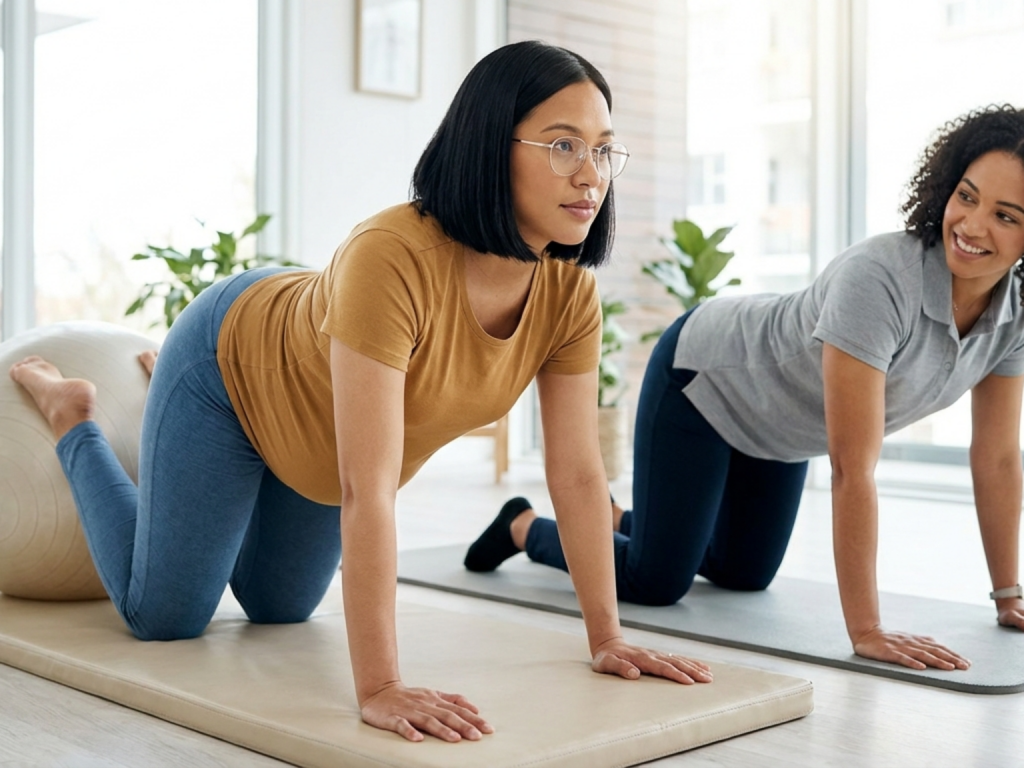
- Cat-style movement: on hands and knees, slowly arch the back, then let the abdomen soften toward the floor. This can be adapted in pregnancy if the wrists, knees, and abdomen are comfortable.
- Bridge exercise: lying with knees bent, tighten the abdomen and buttocks, then lift the hips only as high as comfortable. This emphasizes gluteal and trunk support rather than lumbar gripping.
- Shoulder blade squeeze: seated upright, draw the shoulder blades together briefly. This can help counter rounded feeding, desk, or phone posture that indirectly increases back strain.
None of these movements should be forced. A small range performed consistently is usually more useful than a large range that causes guarding afterward.
Adapt relief positions during labor
Labor adds intensity, timing, monitoring needs, fatigue, and sometimes epidural analgesia or IV lines. The best position is therefore the one that provides relief, keeps you stable, and remains compatible with clinical care. During contractions, some people prefer forward-leaning positions during labor, such as leaning over a raised bed, chair, countertop, or birthing ball. This can reduce the feeling of compression through the lower back while allowing the abdomen to soften between contractions.
The hands-and-knees position for back labor is another commonly used option because it takes direct pressure off the sacrum and lets the pelvis shift subtly. Supported kneeling can offer a similar effect for people who want forward support but do not want weight through the wrists. Upright positions during labor may feel empowering and allow more frequent position changes, but fatigue, dizziness, fetal monitoring, and medication effects should guide what is safe.
Supportive touch can be part of positioning. Sacral counterpressure during contractions involves firm, steady pressure over the sacrum or lower back from a partner, doula, nurse, or midwife, but it should always be consent-based and adjustable. Warm compresses for lower-back discomfort may also feel soothing. If a back-lying position is needed for an exam, procedure, fetal tracing, or birth, ask whether a supported, tilted, or elevated posture is possible.
Build a cautious routine and know when to stop
A practical routine does not need to be long. Choose one resting position, one gentle mobility technique, and one labor or postpartum support strategy. For example, side-lying with a pillow between the knees may be the rest position, lower back rotational stretch may be the mobility technique, and forward leaning with sacral support may be the labor comfort option. Track what reliably helps, what has no effect, and what makes pain worse.
Progress should be gradual. Start with a few repetitions or short holds, then increase only if symptoms remain calm afterward. People beginning exercise because of ongoing back pain, a recent injury, pregnancy-related complications, cesarean recovery, pelvic floor symptoms, or neurologic complaints should ask a physical therapist or healthcare team which activities are appropriate. The same caution applies postpartum, especially when lifting, feeding, and sleep deprivation make posture harder to control.
Stop any technique that causes escalating pain, radiating leg symptoms, weakness, numbness, dizziness, vaginal bleeding, fluid leakage, fever, or a feeling that something is not right. Relief work should make the body feel safer, not more threatened.
When to seek medical help
- Get urgent care for new bowel or bladder dysfunction, saddle numbness, or progressive leg weakness.
- Seek prompt assessment for back pain with fever, trauma, unexplained weight loss, or severe unrelenting night pain.
- During pregnancy or postpartum, contact your care team for pain with bleeding, fluid leakage, contractions before term, severe headache, or reduced fetal movement.
- Stop stretches that trigger numbness, tingling, electric pain, or pain spreading below the knee.
- Ask for individualized advice before exercising after a recent back injury, surgery, cesarean birth, or neurologic diagnosis.
Tools & Assistance
- Body pillow or firm pillows for side-lying support
- Rolled towel for small lumbar or waist support
- Stable chair, bed edge, or birthing ball for supported forward leaning
- Warm compress for lower-back comfort if approved by the care team
- Physical therapist, obstetric clinician, midwife, or labor nurse for individualized positioning guidance
FAQ
Is side-lying better than lying on my back for back pain?
Side-lying with a pillow between the knees often improves alignment through the hips, pelvis, and spine. Back-lying with a pillow under the knees may also help some people, but late pregnancy may require tilted or side-lying positions.
Should I stretch through back pain if I am in labor?
No. Labor positioning should reduce distress, not add strain. Choose supported positions and ask your nurse, midwife, doula, or clinician to help adapt movement to monitoring, medication, and fatigue.
Can knee-to-chest stretches be used during pregnancy?
Sometimes they need modification because the abdomen, pelvis, or reflux symptoms may make the standard position uncomfortable. Ask a clinician or physical therapist for pregnancy-appropriate alternatives.
What if one technique helps one day and not the next?
That is common. Back pain can change with sleep, fetal position, contractions, lifting, feeding posture, and fatigue. Rotate between rest, gentle mobility, and supported positions rather than forcing one method.
Sources
- Mayo Clinic — Sleeping positions that reduce back pain
- Mayo Clinic — Back exercises in 15 minutes a day
- Hospital for Special Surgery — Stretches and Exercises for Lower Back Pain, from a PT
Disclaimer
This article is for informational purposes only and does not replace medical evaluation, diagnosis, or treatment. Consult a qualified healthcare professional for personalized advice, especially during pregnancy, labor, or postpartum recovery.

















Please log in to leave a comment.