
Intro
Pregnancy often makes everyday choices feel suddenly high-stakes, and cosmetics are a common example. A lipstick, moisturizer, or foundation may seem harmless to one person and worrying to another, especially when social media turns a routine product into a supposed danger to the baby.
The short answer is that the myth is too broad. The scientific picture is more nuanced: ordinary cosmetic use has not been shown to cause major adverse birth outcomes, but the way products are used, how many are used, and which ingredients are involved can still matter. If you are pregnant and trying to balance reassurance with caution, that is a very reasonable place to be.
Highlights
The idea that all cosmetics are harmful in pregnancy is not supported by current evidence.
A prospective cohort study found no significant link between maternal cosmetics use and several major outcomes such as preterm birth or low birth weight.
Higher-frequency cosmetics use showed a modest association with small for gestational age, which means exposure patterns still deserve thoughtful review.
Practical pregnancy care usually focuses on reducing unnecessary exposure, not on avoiding every beauty product altogether.
What the myth gets wrong
The myth usually sounds absolute: cosmetics will harm the baby, so they should be avoided completely. That message is understandable because pregnancy increases attention to anything that might cross the placenta or affect fetal development. Still, broad claims are rarely accurate in medicine.
Cosmetics are a diverse category. A moisturizer, a rinse-off cleanser, a powder, a lipstick, and a salon treatment do not create the same exposure profile. The scientific evidence does not support the idea that ordinary cosmetic use, by itself, is a major cause of birth harm. Public health guidance from Cancer Research UK also notes that the available evidence does not suggest people need to avoid cosmetics, and products sold in the UK and EU are unlikely to cause cancer.
That does not mean every product is equally reassuring. Rather, it means the conversation should move from fear to risk stratification: how often is the product used, how is it absorbed or inhaled, and what other exposures are present? That more careful question is much closer to how clinicians think about pregnancy safety.
What the research actually shows
The strongest study in the source set is a prospective cohort study of maternal cosmetics use during pregnancy. It found no significant association with preterm birth, low birth weight, macrosomia, or large for gestational age. In other words, the common fear that using cosmetics automatically leads to the most talked-about adverse birth outcomes was not supported.
However, the same study reported a 23% increased risk of small for gestational age, along with a dose-response pattern in which higher-frequency cosmetics use was associated with greater risk. That finding deserves attention, but it should be interpreted carefully. Observational research can identify associations, yet it cannot prove that cosmetics caused the outcome. Frequency of use may also reflect other factors that are difficult to measure, such as socioeconomic status, occupational exposure, lifestyle, or underlying health differences.
For a medically literate reader, the key point is nuance. A modest association in one study is not the same as proof of harm, but it is enough to justify prudence, especially when simple substitutions can reduce exposure without making pregnancy feel restrictive or punitive.
Why some routines deserve a closer look
The route of exposure matters. Cosmetic ingredients can be absorbed through the skin, inhaled from sprays or powders, or contacted through mucosal surfaces such as the lips. Most products contribute a small amount, but repeated use across many categories can raise the cumulative dose. That is why clinicians often think in terms of aggregate exposure rather than one product in isolation.
Concern also increases when a routine involves professional services or multiple chemical sources. In those cases, the issue is not just cosmetic use but the broader context of placental transfer of environmental chemicals. If you work around frequent product application, or you spend time in settings with strong fumes, your exposure profile may differ from someone who wears makeup only occasionally.
For example, chemical exposure from hair products may be more relevant in a salon environment than a single tube of hand cream at home. Likewise, ventilation for nail polish fumes matters more in a closed room with repeated service appointments than in a brief at-home manicure. The point is not to frighten you away from self-care; it is to show why some patterns deserve more attention than others.
Pregnancy-friendly ways to simplify a beauty routine
The perinatal counseling review in the source set offers practical advice that is easy to apply. It recommends reducing the number, frequency, and amount of cosmetic products used during pregnancy and breastfeeding. It also favors simple, fragrance-free, rinseable products with short ingredient lists. Those suggestions are not about perfection; they are about reducing unnecessary complexity.
A simple routine might mean keeping one cleanser, one moisturizer, and one makeup product you truly use, rather than layering many items out of habit. It might mean choosing products with fewer fragrance components if scent makes you nauseated or irritates your skin. It may also mean preferring rinse-off formulas over leave-on products when the option is realistic and comfortable.
If you enjoy beauty rituals, that does not automatically conflict with pregnancy safety. The goal is not to erase self-expression. It is to choose the lowest-exposure version of the routine that still feels like you. For many people, that balance reduces anxiety more effectively than strict avoidance ever could.
When to ask your obstetric team or midwife
Personalized advice is especially useful when your exposure is higher than average or when you have a medical condition that changes tolerability. For example, ask for guidance if you work in a salon, use many products every day, have asthma or fragrance-triggered symptoms, or notice skin irritation, headaches, or nausea after certain products. Those symptoms do not necessarily mean danger to the baby, but they are useful signals that your routine may need adjustment.
It is also sensible to ask before changing prescription skin treatments. Some people assume that all topical therapies should be stopped during pregnancy, but that is not always appropriate. A clinician can help separate routine cosmetics from medications used to treat acne, eczema, or other skin conditions.
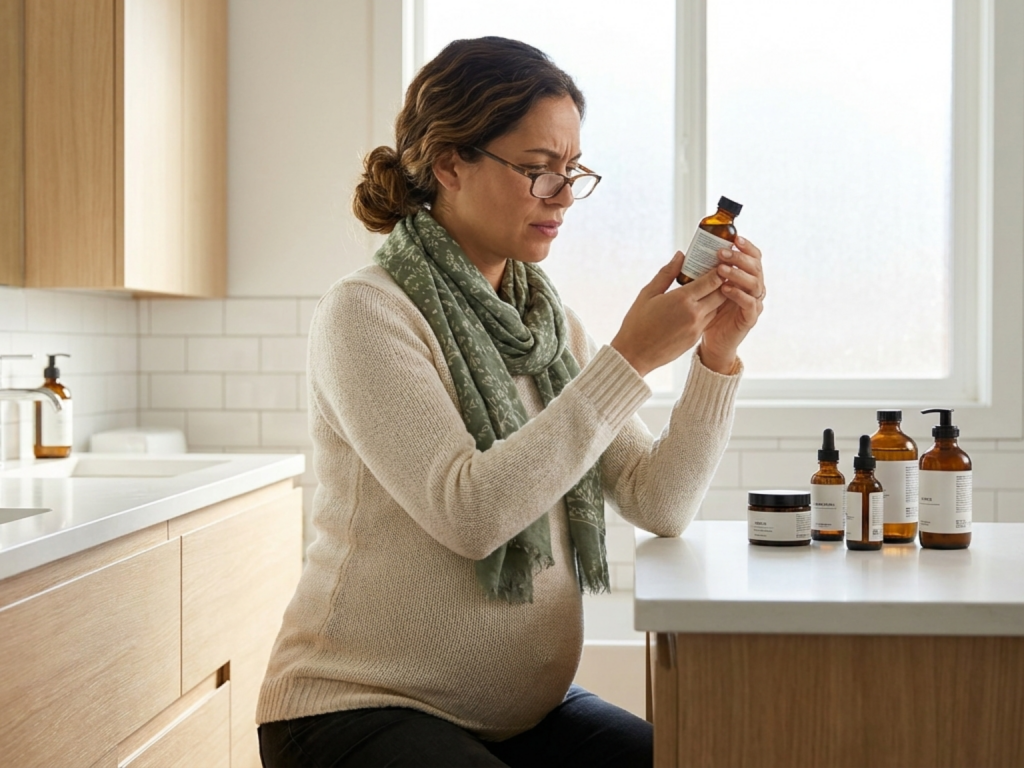
If your concern is specific, bring the product names or ingredient lists to your appointment. A pharmacist, obstetric clinician, or midwife can help you judge whether the product is a reasonable choice, whether a simpler substitute exists, or whether you can continue it safely with a few modifications.
A balanced takeaway for expectant parents
The myth says cosmetics are broadly dangerous to the baby. The evidence says something more reassuring and more realistic: ordinary cosmetic use has not been linked to several major adverse birth outcomes, and broad avoidance is usually unnecessary. At the same time, the literature does support a cautious approach to repeated, high-frequency, or occupational exposure, especially when products are heavily fragranced or used in large amounts.
That is a good example of pregnancy medicine in general. Most choices are not all-or-nothing. The safest path is often a measured one: use fewer products, choose simpler formulas, avoid unnecessary fumes, and ask for advice when your routine is intensive or when a specific product concerns you. The goal is not to eliminate every trace of risk, because that is impossible. The goal is to keep risk low while preserving comfort, dignity, and everyday self-care.
If cosmetics are part of how you feel like yourself, you can usually keep them in your life while still being thoughtful about exposure. That balance is evidence-based, humane, and far more sustainable than fear.
When extra caution is warranted
- Do not assume that a product is safe just because it is marketed as natural or clean.
- Seek personalized advice if you work around many beauty products, salon fumes, or repeated aerosol sprays.
- Do not stop a prescribed skin medication without speaking to a clinician first.
- Get medical review if a product causes rash, breathing symptoms, severe nausea, or eye irritation.
- Use extra caution with products that require poor ventilation or prolonged close contact.
Tools & Assistance
- Bring your cosmetic or skincare ingredient list to your prenatal visit.
- Ask a midwife, obstetric clinician, or pharmacist to review high-use products.
- Choose fragrance-free, rinseable, short-ingredient products when practical.
- Keep your beauty routine simple and note which products you use most often.
FAQ
Should I stop all cosmetics during pregnancy?
Usually no. The evidence does not support avoiding all cosmetics, though simplifying a high-use routine is sensible.
Is daily makeup use automatically risky for the baby?
Not automatically. The main concern is higher-frequency or more complex exposure patterns, not occasional ordinary use.
Are fragrance-free products better in pregnancy?
They can be a practical choice because they are often simpler and less irritating, especially for sensitive skin or nausea.
What if I work in a salon or use many beauty products?
That is worth discussing with your clinician, because occupational or repeated exposure may deserve more individual assessment.
Sources
- PubMed Central (NIH) — Maternal cosmetics use during pregnancy and risks of adverse birth outcomes: a prospective cohort study
- Journal of Midwifery & Women's Health — Use of Cosmetic Products in Pregnant and Breastfeeding Women: Recommendations for Counselors
- Cancer Research UK — Cosmetics in pregnancy
Disclaimer
This article is for general information only and does not replace personalized medical advice. If you are pregnant or breastfeeding, discuss specific products, exposures, or symptoms with your obstetric clinician, midwife, or pharmacist.
















Please log in to leave a comment.