
Intro
If you are worried because you had sex while bleeding, you are not alone. Many people have heard that a period means pregnancy is impossible, and that idea can feel reassuring until the facts become less simple.
The short answer is that pregnancy during a true period is less likely, but not impossible. The real determinant is ovulation timing, and that timing can vary from one cycle to the next. Understanding that difference can reduce anxiety and help you make more accurate decisions about contraception or conception.
Highlights
A period does not act like a contraceptive guarantee.
The fertile window matters more than the presence of bleeding.
Pregnancy during menstruation is uncommon, but short cycles and early ovulation make exceptions possible.
Irregular bleeding and spotting can be mistaken for a real period.
Why the myth survives
It is easy to see why people assume menstruation and pregnancy cannot overlap: bleeding usually marks the start of a new cycle, and ovulation tends to happen later. But the menstrual cycle is variable, and the timing of its phases is not identical from one person to another or even from one month to the next. Menstrual bleeding, the follicular phase, ovulation, and the luteal phase do not always line up in a perfectly predictable way.
That is why the claim that you are automatically safe during your period is a myth. For many people, the risk is low on the heaviest days of flow, but low is not the same as zero. The key issue is not the bleeding itself; it is when ovulation happens relative to that bleeding. If ovulation is earlier than expected, the overlap becomes more plausible.
This is also why period sex can create a lot of confusion. People often use bleeding as a shortcut for fertility, but biology is not that tidy. A cycle that looks regular on paper can still shift enough to change the timing of the fertile window.
What actually creates pregnancy risk
Pregnancy requires sperm and an egg to meet during the fertile window, which is centered around ovulation. Major public health guidance consistently emphasizes that fertility is tied to ovulation rather than to menstrual bleeding itself. Even if your cycles are usually regular, one cycle can shift enough to move ovulation earlier or later than expected.
That variability matters because sex during a period can still fall close enough to early ovulation for pregnancy to occur. This is especially relevant in shorter cycles, where the interval between the end of bleeding and ovulation may be brief. In other words, the risk is usually lower during menstruation, but it does not disappear.
It can help to think of pregnancy risk as a timing question, not a bleeding question. If ovulation happens soon after the period ends, period sex may be farther from a safe zone than many people assume. That is why clinicians and sexual health educators describe this as a myth with an important exception, rather than a simple yes-or-no rule.
When the risk becomes more plausible
Several situations make the myth less reliable. If your cycle is short, if you bleed for many days, or if your ovulation tends to happen early, pregnancy from period sex becomes more plausible. Some people also mistake non-menstrual bleeding, such as spotting, for a true period, which can obscure timing even more. In those cases, the apparent period may not reflect the same hormonal stage as a typical menstrual bleed.
If you are tracking cycles, this can be confusing in real life. A bleed that feels like the start of a period may not behave like a textbook 28-day cycle, and that is especially true for adolescents, postpartum cycles, perimenopausal patterns, or otherwise irregular cycles. Calendar assumptions become less dependable when the cycle does not follow a predictable rhythm.
The closer sex occurs to the end of bleeding, the less the timing resembles a guaranteed infertile phase. That does not mean pregnancy is likely, only that the margin for error shrinks. This is one reason why the answer is not comforting in a universal way: period sex is often lower risk, but lower risk is not the same as no risk.
How to think about timing without panic
If you are trying to avoid pregnancy, the safest approach is to use reliable contraception every time you have sex, not to rely on the calendar or on bleeding. If you are trying to conceive, the opposite lesson is also important: focus on the fertile window, not on the presence or absence of bleeding. Bleeding tells you where you are in the cycle, but it does not tell you with enough certainty whether ovulation is days away or already approaching.
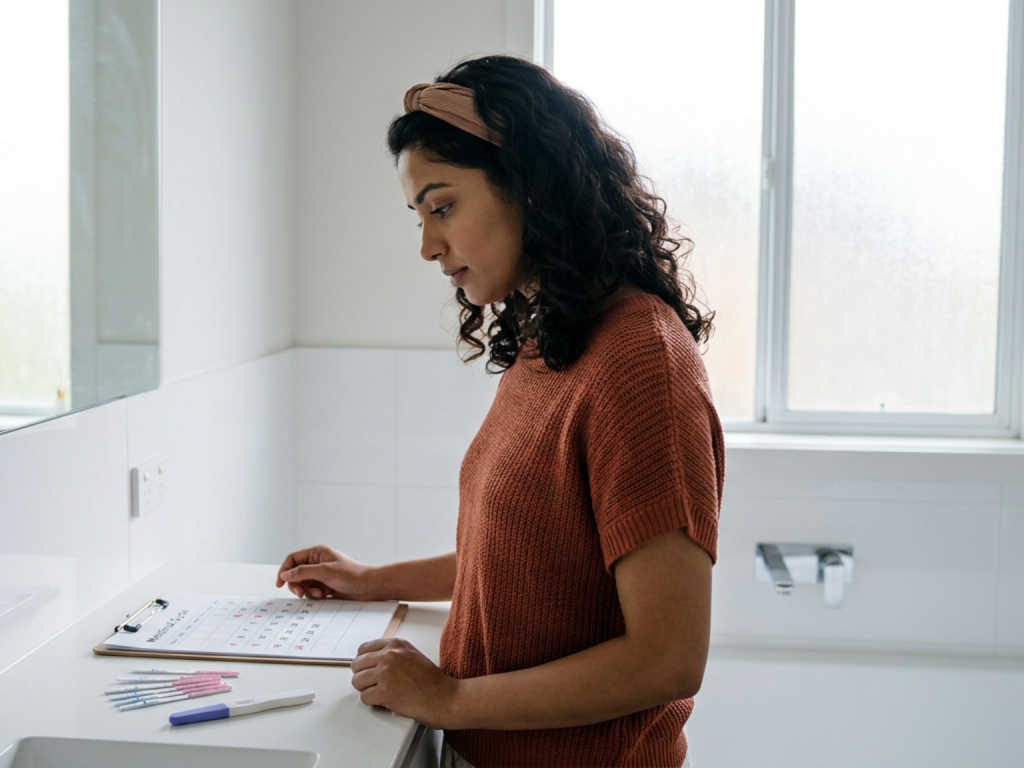
Simple cycle tracking can help some people, but it is not perfect. Calendar estimates for ovulation may be misleading if your cycles vary, and ovulation predictor kits can be more informative for some users. Ovulation-focused tracking can also include basal body temperature, cervical mucus changes, or other markers, though each method has limits. The point is not to create more anxiety; it is to reduce guesswork.
If you are unsure how to interpret your cycle, a clinician can help you choose a method that fits your pattern. That can be especially useful if you have short cycles, irregular bleeding, or recent changes in menstrual regularity. In those situations, using a one-size-fits-all calendar can create more false reassurance than clarity.
What to do if you had sex during your period
First, try not to assume the worst. The chance of pregnancy during a true period is usually lower than at mid-cycle, but the next step depends on timing, cycle length, and whether ovulation may have been early. If the sex was unprotected and you want to avoid pregnancy, it may be worth speaking with a pharmacist or healthcare professional promptly about options and timing.
If you are waiting to see whether pregnancy occurred, a test is usually most useful after a missed period or about the time a period would be expected, depending on the test instructions. Testing too early can be falsely reassuring. If your bleeding was unusually light, short, or different from your norm, it may be harder to know whether it was truly menstrual.
Seek medical advice sooner if you have very irregular bleeding, if you are unsure whether the bleeding was actually a period, or if you have symptoms that feel unusual for your body. Supportive care is available, and you do not have to interpret the timing alone.
Bottom line
The myth is too absolute. You can sometimes get pregnant during your period, but it is less common than pregnancy around ovulation. Menstruation does not function like a daily contraceptive shield, and cycle timing is flexible enough that risk can appear when people least expect it.
The safest mindset is practical rather than fearful: understand your cycle, use contraception when avoiding pregnancy, and seek individualized guidance if your periods are short, irregular, or hard to interpret. If you are trying to conceive, the same timing logic applies in the other direction: focus on ovulation and the fertile window, not on bleeding alone.
When to get medical help
- A period is not a reliable form of contraception.
- Pregnancy can still happen if ovulation occurs earlier than expected.
- Very heavy bleeding, fainting, or severe one-sided pain should be assessed urgently.
- If your cycles are very short or irregular, calendar timing is less dependable.
- If bleeding is unusual for you, get individualized advice rather than guessing.
Tools & Assistance
- Menstrual cycle tracking app or paper calendar
- Ovulation predictor kits
- Pregnancy test used at the recommended time
- OB-GYN, midwife, or sexual health clinic consultation
FAQ
Can you get pregnant if you have sex on the first day of your period?
It is usually less likely, but it is not impossible, especially if you have a short cycle or ovulate early.
Does bleeding mean I am not fertile?
No. Bleeding and fertility are related to different parts of the cycle, so bleeding alone does not prove you are infertile.
Should I use emergency contraception after unprotected sex during my period?
If you want to avoid pregnancy, speak with a pharmacist or healthcare professional promptly because timing matters.
When should I take a pregnancy test?
Testing is usually most useful after a missed period or when a period would normally be expected, depending on the test instructions.
Sources
- NHS — Periods and fertility in the menstrual cycle
- American Pregnancy Association — Can You Get Pregnant on Your Period? Medical Facts
- Planned Parenthood — Can you get pregnant if you have sex during your period?
Disclaimer
This article is for general information only and does not replace personalized medical advice, diagnosis, or treatment. If you are worried about pregnancy, bleeding, or cycle changes, speak with a qualified healthcare professional.













Please log in to leave a comment.