
Intro
Screen time for 10- to 12-year-olds can feel hard to manage because it is no longer just cartoons or games. At this age, screens may be part of schoolwork, friendships, hobbies, entertainment, and emerging independence. Many families are trying to protect sleep, mood, learning, and physical health while also recognizing that digital life is now a real part of childhood.
A balanced approach is usually more effective than shame or all-or-nothing rules. The goal is not to make parents feel guilty or to label a child as “addicted” based on screen use alone, but to notice patterns: what screens are replacing, how a child feels afterward, whether sleep or school is affected, and whether online spaces are developmentally appropriate.
Highlights
For many 10- to 12-year-olds, the most important question is not only “how many hours?” but also “what kind of screen use, at what time, and with what effect?”
Excessive discretionary screen time is associated with sleep disruption, weight-related concerns, academic difficulties, and social-emotional symptoms, but moderate, purposeful use can fit into a healthy routine.
Preteens are especially vulnerable to social comparison, persuasive design, online conflict, and using screens to cope with distress.
A family media plan works best when it is specific, predictable, and paired with appealing offline alternatives.
Why screen time changes between ages 10 and 12
Between 10 and 12 years, children are entering a neurodevelopmental transition. Executive functions such as planning, inhibition, time estimation, and emotional self-monitoring are improving, but they are still immature. At the same time, peer approval becomes more salient, curiosity increases, and many children start requesting greater privacy. This makes screen time more complex than it was in early childhood.
Preteens may use devices for homework, videos, group chats, gaming, music, creative projects, and early social media exposure. Some of this can be positive. A child may learn animation, keep in touch with relatives, practice a language, or find a supportive interest-based community. However, digital platforms are often designed to extend use through autoplay, notifications, reward loops, streaks, and social feedback. A 10-year-old may understand a rule but still struggle to stop when a game, video feed, or group chat keeps offering the next stimulus.
Research summarized by pediatric and psychological organizations suggests that many preteens now spend several hours per day on devices outside school demands. This matters because time is finite. High screen use can displace sleep, physical activity, reading, chores, outdoor play, unstructured boredom, and face-to-face connection. The concern is not that every screen minute is harmful; it is that repeated displacement during a sensitive developmental window can affect routines, emotional regulation, and health behaviors.
What counts as screen time, and what matters most
Families often need to separate required screen use from discretionary screen use. Required use includes school assignments, assistive technology, video appointments, or communication that a caregiver has approved as necessary. Discretionary use includes gaming, social media, streaming videos, short-form feeds, and casual browsing. A commonly cited benchmark for children aged 7 to 12 is about one hour per day of discretionary screen time, although real-life needs vary by child, school expectations, disability accommodations, and family context.
Quality and context are clinically important. A preteen watching a science video with a parent and discussing it is different from scrolling short videos alone at midnight. Video chatting with a grandparent is different from exposure to appearance-based comparison or aggressive gaming chat. Co-use, content quality, emotional tone, and timing all influence risk.
It can help to classify screen use into three practical categories:
- Beneficial or necessary: school tasks, creative tools, supervised learning, telehealth, assistive communication, and meaningful family connection.
- Neutral or recreational: age-appropriate games, shows, or videos used within agreed limits and not interfering with health routines.
- Higher-risk: late-night use, anonymous chats, unmoderated multiplayer spaces, compulsive scrolling, violent or sexualized content, cyberbullying, and content that worsens body image, anxiety, or irritability.
This framework helps parents avoid a blanket fight over “screens” and instead focus on specific patterns that affect functioning.
Possible effects on sleep, learning, mood, and body health
Excessive screen time has been associated with cognitive, language, and social-emotional concerns in children, as well as obesity risk, sleep problems, and poorer academic performance. Association does not always prove causation for an individual child, but the pattern is strong enough to justify prevention and monitoring.
Sleep is often the first area to suffer. Evening screen exposure can delay bedtime through stimulating content, social pressure to respond, and blue-enriched light that may suppress melatonin signaling. Preteens generally still need substantial sleep for growth, immune function, attention, memory consolidation, and emotional regulation. A child who seems “moody” or “unmotivated” may actually be living with chronic partial sleep deprivation intensified by late device use.
Learning can also be affected. Rapidly switching between homework, messages, videos, and games increases cognitive load. The prefrontal networks responsible for sustained attention and working memory are still developing, so multitasking may reduce comprehension and retention. If a child says homework takes three hours, it is worth observing whether the task itself is hard or whether device interruptions are fragmenting attention.
Mood effects are nuanced. Some studies suggest increased screen time can be linked with anxiety, depressive symptoms, and lower self-esteem, especially when use involves social comparison, online rejection, or conflict. At the same time, extremely low screen access may also correlate with poorer well-being in some groups, possibly because digital connection is part of peer life. The aim is not isolation from technology; it is a moderate, supervised, developmentally appropriate pattern that leaves room for sleep, school, family, and offline competence.
The emotional loop: when screens become a coping tool
One important concern in preteens is the bidirectional relationship between screen use and emotional symptoms. A child who feels anxious, lonely, bored, or rejected may turn to a device for relief. The device offers distraction, social contact, rewards, or a sense of control. Over time, however, heavy use may worsen sleep, reduce coping practice, increase comparison, or expose the child to conflict. The child then feels worse and uses screens even more. This is sometimes described as a vicious circle.
Caregivers can respond more effectively when they look beneath the behavior. Instead of beginning with “You are always on that tablet,” try “I notice it is hard to stop after group chats, and you seem upset afterward. What is happening?” This kind of family communication with preteens reduces defensiveness and gives adults better information about the function of the screen use.
Warning patterns include escalating secrecy, intense distress when asked to stop, loss of interest in previously enjoyed activities, declining school performance, recurrent headaches or sleepiness, online conflict, or using screens to avoid nearly all uncomfortable emotions. These signs do not prove a psychiatric disorder, but they do indicate that a pediatrician, mental health professional, school counselor, or other qualified clinician may be helpful.
It is also important not to remove a child’s main coping strategy without replacing it. If screens are helping a preteen manage loneliness, the plan should include social repair, structured activities, physical movement, calming routines, and adult connection. Otherwise, restriction alone may increase conflict without improving emotional health.
Social media, gaming, and digital peer life
The digital social life in preteens often begins before families feel fully ready. Even when a child is not officially using social media, they may participate in group chats, multiplayer games, shared video platforms, or classroom messaging tools. These spaces can support friendship, collaboration, and humor, but they can also intensify exclusion, comparison, impulsive comments, and exposure to mature content.
At ages 10 to 12, perspective-taking is still developing. A child may not fully anticipate how a screenshot, joke, or angry message could affect someone else or follow them later. They may also be highly sensitive to being left on read, removed from a group, or compared through likes and views. For some children, social feedback online feels immediate and physiologically activating, contributing to rumination and sleep delay.
Gaming deserves a similarly balanced view. Many games build strategy, persistence, visuospatial skills, and peer connection. Problems are more likely when games include unmoderated chat, pressure to make purchases, long sessions that replace sleep or movement, or intense emotional dysregulation during stopping points. Parents can reduce conflict by learning the structure of a game: whether it has rounds, save points, team penalties for leaving, or in-game purchases. A transition warning is more realistic when it aligns with the game’s natural stopping point.
Practical safeguards include keeping accounts private when possible, disabling unnecessary notifications, reviewing privacy settings together, discussing screenshots and permanence, and requiring that caregivers know which platforms and contacts are involved. Preteens do not need total surveillance in every moment, but they do need developmentally appropriate supervision.
Building a realistic family media plan
A family media plan works best when it is concrete and predictable. Vague rules such as “not too much” are difficult for a preteen to follow and easy for parents to enforce inconsistently. A more effective plan specifies when screens are allowed, where devices are charged, what content is acceptable, how homework screens are handled, and what happens when rules are not followed.
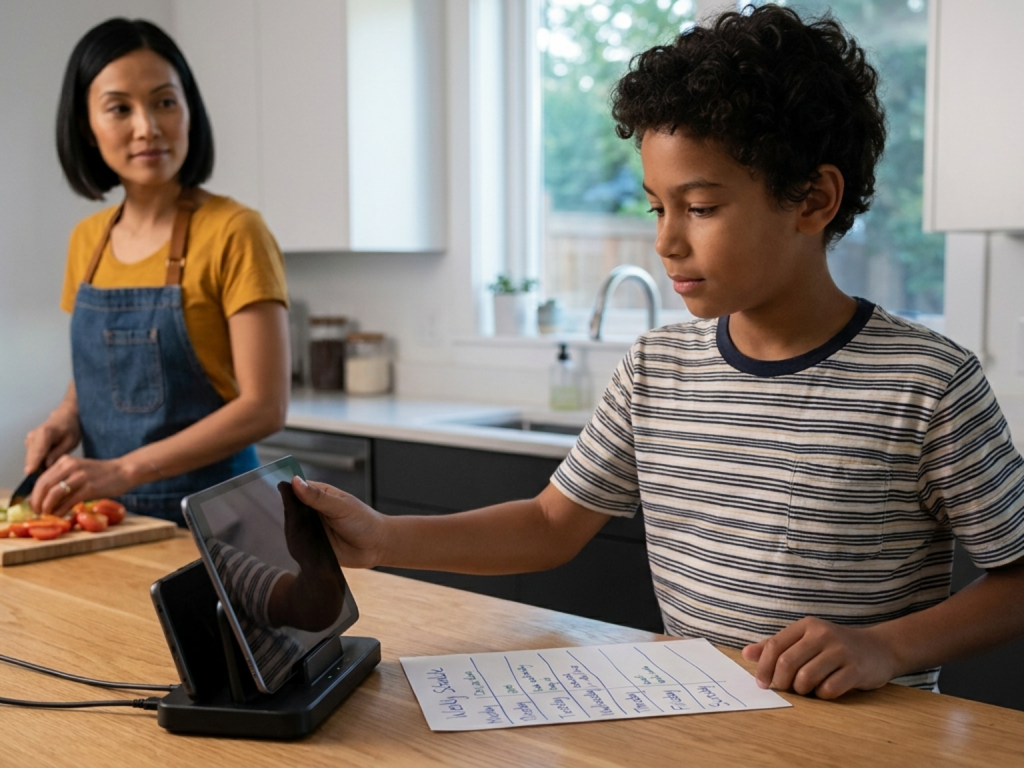
Start with the health anchors: sleep, school, meals, movement, hygiene, and family responsibilities. Screens should fit around these anchors rather than dominate them. Many families use device-free bedrooms overnight, a charging station outside sleeping areas, no recreational screens during meals, and a screen curfew 30 to 60 minutes before bed. For schoolwork, consider a visible workspace, notification limits, and short planned breaks rather than constant app switching.
Preteens are more likely to cooperate when they have some agency. Offer choices within boundaries: “You may choose your one recreational hour before dinner or after homework, but not both,” or “You can pick the show, and I will pick the stopping time.” Include physical activity in preteens as a non-negotiable health need, not as a punishment for screen use. Outdoor time, sports, walking the dog, dance, cycling, playground time, or active chores can all help restore balance.
Consequences should be calm, brief, and related to the rule. If a child sneaks a device at night, the next step may be charging it in a parent’s room, not a week of humiliation or broad punishment. The tone matters: “Our job is to protect your sleep and brain, and we will help you practice,” is more useful than “You cannot control yourself.”
When to seek professional guidance
Families should consider professional support when screen use is associated with persistent functional impairment. Examples include chronic insomnia, frequent school refusal, major grade decline, panic symptoms, depressive symptoms, aggressive outbursts around device limits, suspected cyberbullying, exposure to sexual exploitation, disordered eating content, or compulsive use that the child cannot reduce despite distress.
A pediatrician can screen for sleep disorders, headaches, vision concerns, attention difficulties, mood symptoms, weight trajectory, and medical contributors to fatigue or irritability. A mental health clinician can help evaluate anxiety, depression, attention-deficit/hyperactivity disorder, trauma, family stress, or problematic coping patterns. The goal is not to blame the child or parent, but to understand the full clinical and psychosocial context.
Bring specific observations to appointments: approximate daily recreational screen time, bedtime and wake time, nighttime device access, platforms used, mood before and after screen sessions, school changes, physical symptoms, and any online safety concerns. This information is more useful than a general statement that the child is “on screens too much.”
Finally, caregivers should give themselves compassion. Modern digital environments are engineered to be compelling, and many adults struggle with the same pressures. Preteens need limits, modeling, and repeated practice. Progress may look like fewer late nights, less conflict, better transitions, or more offline interest, rather than perfect adherence every day.
Seek help urgently if safety is a concern
- A child expresses suicidal thoughts, self-harm thoughts, or hopelessness.
- There is suspected online exploitation, grooming, blackmail, or sexual coercion.
- Cyberbullying is severe, threatening, or associated with school refusal or panic.
- Screen use is accompanied by major sleep loss, rapid mood change, or aggressive behavior.
- A child is exposed to dangerous challenges, self-harm content, or eating-disorder content.
Tools & Assistance
- Create a written family media plan with device-free times and charging locations.
- Use built-in parental controls and privacy settings, reviewed with the child.
- Schedule a pediatric visit if screen use is affecting sleep, mood, weight, headaches, or school.
- Ask the school counselor about cyberbullying, classroom device expectations, and peer conflict.
- Replace restricted screen time with specific offline options, not just “go do something else.”
FAQ
How much recreational screen time is reasonable for a 10- to 12-year-old?
Some research-based guidance suggests aiming for about one hour per day of discretionary screen time for ages 7 to 12. Families may need to individualize this based on school demands, health needs, and functioning.
Are educational videos and homework screen time the same as gaming or social media?
No. Purpose, content, timing, and supervision matter. Required school use or high-quality learning is different from late-night scrolling, unmoderated chat, or prolonged recreational gaming.
Should devices be allowed in the bedroom at night?
For many preteens, overnight device access increases the risk of delayed sleep, notifications, and unsupervised use. A shared charging area outside the bedroom is often a practical protective step.
What if my child becomes very upset when screen time ends?
Use predictable warnings, natural stopping points, and calm consistency. If distress is extreme, persistent, or linked with anxiety, depression, aggression, or school problems, consider professional guidance.
Is all screen time harmful?
No. Screens can support learning, creativity, accessibility, and connection. The main concerns are excessive use, inappropriate content, poor timing, loss of sleep or movement, and use as the only coping strategy.
Sources
- National Institutes of Health (NIH) — Effects of Excessive Screen Time on Child Development
- Children's Hospital of Orange County (CHOC Health) — The effects of screen time on children: The latest research parents should know
- American Psychological Association — Screen time and emotional problems in kids: A vicious circle?
Disclaimer
This article is for general educational purposes and is not a diagnosis or treatment plan. Consult a qualified healthcare professional for concerns about your child’s sleep, mood, behavior, development, or safety.


















Please log in to leave a comment.