
Intro
Transitions can be demanding for children because they require the brain and body to shift attention, predict what comes next, regulate emotion, and adapt to new expectations. For some children, especially those with developmental differences, chronic illness, anxiety, learning needs, communication challenges, or recent disruption, transitions may trigger distress that looks like avoidance, shutdown, irritability, somatic complaints, or behavioral escalation.
Supportive transition planning is not about forcing a child to cope alone. It is about making the environment more predictable, listening carefully to the child and caregivers, coordinating medical and educational supports, and building skills gradually. The strategies below can be adapted for daily routines, preschool or school changes, moving between services, returning after illness, or preparing for adolescence and adult-oriented care.
Highlights
Strong transition support begins with the child’s voice, caregiver insight, and coordinated communication among educators, clinicians, and support staff.
A dedicated point person or transition coordinator can reduce fragmented care and help ensure that accommodations follow the child across settings.
Predictable routines, visual schedules, advance preparation, and structured documentation help children understand what will happen and what is expected.
Skill-building should include self-determination, self-advocacy, problem-solving, and safe participation in the community when developmentally appropriate.
Understanding transitions from a child-centered perspective
A transition is any shift from one activity, place, person, routine, service, or developmental stage to another. For a child, this may be as small as moving from play to cleanup or as complex as changing schools, returning after hospitalization, starting secondary school, or moving from pediatric to adolescent-focused care. Even positive transitions can be physiologically stressful because they increase uncertainty and demand executive functioning: inhibition, working memory, cognitive flexibility, planning, and emotional regulation.
Children rarely struggle with transitions for only one reason. A child may have sensory sensitivities, limited receptive language, anxiety about separation, fatigue from a medical condition, difficulty estimating time, or fear of social failure. In a classroom, a transition may also expose academic vulnerability; a child who resists writing time may be communicating that written expression is effortful or embarrassing. In this context, supporting child with learning difficulties is part of transition planning, not a separate concern.
A helpful starting point is to assume that the behavior is a message. Instead of asking, “How do we make this child comply?” ask, “What skill, information, sensory support, relationship, or accommodation is missing?” This reframing lowers shame and helps adults choose supports that are preventive rather than reactive. It also protects the child’s dignity, which is essential for trust and long-term participation.
Build a coordinated transition team
Research on transition planning emphasizes four core components: stakeholder voice, a dedicated point person, individualized recommendations or accommodations, and a formal transition meeting. In practice, this means the child, caregivers, educators, school health staff, therapists, and clinicians should share relevant information before the transition occurs, not after difficulties have already escalated.
The child’s voice matters even when the child is young or has limited verbal language. Adults can gather preferences through observation, pictures, choice-making, rating scales, play-based conversation, or augmentative and alternative communication. Caregivers contribute information about sleep, medications, triggers, recovery strategies, cultural context, and what has or has not worked at home. Teachers and school staff can describe environmental demands, peer dynamics, curriculum expectations, safety concerns, and staffing realities.
A named point person is especially valuable. This may be a special educator, school nurse, counselor, transition coordinator, case manager, or another designated professional. Their role is not to “own” the child, but to maintain continuity: collecting documents, confirming responsibilities, tracking accommodations, communicating with families, and ensuring that medical or developmental recommendations are translated into school practice. When multiple adults assume someone else is coordinating, important details are easily lost.
Families can ask for a formal transition meeting when a child is entering a new classroom, changing schools, returning after a medical absence, or moving into a more independent level of care. The meeting should end with specific actions, names, timelines, and a plan for review.
Use advance planning, routines, and structured documentation
Children cope better when adults reduce ambiguity. Advance planning can include visiting the new setting, meeting key adults, reviewing photos of the environment, practicing a morning route, reading a social narrative, or creating a simple calendar. For some children, too much preparation too early increases anxiety, so timing should be individualized. The goal is not to flood the child with information, but to provide enough predictability to make the next step feel manageable.
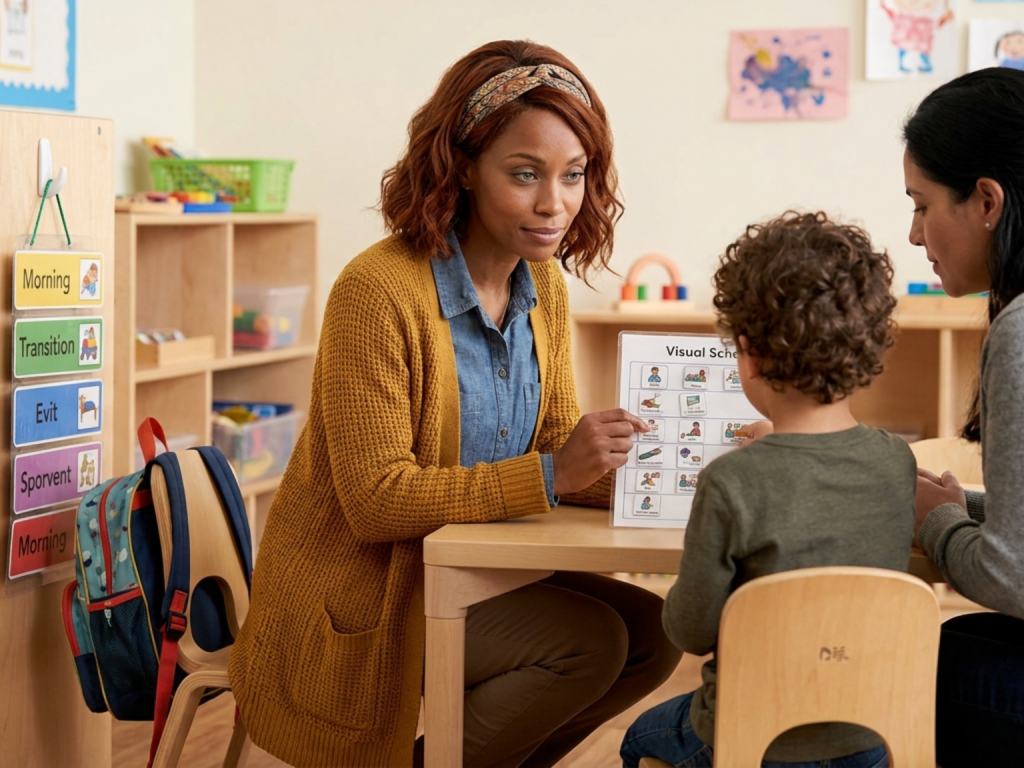
Clear routines and defined timetables are protective because they externalize expectations. Visual schedules, first-then boards, timers, transition songs, cue cards, written checklists, or color-coded calendars can help children who struggle with language processing, time perception, attention, or working memory. Preschool daily transitions and consistency are particularly important because young children rely heavily on repeated cues and co-regulation from adults.
Structured documentation prevents the plan from depending on memory. A practical transition profile may include:
- Current strengths, interests, communication style, and preferred motivators.
- Known triggers, sensory needs, medical considerations, fatigue patterns, and early warning signs of distress.
- Effective regulation supports, such as movement breaks, quiet spaces, breathing routines, or trusted adult check-ins.
- Academic, mobility, feeding, toileting, medication, or safety accommodations, when relevant.
- Names of responsible adults and dates for follow-up review.
Some schools use a “year wheel” or annual planning calendar to map key dates and responsibilities. This approach is helpful because transitions often cluster around predictable moments: enrollment deadlines, school visits, assessment reviews, individualized education plan meetings, exams, holidays, service changes, and graduation planning. Mapping these dates early reduces last-minute stress for both families and staff.
Support emotional regulation before, during, and after transitions
Transition distress is often a regulation problem before it is a behavior problem. A child may need an adult nervous system to “lend” calm through co-regulation: a steady voice, simple language, predictable body posture, and an emotionally safe limit. For younger children, toddler emotional support strategies such as naming feelings, offering limited choices, and staying close during distress can be adapted to older children with more age-appropriate language.
Before a transition, adults can lower the demand load. This may mean reducing verbal instructions, preparing materials in advance, avoiding rushed departures, or allowing a child to finish a meaningful stopping point. During the transition, cues should be brief and consistent: “Two minutes, then shoes,” followed by the same visual or auditory cue each day. After the transition, praise should be specific and process-focused: “You looked at the schedule, took your folder, and walked to class even though it was hard.”
It is also important to plan for recovery. A child who appears calm after a difficult transition may still be using significant cognitive and emotional energy. Recovery supports might include a quiet arrival routine, hydration, a sensory break, journaling, drawing, or a brief check-in with a trusted adult. In school settings, a “soft start” can help some children shift from home or transport into learning without immediate overload.
When distress escalates, safety comes first. Adults should avoid lengthy reasoning during peak dysregulation. Once the child is calm, collaborative problem-solving can identify what happened and what should be changed next time. Repeated escalation is a signal to revise the plan, not proof that the child is failing.
Teach self-determination and self-advocacy gradually
Transition support should not only make the environment easier; it should also build the child’s capacity over time. Evidence-informed transition services often include self-determination instruction: teaching children to make choices, set goals, solve problems, monitor progress, and ask for help. These skills are particularly important for adolescents who are expected to participate more actively in school planning, healthcare conversations, community activities, and eventually work or further education.
Self-advocacy should be taught explicitly, not assumed. A child may need scripts such as, “I need the directions in writing,” “Can I take a movement break?” or “I do not understand the next step.” Adolescents can practice contributing to meetings by sharing one strength, one challenge, and one accommodation that helps. For students with disabilities, self-advocacy curricula can prepare them to participate meaningfully in individualized education plan discussions while adults continue to provide protection and guidance.
Mentoring and peer-assisted instruction can also support transitions. Mentors can model belonging, problem-solving, and future possibilities, including confidence in science, technology, engineering, and mathematics pathways for students who may have been underestimated. Peer-assisted approaches can improve social participation by making routines more visible and providing structured opportunities for interaction rather than leaving the child to interpret complex social cues alone.
Independence should be paced. A child who can choose between two snacks may not yet be ready to manage medication discussions or transport safety independently. Adults can scaffold responsibility through small, repeated steps, celebrating competence while keeping age, cognition, medical needs, and emotional readiness in mind.
Plan for school, healthcare, and community transitions
School transitions require attention to both learning and wellbeing. When a child moves classes or schools, teams should review accommodations, communication needs, health plans, assistive technology, behavioral supports, and social vulnerabilities. If bullying, exclusion, or peer conflict has affected the child, supporting child through bullying may need to be part of the transition plan so that safety is addressed proactively in the new environment.
Healthcare-related transitions can include returning to school after hospitalization, adjusting to a new treatment routine, or coordinating with school-based services. School based health services and supporting child through treatment may involve medication administration, emergency care plans, mental health supports, or privacy-conscious communication between clinicians and educators. Families should ask clinicians what information the school needs, what can remain private, and whether written recommendations are appropriate.
Community-based instruction can be useful for older children and adolescents who need practice with real-world routines. This may include crossing streets safely, using public transportation, purchasing items, requesting assistance, or navigating community spaces. These skills should be taught with careful risk assessment and supervision, particularly for children with impulsivity, seizures, mobility needs, communication differences, trauma histories, or poor danger awareness.
Finally, every transition plan needs review. A plan that worked in September may be insufficient in January after academic demands increase, medication changes, sleep worsens, friendships shift, or puberty affects mood and energy. Scheduled follow-up helps adults adjust supports before the child reaches crisis. When concerns are persistent, severe, or worsening, families should consult pediatricians, developmental-behavioral specialists, child mental health professionals, occupational therapists, speech-language pathologists, or other appropriate clinicians for assessment and guidance.
When to seek additional help
- A child’s transition distress includes self-harm talk, aggression that risks injury, elopement, or unsafe impulsivity.
- School refusal, panic symptoms, sleep disruption, weight change, or somatic complaints persist or worsen.
- A child loses previously acquired skills, communication abilities, toileting skills, or social engagement.
- Medical needs, medication effects, pain, seizures, fatigue, or feeding issues may be contributing to transition difficulties.
- Bullying, trauma, discrimination, or unsafe school conditions are suspected.
Tools & Assistance
- Create a one-page transition profile with strengths, triggers, accommodations, and key contacts.
- Ask the school or care team to identify a named transition point person.
- Use visual schedules, first-then supports, timers, calendars, or social narratives as appropriate.
- Schedule a formal transition meeting before major changes and a follow-up review afterward.
- Consult pediatric, developmental, mental health, or therapy professionals when distress is severe or persistent.
FAQ
How early should transition planning begin?
For major school or service changes, planning often works best weeks to months ahead. Daily transitions may improve with immediate routine changes, but complex transitions need time for meetings, documentation, and practice.
What if preparing my child too early makes anxiety worse?
Preparation should be individualized. Some children need a long preview, while others do better with brief, concrete information closer to the event. A clinician or school team can help calibrate timing.
Are visual schedules only for young children?
No. Visual supports can help children and adolescents who struggle with memory, language processing, executive functioning, anxiety, or fatigue. The format should be age-respectful.
Who should be the transition point person?
The best point person is someone with enough access, authority, and reliability to coordinate communication. This may be a teacher, case manager, counselor, nurse, or transition coordinator.
Can transition support replace medical or psychological care?
No. Environmental support can be very helpful, but persistent or severe distress may require evaluation by qualified healthcare or mental health professionals.
Sources
- National Center for Biotechnology Information / PubMed Central — A Systematic Literature Review and Framework of Practices
- Stages Learning — What Works? Evidence-Based Transition Services
- Taylor & Francis Online — Development of a practical guide to facilitate smooth transitions in schools
Disclaimer
This article is for informational purposes only and does not diagnose, treat, or replace professional medical, developmental, psychological, or educational advice. Consult qualified healthcare and school professionals for guidance tailored to your child.


















Please log in to leave a comment.