
Intro
The hours after school can be surprisingly intense for children and caregivers. A child may arrive home hungry, overstimulated, emotionally depleted, or still carrying worries from the classroom, while adults may be trying to manage work, meals, homework, activities, and bedtime. A thoughtful after-school routine is not about perfection; it is a predictable rhythm that helps the nervous system settle and gives children a sense of safety and agency.
Highlights
A predictable after-school rhythm can support emotional regulation, behavior, sleep readiness, nutrition, and family connection.
Children often need decompression before homework or chores, especially after a socially and cognitively demanding school day.
Movement, food, screen boundaries, and a consistent bedtime routine work together; they should not be treated as separate problems.
The best routines are developmentally appropriate, flexible, and co-created with the child whenever possible.
Why after-school routines matter
An after-school routine for children is a repeated sequence of events that helps a child move from the demands of school into the more personal environment of home. This transition is neurobiologically important. During the school day, children use sustained attention, impulse control, working memory, social inhibition, and emotional masking. By dismissal, many have depleted executive function resources, meaning the brain systems that support planning, inhibition, and flexible problem-solving are tired.
Research on family routines and child development suggests that consistent daily structures are associated with better emotional regulation, behavioral stability, and mental health, especially for children exposed to stress or instability. Predictability reduces cognitive load: the child does not have to constantly ask, “What happens next?” This frees energy for connection, learning, and recovery.
Routines also provide repeated opportunities for mastery. When a child knows that shoes go in the same place, snack comes before homework, and screens happen only after responsibilities, the sequence becomes less dependent on adult reminders. Over time, predictable routines and emotional regulation become linked: the external structure helps the child gradually internalize self-management skills.
Start with decompression, not demands
Many after-school struggles begin because adults ask for homework, chores, or detailed conversation too quickly. A child who has held themselves together all day may collapse emotionally at home, a phenomenon some families call restraint collapse. This is not manipulation; it can reflect fatigue, hunger, sensory overload, or accumulated stress.
After-school decompression time should be brief, predictable, and restorative. For some children, this means quiet play, reading, drawing, lying down, or listening to music. For others, especially children with high motor needs, it means outdoor running, cycling, playground time, or a walk. The key is to make decompression intentional rather than letting it become an open-ended screen session that later makes transitions harder.
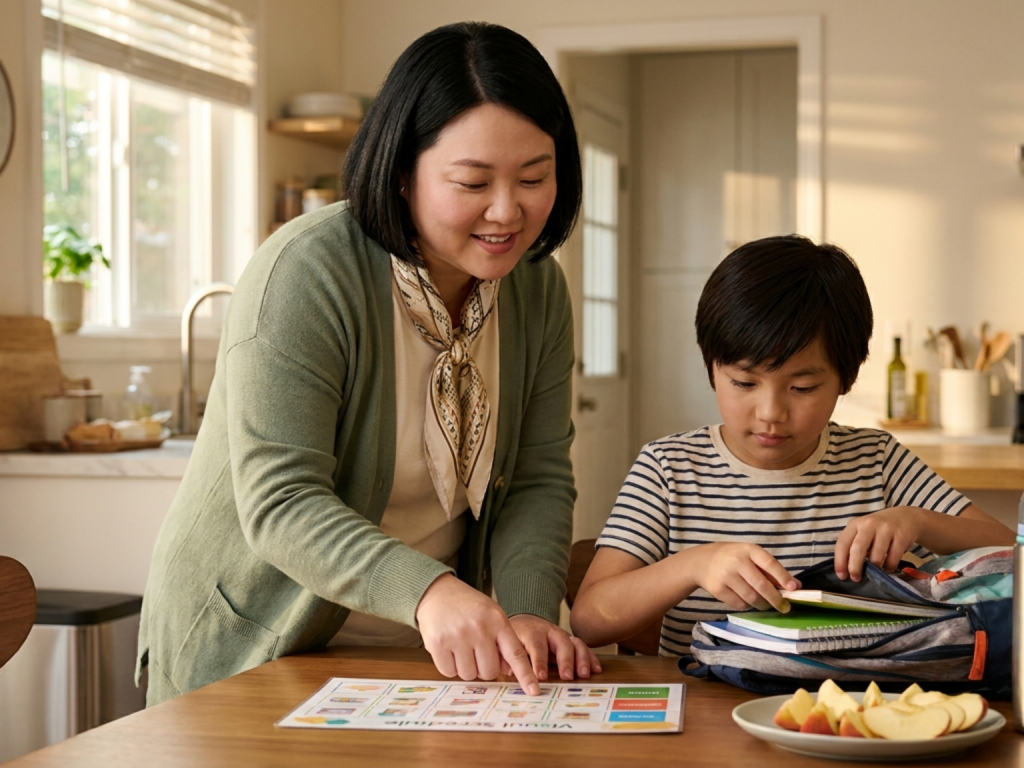
A simple transition sequence may look like this: arrive home, greet briefly, put away backpack, wash hands, eat snack, then choose 15 to 30 minutes of decompression. Some children benefit from a visual timer or visual schedule. Others need a caregiver script such as, “You are home, you are safe, and you do not have to answer questions yet. First snack, then rest, then we will look at homework together.”
Food, hydration, and the physiology of mood
After school, mood and behavior are often strongly influenced by physiology. Mild dehydration, low energy availability, and long gaps between meals can worsen irritability, headaches, inattention, and emotional reactivity. A balanced snack is not a reward for good behavior; it is part of basic nervous system support.
Useful snacks usually combine carbohydrate for energy with protein, fiber, or fat for steadier satiety. Examples include yogurt with fruit, whole-grain toast with nut or seed butter, cheese with crackers, hummus with vegetables, eggs, soup, or leftovers from lunch. Children with allergies, diabetes, feeding disorders, gastrointestinal conditions, or growth concerns need individualized guidance from a pediatrician, registered dietitian, or relevant specialist.
Hydration can be built into the routine without making it a battle. A water bottle can be placed near the homework area or brought to the table during snack. If a child often reports abdominal pain, dizziness, recurrent headaches, excessive thirst, weight change, vomiting, or persistent fatigue after school, caregivers should seek medical advice rather than assuming it is “just school stress.”
Movement before or after homework
Daily movement after school supports cardiovascular health, musculoskeletal development, sleep pressure, mood regulation, and attention. Educational guidance often recommends building in about 60 minutes of physical activity across the day, which can include school recess, sports, active transport, outdoor play, dance, playground time, or family walks. For many children, movement before homework improves task initiation because it discharges accumulated motor tension.
The best timing depends on the child. A child who becomes too activated after vigorous play may do better with homework first, followed by sports or outdoor time. A child who cannot sit still after school may need movement before academic tasks. The goal is not to force one ideal schedule, but to observe the child’s regulation pattern.
Consider three movement categories: calming movement such as walking, stretching, yoga poses, or swinging; organizing movement such as obstacle courses, climbing, or chores involving carrying; and vigorous movement such as running games, cycling, swimming, or team sports. Children with asthma, cardiac disease, seizure disorders, injuries, hypermobility, or chronic pain should have activity plans discussed with healthcare professionals, especially if symptoms occur during exertion.
A homework routine that reduces conflict
A homework routine for school-age children works best when it is short, visible, and consistent. Homework conflict often reflects more than “not trying.” It may involve fatigue, learning differences, anxiety, attention difficulties, weak working memory, perfectionism, or unclear instructions. A calm structure helps adults identify which issue is present.
Set up a distraction-reduced homework area with the materials the child usually needs: pencils, paper, charger, calculator if appropriate, and a water bottle. The area does not have to be silent or separate; some children work best near a caregiver. Begin with a two-minute review: what needs to be done, what order makes sense, and how long the child expects it to take.
For younger children, use short work intervals, such as 10 to 15 minutes, followed by a brief movement break. Older children may tolerate longer blocks but still benefit from planning. If homework regularly takes far longer than the school suggests, causes panic, or leads to nightly meltdowns, contact the teacher. Persistent homework avoidance in school-age children may signal a mismatch between workload and developmental, emotional, or learning needs.
Caregivers can support without taking over by asking: “What is the first step?” “Which part feels confusing?” and “Do you want me to sit nearby or check at the end?” This promotes executive function in children while preserving the child’s ownership of the work.
Chores, autonomy, and family contribution
Household responsibilities can be part of the after-school rhythm, but they should be realistic and clearly defined. Chores teach sequencing, contribution, and self-efficacy. They also reduce the feeling that adults are constantly serving the child, which can improve family dynamics.
Age-appropriate examples include unpacking the lunchbox, placing papers in a parent review spot, feeding a pet with supervision, setting the table, putting shoes away, folding small laundry items, or preparing simple snack components. The chore should have a visible endpoint. “Clean your room” may be too vague; “put dirty clothes in the basket and books on the shelf” is clearer.
Children are more cooperative when they help design the routine. Offer limited choices: “Would you rather unpack your backpack before snack or after snack?” This supports autonomy without surrendering the structure. Positive reinforcement for routines can be specific and non-material, such as, “You put your lunchbox away without a reminder; that helps tomorrow morning go more smoothly.”
Screens, dinner, and the evening bridge to sleep
Screens are not inherently harmful, but timing, content, and transition difficulty matter. After school, screens can provide relaxation, social connection, or learning. They can also displace movement, increase irritability when stopped, delay homework, and push bedtime later. Families often do best with a simple rule: responsibilities and regulation first, recreational screens later and within a defined boundary.
A screen boundary may include no screens during snack conversation, no autoplay during homework breaks, devices parked outside the bedroom at night, or a shared family media plan. Children who become highly distressed when screens end may need shorter sessions, visual countdowns, or alternative decompression options rather than sudden removal.
Dinner acts as a biological and relational anchor. It does not need to be elaborate. Even a simple meal can provide nutrition, routine, and a chance for low-pressure connection. Some children talk more during a side-by-side task than at the table, so avoid turning dinner into an interrogation about school.
The after-school routine should eventually feed into a consistent bedtime routine. Sleep supports memory consolidation, immune function, growth, mood regulation, and attention. A wind-down hour before bedtime, predictable hygiene steps, reading, and reduced light exposure can help the body shift toward sleep. If snoring, witnessed pauses in breathing, restless sleep, severe bedtime anxiety, or excessive daytime sleepiness occurs, medical evaluation is appropriate.
Adapting routines for temperament and neurodevelopment
No single schedule fits every child. A highly sensitive child may need quiet, dimmer lighting, fewer questions, and a slower transition. A sensation-seeking child may need heavy work, outdoor play, or structured sports. A child with attention-deficit/hyperactivity traits may need external reminders, body doubling, timers, and tasks broken into smaller steps. A child with autism spectrum traits may benefit from visual schedules, advance warnings before transitions, and consistent language.
Children with anxiety may appear oppositional when they are actually avoiding uncertainty or feared failure. Children with depression may show irritability, withdrawal, low energy, or loss of interest rather than sadness alone. Children with trauma histories may be particularly dependent on predictability, caregiver warmth, and non-shaming correction. These patterns deserve compassion and, when persistent or impairing, professional assessment.
Flexibility is part of a healthy routine. A routine should be sturdy enough to guide the day and flexible enough to survive illness, extracurricular activities, parental work shifts, shared custody, or cultural and religious commitments. The question is not, “Did we follow the routine perfectly?” but “Did the child have enough predictability, nourishment, movement, connection, and sleep protection today?”
Building a routine your family can actually keep
Start small. Choose one or two friction points rather than redesigning the entire evening. For example, begin with the first 45 minutes after school: backpack spot, handwashing, snack, and decompression. Once that becomes easier, add homework timing or screen rules.
A practical sequence may include:
- Arrival and warm greeting.
- Backpack, shoes, and lunchbox in assigned places.
- Handwashing, snack, and water.
- After-school decompression for 15 to 30 minutes.
- Homework or reading in a predictable place.
- Chore or family contribution.
- Daily movement or extracurricular activity.
- Dinner, screen-free downtime, hygiene, and bedtime routine.
Review the plan with the child at a calm time, not during a meltdown. Use a visual schedule for younger children or a checklist for older children. Keep language brief and neutral during transitions. If the routine fails, treat it as data: Was the child hungry? Was the homework too hard? Was the screen limit unclear? Was bedtime too late the night before?
Caregivers also deserve compassion. Family routines are harder under economic strain, caregiver burnout, disability, housing instability, and unpredictable work hours. Even a partial routine can be protective. One reliable anchor, such as snack together or a predictable bedtime sequence, can still support a child’s sense of safety.
When to seek extra help
- Consult a pediatrician or qualified clinician if after-school fatigue, headaches, abdominal pain, dizziness, or appetite changes are persistent or severe.
- Seek urgent help if a child talks about self-harm, feels unsafe, or shows sudden extreme behavior change.
- Ask the school for support if homework consistently causes panic, takes excessive time, or suggests possible learning difficulties.
- Discuss snoring, breathing pauses during sleep, or marked daytime sleepiness with a healthcare professional.
- Consider mental health support if meltdowns, withdrawal, aggression, or anxiety significantly impair family life or school functioning.
Tools & Assistance
- Create a one-page visual after-school schedule with the child
- Use a timer for decompression, homework blocks, and screen transitions
- Prepare a snack station with balanced options approved for the child’s health needs
- Coordinate with teachers about homework load and classroom stressors
- Speak with a pediatrician, school counselor, occupational therapist, psychologist, or dietitian when concerns persist
FAQ
How long should after-school decompression last?
Many children do well with 15 to 30 minutes, but the ideal length depends on age, temperament, hunger, sleep, and the day’s demands. Keep it predictable and avoid letting it unintentionally delay the whole evening.
Should homework happen before or after play?
Either can work. Children who are physically restless may need movement first, while children who struggle to restart after play may do better with a short homework block before longer recreation.
Are screens okay after school?
Screens can be part of family life, but clear timing and limits help. Prioritize snack, movement, homework, connection, and sleep protection, and use countdowns or device parking if transitions are difficult.
What if my child melts down every day after school?
Daily meltdowns may reflect fatigue, hunger, sensory overload, anxiety, learning strain, bullying, sleep problems, or neurodevelopmental needs. Track patterns and consider discussing them with the teacher and a healthcare professional.
How can parents keep routines realistic with busy schedules?
Use anchors rather than perfection: a consistent backpack spot, snack, short connection time, and bedtime sequence. Even small predictable steps can reduce stress.
Sources
- Wiley Online Library — Routines and child development: A systematic review
- U.S. Department of Health and Human Services, ASPE — Afterschool Programs to Improve Social-Emotional, Behavioral, and Physical Health of Economically Vulnerable Children: A Targeted Literature Review
- Penn State University Thrive — Establishing an After-School Routine
Disclaimer
This article is for informational purposes only and does not replace medical, psychological, or educational evaluation. Consult a qualified healthcare professional for concerns about your child’s health, behavior, sleep, nutrition, or development.

















Please log in to leave a comment.