
Intro
Play is not a break from development; it is one of the main ways development happens. From a toddler repeatedly dropping a spoon to a teenager negotiating strategy in a team sport or online game, play reflects the brain’s changing priorities: movement, language, imagination, self-control, belonging, identity, and autonomy.
Parents and caregivers often worry when play looks different from one stage to the next. A preschooler’s pretend world may fade, a school-age child may become absorbed in rules, and a teen may prefer peers or digital spaces. These shifts are usually expected, but they still benefit from warm adult attention, safe boundaries, and medical or developmental guidance when concerns arise.
Highlights
Play changes because the child’s nervous system, motor skills, language, executive functions, and social needs are changing.
Toddlers learn through sensorimotor play; preschoolers add symbolic play and imagination; school-age children increasingly enjoy rules, mastery, and peer cooperation.
Preteens and teens often use play to explore identity, status, risk, belonging, creativity, and independence.
Play deprivation can affect emotional flexibility, social competence, mood, and resilience, so protected play time remains important even in adolescence.
Seek professional guidance if play becomes persistently absent, highly restricted, unsafe, distressing, or associated with developmental regression or major mood changes.
Play as brain-building, not just entertainment
Across childhood, play supports development at several levels at once. Pediatric research describes play as a driver of changes at molecular, cellular, and behavioral levels. In practical terms, playful experience can influence stress physiology, strengthen neuronal connectivity, and help children practice socioemotional skills and executive functions such as inhibition, working memory, and cognitive flexibility.
Neuroscience research also describes play circuits that involve midbrain and limbic pathways, with downstream effects on movement, affect regulation, and social learning. This does not mean every moment must be educational. In fact, the developmental power of play often comes from its self-directed, emotionally meaningful, and flexible nature. A child tries, fails, laughs, adjusts, imitates, competes, cooperates, and tries again.
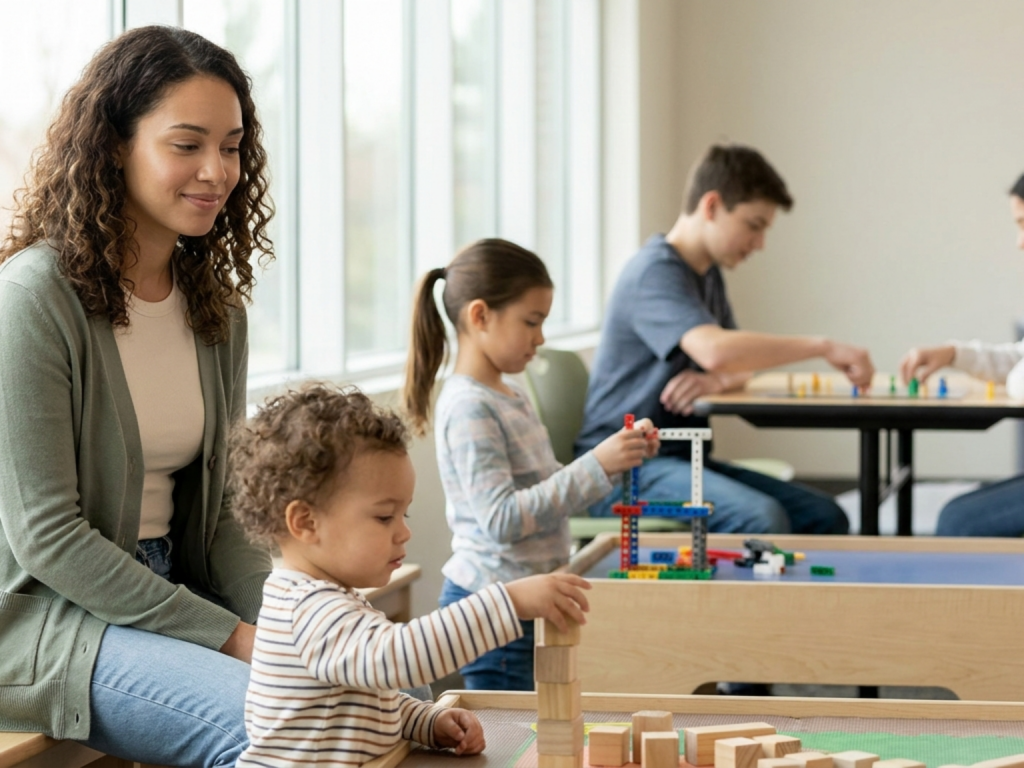
As children grow, the visible form of play changes. The toddler banging blocks together, the 7-year-old organizing a game with rules, and the 15-year-old rehearsing music with friends are all using play to integrate body, brain, emotion, and social context. The adult role is not to force play into a narrow mold, but to notice what the child is practicing and to keep the environment safe enough for exploration.
Toddlerhood: movement, repetition, and shared attention
In toddlerhood, play is heavily sensorimotor. Children explore through climbing, carrying, mouthing, dumping, stacking, throwing, and repeating. This toddler learning through movement is not random; it helps integrate vestibular input, proprioception, fine motor control, cause-and-effect reasoning, and early problem solving. A toddler may push the same toy car down the same ramp many times because repetition is how the nervous system predicts outcomes and refines motor plans.
Socially, toddlers are often moving from solitary play toward parallel play, where they play near other children without sustained cooperation. Brief imitation, turn-taking, and shared attention begin to emerge. A toddler who hands a caregiver a toy, looks back to check the adult’s reaction, or laughs after a familiar game is practicing joint attention and early social reciprocity.
Language and emotion are still immature, so play often carries feelings the child cannot yet explain. A toddler may crash toys when frustrated, hide and reappear to master separation, or insist on the same game during transitions. Supportive adults can narrate feelings, offer simple choices, and provide safe physical outlets. Because toddlers have limited impulse control, close supervision is a developmental necessity, not a sign that the child is being difficult.
Preschool years: imagination, roles, and early self-control
During the preschool years, symbolic play becomes more visible. A block becomes a phone, a cardboard box becomes a clinic, and a stuffed animal becomes a patient. Preschool symbolic play reflects growing language, memory, theory of mind, and representational thinking. Children start to use pretend scenarios to explore family roles, fears, care, power, injury, repair, and rules.
Imaginative play also gives children a low-stakes way to practice self-regulation. In a pretend restaurant, a child may wait for a turn, follow a role, inhibit an impulse, and negotiate a script with another child. These are early executive function exercises embedded in joy. Rough-and-tumble play, when mutual and well supervised, may also help children read social cues, modulate force, and recover from brief frustration.
Adults can support this stage by providing open-ended materials: blocks, dress-up items, art supplies, puppets, toy animals, fabric, containers, and outdoor space. The goal is not elaborate toys but flexible possibilities. If a child’s pretend themes seem intense, repetitive, or aggressive, caregivers can observe calmly rather than immediately shut them down, while setting firm limits on real harm. Consultation with a pediatrician or child development professional is appropriate if play is persistently absent, extremely rigid, or accompanied by loss of language or social engagement.
School-age play: rules, competence, and friendship
In middle childhood, play often becomes more rule-based and skill-based. Board games, sports, collections, construction sets, dance, coding, music, playground games, and cooperative projects become appealing because children are developing stronger working memory, planning, motor coordination, and perspective-taking. They can hold rules in mind, compare strategies, and tolerate more complex sequences.
This is also the age when children often care deeply about fairness. Arguments over rules may look petty to adults, but they are part of moral and social learning. Children are testing reciprocity, group norms, loyalty, and consequences. Learning differences in school-age children may show up during play as difficulty following multi-step rules, frustration with motor demands, trouble joining groups, or avoidance of competitive activities. These patterns do not automatically indicate a disorder, but they can guide supportive adaptations.
Adults can help by offering a range of play types rather than valuing only competitive achievement. A child who dislikes team sports may thrive in martial arts, swimming, theater, robotics, nature exploration, or art. The protective factor is not one ideal activity; it is repeated access to mastery, belonging, physical movement, creativity, and joy. Over-scheduling can crowd out self-directed play, while too little structure can leave some children isolated. The balance depends on temperament, health, family context, and the child’s own preferences.
Preteens: comparison, belonging, and changing motivation
The preteen years are a bridge between childhood and adolescence. Play may become less visibly childlike, but the need for playful exploration remains. Many preteens shift toward friendship-based activities, team identity, humor, digital games, creative projects, sports, music, social media trends, and private hobbies. Preteen learning motivation is increasingly shaped by competence, peer acceptance, autonomy, and the wish not to appear childish.
Peer comparison in middle childhood and the preteen years can make play feel emotionally loaded. A child who once sang freely may stop after one teasing comment. Another may quit a sport because body changes, coordination differences, or social ranking make participation feel unsafe. This does not mean adults should pressure children to persist at all costs. Instead, caregivers can help distinguish between normal challenge, harmful social pressure, and a poor fit.
Preteens also begin to seek more privacy. Their play may happen through messages, shared videos, inside jokes, multiplayer games, or creative online spaces. Adults still need to provide supervision, digital safety expectations, sleep protection, and support for offline relationships. The tone matters: curiosity works better than surveillance alone. Asking “What do you like about this game?” or “Who do you usually play with?” often opens more information than immediate criticism.
Teen play: identity, autonomy, and social intensity
Adolescence does not end the need for play; it transforms it. Teen play may look like sports, theater, music, gaming, debate, fashion experimentation, outdoor adventure, coding, volunteering, humor, fandom, or simply hanging out. These activities support identity formation, social competence, emotional regulation, and autonomy. They also offer a developmentally appropriate space to test roles: leader, artist, athlete, caregiver, advocate, strategist, or friend.
Early adolescent brain development is marked by remodeling that prepares the brain for adulthood, with increasing neural integration and heightened sensitivity to social context. In young teens, dopamine-related reward systems can be highly reactive, making novelty, peer approval, and emotionally intense experiences especially compelling. This helps explain why play becomes more peer-centered and why decision-making may worsen in high-arousal social situations.
Healthy teen play includes some risk, but the risk should be bounded. A challenging climb with safety equipment, a competitive match with rules, or a performance in front of an audience can build courage and resilience. In contrast, play that involves coercion, humiliation, dangerous substances, reckless driving, self-harm challenges, or sexual pressure requires adult intervention and, when needed, professional support. The aim is not to eliminate adolescent risk-taking, but to channel novelty-seeking toward safer mastery and meaningful connection.
What play deprivation can look like
Because play supports emotional flexibility, empathy, social competence, and stress regulation, a persistent lack of play can matter. Play deprivation may appear as chronic boredom, rigidity, irritability, social withdrawal, reduced creativity, low frustration tolerance, or loss of joy. In teenagers, too little restorative play can contribute to burnout-like patterns: exhaustion, cynicism, emotional narrowing, and a sense that every activity must be productive or evaluated.
Modern children may lose play for many reasons: academic pressure, unsafe neighborhoods, family stress, excessive screen-based passivity, illness, sleep deprivation, bullying, anxiety, depression, neurodevelopmental differences, or caregiving responsibilities. It is important not to blame families. Many caregivers are trying to protect children in complex environments with limited time and resources.
A useful question is: “Does this child have regular access to safe, chosen, socially nourishing, and physically or creatively engaging play?” If the answer is no, start small. Ten minutes of floor play with a toddler, a weekly playground routine, a low-pressure art corner, a family card game, or protected time for a teen’s music can be meaningful. If loss of play is accompanied by persistent sadness, marked anxiety, developmental regression, sleep disruption, appetite change, school refusal, or safety concerns, families should consult a healthcare professional.
How adults can support play at every age
Supportive adults protect play without controlling every detail. For younger children, this means safe spaces, supervision, repetition, sensory-rich materials, and responsive interaction. For school-age children, it means access to peers, movement, creative tools, and chances to experience competence without constant performance pressure. For teens, it means respecting autonomy while maintaining boundaries around safety, sleep, digital life, and harmful peer dynamics.
One practical approach is to observe before intervening. Ask what the play is helping the child practice. Is the toddler mastering balance? Is the preschooler processing a fear? Is the 9-year-old negotiating fairness? Is the teen seeking belonging or identity? This perspective can reduce conflict and help caregivers respond with empathy.
Families can also advocate for recess, arts, physical education, accessible recreation, and inclusive extracurriculars. Children with disabilities, chronic illness, sensory processing differences, or social communication differences may need adapted play environments, assistive equipment, smaller groups, or adult facilitation. The goal is participation and pleasure, not making every child play in the same way.
Finally, adults should remember that connection itself can be playful. Shared humor, cooking, walking the dog, repairing a bike, singing in the car, or creating a family ritual can all carry the essential features of play: engagement, flexibility, emotional safety, and joy.
When to seek guidance
- A child loses previously acquired play, language, motor, or social skills.
- Play is persistently absent, extremely rigid, or causes major distress.
- A child or teen withdraws from nearly all enjoyable activities for more than a brief period.
- Play involves repeated cruelty, coercion, unsafe sexual behavior, self-harm, dangerous substances, or serious risk-taking.
- Concerns about bullying, depression, anxiety, neurodevelopmental differences, sleep problems, or trauma are affecting play and relationships.
Tools & Assistance
- Discuss developmental concerns with the child’s pediatrician or family physician.
- Ask school staff about recess, peer relationships, learning supports, and inclusive activities.
- Consider referral to occupational therapy, speech-language therapy, developmental pediatrics, or child mental health services when appropriate.
- Create a weekly family rhythm that protects unstructured play, outdoor movement, and sleep.
- Use open-ended toys, art materials, books, music, safe digital boundaries, and community recreation programs.
FAQ
Is it normal for a teenager to stop playing with toys?
Yes. Teen play usually shifts toward peers, sports, music, games, creative work, humor, identity exploration, and social activities. The need for play remains, even when the form changes.
How much should adults direct a child’s play?
Young children need safety and supervision, but not constant instruction. Across ages, the most beneficial play often includes choice, curiosity, and flexibility.
Are video games always a problem?
No. Digital games can involve strategy, cooperation, creativity, and friendship. Concerns rise when gaming displaces sleep, school, physical activity, offline relationships, or emotional regulation.
What if my child does not enjoy competitive play?
That can be completely normal. Many children prefer art, building, music, nature, pretend play, coding, reading, or cooperative activities. The goal is meaningful engagement, not competition.
Can play help with emotional regulation?
Play can support emotional regulation by allowing children to practice flexibility, recovery from frustration, social cues, and problem solving. It is not a substitute for medical or mental health care when symptoms are significant.
Sources
- American Academy of Pediatrics — The Power of Play: A Pediatric Role in Enhancing Development in Children
- Normal Is Fun Play — The Science of Play: Neuroscience & Research
- Developmental Science — Nine Big Changes in Young Teens that You Should Know About
Disclaimer
This article is for general educational purposes only and is not a diagnosis or treatment plan. Consult a qualified healthcare professional for concerns about a child’s development, behavior, mood, or safety.


















Please log in to leave a comment.