
Intro
Preschool social skills are the everyday abilities children use to communicate, play, cooperate, manage feelings, solve small conflicts, and begin friendships. A checklist can help parents, caregivers, teachers, and clinicians observe these skills consistently without turning childhood into a test.
Children develop socially at different rates, and context matters: a child may be talkative at home but quiet at preschool, or cooperative with familiar adults but overwhelmed in a noisy group. Use this checklist as a supportive observation tool, not as a diagnostic instrument. If concerns persist, especially across settings, discuss them with a pediatrician, early childhood educator, speech-language pathologist, occupational therapist, or early childhood mental health professional.
Highlights
A preschool social skills checklist is most useful when it looks at communication, play, emotion recognition, self-regulation, cooperation, and problem-solving together.
Social development is not linear. Fatigue, sensory overload, language delays, temperament, illness, family stress, and classroom demands can all affect a child’s social behavior.
Play-based practice, warm adult coaching, visual routines, and designed physical activities can support peer interaction and self-regulation.
Checklists should guide observation and conversation, not label a child. Persistent or worsening concerns deserve professional evaluation.
What a preschool social skills checklist is for
A preschool social skills checklist is a structured way to notice how a child interacts with adults, peers, routines, emotions, and group expectations. It is not meant to rank children or force adult-like behavior. Instead, it helps adults see patterns: which skills are already strong, which are emerging, and which situations make social participation harder.
Preschool social development typically includes communication, cooperation, empathy, self-regulation, friendship skills, and flexible problem-solving. These skills rely on several neurodevelopmental systems working together, including receptive and expressive language, attention, executive function, sensory processing, motor planning, emotional regulation, and social cognition. This is why a child who struggles with turn-taking may not be “being difficult”; they may be managing limited impulse control, reduced language for negotiation, or high arousal in a busy room.
A useful checklist should be observed across more than one context. For example, note whether the child uses words, gestures, facial expressions, or body positioning to communicate during free play, snack time, transitions, outdoor play, and small-group activities. Also note what kind of adult support helps: a visual cue, a brief model sentence, a calm reminder, a sensory break, or direct mediation between children.
Many preschoolers show uneven profiles. A child may share toys easily but become distressed when rules change. Another may talk fluently with adults but avoid peer play. These patterns can still be developmentally understandable, but tracking them helps families and educators choose supportive strategies and decide whether further assessment is needed.
Core checklist domains to observe
The following domains create a broad picture of preschool social functioning. You can rate each item as “not yet observed,” “emerging with support,” “sometimes independent,” or “usually independent.” Avoid judging a child based on one hard day; look for repeated patterns over several weeks.
- Communication: Uses words, gestures, pointing, facial expression, or augmentative supports to express needs; responds to name or bids for attention; listens briefly to another person; uses simple social language such as greeting, requesting, refusing, thanking, or asking for help.
- Nonverbal social awareness: Notices when another child is nearby; looks toward a speaker or activity; adjusts personal space with reminders; follows simple gestures such as pointing; recognizes basic emotional cues in faces, voices, or body posture.
- Play: Plays near other children, imitates actions, joins simple pretend play, shares materials with support, takes short turns, and gradually participates in associative or cooperative play.
- Emotions: Names basic feelings such as happy, sad, mad, scared, or frustrated; accepts comfort from a trusted adult; begins to notice another child’s distress; uses simple coping language such as “I need help” or “I’m not ready.”
- Self-regulation: Waits briefly, transitions with support, follows one- or two-step directions, tolerates small disappointments, and recovers from frustration with adult co-regulation.
- Problem-solving: Seeks adult help instead of hitting or grabbing, tries simple solutions, accepts choices, negotiates with support, and begins to understand rules and consequences.
These domains overlap. For instance, problem-solving during a toy conflict requires language, emotional inhibition, perspective-taking, memory of classroom rules, and sometimes motor control. A checklist should capture this complexity rather than treating each behavior as isolated.
Play and peer interaction: from parallel play to cooperation
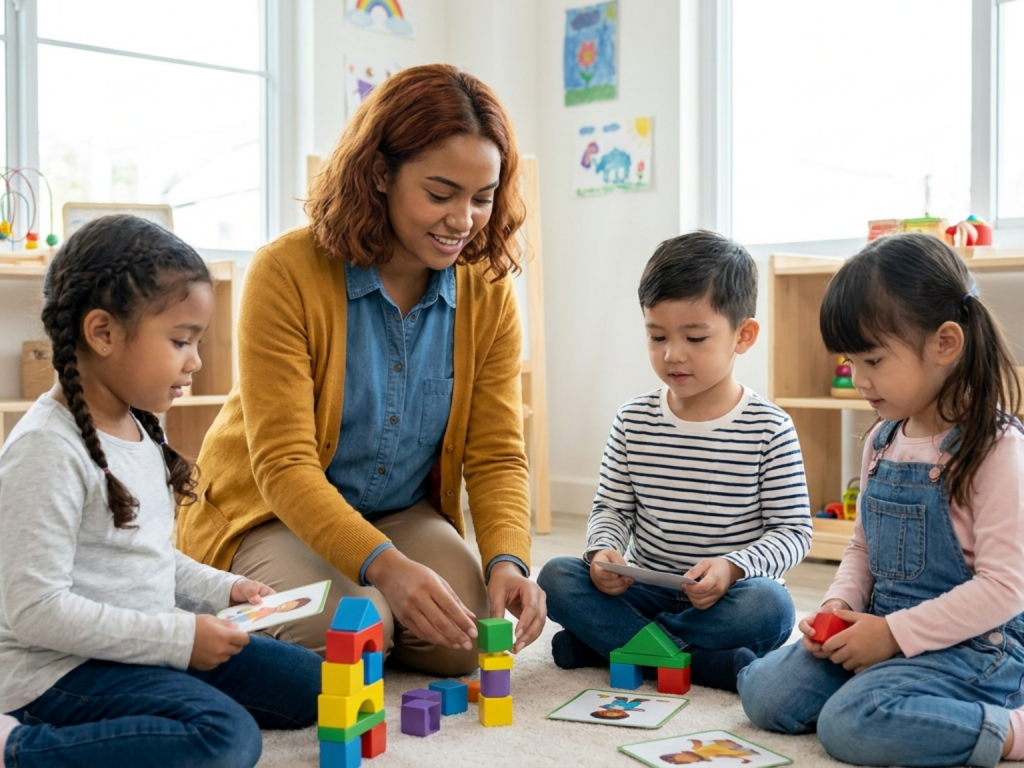
Play is the main laboratory for preschool social learning. In early preschool, many children still use parallel play: they play beside peers with similar toys but limited direct interaction. This can be appropriate, especially for younger preschoolers or children who are warming up to a new environment. Over time, children often move toward associative play, where they share materials, comment on each other’s actions, or briefly coordinate ideas. More advanced preschool play includes cooperative pretend roles, shared goals, simple rules, and group problem-solving.
Checklist items for beginning social play may include staying near peers without distress, watching another child’s play, imitating an action, tolerating another child using nearby materials, and accepting adult-supported sharing. Intermediate items include offering a toy, taking turns for a short game, asking to join, responding when a peer asks a question, and participating in a small group for several minutes. Advanced items include building a shared pretend story, following game rules, negotiating roles, repairing a conflict, and staying engaged without constant adult supervision.
Adults can support these skills by narrating social moments in simple language: “Maya is using the blue truck. You can ask, ‘Can I have a turn next?’” This type of coaching gives the child a script while reducing shame. Visual turn-taking tools, sand timers, duplicate materials, predictable cleanup songs, and small group play can reduce the cognitive load of peer interaction.
It is also important to respect temperament and sensory needs. Some children need more time to observe before joining; others become dysregulated in crowded, loud play. Support should invite participation without forcing eye contact, physical affection, or immediate group involvement. Preschool learning skills development is strongest when social expectations are developmentally appropriate and embedded in play.
Emotion recognition and self-regulation
Preschoolers are still developing the prefrontal and limbic systems involved in inhibition, emotional modulation, and flexible thinking. Because of this, big feelings can rapidly become big behaviors. A social skills checklist should therefore include not only whether a child “behaves,” but how the child recognizes, communicates, and recovers from emotion.
Useful checklist items include identifying basic feelings in self and others, using a word or gesture to request help, accepting comfort, pausing before grabbing or pushing, waiting briefly, trying a calming strategy with adult guidance, and returning to play after disappointment. Many preschoolers need co-regulation first: an adult’s calm voice, predictable body language, reduced stimulation, and clear choices. Self-regulation develops gradually through repeated supported experiences.
Preschool emotional challenges may appear as crying, withdrawal, rigidity, aggression, refusal, excessive silliness, or difficulty transitioning. These behaviors can reflect normal developmental stress, but they can also signal unmet needs such as sleep insufficiency, anxiety, trauma exposure, neurodevelopmental differences, language delay, sensory overload, or medical discomfort. The checklist should include context: What happened before the behavior? What helped the child recover? Did the same pattern occur at home and school?
Practical supports include emotion picture cards, “first-then” language, calm-down spaces that are not punitive, predictable routines, movement breaks, and modeling. Instead of saying, “Use your words” when the child is already flooded, try a short script: “You wanted the block. Say, ‘Turn please.’” If the child cannot use words in that moment, gestures, pointing, or adult mediation may be appropriate.
Communication, empathy, and early friendship skills
Social communication in preschool includes more than vocabulary. Children learn to initiate interaction, respond to others, repair misunderstandings, adapt tone, use gestures, and understand that other people have different feelings or intentions. These skills support early friendship, but they develop unevenly.
Checklist items may include greeting familiar people, responding to a peer’s invitation, asking simple questions, making a relevant comment, using polite refusal, requesting help, and repairing a communication breakdown by repeating, pointing, showing, or choosing another word. For non-speaking or minimally speaking children, social communication may include eye gaze, facial expression, body movement, sign language, picture exchange, speech-generating devices, or other augmentative and alternative communication. The goal is effective connection, not one specific communication style.
Empathy in preschool is emerging. A child may comfort a crying peer one day and laugh at another child’s frustration the next. Checklist items can include noticing distress, pausing when someone says “stop,” offering help with adult prompting, and beginning to understand simple perspectives: “He is sad because his tower fell.” Adults can build empathy through storybooks, puppet play, and calm reflection after conflicts.
Friendship skills include choosing a play partner, remembering a peer’s preference, inviting another child to play, accepting “no” with support, and enjoying shared routines. Avoid assuming that quiet children lack social interest. Some children prefer one close peer, adult interaction, or solitary play after a socially demanding morning. The key question is whether the child has ways to connect, communicate needs, and participate without persistent distress.
Problem-solving, rules, and group participation
Preschool group life asks a lot from a young nervous system: sitting briefly, listening, waiting, sharing materials, following routines, accepting limits, and shifting from preferred to nonpreferred activities. A checklist can help separate skill deficits from willful noncompliance. For example, a child who leaves circle time may have difficulty with auditory attention, posture, sensory regulation, or understanding group expectations.
Problem-solving items include asking an adult for help, choosing between two acceptable options, using a rehearsed phrase such as “Can I have a turn?”, accepting a timer, helping repair a spill or mess, and trying again after a mistake. Rule-following items include responding to simple safety rules, stopping with adult support, staying with the group during transitions, and participating in cleanup. Advanced preschool skills include joining group games, following multi-step play rules, and managing short periods without direct adult guidance.
Preschool behavior challenges and common issues explained through observation often show patterns: conflicts during unstructured play, refusals during transitions, meltdowns when hungry, or aggression when language demands exceed ability. The checklist should include antecedents, the behavior itself, and consequences or adult responses. This does not mean blaming adults; it means identifying modifiable supports.
Helpful strategies include visual schedules, transition warnings, consistent routines, short and concrete instructions, role-play before difficult situations, and positive attention for small steps. If a child repeatedly harms others, runs away, seems extremely withdrawn, or cannot participate despite reasonable supports, professional guidance is appropriate. Early intervention is not a label; it is a way to understand the child’s needs and reduce stress for everyone.
How to use the checklist without overpathologizing
Use the checklist as a living document. Observe the child over two to four weeks, across different times of day and settings. Record what the child can do independently, what they can do with support, and what has not yet been seen. Include strengths: humor, persistence, affection, curiosity, imagination, leadership, kindness to younger children, or strong memory for routines.
A practical rating system might be: “not yet,” “emerging,” “with adult support,” and “consistent.” This is often more useful than yes/no scoring because social skills are context-dependent. A child may take turns in a two-person game but not in a noisy group of six. They may use calm words with adults but not with peers. These distinctions guide intervention.
Share observations respectfully between home and preschool. Parent-reported and teacher-reported observations may differ because the environments differ. A child may use more advanced social language at home where attachment security is high, or may show more independence at school because routines are predictable. Neither observer is necessarily wrong.
Evidence suggests that designed physical activities can improve preschool social skills, especially when activities are structured, sustained, and socially engaging. Programs that combine movement with music, tools, turn-taking, and cooperative goals may create natural opportunities for imitation, waiting, shared attention, and peer coordination. However, interventions should be adapted to the child’s developmental level, motor abilities, sensory needs, and medical safety.
Consult a healthcare or developmental professional if concerns are persistent, intense, or affecting safety, learning, family functioning, or peer relationships. A pediatrician may recommend developmental screening; a speech-language pathologist can assess social communication and language; an occupational therapist can assess sensory-motor and self-regulation factors; and an early childhood mental health clinician can help with emotional or relational concerns.
When to seek extra support
- A child frequently hurts self or others, runs away, or cannot follow basic safety limits.
- Social withdrawal, loss of previously acquired skills, or minimal response to familiar people persists.
- Aggression, severe tantrums, or distress occurs across settings despite consistent support.
- Language, hearing, sensory processing, motor, sleep, or feeding concerns appear to affect social participation.
- Teachers or caregivers report that the child cannot engage in preschool routines or peer play over time.
Tools & Assistance
- Observe the child across home, preschool, outdoor play, meals, and transitions before drawing conclusions.
- Use a simple rating scale: not yet observed, emerging with support, sometimes independent, usually independent.
- Ask the preschool teacher to describe specific situations, triggers, and successful supports.
- Consider developmental screening through the child’s pediatrician if concerns persist.
- Request evaluation from speech-language pathology, occupational therapy, or early childhood mental health services when indicated.
FAQ
What age is a preschool social skills checklist for?
It is generally used for children around ages 3 to 5, but expectations should be adjusted for developmental level, language ability, temperament, culture, and setting.
Should my child always share toys in preschool?
Not always. Sharing and turn-taking are emerging skills. Many preschoolers need adult modeling, timers, duplicate toys, and simple scripts before they can share consistently.
Is parallel play a concern?
Parallel play can be developmentally appropriate, especially in younger preschoolers or new settings. Concern increases if a child persistently shows distress, no interest in people, or cannot engage with support.
Can physical activity improve social skills?
Structured movement activities may support social skills by practicing turn-taking, imitation, cooperation, and shared attention. Activities should be safe, inclusive, and developmentally appropriate.
Can a checklist diagnose autism, ADHD, anxiety, or a language disorder?
No. A checklist can identify patterns that deserve discussion, but diagnosis requires a qualified professional using a comprehensive developmental and clinical assessment.
Sources
- Frontiers in Psychology — Designed physical activities targeting social skills in preschoolers
- Twinkl — Preschool: Social Skills Checklist - Twinkl
- The OT Toolbox — Social Skills Checklist
Disclaimer
This article is for general educational purposes and is not a medical diagnosis or treatment plan. Consult a qualified healthcare or developmental professional for concerns about a child’s social, emotional, behavioral, or communication development.
















Please log in to leave a comment.