
Intro
Homework can be a useful bridge between school and home, but it can also become a nightly source of conflict, fatigue, and worry. Many children are not resisting learning itself; they may be reacting to cognitive overload, unclear instructions, fear of failure, hunger, sleep debt, or the feeling that they have little control over their evening.
A supportive homework routine protects both learning and emotional well-being. The goal is not to remove all effort, but to create conditions in which a child can practice skills, ask questions, tolerate mistakes, and gradually build independence without chronic pressure.
Highlights
Homework support works best when it meets a child’s needs for autonomy, competence, and emotional connection.
Short, predictable routines with breaks often reduce stress more effectively than longer sessions with repeated correction.
Parents can help by coaching process skills, clarifying instructions, and communicating with teachers, rather than taking over the task.
Persistent distress, physical complaints, or major avoidance may signal that a child needs additional educational, emotional, or medical support.
Why homework can feel stressful for children
Homework is not just an academic task; it is a neurodevelopmental task. A child must hold instructions in working memory, inhibit distractions, plan steps, tolerate uncertainty, and sustain attention after a full day of school. These executive functions are still maturing through childhood and adolescence, so a task that looks simple to an adult may be genuinely demanding for a child.
Stress rises when homework threatens three core psychological needs: autonomy, competence, and relatedness. Autonomy means the child feels some sense of choice. Competence means the child believes effort can lead to progress. Relatedness means the child feels emotionally safe with the adult nearby. Research on need-supportive parenting during homework suggests that empathy, autonomy support, and competence-building can reduce stress for both children and parents.
Pressure often appears in subtle forms: repeated reminders, rapid correction, visible frustration, comparing siblings, or focusing only on grades. A child may respond with shutdown, anger, tears, or avoidance. These reactions are not always defiance; they can reflect cognitive fatigue or a protective response to perceived failure. Understanding child stress and coping helps adults shift from confrontation to co-regulation.
Start with connection before correction
Children learn better when their nervous system is not in a state of threat. Before checking answers or discussing missing assignments, start with a brief relational reset: a snack, a few minutes of movement, a calm greeting, or a question about the child’s day. This does not reward avoidance; it prepares the brain for effort.
A useful opening sounds like: “You’ve had a long day. Let’s look at what needs doing and choose the first step together.” This validates the child’s experience while still moving toward responsibility. Validation is not agreement that homework is pointless; it is recognition that the task may feel hard.
Try to separate the child’s worth from the product. Instead of “You should know this,” use “This part is confusing right now; let’s find the first clue.” Instead of “Stop being lazy,” use “Your brain looks tired. Do you need a two-minute reset or help understanding the direction?” These phrases support emotional regulation and preserve dignity.
For preteens, the need for respect and privacy becomes stronger. A supportive approach may involve asking permission before reviewing work, offering help in scheduled windows, and avoiding public criticism. Supporting preteen emotional health during homework often means balancing independence with quiet availability.
Build a predictable homework routine
A predictable routine reduces decision fatigue. The ideal routine is simple enough to repeat on ordinary school nights, not an elaborate system that collapses when life is busy. Children benefit from knowing when homework begins, where materials belong, how breaks work, and what happens if they are stuck.
Practical elements include:
- A visible plan: list assignments, estimate time, and choose an order. Many children do best starting with a short or moderately easy task to create momentum.
- Reasonable time limits: open-ended homework can become a stress trap. If a child is working diligently but exceeding expected time, document it and discuss expectations with the teacher.
- Task chunking: break worksheets, reading, or projects into smaller steps. “Do math” becomes “complete problems 1 to 5, check directions, then pause.”
- Planned breaks: short movement or sensory breaks can improve attention. Breaks should have a clear start and end so they do not become another conflict.
- A closing ritual: pack the bag, place forms in a folder, and name one thing the child handled well.
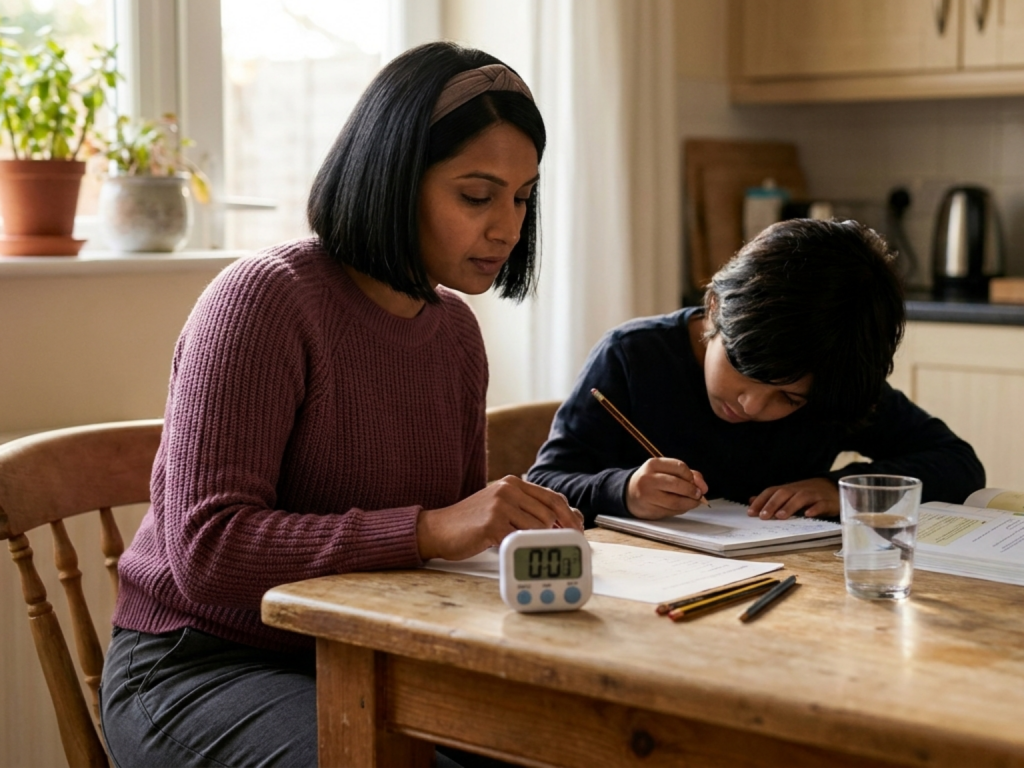
Consistency matters more than perfection. Some children focus best at a desk; others work better at a kitchen table near an adult. The best location is one that reduces distraction while allowing the level of support the child actually needs.
Support autonomy without abandoning the child
Autonomy-supportive homework help does not mean leaving a child alone with work they cannot understand. It means offering structure while allowing the child to participate in decisions. Choices can be small: pencil or keyboard, reading before math or math before reading, ten-minute timer or fifteen-minute timer. Small choices reduce resistance because the child experiences agency.
Adults can use a “coach, not rescuer” role. A coach asks guiding questions: “What is the direction asking?” “Which example looks similar?” “What have you tried?” “Where could you look for the next clue?” This builds metacognition, the ability to think about one’s own thinking. In contrast, giving answers may reduce conflict in the moment but can increase dependence and anxiety over time.
When a child is stuck, avoid rapid-fire explanations. Pause and identify the barrier. Is the child missing background knowledge? Misreading the question? Overwhelmed by too many items on the page? Afraid to make a mistake? Each barrier calls for a different response. For example, a child with reading fatigue may need text covered except for one line at a time, while a child with perfectionism may need reassurance that draft work is allowed to be imperfect.
Positive reinforcement should be specific and process-based: “You came back after the break,” “You checked the example before asking,” or “You corrected one error without giving up.” This strengthens persistence without making love or approval dependent on performance.
Protect the body that is doing the learning
Learning is biologically embodied. Attention, memory consolidation, emotional regulation, and frustration tolerance are influenced by sleep, nutrition, hydration, movement, pain, and sensory load. A child who is hungry, sleep-deprived, or dealing with headaches may look unmotivated when they are actually physiologically depleted.
After school, many children need a transition period before academic work. A snack containing protein or fiber, water, outdoor light, or ten minutes of physical movement can improve readiness. Heavy screen use immediately before homework may make transitions harder for some children, especially if the screen activity is highly rewarding compared with the assignment.
Sleep is especially important. Insufficient sleep impairs attention, working memory, and emotional control. A Sleep schedule school age children plan may include consistent wake times, morning light, a calming evening routine, and limits on stimulating screens before bed. If homework regularly pushes bedtime later, the workload or routine needs review; chronic sleep loss is not a healthy academic strategy.
Physical symptoms deserve attention. Recurrent headaches, abdominal pain, dizziness, panic-like symptoms, or marked fatigue around homework may be stress-related, medical, vision-related, sleep-related, or connected to learning difficulties. Parents should not assume the cause without assessment. If symptoms are frequent, severe, worsening, or interfering with school participation, consult a pediatrician or appropriate healthcare professional.
When perfectionism, avoidance, or anxiety shows up
Some children experience homework as a test of identity: “If I get this wrong, I am bad at school.” Perfectionistic children may erase repeatedly, spend excessive time on minor details, or refuse to start because starting creates the possibility of error. Avoidant children may argue, distract, lose materials, or need repeated reassurance. Both patterns can be attempts to reduce distress.
Respond by lowering the emotional stakes while keeping the learning expectation. You might say, “This is practice work, not a judgment of you,” or “Let’s make a messy first attempt.” Timed “good enough” drafts can help children who overwork. For children who avoid, begin with a very small action: writing the name, reading the first direction, or choosing the first problem.
It is also helpful to name the difference between support and pressure. Support says, “I will help you find a way through.” Pressure says, “You must perform correctly right now so I feel reassured.” Children can often feel this distinction even when adults do not say it aloud.
If anxiety is intense, persistent, or spreading beyond homework into sleep, appetite, mood, friendships, or school refusal, professional support may be needed. A clinician, school psychologist, or counselor can help evaluate anxiety symptoms, attention concerns, learning differences, or other contributors without reducing the child to a label.
Work with teachers rather than struggling alone
Homework should provide practice, consolidation, or preparation; it should not routinely require parents to reteach full lessons. If a child consistently cannot complete assignments without extensive adult help, the school needs to know. Teachers may not see the tears, time spent, or family conflict occurring at home.
When communicating with teachers, use concrete information: how long the assignment took, what part confused the child, what supports were tried, and whether the child was working attentively. This is more useful than saying only “homework is too hard.” Ask about expected time limits, grading priorities, and whether incomplete work after sincere effort should be stopped and signed by a caregiver.
Some children may need classroom accommodations, targeted instruction, assessment for learning differences, or support with executive functioning. Others may simply need clearer directions or adjusted workload during a stressful period. If a child has a chronic medical condition, mental health concern, or recovery period after illness, school-based supports can help align academic expectations with the child’s health needs.
The shared goal is sustainable learning. A child should gradually develop responsibility, but responsibility grows best in an environment where adults communicate, expectations are realistic, and the child is not left carrying adult-level stress.
When to seek extra help
- Homework distress is frequent, severe, or causes panic, aggression, or shutdown.
- Physical complaints such as headaches, abdominal pain, or fatigue are recurrent or worsening.
- Homework regularly delays sleep or disrupts eating, mood, or family functioning.
- A child needs extensive adult help for work that is expected to be independent.
- There are concerns about vision, hearing, attention, learning differences, anxiety, depression, or school refusal.
Tools & Assistance
- Use a homework timer with planned short breaks and a clear stopping point.
- Keep a simple assignment log noting time spent, effort, and sticking points.
- Ask the teacher about expected homework duration and when to stop after sincere effort.
- Create a calm homework station with needed supplies and reduced distractions.
- Consult a pediatrician, school psychologist, or licensed mental health professional if distress or physical symptoms persist.
FAQ
Should I correct every homework mistake?
Usually no. Correcting every error can increase pressure and dependence. Focus on understanding directions, effort, and a few meaningful corrections unless the teacher has asked for complete checking.
What if my child refuses to start homework?
Begin with connection, then reduce the first step until it feels doable. Offer limited choices, use a short timer, and avoid long lectures. If refusal is persistent, involve the teacher and consider whether anxiety, fatigue, or learning difficulties are contributing.
How long should homework take?
Expectations vary by age, school, and assignment purpose. If a child is working with reasonable focus but homework routinely takes far longer than expected, communicate with the teacher and protect sleep.
Is it okay to give rewards for homework?
Small routines and positive reinforcement can help, especially when they reward effort or independence. Avoid making rewards so large that the child focuses only on the prize rather than learning.
When is homework stress a health concern?
It may be a health concern when distress is intense, persistent, associated with physical symptoms, affects sleep or appetite, or leads to school avoidance. Seek guidance from a healthcare or mental health professional.
Sources
- ScienceDirect — Reducing homework stress by increasing adoption of need-supportive practices: A two-study intervention with parents
- Educational Neuroscience UK — Does homework work? The science of when and how to approach it
- Oxford Learning — Homework Help: Everything You Need to Know
Disclaimer
This article is for informational purposes only and does not diagnose, treat, or replace medical, psychological, or educational evaluation. Consult a qualified healthcare professional or school specialist for concerns about a child’s symptoms, learning, or emotional well-being.
















Please log in to leave a comment.