
Intro
Toddler routines can feel deceptively simple on paper and very difficult in real life. A child may resist toothbrushing, collapse during transitions, wake too early, refuse the car seat, or demand that a bedtime step be repeated again and again. These moments are not signs that a family is failing; they are often the predictable result of an immature nervous system meeting hunger, fatigue, autonomy, sensory input, and rapid developmental change.
Consistency helps toddlers because repeated patterns reduce cognitive load and support emotional regulation. At the same time, consistency is not the same as rigidity. A healthy routine gives a toddler enough predictability to feel secure and enough flexibility to tolerate ordinary life disruptions.
Highlights
Consistent home routines are associated with better child mental health, fewer internalizing and externalizing behavior problems, and stronger school readiness.
Toddlers often resist routines because transitions, fatigue, hunger, sensory discomfort, and autonomy needs overwhelm their still-developing self-regulation systems.
A useful routine is predictable, brief, and repeatable, but it should also allow flexibility for illness, travel, family stress, or developmental changes.
Parents and caregivers do not need perfection; they need a small number of reliable anchors that happen most days.
Why toddlers need predictable routines
Toddlers are in a period of rapid neurodevelopment. Language, motor planning, social cognition, sleep regulation, appetite patterns, and impulse control are all changing at once. The prefrontal cortex, which supports inhibition, sequencing, flexible thinking, and emotional regulation, is still immature. Because of this, toddlers depend heavily on external structure from caregivers.
A routine acts like an external nervous system. It tells the child what is happening now, what comes next, and what will stay the same even when feelings are big. Repeated sequences such as dinner, bath, pajamas, story, and lights out help a toddler anticipate transitions. Anticipation lowers uncertainty, and lower uncertainty can reduce behavioral escalation.
Research on family routines and child development supports this practical observation. Consistent routines at home are linked with healthier social-emotional development, fewer internalizing behaviors such as anxiety-like withdrawal, fewer externalizing behaviors such as aggression or oppositional behavior, and better school readiness. Routines may also buffer children when other family stressors are present, because predictable daily patterns provide stability even when adult schedules, conflict, or stress fluctuate.
This does not mean every minute should be scheduled. Toddlers also need free play, exploration, and opportunities to practice autonomy. The goal is a rhythm: reliable anchors for sleep, meals, hygiene, transitions, and connection, surrounded by enough open space for ordinary family life.
Why routine resistance happens
Routine resistance is common because toddlers are learning that they have preferences, bodies, and voices. Saying “no” is developmentally meaningful, even when it is exhausting. A child may resist leaving the park not because the parent explained poorly, but because stopping a rewarding activity requires impulse control and time perception that toddlers have not fully developed.
Several physiologic and environmental factors can intensify routine challenges. Fatigue increases emotional reactivity and reduces frustration tolerance. Hunger can mimic behavioral defiance because glucose fluctuations and discomfort make self-control harder. Constipation, teething pain, eczema itch, reflux symptoms, or recurrent otitis media can make routine steps such as sitting, lying down, or getting dressed more difficult. Sensory sensitivities may also matter: toothbrushing, hair washing, sock seams, bright bathroom lights, or loud hand dryers can feel genuinely overwhelming to some children.
Transitions are especially difficult. A toddler must disengage attention, shift motor activity, accept loss of control, and follow an adult direction. This is a complex executive function task. Tantrums during transitions often reflect overload rather than deliberate misbehavior.
Parents may also notice that routines become harder during developmental leaps, after travel, during illness, after a new sibling arrives, when childcare changes, or when caregivers are understandably inconsistent because of work demands. These disruptions do not erase progress. They simply mean the child may need a brief return to simpler cues, shorter instructions, and more caregiver co-regulation.
Consistency versus rigidity
Consistency means the caregiver’s response is predictable enough that the child can learn the pattern. Rigidity means the routine becomes so inflexible that it creates distress when life inevitably changes. Toddlers benefit from consistency, but they also need gradual practice tolerating small variations.
A consistent routine usually has three features. First, the order is familiar. For example: snack, diaper or toilet, pajamas, book, bed. Second, the caregiver response is stable. If the rule is “two books,” it remains two books most nights, not one book during caregiver stress and six books after a protest. Third, the emotional tone is safe. A firm limit can still be warm, brief, and non-shaming.
Flexibility can be built into the routine deliberately. A parent might say, “At home we do bath before pajamas. At Grandma’s house we do wipes, pajamas, and story.” The core structure remains: clean body, sleep clothes, connection, sleep. This helps the child learn that routines have essential parts and optional parts.
It is also important to avoid perfectionism. If a family can only protect three anchors, sleep timing, mealtimes, and a short daily connection ritual are often a practical starting point. Many toddlers do better with a “mostly predictable” routine than with an elaborate plan that collapses under real-life pressure.
Building routines that toddlers can actually follow
The most effective toddler routines are concrete, short, and visible. Long verbal explanations often exceed a toddler’s working memory. Instead of saying, “We need to get ready because we are late and you have to cooperate,” a caregiver can use a simple sequence: “Shoes, coat, car.” Then the adult can point, model, and help.
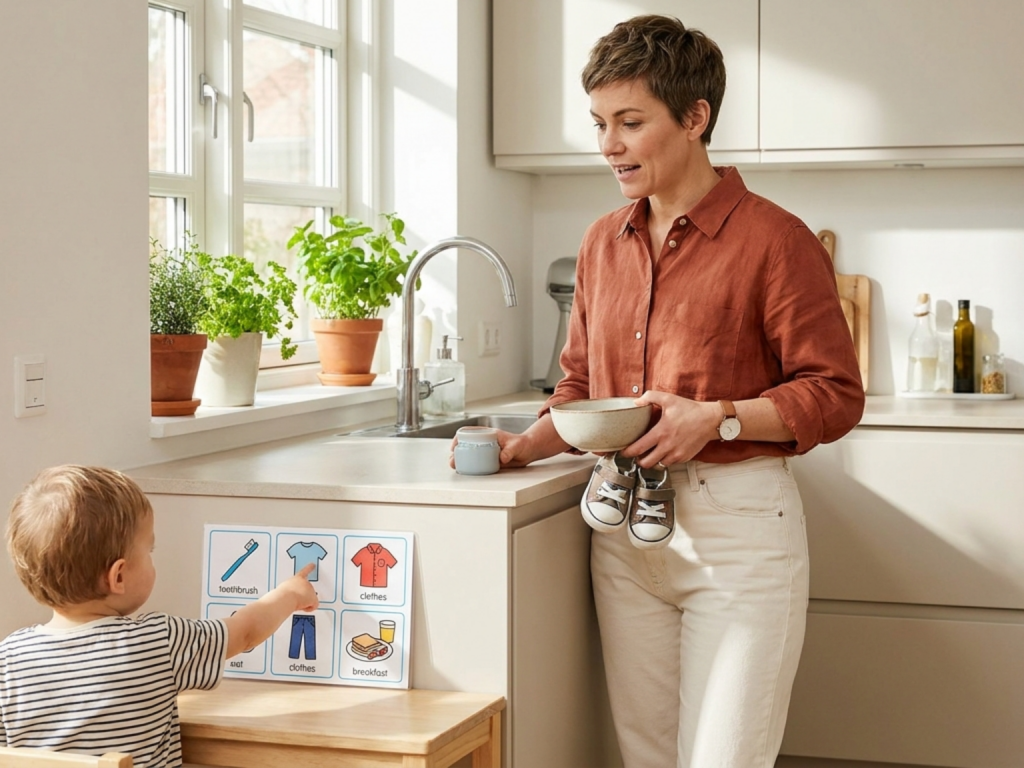
Visual cues can be powerful. A picture chart showing breakfast, toothbrushing, shoes, and stroller can reduce repeated negotiation. Some families use photographs of the child doing each step. Others use objects: pajamas placed on the bed, toothbrush by the sink, shoes near the door. The cue should make the next action obvious.
Choice also helps, but only when the choices are real and limited. “Do you want the red cup or blue cup?” is easier than “What do you want for breakfast?” “Do you want to hop to the bathroom or walk?” preserves the non-negotiable step while offering autonomy. Too many choices can overwhelm the child and prolong the routine.
Caregivers can use “first-then” language: “First diaper, then book.” This supports sequencing and reduces the feeling that the adult is simply taking something away. Timers, transition songs, and countdowns may help some toddlers, although they should be used calmly rather than as threats.
Positive attention is a central tool. When a toddler completes a step, immediate labeled praise is more useful than general approval: “You put your shoes by the door. That helped us get ready.” This reinforces the exact behavior the caregiver wants to see again.
Common pressure points: mornings, meals, and transitions
Morning routines are hard because they often combine adult time pressure with toddler slowness. Preparation the night before can reduce conflict: clothes chosen, bag packed, breakfast options limited, and shoes in the same place. If the child struggles with dressing, consider whether the issue is autonomy, sensory discomfort, or difficulty with motor sequencing. A child who melts down over socks may need a different fabric or seam placement, not a longer lecture.
Mealtime routines should support nutrition without turning eating into a power struggle. Regular meal and snack times help toddlers arrive at the table hungry but not dysregulated. A simple structure is often enough: sit together, offer a small number of foods, allow the child to decide what and how much to eat from what is offered, and end the meal calmly. If there is choking risk, poor growth, persistent vomiting, suspected food allergy, extreme food restriction, or significant feeding anxiety, families should seek pediatric guidance.
Transitions away from play often need more support than adults expect. Toddlers benefit from a warning, a concrete endpoint, and a connecting action. For example: “Two more slides, then stroller. I will help you.” If the child protests, the adult can validate briefly while maintaining the limit: “You wanted more slides. It is hard to stop. It is stroller time.”
For children with frequent public meltdowns, reducing the number of transitions in a single outing may be more effective than trying to “teach a lesson” in the middle of distress. Toddler behavior management tips often emphasize prevention, co-regulation, and consistent follow-through rather than lengthy reasoning during peak escalation.
Sleep routines and evening consistency
Evening is a common flashpoint because toddlers are tired, caregivers are depleted, and separation becomes more salient. A toddler bedtime routine should be predictable and calming, but not so long that it becomes a second evening of negotiations. Many families do well with a 20- to 30-minute sequence: hygiene, pajamas, two short books, brief song or cuddle, and a consistent goodnight phrase.
Sleep pressure matters. If bedtime is too early, a toddler may not be physiologically ready to sleep. If bedtime is too late, overtiredness can produce hyperactivity, irritability, and more night waking. Nap timing, morning wake time, light exposure, illness, and activity level all influence sleep onset. A consistent toddler bedtime routine works best when the broader sleep schedule is developmentally appropriate.
Bedtime resistance may also reflect separation distress. Toddlers are learning object permanence and caregiver availability, so they may call repeatedly to confirm that the caregiver still exists and will return. A calm, predictable response can help: brief reassurance, minimal stimulation, and the same wording each time. In some cases, a transitional object may be useful if it is safe for the child’s age and sleep setting.
Caregivers should seek medical advice if sleep disruption is severe or associated with loud snoring, pauses in breathing, labored breathing, poor growth, significant daytime sleepiness, recurrent vomiting, seizures, or developmental regression. Behavioral sleep strategies should not replace evaluation for possible medical contributors.
Staying consistent when life is stressful
Consistency is harder when parents are exhausted, working irregular hours, managing financial strain, caring for multiple children, or recovering from their own health issues. In these circumstances, routines should become smaller, not more elaborate. A “minimum viable routine” might include a predictable wake-up cue, regular meals or snacks, a short outdoor or movement period, and a stable bedtime sequence.
Caregiver alignment is helpful, but perfect agreement is not always possible. When multiple adults care for a toddler, choose a few non-negotiables and write them down. For example: no screens during meals, same bedtime phrase, shoes before leaving, and comfort without adding unlimited extra steps. Children can adapt to different caregiver styles if the core expectations are clear.
After a disruption, return to the routine without criticism. A toddler who had extra screen time during illness or later bedtimes during travel is not “ruined.” The adult can say, “Vacation is done. Tonight we are back to bath, book, bed.” Expect protest for a few days. Consistency is the repetition of the response, not the absence of protest.
Parents should also monitor their own stress physiology. A dysregulated adult nervous system can unintentionally intensify a toddler’s distress. Brief pauses, tag-teaming with another caregiver, lowering the voice, and reducing verbal input can help. If a caregiver feels at risk of shouting, shaking, or harming a child, the safest step is to place the child in a safe location and seek immediate help from another adult or emergency service.
When to seek professional guidance
- Contact a pediatric clinician if routine struggles are accompanied by poor growth, feeding difficulty, persistent vomiting, chronic constipation, pain, or sleep-disordered breathing signs.
- Seek urgent help if a child has breathing pauses, seizure-like events, severe lethargy, dehydration, or sudden developmental regression.
- Ask about developmental screening if communication delays, loss of skills, extreme sensory distress, or persistent aggression interferes with daily life.
- If caregiver stress feels unsafe or unmanageable, place the child somewhere safe and seek immediate support.
- Do not use punishment, food restriction, physical force, or medication to control routines without professional guidance.
Tools & Assistance
- Create a two- or three-step picture routine for the hardest transition of the day.
- Track sleep, meals, and meltdowns for one week to identify patterns in fatigue or hunger.
- Discuss persistent routine problems with your child’s pediatric clinician or health visitor.
- Coordinate a short written plan for all caregivers who handle mornings, meals, or bedtime.
- Use early childhood parenting programs or occupational therapy referral pathways when recommended by professionals.
FAQ
How long does it take for a toddler routine to become easier?
Many toddlers need several days to a few weeks of repetition before a routine feels familiar. Illness, travel, and developmental changes can temporarily reset progress.
Should I follow the routine exactly every day?
No. Aim for consistent anchors rather than perfection. The same order for key steps most days is usually more realistic and healthier than rigid control.
What if my toddler tantrums every time we start the routine?
Shorten the routine, reduce verbal demands, use visual cues, and check for fatigue, hunger, pain, or sensory discomfort. If tantrums are severe, prolonged, or worsening, consult a pediatric professional.
Are rewards useful for toddler routines?
Simple praise and connection are often enough. Sticker charts may help some older toddlers, but rewards should not replace warmth, clear limits, sleep adequacy, and evaluation for medical or developmental concerns.
Can different homes have different routines?
Yes. Toddlers can learn that routines vary by setting if each setting is internally predictable. Keep a few shared anchors, such as bedtime order or morning departure steps, when possible.
Sources
- Wiley Online Library — Routines and child development: A systematic review
- ScienceDirect — Consistent routines matter: Child routines mediated the association between interparental functioning and school readiness among preschoolers
- University of Georgia College of Agriculture and Environmental Sciences — Creating Consistency to Aid Brain Development in Babies
Disclaimer
This article is for general educational purposes and is not a diagnosis or treatment plan. Consult a qualified healthcare professional for concerns about your child’s health, sleep, feeding, development, or behavior.
















Please log in to leave a comment.