
Intro
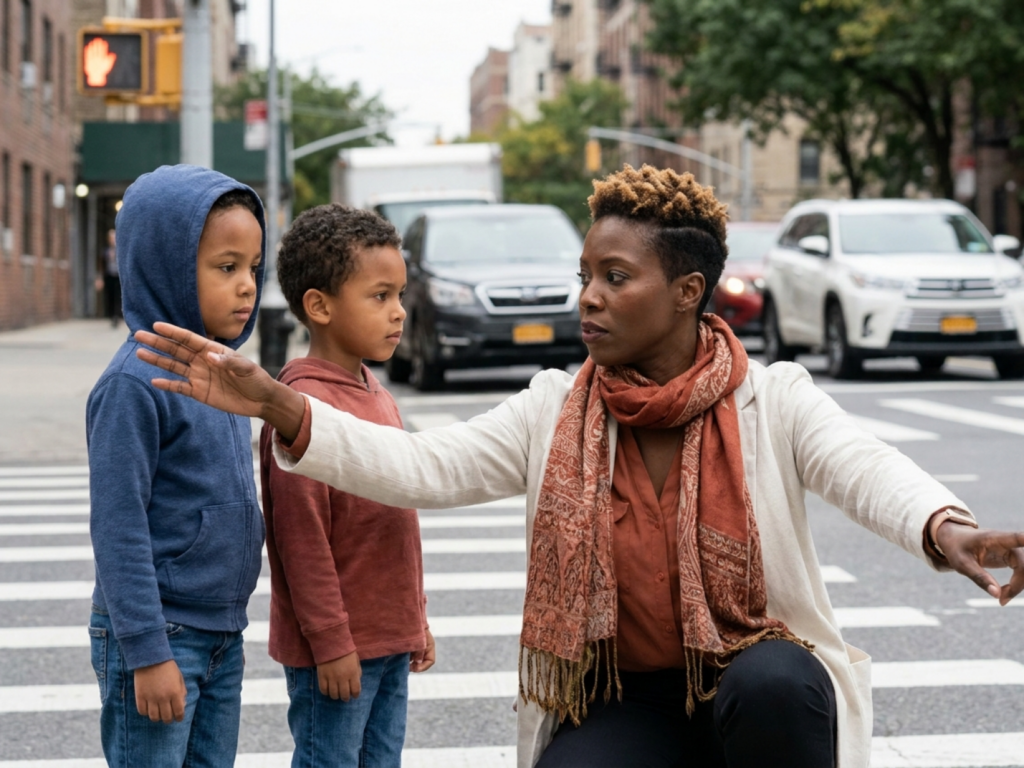
Busy streets can feel overwhelming to children and caregivers alike. Traffic moves quickly, vehicles may be difficult to hear or see, and young children are still developing attention, judgment, impulse control, and the ability to estimate speed and distance. The goal is not to make children fearful. It is to give them calm, repeatable behaviors that become safer habits over time.
Teaching works best as a gradual process: explain the rules, demonstrate them, practise together in low-risk settings, and provide close supervision near traffic. Children develop at different rates, so independence should be based on demonstrated skills and the complexity of the route, not age alone.
Highlights
Teach children to stop at the curb, look and listen carefully, and cross only when the route is clear.
Use marked crossings or intersections whenever possible, and obey pedestrian signals.
Children younger than 10 generally need an adult to cross streets with them because traffic judgment and hazard perception are still developing.
Even at a crosswalk, children should watch for turning, reversing, or approaching vehicles and avoid distractions.
Why busy streets are challenging for children
Children do not process traffic risks in the same way as adults. A young child may understand that cars are dangerous but still struggle to judge whether a vehicle is moving toward them, how quickly it is approaching, or whether a driver has seen them. Height can also limit visibility: parked cars, buses, hedges, and other adults may block a child’s view of the road, while drivers may not see a small child easily.
Children are also more likely to act impulsively, focus on an interesting object, follow a peer, or assume that a familiar route is automatically safe. Turning vehicles are particularly difficult because a car may be close to the crossing while the driver is looking in another direction. Research on primary-school children indicates that structured education and adult supervision can improve behaviors such as stopping at the curb, monitoring traffic, using marked crossing lines, and staying alert.
These limitations are developmental rather than signs of carelessness. A supportive adult can reduce risk by changing the environment, slowing the routine, and repeating the same instructions without shaming the child.
Teach one consistent crossing routine
Children learn more effectively when the instructions are short, predictable, and practised in the same order. A useful routine is: stop, stand back from the curb, look, listen, make eye contact when possible, and cross when the way is clear.
- Stop: Halt before the curb, driveway edge, or road surface. Do not run into the street to retrieve a ball, toy, or dropped item.
- Stand back: Remain several steps away from moving traffic and keep the child physically close, especially near a busy road.
- Look: Look left, right, and left again, while scanning for vehicles in every lane. In countries where traffic travels on the opposite side, adapt the sequence to local road rules.
- Listen: Use hearing as an additional cue, particularly when visibility is limited. Listening is not a substitute for looking because quiet electric vehicles, bicycles, and environmental noise can make traffic difficult to detect.
- Check drivers and vehicles: At a crossing, wait for vehicles to stop and look for signs that the driver has noticed the child. Eye contact can help, but it is not a guarantee that a driver will stop.
- Cross attentively: Walk, do not run, use the marked crossing when available, continue watching traffic, and avoid crossing between parked cars.
Practise the sequence aloud at first, then gradually let the child say the steps. Consistent language such as “stop, look, listen, think, cross” helps the child remember what to do under pressure.
Choose the safest place to cross
Teach children to cross at a marked crosswalk, pedestrian signal, or intersection rather than at the middle of a block. These locations are more predictable and give drivers clearer expectations. A crossing with good lighting, a clear view in both directions, a raised refuge or median where available, and a manageable traffic flow may be safer than a technically shorter route.
At an intersection, explain that a green pedestrian signal does not mean the road is risk-free. Children should still check for vehicles turning across the crossing, drivers who have failed to stop, bicycles, motorcycles, and vehicles emerging from driveways. A red or flashing signal means wait, even if the road appears empty. If a signal changes while the child is crossing, continue calmly to the other side rather than turning back.
Walk the route together and identify hazards before the child needs to navigate independently. Discuss blind corners, parked vehicles, construction areas, bus stops, wet or icy surfaces, narrow sidewalks, and roads without a pedestrian crossing. If a route requires crossing several busy lanes or roads with high speed limits, choose an alternative route or continue adult supervision.
Children should not cross from between parked cars, over barriers, through a median unexpectedly, or diagonally across an intersection. They should use sidewalks where available and face traffic while walking along a road without a sidewalk, following local pedestrian rules.
Use supervision and adult modeling deliberately
Young children need more than verbal reminders; they need an adult to demonstrate the behavior repeatedly. Safe Kids Worldwide advises keeping children under 10 with an adult when crossing streets, while recognizing that readiness varies. An older child may still need supervision on a complex, fast, unfamiliar, or poorly designed route.
Model the complete behavior even when in a hurry. Stop at the curb, put away the phone, remove headphones, scan visibly, and explain your decision in simple language: “The car is turning, so we will wait.” Avoid crossing against a signal or between parked cars and then expecting a child to follow different rules. Children learn from observed behavior as much as from instruction.
Begin with hand-holding or another close-contact method in high-risk settings. As skills improve, use graduated supervision: the adult gives reminders, then observes quietly, and eventually asks the child to lead while remaining close enough to intervene. This is not a test that the child must pass once. Reassess after a move, a change in school route, a developmental transition, or a near miss.
Make practice active rather than frightening. Ask, “What do you see?” “Which vehicles could turn?” and “Where will we wait?” Praise specific behaviors, such as stopping before the curb or continuing to scan while walking. Correct mistakes calmly and practise the step again.
Reduce distractions and increase visibility
Attention is a safety resource. Before approaching a crossing, pause conversations and ask the child to put away toys, phones, and other objects. Headphones and loud audio can reduce awareness of approaching traffic. A child carrying a backpack, sports equipment, or an umbrella may have a restricted view, so adjust the load or stop in a safe place before scanning.
Bright clothing or reflective materials may improve visibility in low light, but they do not make crossing safe by themselves. Teach children that drivers may not see them at night, in rain, near glare, or behind an obstruction. Choose well-lit routes and avoid crossing where parked vehicles, foliage, roadwork, or weather conditions block the child’s view.
Keep pets on a short, controlled lead and avoid allowing a child to manage a large or excitable animal while crossing. Strollers, bicycles, scooters, and mobility devices should be brought to a complete stop before the curb. Children using wheeled equipment should walk it across when local rules and conditions make that safer.
Adults should stay close rather than calling instructions from across the street. Never assume that a child can safely cross because they know the route, are wearing a safety vest, or have memorized the rules. Environmental controls and active supervision remain essential.
Adapt teaching to the child’s abilities
Some children need additional time or tailored instruction because of visual impairment, hearing loss, attention-deficit/hyperactivity disorder, autism, developmental delay, cerebral palsy, intellectual disability, anxiety, or mobility limitations. These conditions do not automatically determine whether a child can learn street-crossing skills, but they may affect hazard detection, communication, balance, response inhibition, or the ability to manage sensory overload.
Use concrete language, visual sequences, role-play, and frequent short practices. A picture card showing stop, look, listen, wait, and cross may help a child who benefits from visual structure. Practise one environment at a time and reduce background noise where possible. For a child with visual or hearing differences, identify the most reliable cues and teach a clear backup plan, such as waiting for an adult or using an accessible signal.
Do not force an overwhelmed child to cross. Move to a safe location, regulate the situation, and try again later with an adult. If you are uncertain about the child’s functional abilities, ask a pediatrician, occupational therapist, physiotherapist, orientation and mobility specialist, audiologist, or other qualified professional for individualized guidance. These professionals can help address sensory, motor, communication, or visual needs without assuming that one method fits every child.
Related child personal safety skills can also support a broader plan for staying near trusted adults, responding when separated, and asking for help in a public place.
Practise real-life scenarios and emergency responses
Children benefit from rehearsing what to do when normal conditions change. In a safe setting, practise waiting when a driver does not stop, recognizing a turning vehicle, navigating a crowded crossing, and responding when a friend urges them to run. Teach the child never to chase a ball or animal into the road. Instead, stop, move away from traffic, and ask an adult for help.
Explain that if the child drops something in the street, they should leave it there until an adult retrieves it. If they become separated from a caregiver, they should move to a safe place away from the curb, seek help from a known safe adult such as a uniformed transport worker or police officer, and use a memorized caregiver name and telephone number when developmentally able. They should not run across the road to catch up.
Use role-play without staging real danger. An adult can point out a pretend blocked sidewalk or ask the child to describe the safest alternative. After each practice, ask the child to explain why the choice was safer. This reveals whether they understand the principle or are only repeating words.
If a collision or near collision occurs, move away from traffic first and contact emergency services when anyone may be injured. For a child who has been struck or fallen, avoid moving them unnecessarily unless there is immediate danger, and seek urgent medical assessment. A healthcare professional can advise about evaluation after a significant impact, even when external injuries appear minor.
Build independence gradually and review the plan
Independence should be earned through repeated observation of safe behavior across different conditions, not granted solely because a child reaches a particular birthday. Consider the child’s ability to stop reliably, resist distractions, judge traffic gaps, follow signals, identify turning vehicles, and ask for help. Also consider the route’s speed limits, traffic volume, visibility, crossing design, weather, and whether the child will be alone or with peers.
Start by walking the route together. Then let the child make decisions while the adult remains beside them, followed by practice with the adult a few steps behind, if appropriate. Review the route whenever school, housing, traffic patterns, or construction changes. A safer route that takes longer is often preferable to a direct route with complicated crossings.
Families, schools, and caregivers should use the same core rules so that children receive consistent messages. Encourage adults who supervise the child to avoid phone use near crossings and to maintain physical proximity. If the child has had repeated near misses, appears unable to recognize hazards, or experiences intense distress around roads, discuss the situation with a pediatric or rehabilitation professional rather than relying on punishment or pressure.
Safety reminders
- Never allow a child to run into traffic to retrieve a toy, ball, or animal.
- A stopped vehicle, pedestrian signal, or apparent eye contact does not guarantee that every lane is safe.
- Do not let children cross while using a phone, wearing headphones, or moving between parked cars.
- Children younger than 10 generally require an adult when crossing streets, and older children may also need supervision on difficult routes.
- After a possible vehicle impact, seek urgent medical help for concerning symptoms or any significant injury.
Tools & Assistance
- Practise the stop, look, listen, think, cross routine on a quiet route before using it near busy traffic.
- Walk the school route with the child and mark crosswalks, pedestrian signals, safe waiting areas, and places to ask for help.
- Use visual cue cards, role-play, and short repeated practices for children who benefit from structured learning.
- Ask a pediatrician, occupational therapist, physiotherapist, or orientation and mobility specialist for individualized advice when developmental, sensory, visual, hearing, or mobility needs affect street safety.
FAQ
What age can a child cross a busy street alone?
There is no universal age because readiness depends on the child and the route. Many safety organizations advise that children younger than 10 cross with an adult. Older children should demonstrate reliable skills on the specific route before independence is considered.
Should children always make eye contact with drivers?
Eye contact can help indicate that a driver has noticed the child, but it is not proof that the vehicle will stop. Children should wait for vehicles to stop, continue scanning, and cross only when every lane is clear.
Is looking left, right, and left enough?
It is a useful routine, but children must scan all lanes and directions, watch for turning or reversing vehicles, and account for local traffic patterns. Listening and checking the crossing signal add information but do not replace visual observation.
How can I teach a child who becomes distracted near traffic?
Use brief instructions, stop before the curb, remove toys and headphones, and practise in short sessions. If distraction remains a serious safety concern, consult a pediatrician or qualified developmental professional for tailored strategies.
Sources
- Safe Kids Worldwide — Pedestrian Safety Tips
- National Highway Traffic Safety Administration — Pedestrian Safety
- MDPI — Child Pedestrian Safety: Study of Street-Crossing Behaviour of Primary School Children with Adult Supervision
Disclaimer
This article provides general educational information and is not a substitute for individualized medical, developmental, rehabilitation, or emergency advice. Consult a qualified healthcare professional for concerns about a child’s abilities, injuries, or safety needs.

















Please log in to leave a comment.