
Intro
Physical development activities help babies build strength, coordination, postural control, and confidence through ordinary daily interactions. In the first year, movement develops progressively: babies learn to stabilize the head and trunk, shift weight, reach, roll, sit, crawl, pull to stand, and eventually take early steps. These skills emerge at different rates, so the purpose of play is to provide safe opportunities for exploration rather than to accelerate a timetable.
A supportive approach combines responsive caregiving, supervised floor-based play, and adequate rest. Short, frequent sessions are often more manageable than formal exercise periods. Observe your baby’s cues, adapt activities to their developmental stage, and ask a pediatrician, family physician, or child health professional for individualized guidance if you have concerns.
Highlights
Supervised floor play gives babies repeated opportunities to develop motor control and explore movement.
Tummy time while awake supports head, neck, shoulder, and trunk strength; it should always be stopped when the baby becomes tired or distressed.
Simple activities such as reaching, rolling, kicking, and tracking a toy can support coordination without expensive equipment.
Babies should spend limited time restrained in car seats, bouncers, swings, and other devices when they are not being transported.
Milestones have a normal range, but loss of skills, persistent asymmetry, or marked difficulty moving should be discussed with a healthcare professional.
How physical development unfolds in infancy
Infant motor development is influenced by neuromuscular maturation, postural control, sensory feedback, opportunities to move, and the quality of responsive interaction. Gross motor milestones involve large muscle groups and whole-body movement, while fine motor skills involve the hands and fingers. These domains interact: a baby who can stabilize the trunk may have more control for reaching, grasping, and manipulating objects.
Development is sequential but not perfectly linear. Early head control generally precedes independent sitting; sitting stability supports more purposeful reaching; and mobility may develop through rolling, pivoting, crawling, bottom shuffling, or other individual patterns. Some babies crawl briefly or use an alternative method before standing and walking. MedlinePlus describes typical progressions such as improved head control, sitting, crawling, and early walking, while emphasizing that individual variation is expected.
Use milestones as broad clinical reference points rather than pass-or-fail tests. A baby born prematurely may need assessment using corrected age, depending on gestational age and local clinical guidance. A child health professional can interpret development in context, including birth history, tone, feeding, vision, hearing, and overall health.
Tummy time and early floor play
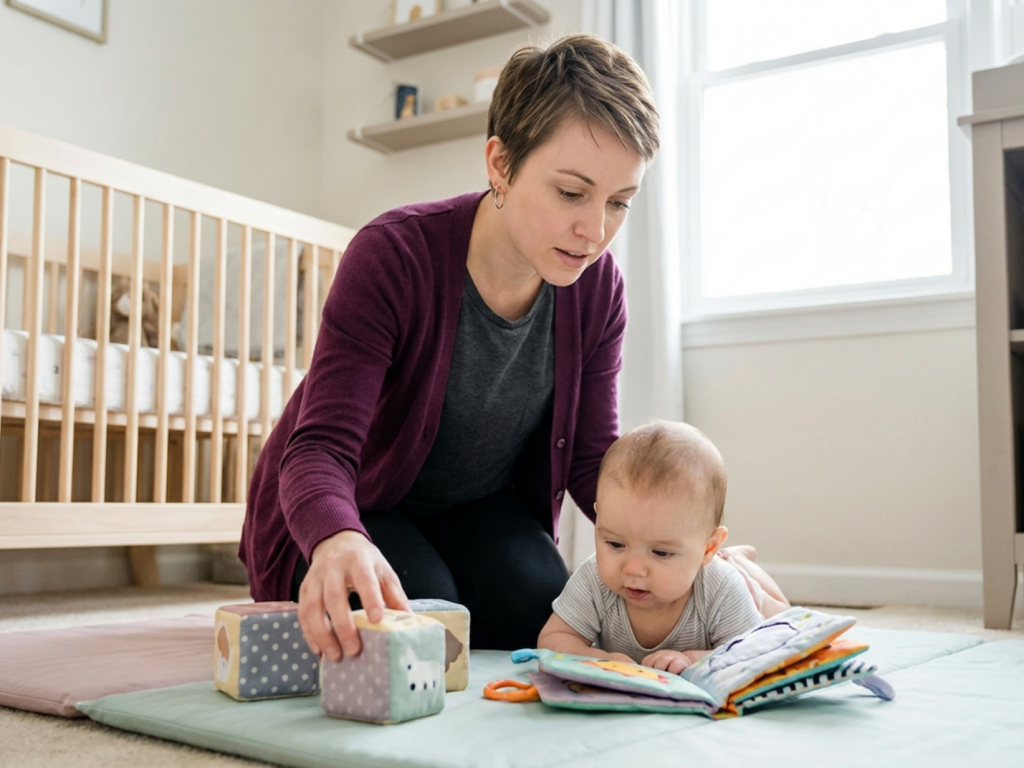
Tummy time means placing a baby on their stomach while they are awake and continuously supervised. It gives the infant opportunities to lift and turn the head, activate the neck and upper-back muscles, bear weight through the forearms, and gradually strengthen the shoulder girdle and trunk. These actions contribute to later rolling, sitting, crawling, and reaching.
Begin with brief periods that fit your baby’s tolerance. You can place the baby on a firm, clear floor surface, lie face-to-face at their level, or position a small rolled towel under the upper chest if a healthcare professional has advised that this is appropriate. A caregiver’s face, voice, or a simple high-contrast toy can encourage the baby to lift the head and look around. As strength and tolerance improve, offer several short opportunities during the day.
Never use tummy time for sleep. If the baby falls asleep, place them on their back on a separate, firm, flat sleep surface. Stop the activity when the baby shows fatigue, becomes very upset, has difficulty breathing, or cannot maintain a safe position. WHO guidance supports supervised floor-based play for infants and recommends avoiding prolonged restraint when babies are awake.
Activities for reaching, rolling, and coordination
Reaching and rolling are useful transitional skills because they require visual attention, weight shifting, trunk rotation, and coordinated muscle activation. During awake floor play, place a soft, age-appropriate object within sight but just beyond immediate reach. Move it slowly from one side to the other, allowing the baby time to look, turn the head, extend an arm, and attempt to shift the body. Avoid repeatedly pulling the toy away or creating frustration; the objective is exploration, not performance.
Offer toys in different positions while maintaining close supervision. A toy near the midline can encourage symmetrical hand use, whereas a toy slightly to one side may invite controlled rotation. When a baby begins rolling, clear the surrounding area and avoid leaving them unattended on beds, sofas, changing tables, or other elevated surfaces. Rolling can emerge unexpectedly.
Gentle bicycle-like leg movements, kicking at a suspended soft object, and grasping a caregiver’s fingers can provide opportunities for reciprocal movement and body awareness. Do not force a limb through a range of motion, pull a baby into a sitting position, or use devices that hold the baby upright before they can control their trunk. Responsive pacing is particularly important for infants with increased or decreased muscle tone, orthopedic conditions, or a history of intensive neonatal care.
Building sitting, crawling, and standing skills
When a baby can maintain better head and trunk control, floor play can include supported sitting. Sit behind the baby on the floor and place toys at chest level or slightly to either side. Keep one hand close enough to prevent a sudden fall, and use a wide, stable base rather than propping the baby in a position they cannot yet control. Short periods of assisted sitting can help the infant practice balance reactions and protective arm responses.
For babies who are beginning to move across the floor, place interesting objects a small distance away on a clear surface. This may encourage pivoting, rolling, crawling, or another self-selected mobility pattern. Give the baby enough space to initiate movement and avoid routinely positioning them in walkers or activity devices that restrict natural weight shifting. HSE active-play guidance includes floor-based opportunities for rolling, reaching, crawling, and movement during everyday play.
Once a baby pulls to stand, check the environment carefully. Anchor furniture, secure cords, block access to stairs, and remove small objects that could be swallowed. A stable, low surface may provide an opportunity for supported standing if the baby initiates the movement. Stay close because balance is immature and falls are common. Avoid holding the baby by the hands to make them walk for extended periods, and do not use footwear or equipment to force a particular gait pattern unless advised by a clinician.
Turning daily routines into movement opportunities
Physical development does not require a packed schedule. Routine care can provide frequent, low-pressure practice. During diaper changes, allow supervised leg kicking and gentle movement on a secure surface. During dressing, pause so the baby can assist by moving an arm or leg. Carry the baby in varied, well-supported positions while maintaining airway safety, and change positions gradually as their head and trunk control improve.
During feeding, make sure the baby is well supported and positioned according to professional feeding guidance. Afterward, when appropriate and alert, provide a brief period of floor play rather than immediately returning to a seat or bouncer. Songs, talking, and face-to-face interaction can encourage a baby to turn toward a sound or caregiver, linking sensory attention with movement.
WHO recommendations for children under five emphasize active play, adequate sleep, and reducing sedentary time spent restrained. For infants, movement should be distributed across the day in varied ways. Car seats are essential for transport, but they are not intended as general-purpose resting or play spaces. Swings, bouncers, and other seats should be used according to manufacturer instructions and under supervision, with regular opportunities for unrestricted movement on the floor.
Creating a safe and responsive play environment
A safe play area is firm, uncluttered, and free from hazards such as small detachable parts, plastic bags, cords, unstable furniture, accessible hot liquids, and pets that cannot be reliably separated. Use toys that are appropriate for the baby’s age and developmental abilities. Inspect them regularly for broken components, loose parts, peeling surfaces, or choking hazards.
Supervision means remaining close enough to respond, not simply being in the same building. Babies can change position quickly once they learn to roll, crawl, or pull up. Place them on the floor for movement practice and keep elevated surfaces reserved for tasks where a caregiver maintains continuous physical control. Follow local safe-sleep recommendations, including placing infants on their backs for sleep and keeping the sleep area clear of loose bedding and soft objects.
Let the baby’s behavior guide the session. Engagement may include relaxed movements, eye contact, vocalization, reaching, or repeated attempts to change position. Signs of overstimulation or fatigue can include turning away, yawning, hiccupping, arching, irritability, frantic movements, or reduced responsiveness. Pause, offer comfort, and try again later. A calm, predictable relationship supports the attention and regulation needed for active exploration.
When to discuss motor development with a professional
Variation in timing is common, but concerns deserve attention without waiting for a milestone deadline. Contact a pediatrician, family physician, public health nurse, or other qualified child-development professional if your baby loses a previously acquired skill, consistently uses one side much more than the other, appears unusually stiff or floppy, has persistent difficulty holding the head, or does not seem to progress in movement over time.
Also seek advice if feeding, breathing, vision, pain, or frequent falls interfere with participation in play. Persistent movement asymmetry, limited use of an arm or leg, or a strong preference for turning the head in one direction can have several possible explanations and cannot be assessed accurately through an article. Early assessment may lead to reassurance, monitoring, physiotherapy, or referral for further evaluation when appropriate.
Bring practical observations to an appointment: what positions the baby tolerates, which movements occur spontaneously, whether skills are changing, and whether the baby was born preterm or has relevant medical history. Short videos recorded in a safe setting may help a clinician understand the concern, but do not delay urgent care for filming. Seek immediate medical attention for breathing difficulty, a serious fall, acute weakness, marked lethargy, or another emergency symptom.
Safety reminders
- Use tummy time only when the baby is awake and continuously supervised.
- Place infants on their backs for sleep on a firm, flat, clear sleep surface.
- Do not leave a rolling or mobile baby unattended on an elevated surface.
- Limit prolonged time in car seats, bouncers, swings, and other restraint devices when awake.
- Discuss regression, persistent asymmetry, unusual muscle tone, or stalled progress with a healthcare professional.
Tools & Assistance
- A clear floor area with a firm play mat
- Age-appropriate soft toys without small detachable parts
- A daily observation note for positions, movements, and tolerance
- A pediatrician, family physician, public health nurse, or pediatric physiotherapist
- Local infant first-aid and safe-sleep education
FAQ
How much tummy time does a baby need?
Offer frequent, brief periods of supervised tummy time while the baby is awake, increasing the total as tolerance improves. There is no need to force a distressed or exhausted baby to continue. Ask a healthcare professional for individualized advice, especially after prematurity or illness.
What if my baby dislikes tummy time?
Try shorter sessions, face-to-face positioning, a caregiver’s chest while fully awake, or a small adjustment to the support under the upper chest. Stop when the baby is fatigued or very upset and reattempt later. Persistent difficulty should be discussed with a clinician.
Do babies need walkers or special exercise equipment?
No. Babies can develop through supervised floor play and ordinary interaction. Walkers and other devices may restrict natural movement or create safety hazards. Use any equipment only as directed and seek professional guidance if it is being considered for a medical reason.
When should I worry about a missed milestone?
A single later-than-expected skill does not necessarily indicate a problem. Seek professional advice for loss of skills, persistent asymmetry, unusual stiffness or floppiness, limited head control, pain, or a broader lack of progress.
Sources
- World Health Organization — Guidelines on physical activity, sedentary behaviour and sleep for children under 5 years of age
- Health Service Executive — Active Play Every Day
- MedlinePlus — Infant and Newborn Development
Disclaimer
This article provides general educational information and is not a diagnosis, treatment plan, or substitute for medical advice. Consult a qualified healthcare professional about your baby’s individual development, safety, or symptoms.


















Please log in to leave a comment.