
Intro
Fertility apps can be reassuring because they turn a confusing menstrual cycle into a visible pattern. For many people, that sense of structure is helpful. But the way these apps predict ovulation is usually more estimate than measurement, and the difference matters if you are trying to conceive or trying to avoid pregnancy.
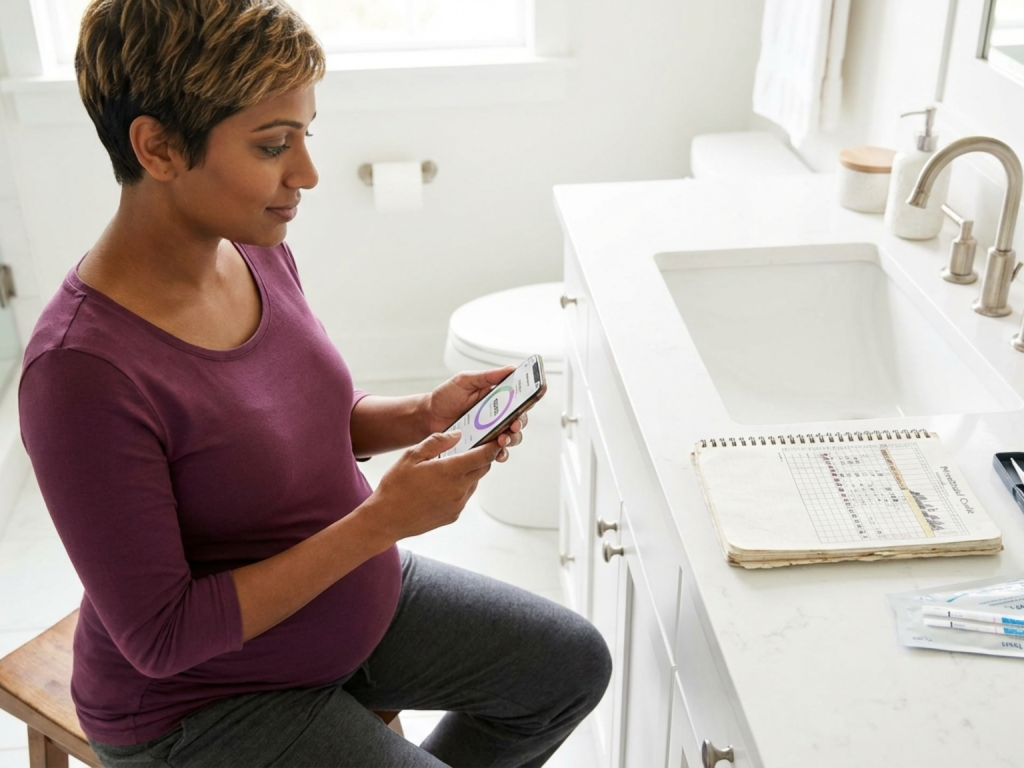
Most apps combine cycle history with one or more biologic signals such as cervical mucus, basal body temperature, or a positive ovulation test. That can make predictions more informative than date-only guessing, yet no app can directly see the egg release itself. Understanding how the algorithms work can help you use the app with realistic expectations and less anxiety.
Highlights
Most fertility apps start with cycle history and calculate an expected fertile window from past period dates. That is useful for planning, but it is still an estimate rather than proof of ovulation.
The most informative apps add biologic markers such as cervical mucus, basal body temperature, or the luteinizing hormone surge. These signals are closer to the body’s actual fertility pattern than calendar math alone.
Ovulation can shift from cycle to cycle because of stress, illness, breastfeeding, perimenopause, PCOS, or other causes of cycle length variability. When that happens, app predictions can drift noticeably.
An app is best viewed as a tracking tool, not a diagnostic test. If cycles are irregular or conception is not happening, medical evaluation is more useful than repeated recalculation.
What fertility apps are actually estimating
At the simplest level, a fertility app uses calendar-based ovulation prediction. It looks at the first day of each period, estimates your cycle length, and then projects when ovulation is likely to happen in the next cycle. Many apps still rely on assumptions that resemble a 28-day cycle with ovulation around day 14, even though real cycles are often longer, shorter, or variable from month to month.
More advanced apps use your recent cycle history to refine the estimate. They may adjust the predicted fertile window based on average cycle length, luteal phase length, or past ovulation dates if you have entered them. This can make the forecast feel personalized, but it is still an algorithm working from prior patterns rather than a direct physiologic measurement. If your cycles are fairly regular, the estimate may be reasonably close. If your cycles change often, the same app can be off by several days or more.
This is why the most honest answer to the question how fertility apps predict ovulation is: they infer it. They are trying to identify the likely day or days of ovulation so they can display the days when pregnancy is more likely, but the app itself usually does not know whether ovulation has actually occurred.
The biologic signals apps can track
Apps become more informative when they incorporate current-cycle markers instead of relying only on dates. One common marker is cervical mucus monitoring. As estrogen rises before ovulation, cervical mucus often becomes clearer, stretchier, and more abundant. That pattern suggests the body is entering the fertile phase, because the mucus environment becomes more favorable for sperm survival and movement.
Another marker is luteinizing hormone surge detection through a home urine test or ovulation predictor kit. LH rises sharply shortly before ovulation, and a positive test often means ovulation may occur in roughly the next 24 to 36 hours. This is a useful clue, but it is still a prediction of timing, not proof that the egg has already been released.
Basal body temperature works differently. BBT usually rises only after ovulation, when progesterone increases. That means temperature tracking is better for confirming that ovulation probably already happened than for announcing it in advance. Apps that combine temperature, mucus, and LH testing are using a calculothermal or fertility-awareness-based approach, which is generally more biologically grounded than date-only models.
Why predictions drift from real ovulation
Even well-designed apps can miss the mark because the menstrual cycle is not a fixed machine. Ovulation can happen earlier or later than expected, and some cycles are anovulatory, meaning no ovulation occurs at all. Cycle length variability is common, especially in adolescence, after pregnancy, during breastfeeding, approaching menopause, or when conditions such as PCOS or thyroid disease are present.
Daily life can also move ovulation. Stress, sleep disruption, travel, illness, major weight change, and recent hormonal contraception can all alter the timing of ovulation or make a cycle harder to interpret. In those settings, a neat app forecast may look precise while the body is doing something different. That is one reason date-only predictions are often less reliable than biologic markers.
Evidence summarized in medical reviews has shown that some app-based ovulation predictions perform poorly when compared with actual ovulation timing, with one cited study finding accuracy no better than 21%. That number is not a universal score for every app or every user, but it is a reminder to treat app estimates as rough guides. If the app and your body signals disagree repeatedly, the app should not automatically win.
How to use a fertility app more effectively
The best use of a fertility app is as an organized notebook for your cycle, not as a stand-alone answer key. Enter period start dates consistently, and if you want more precision, log cervical mucus changes, basal body temperature, and ovulation tests on the same days each cycle. Over time, the app can show whether your fertile window tends to cluster earlier, later, or more variably than you expected.
If you are trying to conceive, the most practical mindset is to treat the app’s fertile days as an estimated range. Sperm can survive for several days in fertile cervical mucus, while the egg has a much shorter lifespan after ovulation. That is why timing matters, but also why a single predicted day is rarely enough. A combination of app data plus biological signs is usually more helpful than relying on the app alone.
It can also help to review the app after the cycle ends. If your temperature shift, mucus pattern, and LH test point to a different day than the app predicted, update the record. The goal is not perfect control; it is better pattern recognition. Many people feel less overwhelmed when they stop expecting a fertility app to be a test and start using it as a trend tracker.
When to take predictions seriously but not literally
Fertility apps can be useful for awareness, but they should not be treated as contraception or as confirmation that ovulation has definitely occurred. If you are avoiding pregnancy, do not rely on a calendar estimate alone. If you are trying to conceive and the app says the timing is ideal but pregnancy is not happening, the next step is usually a medical conversation, not a better app algorithm.
Seek clinical guidance sooner if your cycles are very irregular, you go many weeks without bleeding, you have severe pelvic pain, unusually heavy bleeding, or symptoms that suggest a hormone problem. If you have been trying to conceive for 12 months without success, or for 6 months if you are 35 or older, evaluation is generally appropriate. A clinician can assess for ovulation disorders, thyroid disease, PCOS, prolactin issues, or other causes that an app cannot diagnose.
That caution is especially important because apps can create false confidence. A pretty calendar does not guarantee ovulation, and a missed predicted day does not automatically mean infertility. Real-life fertility is influenced by far more than an algorithm can see.
A realistic way to read the app each month
Think of the app as a starting point. Day 1 gives the app a reference, but the cycle is then refined by what you log next. If your cervical mucus becomes fertile earlier than expected, or an ovulation test turns positive sooner than the calendar predicted, the body is giving you more current information than the original estimate.
When the app, mucus, and LH test all point in the same direction, confidence is higher. When only the calendar predicts ovulation, confidence is lower. When the temperature rises after the fact, that is useful confirmation that ovulation probably happened, even though it does not help much with same-day timing. In other words, the most reliable app experience comes from combining prediction with observation.
That balanced approach can reduce frustration. You do not need to distrust fertility apps completely, but you also do not need to treat them as medical proof. Used well, they are a support tool: a way to organize your data, notice patterns, and know when to ask for help if the pattern is not making sense.
Be cautious if you are relying on an app
- An app cannot confirm ovulation by itself; it estimates based on data you enter.
- Date-only predictions are often inaccurate when cycles vary from month to month.
- Do not use a fertility app alone to prevent pregnancy.
- Repeatedly irregular cycles, absent periods, or no conception after many months deserve medical evaluation.
- If app predictions and biologic signs disagree often, discuss the pattern with a clinician.
Tools & Assistance
- A menstrual cycle log that records period dates, cervical mucus, basal body temperature, and LH test results
- An ovulation predictor kit for home urinary hormone testing
- A basal thermometer for consistent morning temperature tracking
- A consultation with a gynecologist, reproductive endocrinologist, or primary care clinician if cycles are irregular
FAQ
Can a fertility app tell me exactly when I ovulate?
Usually not. Most apps estimate a likely fertile window and ovulation day, but they do not directly measure ovulation.
Which app inputs make predictions more accurate?
Cervical mucus, basal body temperature, and a positive ovulation predictor kit can make the estimate more biologically informed than calendar tracking alone.
Why does my app keep changing my fertile days?
Your cycle length may vary from month to month, or the app may be adjusting to new data. That usually means the prediction is being recalculated, not that ovulation has been confirmed.
Should I trust the app if I am trying to avoid pregnancy?
No app should be used as the only method of contraception. If avoiding pregnancy matters, use a method recommended by a healthcare professional.
Sources
- PubMed Central — Plausibility of Menstrual Cycle Apps Claiming to Support Conception
- PubMed Central — Period tracker applications: What menstrual cycle information are they giving women?
- Cedars-Sinai — Do Fertility and Ovulation Apps Work?
Disclaimer
This article is for educational purposes only and is not a substitute for medical advice, diagnosis, or treatment. If you have irregular cycles, infertility concerns, or symptoms that worry you, please consult a qualified healthcare professional.













Please log in to leave a comment.