
Intro
Preparing for labor is not a test of strength or flexibility. A balanced approach combines pelvic floor awareness, the ability to contract when needed, and the ability to relax and lengthen the same muscles during labor. Gentle mobility can also help you become familiar with positions that may feel comfortable during contractions.
The most appropriate exercises vary according to pregnancy complications, symptoms, fitness history, pelvic floor function, and planned mode of birth. Discuss your plan with your obstetric clinician, midwife, or pelvic health physical therapist, particularly if exercise causes pain, pressure, bleeding, contractions, leakage of fluid, or other concerning symptoms.
Highlights
Pelvic floor preparation involves both controlled contraction and complete relaxation.
Gentle stretching may support comfort and movement, but it cannot guarantee a shorter or easier labor.
Antenatal pelvic floor exercise research suggests possible benefits for second-stage labor and severe perineal trauma, although the evidence has important limitations.
Stop an exercise that causes pain, dizziness, vaginal bleeding, fluid leakage, regular contractions, or marked pelvic pressure and seek clinical advice.
Understanding the pelvic floor in labor
The pelvic floor is a layered group of muscles, connective tissue, and fascia forming the base of the pelvis. It supports the bladder, uterus, and bowel, contributes to continence, and helps stabilize the pelvis and trunk. During pregnancy, these tissues accommodate increasing load and hormonal changes. During vaginal birth, they need to lengthen sufficiently to allow fetal descent, particularly as the presenting part passes through the outlet.
This is why pelvic floor preparation should not be reduced to repeated squeezing. A person who can contract but cannot release may experience unnecessary muscular guarding, discomfort, or difficulty coordinating with breathing and pushing. Conversely, reduced strength or poor endurance may contribute to urinary leakage or pelvic heaviness, although symptoms have multiple possible causes. The goal is functional coordination: gentle activation, normal breathing, and a clear return to a resting state.
Evidence is still developing. A systematic review and meta-analysis found that antenatal pelvic floor muscle exercise was associated in some studies with a shorter second stage of labor and fewer severe perineal lacerations. However, the authors emphasized possible bias and the need for higher-quality trials. Earlier evidence reviews also found more consistent support for postpartum urinary-incontinence reduction than for improved labor outcomes or prevention of anal incontinence.
Pelvic floor contractions: technique over intensity
To identify the pelvic floor, imagine gently stopping the passage of gas and drawing the vaginal or urethral openings upward and inward. The sensation should be an internal lift rather than a forceful clench of the buttocks, inner thighs, abdominal wall, or jaw. Continue breathing normally. The Mayo Clinic recommends learning the movement without routinely interrupting urination; stopping the urine stream is not an appropriate training method because it may interfere with normal bladder emptying.
Begin with a small, comfortable contraction followed by a complete release. Some people practice a few slower contractions, holding only as long as they can maintain a relaxed face, steady breathing, and good form, followed by brief, lighter contractions. The precise number, duration, and frequency should be individualized rather than treated as a universal prescription. Quality is more important than fatigue.
Include relaxation practice after every contraction. Notice whether the pelvic floor returns to its resting length or whether you continue to brace. A useful coordination exercise is to inhale gently into the lower ribs and abdomen, allowing the pelvic floor to soften, then exhale without straining. This does not require pushing downward. If you have pain with contraction, difficulty sensing release, pelvic pressure, urinary urgency, or pain with sexual activity, an assessment by pelvic health physical therapy may be more useful than increasing repetitions.
Gentle stretching and mobility for pregnancy
Stretching for labor is best understood as comfortable mobility practice, not an attempt to force the pelvis open. Pregnancy-related ligamentous laxity and altered balance can make aggressive end-range stretching counterproductive. Use slow movements, stable support, and an intensity that feels mild to moderate. You should be able to breathe smoothly and come out of the position without strain.
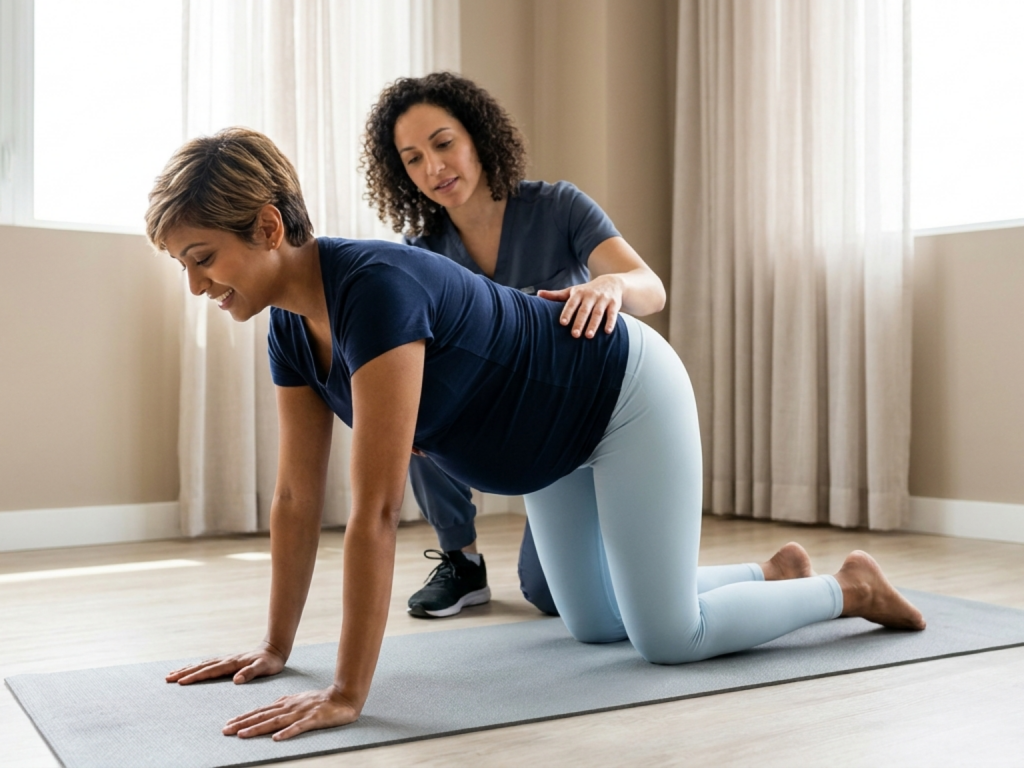
Potential options, if approved for your pregnancy, include a supported hands-and-knees position with slow spinal flexion and extension, gentle pelvic tilts, and controlled rocking backward toward the heels. A seated butterfly position can provide a mild inner-thigh and hip stretch when the knees are supported and the spine remains comfortable. A half-kneeling hip-flexor stretch may be performed with one hand on a wall or chair, keeping the pelvis level rather than arching the lower back.
Supported squatting can help you explore hip and ankle mobility, but it is not suitable for everyone and should not be forced. Use a sturdy surface, keep the range shallow if needed, and avoid prolonged holds if you develop pelvic girdle pain, dizziness, or pressure. Side-lying positioning, gentle hip movements, and supported standing weight shifts are alternatives when floor exercises become uncomfortable. The aim is to maintain options for movement, not to achieve a particular posture.
Breath, relaxation, and pelvic floor lengthening
Labor requires repeated transitions between uterine contraction, rest, movement, and sometimes directed or spontaneous pushing. Practicing relaxation while the pelvic floor is not contracting can help you recognize unnecessary bracing. Try a supported side-lying or upright position, place one hand on the lower ribs, and observe an easy inhale followed by a longer, unforced exhale. Keep the shoulders, tongue, buttocks, and inner thighs as relaxed as possible.
During a comfortable stretch, avoid breath-holding and avoid bearing down unless you are specifically being guided by your maternity team in labor. A sensation of widening or softening is preferable to forceful downward pressure. Some pregnant people find that humming, low vocalization, or slow breathing makes it easier to reduce jaw and pelvic floor tension, although no single technique works for everyone.
These skills can be practiced briefly in different positions so that relaxation is not associated only with an exercise mat. You might rehearse them while standing and leaning over a counter, kneeling over a birth ball, or lying on your side. Breathing techniques for natural birth are most useful when treated as adaptable coping tools rather than rigid rules. In labor, pain relief, monitoring, fatigue, and clinical recommendations may all change how you move and breathe.
Building a safe routine across pregnancy
There is no universally correct starting point. If you were active before pregnancy and have no restrictions, your clinician may support continuing familiar low-impact activity with modifications. If you are new to exercise, start with short periods of gentle mobility and observe how your body responds over the following hours. Avoid exercising to exhaustion, overheating, dehydration, or breathlessness that prevents conversation.
As the abdomen grows, prioritize balance and support. A wall, chair, countertop, or exercise professional can reduce fall risk. Side-lying and hands-and-knees variations may be more comfortable than prolonged supine exercise later in pregnancy. Avoid rapid bouncing, forceful stretching, heavy straining, and positions that reproduce pelvic girdle or pubic pain. Pregnancy exercise safety depends on both the activity and the individual clinical context.
Consider keeping a simple symptom-based record rather than measuring success by repetitions. Note whether an exercise produces pain, heaviness, urinary leakage, bowel symptoms, unusual fatigue, or increased contractions. A planned consultation with pelvic health physical therapy can assess strength, endurance, coordination, breathing mechanics, scar tissue, and the ability to relax. This is especially relevant if you have previous pelvic floor injury, significant incontinence, pelvic organ prolapse symptoms, chronic pelvic pain, or a history of difficult recovery.
Using mobility during labor and preparing for recovery
In labor, movement should remain responsive to comfort, fetal monitoring, analgesia, blood pressure, fatigue, and the advice of the clinical team. Upright leaning, side-lying, hands-and-knees, supported kneeling, and carefully assisted squatting may offer different ways to reduce pressure or change pelvic angles. No position guarantees fetal rotation, descent, or an uncomplicated birth. If an epidural or other medication affects sensation or leg strength, use only positions that are safely supported and supervised.
Pelvic floor exercises do not determine whether birth will be vaginal, operative, spontaneous, or assisted. They also cannot prevent every perineal injury or postpartum symptom. A flexible birth plan can include a preference for position changes and an intention to relax the pelvic floor between efforts, while recognizing that medical circumstances may require a different approach.
After birth, recovery should be gradual. Temporary soreness, swelling, altered sensation, urinary symptoms, or bowel changes may occur, but persistent, worsening, or distressing symptoms deserve clinical assessment. Postpartum pelvic floor rehabilitation may include breathing, gentle circulation work, graded contractions, relaxation, scar management, and functional retraining depending on the birth and examination findings. Seek individualized guidance rather than resuming an intense prenatal routine immediately.
When to pause and seek medical advice
- Do not exercise through vaginal bleeding, fluid leakage, chest pain, faintness, or severe shortness of breath.
- Stop and contact your maternity team for painful regular contractions, concerning abdominal pain, or a marked change in fetal movement.
- Seek guidance for new or worsening pelvic pressure, bulging, urinary retention, fecal leakage, or significant pelvic or pubic pain.
- Avoid unsupported balance exercises if dizziness, weakness, altered sensation, or medication effects increase fall risk.
- Ask your clinician before exercising if you have pregnancy complications, activity restrictions, or uncertainty about your individual risk.
Tools & Assistance
- A prenatal exercise assessment with an obstetric clinician or midwife
- Pelvic health physical therapy for individualized contraction and relaxation training
- A stable chair, wall, countertop, or birth ball for supported mobility
- Comfortable clothing, water, and a symptom-based exercise log
- A labor-position practice session with your birth support person
FAQ
Can pelvic floor exercises make labor easier?
They may support muscle awareness and function, and some studies suggest a shorter second stage or fewer severe perineal lacerations. The evidence is not definitive, so exercises should not be presented as a guarantee of an easier birth.
Should I keep my pelvic floor tight during contractions?
Not necessarily. The pelvic floor needs to coordinate with breathing and fetal descent, and excessive holding may increase tension. Practice gentle activation followed by complete relaxation, then follow individualized intrapartum guidance.
Is deep squatting required to prepare for labor?
No. Supported squatting is one mobility option, not a requirement. Side-lying, hands-and-knees, standing, and gentle hip movements can provide alternatives, particularly when squatting causes pain or instability.
When should I see a pelvic health physical therapist?
Consider assessment for persistent leakage, pelvic heaviness or bulging, pelvic pain, painful intercourse, difficulty relaxing the pelvic floor, prior pelvic floor injury, or uncertainty about technique.
Sources
- PubMed — The effect of antenatal pelvic floor muscle exercises on labour and birth outcomes: a systematic review and meta-analysis
- PubMed — Pelvic floor exercises during and after pregnancy
- Mayo Clinic — The pelvic floor: Essential things to know in pregnancy
Disclaimer
This article provides general educational information and does not diagnose, treat, or replace advice from your obstetric clinician, midwife, or pelvic health physical therapist. Seek individualized medical guidance before changing exercise during pregnancy or after birth.

















Please log in to leave a comment.