
Intro
A development-friendly home does not need to resemble a classroom, contain expensive equipment, or follow a perfect schedule. For babies and young children, development is supported through ordinary experiences: secure relationships, safe movement, conversation, play, rest, and opportunities to participate in daily routines.
The most effective environment is responsive and adaptable. It gives a child room to explore while adults provide supervision, emotional regulation, and appropriate boundaries. Small changes to the arrangement of a home can make it easier for a baby to practice emerging motor, language, cognitive, and social skills without turning family life into a series of formal lessons.
Highlights
A safe, organized environment supports exploration while reducing preventable hazards.
Responsive interaction, shared attention, and conversation are central parts of early learning.
Open floor space and age-appropriate materials provide useful opportunities for motor and sensory practice.
Predictable routines can support self-regulation, sleep, communication, and participation in family life.
Start With Safety and Accessibility
A development-friendly space begins with a reliable safety foundation. Babies learn by reaching, grasping, rolling, mouthing, crawling, pulling up, and eventually walking. The environment should therefore be assessed according to the child’s current abilities and the next skills likely to emerge, rather than according to what the child can do today.
Create a defined area where the baby can spend supervised awake time on a clean, stable surface. Keep small objects, button batteries, medications, cleaning products, cords, hot liquids, and unstable furniture out of reach. Secure furniture that could tip, cover or block electrical hazards, and use safety gates where needed. As mobility increases, reassess the entire room: a previously inaccessible shelf, staircase, window, or pet-feeding area may quickly become reachable.
Accessibility also matters. Store a small selection of safe toys and books where the child can see them and, when developmentally appropriate, reach them. This arrangement encourages choice-making and purposeful movement. It is not necessary to make every object available; rotating a few materials can preserve interest and reduce visual clutter. Supervision remains essential, especially around water, stairs, animals, food, and objects that can become choking hazards.
Protect Space for Safe Movement
Gross motor development depends on frequent opportunities to move against gravity and experiment with changing body positions. A baby who spends time on a firm, open floor surface can practice head control, trunk stability, weight shifting, rolling, reaching, and later transitions such as sitting, crawling, and standing. These experiences contribute to postural control and motor planning.
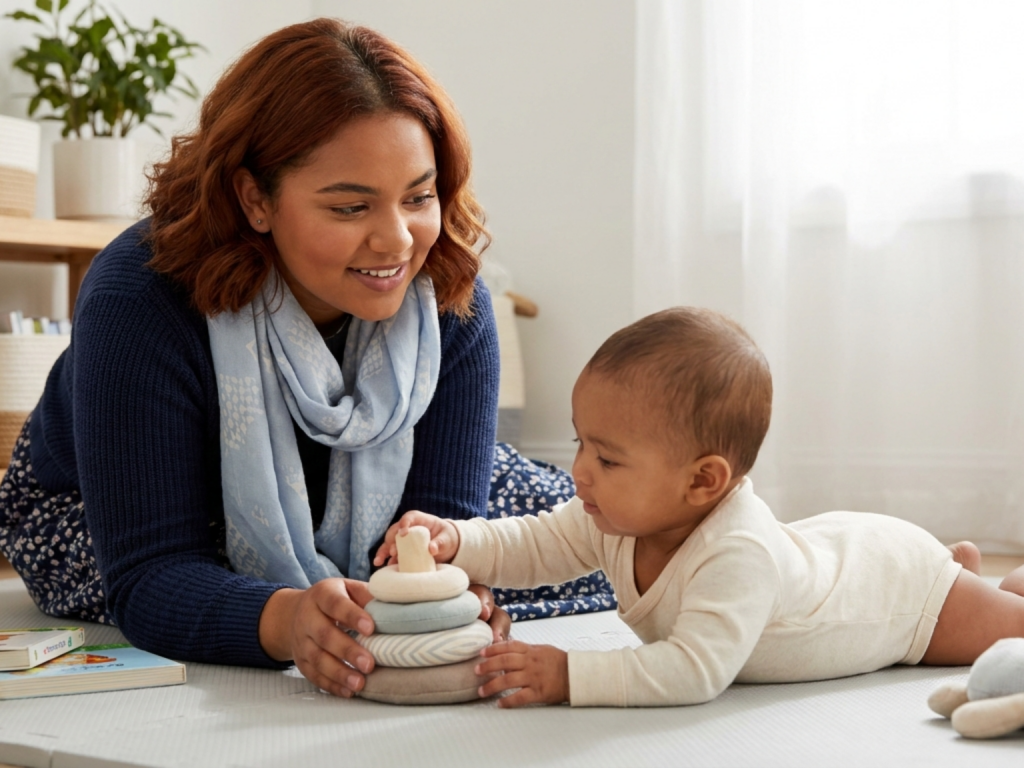
Provide supervised tummy time while awake, beginning with brief intervals and building gradually according to the baby’s tolerance. A caregiver can lie nearby, place an interesting object within view, or use face-to-face interaction to make the position more engaging. If the baby becomes distressed, pause, soothe, and try again later. Tummy time should never be used for unsupervised sleep.
Arrange furniture so there is a clear path for movement. Limit prolonged time in restrictive devices when the baby is awake, and do not use walkers as a substitute for floor-based exploration. Stable, low surfaces can offer supported opportunities to reach and pull up once the child is ready, but they must be secured and used with close supervision. The goal is not to accelerate milestones; it is to offer repeated, safe practice and observe the child’s natural progression.
Build Language and Social Connection Into the Room
The social environment is as important as the physical layout. Early learning is strongly associated with the quality and frequency of interactions between children and caregivers. A development-friendly space makes face-to-face communication easy: place a comfortable seat near the baby’s play area, keep books within reach for shared reading, and reduce competing noise when interaction is the focus.
Talk through ordinary activities using clear, varied language. Name people, objects, actions, and sensations; imitate the baby’s sounds; pause to allow a response; and follow the child’s gaze or gesture. These exchanges support joint attention, receptive language, expressive communication, and the early structure of conversation. Singing, rhythmic speech, and repeated books can provide predictable patterns without requiring the baby to perform.
Use the environment as a source of conversation. A window may invite discussion about light, weather, or movement outside. A basket of laundry can support words such as soft, big, and socks. During feeding, dressing, or bathing, describe what is happening and watch the baby’s cues. Responsive caregiving for babies means adjusting interaction to their signals, including turning away, becoming quiet, smiling, vocalizing, or showing fatigue.
Choose Materials That Invite Exploration
Useful materials are safe, durable, washable, and open-ended enough to support more than one type of play. For young babies, this may include high-contrast images, cloth books, lightweight rattles, graspable rings, textured fabrics, and objects that make gentle sounds. As skills develop, nesting cups, large blocks, simple containers, chunky puzzles, and board books can support grasp refinement, bilateral coordination, visual tracking, problem-solving, and early symbolic understanding.
Offer only materials that are appropriate for the child’s developmental abilities. Inspect toys regularly for broken parts, loose components, sharp edges, peeling surfaces, and accessible batteries. Avoid objects small enough to fit through a standard choking-test cylinder, and follow the manufacturer’s age recommendations while considering the individual child’s behavior and skills.
A smaller collection is often easier to use than an overflowing toy bin. Place a few choices in an uncluttered area, observe what captures the child’s attention, and rotate materials periodically. Household participation can also provide learning opportunities: a baby may watch a caregiver fold fabric, explore a large measuring cup during supervised play, or listen to the sounds of safe kitchen activity from a protected position. These experiences should complement, not replace, direct adult supervision.
Support Regulation Through Predictable Routines
Self-regulation develops in relationship and through repeated experiences of co-regulation. Babies initially rely on caregivers to notice signs of hunger, fatigue, discomfort, or sensory overload and to respond in a calm, timely way. A home arrangement that supports regulation includes a quieter area where stimulation can be reduced and the caregiver can hold, feed, comfort, or speak softly to the child.
Predictable sequences help a baby anticipate what comes next. A consistent pattern around waking, feeding, play, and sleep can provide structure even when exact clock times vary. Use ordinary cues, such as dimming lights before sleep or washing hands before meals, to mark transitions. Keep sleep spaces separate from active play areas when possible, and follow current safe sleep guidance from the child’s healthcare professional and relevant public-health authorities.
Watch for overstimulation signs in babies, which may include turning away, stiffening, frantic movements, yawning, hiccupping, fussing, or difficulty settling. Reduce noise, visual input, and handling when these cues appear. Regulation is not the same as compliance: a baby’s distress is communication, not misbehavior. If crying is intense, persistent, or accompanied by concerning symptoms, contact a healthcare professional.
Make Everyday Routines Developmental Opportunities
Learning does not occur only during designated playtime. Feeding, diapering, dressing, carrying, and household transitions can strengthen communication, body awareness, sequencing, and social participation. Give the baby time to look, reach, vocalize, and respond rather than completing every task as quickly as possible. These pauses create opportunities for reciprocal interaction.
Invite participation at an appropriate level. A baby may hold a washcloth, reach toward a sleeve, or choose between two safe toys. An older infant may place a large object into a container, help turn a page, or imitate a simple action. Describe the sequence of events and use consistent words. Repetition supports memory and helps connect language with actions.
Caregiver availability matters more than elaborate room design. When possible, keep the baby’s safe play area near normal family activity so the child can observe conversation and household routines while the adult remains able to supervise. Balance this social access with periods of quiet. Screens, background television, and constant audio stimulation can compete with face-to-face interaction, so prioritize direct engagement and protect opportunities for rest.
Adapt the Space to the Individual Child
Children develop along varied trajectories, and a supportive home responds to the child rather than forcing a standardized timetable. Consider temperament, sensory preferences, medical history, mobility, vision or hearing differences, and family routines when arranging materials and activity areas. For a child with a disability or a history of prematurity, an occupational therapist, physical therapist, speech-language pathologist, or developmental specialist may suggest individualized adaptations.
Observe patterns over time. Which positions are comfortable? Which sounds or textures attract attention? Does the child need more space, fewer choices, additional contrast, or extra time to process an interaction? Adjust one feature at a time and monitor how the child responds. For preterm infants, caregivers may need to discuss corrected age for preterm infants and individualized expectations with the child’s clinician.
Seek professional advice if you are concerned about a loss of previously acquired skills, persistent feeding or sleep difficulties, unusual muscle tone, asymmetry, hearing or vision responses, or limited social communication. A home environment can support development, but it cannot replace developmental surveillance, screening, or clinical evaluation. The most helpful approach is collaborative: make the home safer and more usable, then obtain guidance tailored to the child and family.
Safety reminders
- Never leave a baby unattended on a bed, sofa, changing surface, or elevated play area.
- Do not place a sleeping baby on a sofa, armchair, or other soft seating surface.
- Keep button batteries, magnets, medications, tobacco products, and cleaning chemicals locked away.
- Use age-appropriate materials and inspect them frequently for loose or broken parts.
- Contact a healthcare professional about concerning symptoms, developmental regression, or persistent caregiver worries.
Tools & Assistance
- A room-by-room home safety assessment
- A small rotating basket of age-appropriate books and toys
- A firm floor mat for supervised awake movement
- A simple routine chart for feeding, play, rest, and caregiving cues
- Pediatric developmental screening and referral services
FAQ
Does creating a development-friendly home require expensive equipment?
No. Safe floor space, responsive interaction, books, and simple age-appropriate objects are usually more valuable than specialized equipment. The caregiver’s attention and adaptation to the child’s cues are central.
How much structured play should a baby have each day?
There is no single schedule suitable for every baby. Offer frequent, brief opportunities for supervised movement, communication, and exploration around feeding, rest, and caregiving routines. Follow the baby’s cues and discuss individualized needs with a clinician.
Can a baby’s play area be in the main living space?
Yes, provided the area is safe and the caregiver can supervise. A shared living space can support social observation and interaction, although babies also need quieter periods for regulation and sleep.
When should caregivers ask for developmental guidance?
Ask a pediatrician or qualified developmental professional when you notice loss of skills, persistent asymmetry, unusual muscle tone, feeding concerns, limited responses to sound or visual interaction, or any concern that does not resolve.
Sources
- Taylor & Francis Online — The home learning environment and its role in shaping children’s educational development
- Head Start — Learning at Home and Homelike Environments
- UNICEF Data — Home environment
Disclaimer
This article provides general educational information and does not diagnose, treat, or replace advice from a pediatrician or other qualified healthcare professional. Seek individualized medical guidance for developmental, safety, feeding, sleep, or behavioral concerns.














Please log in to leave a comment.