
Intro
A backpack is part of a child’s daily school equipment, but it is also a load-bearing item that interacts with the spine, shoulders, hips, and gait. A pack that is too large, poorly adjusted, or unnecessarily heavy may contribute to discomfort, altered posture, skin pressure, and fatigue. Choosing well does not require a perfect product; it requires matching the pack to the child’s torso and teaching safe carrying habits.
Children grow quickly, and their needs change between preschool, primary school, and adolescence. The most useful approach is to check the backpack’s dimensions, fit, contents, and adjustment regularly. A supportive fitting process can also help children participate in decisions without making normal body variation or growth feel like a problem.
Highlights
Torso length is more useful than age or overall height when selecting a backpack.
The pack should sit close to the back, remain relatively high, and not extend far below the waist.
Both shoulder straps should be used and adjusted evenly; a waist or hip belt can improve load distribution when available.
Aim to keep the loaded backpack at no more than about 10–15% of the child’s body weight, while prioritizing comfort and function.
Persistent pain, numbness, weakness, or skin injury warrants discussion with a healthcare professional.
Why backpack size and fit matter
A backpack changes how weight is distributed across the musculoskeletal system. When the load hangs low or away from the body, it creates a longer lever arm, increasing the effort required from the trunk and shoulder muscles to maintain balance. A child may compensate by leaning forward, rounding the shoulders, arching the lower back, or changing stride. These adaptations do not automatically indicate injury, but they can make walking and carrying more tiring.
Fit also affects pressure. Narrow or over-tight straps may compress soft tissue around the neck, shoulders, or axilla, while an unstable pack can rub the skin and shift during movement. Children with scoliosis, neuromuscular conditions, joint hypermobility, chronic pain, sensory sensitivities, or recent orthopedic treatment may have individual equipment needs. A backpack should not be used to assess or correct posture, and caregivers should seek individualized guidance from a pediatrician, physiotherapist, occupational therapist, or other qualified clinician when relevant.
Age labels such as “preschool” or “youth” are useful starting points, but they are not substitutes for measuring the child. Two children of the same age can have substantially different torso lengths, shoulder widths, and carrying tolerance.
Measure the child’s torso, not just overall height
The key measurement is back or torso length. Have the child stand naturally, without pulling the shoulders back. Locate the prominent vertebra at the base of the neck, often called the C7 vertebra, and the top of the hip bones, known as the iliac crest. A practical method is to place the hands on the child’s hips with the thumbs pointing backward; the line connecting the thumbs approximates the top of the pelvis. Measure from the C7 area down to that line.
Compare this measurement with the backpack’s stated back-panel or torso range. Manufacturers measure packs differently, so check whether dimensions refer to the entire bag, the padded back panel, or an adjustable torso system. A pack that is technically large enough may still be too long if its lower edge extends substantially below the pelvis. Conversely, a very small bag may force books or equipment to protrude and make organization difficult.
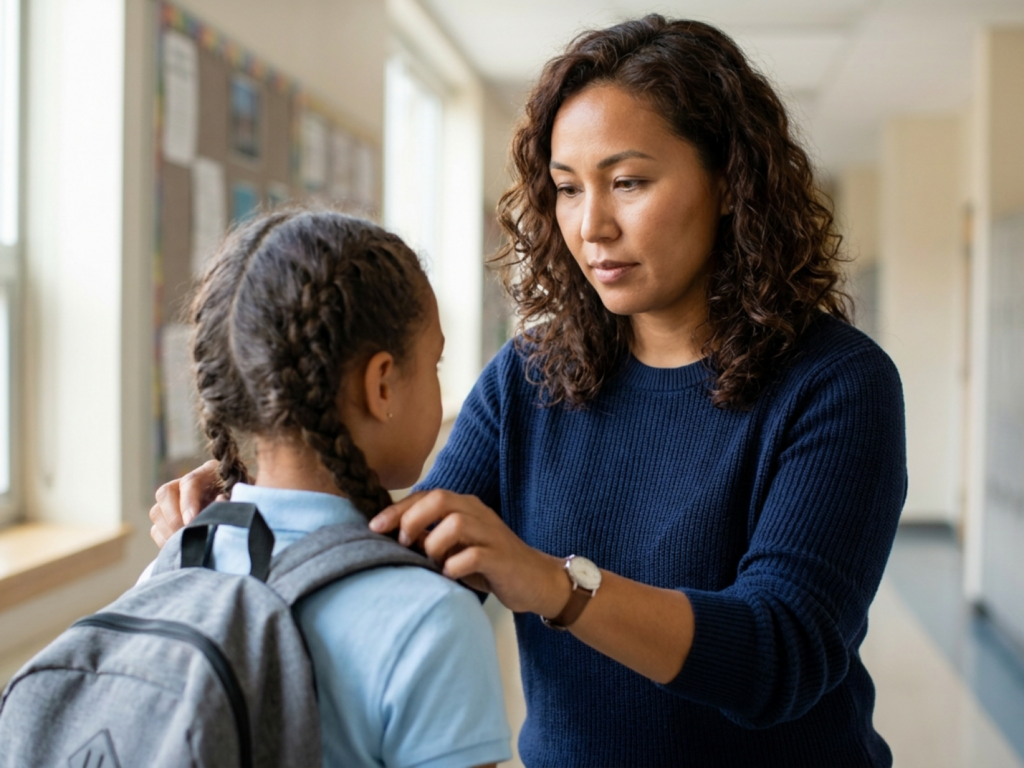
When trying on the backpack, place a small, realistic load inside rather than evaluating an empty bag. The top of the pack should sit near the upper back without pressing into the neck, and the bottom should rest around the waist or slightly above the top of the hips. It should not hang near the buttocks or pull the child backward. Recheck fit after clothing changes and during growth spurts.
Choose features that support a stable fit
Look for two broad, padded, adjustable shoulder straps. They should be comfortable over the shoulders without cutting into the neck or slipping toward the arms. A contoured or padded back panel can improve comfort, but excessive padding should not make the pack unnecessarily deep. A lightweight bag is preferable because the backpack itself consumes part of the available weight allowance.
Multiple compartments can help distribute contents and prevent hard objects from pressing directly against the spine. Heavier items, such as books or a laptop when one is required, should be placed close to the back and centered. Lighter items can go farther from the body. A chest or sternum strap may help prevent shoulder straps from sliding outward, provided it is positioned comfortably and does not restrict breathing. A waist or hip belt can transfer some load toward the pelvis, particularly for larger packs, but it should rest on the hip bones rather than tightly compress the abdomen.
Reflective details, durable fabric, water resistance, and easy-to-operate fasteners may improve practical safety and independence. However, extra pockets, rigid frames, decorative hardware, and built-in features add mass. Choose only features the child will genuinely use. The best backpack is one the child can lift, organize, put on, remove, and adjust with reasonable independence.
Adjust the backpack step by step
- Loosen both shoulder straps before putting the loaded pack on. The child should use both shoulder straps rather than carrying the bag on one shoulder.
- Place the pack high and close to the back. Pull the shoulder straps evenly until the pack no longer swings, but stop before they cause pressure, tingling, restricted breathing, or visible skin indentation.
- If present, fasten the sternum strap across the upper chest at a comfortable height. It should stabilize the straps, not draw the shoulders forward.
- Fasten the hip belt across the hip bones when the pack has one. The belt should be secure without causing abdominal discomfort or interfering with movement.
- Ask the child to walk, climb stairs, bend, and turn. Watch for shifting, strap slippage, leaning, altered gait, or repeated shrugging of the shoulders.
- Have the child report how the pack feels after several minutes, not only immediately after putting it on. Some pressure becomes apparent only during walking.
A quick backpack fit check can become part of the school routine. Adjustments may loosen over time, and a child may change the setting to make the pack easier to put on. Encourage the child to tell an adult about pain or numbness rather than silently tolerating it.
Manage backpack weight and contents
Children’s Healthcare of Atlanta materials commonly cite a limit of approximately 10–15% of body weight for a loaded backpack. For example, a child weighing 30 kilograms would generally carry about 3–4.5 kilograms at that guideline range. This is a practical upper boundary, not a target. A lighter pack is preferable, especially for younger children or those who experience discomfort.
Weigh the backpack occasionally when it contains the items the child actually takes to school. Do not rely only on how heavy it feels to an adult. Remove trash, duplicate supplies, old worksheets, toys, and books that are not needed that day. Use school lockers, classroom storage, digital materials, or a second set of textbooks at home when available. A weekly backpack clean-out routine can reduce cumulative load without placing responsibility entirely on the child.
Distribute contents so the heaviest objects are close to the back and do not shift. Secure bottles and containers to reduce movement, and use protective sleeves for devices if required. A child should be able to lift the packed bag from the floor and put it on without straining. If that is difficult, reduce the contents or ask the school about alternatives.
Recognize discomfort and know when to ask for help
Normal adjustment may include briefly noticing pressure when a new pack is fitted, but ongoing or escalating symptoms should not be dismissed. Watch for recurrent neck, shoulder, mid-back, or lower-back pain; headaches associated with carrying; skin redness that persists; blisters; shoulder strap marks; numbness or tingling; arm weakness; unusual fatigue; or a visible change in walking or posture while carrying the pack.
Ask the child open questions, such as whether the pack hurts during the walk to school, whether one side feels heavier, or whether they remove it because of discomfort. Younger children may express a fit problem through irritability, reluctance to walk, or repeated requests for an adult to carry the bag. These observations are useful but are not diagnostic.
Stop using a painful or damaged pack and review the load and adjustments. Seek advice from a healthcare professional if symptoms persist, interfere with school or activity, occur without the backpack, or include weakness, significant numbness, balance problems, or substantial pain. A clinician can consider the child’s medical history and determine whether assessment by physiotherapy, occupational therapy, orthopedics, or another service is appropriate.
Make fitting a supportive, repeatable routine
Children often value autonomy, so involve them in selecting color, compartments, and ease of use after safety requirements have been met. Explain that the goal is comfort and easier movement, not perfection or criticism of their body. Practice putting the bag on with both straps, adjusting it, and removing it safely. This is especially helpful for preschool and early primary-school children who are still developing motor planning and self-care skills.
Reassess at the beginning of each school term, after a growth spurt, when winter clothing is added, or when school equipment changes. Check stitching, zippers, buckles, padding, and strap length. A worn strap can change the load pattern even if the pack originally fit well.
Families may also coordinate with teachers and school staff about storage, device transport, classroom supplies, and accessibility needs. For a child with a diagnosed condition or functional limitation, equipment planning should be individualized rather than based only on general weight percentages. A practical, respectful routine helps the child carry what is necessary while protecting comfort and participation.
Safety reminders
- Do not routinely load a backpack beyond approximately 10–15% of the child’s body weight.
- Do not allow a pack to hang low near the buttocks or pull the child backward.
- Use both shoulder straps; one-shoulder carrying can create uneven loading and instability.
- Persistent pain, numbness, weakness, skin injury, or altered gait needs professional attention.
- General fit guidance does not replace individualized advice for a child with a medical or orthopedic condition.
Tools & Assistance
- A tape measure for torso-length assessment
- A household scale for checking the loaded backpack
- A weekly backpack clean-out routine
- A school meeting about storage, devices, or accessibility
- A pediatrician, physiotherapist, or occupational therapist for individualized concerns
FAQ
Should a child’s backpack reach below the waist?
Generally, no. The pack should sit relatively high and close to the back, with its lower edge around the waist or slightly above the top of the hips rather than hanging near the buttocks.
Is a rolling backpack safer than a backpack?
Not necessarily. Rolling bags may reduce shoulder loading but can be difficult on stairs, uneven ground, or crowded routes and may require twisting. Consider the child’s route, strength, school rules, and comfort.
How often should backpack fit be checked?
Check at least each school term and whenever the child grows, changes clothing layers, adds equipment, or reports discomfort. Straps and buckles should also be inspected for wear.
What if my child says the backpack hurts even when it is light?
Recheck torso length, strap placement, pressure points, and the child’s walking pattern. If discomfort persists or occurs outside backpack use, consult a healthcare professional for individualized assessment.
Sources
- Children’s Healthcare of Atlanta — Don’t Let a Heavy Backpack Weigh Your Kid Down
- MEC — Backpacks for kids: how to choose the right fit
- Children’s Healthcare of Atlanta — Backpack tip sheet
Disclaimer
This article provides general educational information and is not a diagnosis or individualized medical advice. Consult a qualified healthcare professional about persistent symptoms, medical conditions, or specific equipment needs.














Please log in to leave a comment.