
Intro
Choosing sports gear for a child is about more than finding the right size or the most attractive design. Equipment should match the sport, the child’s developmental stage, the level of contact or impact, and the rules of the organization. Thoughtful choices can improve comfort, confidence, and protection while helping children enjoy participation.
No item eliminates every injury risk. A well-fitted helmet, mouthguard, or pair of protective glasses works best alongside coaching, age-appropriate rules, supervision, warm-ups, rest, hydration, and a clear plan for responding to injury. Involving the child in selection and teaching them how to use and inspect equipment supports safer habits.
Highlights
Fit is a safety feature: equipment that shifts, pinches, blocks vision, or restricts movement may not protect as intended.
Use equipment designed and certified for the specific sport rather than relying on general-purpose substitutes.
Inspect safety-critical gear regularly and replace items after significant impact, visible damage, or loss of proper fit.
Protective equipment reduces selected risks but cannot prevent all injuries, including concussion or overuse injury.
Start with the sport and the child, not the shopping list
Begin by asking what the child will actually do: run, slide, strike, catch, collide, fall, or move through a particular environment. A cyclist, goalkeeper, gymnast, skier, swimmer, and contact-sport player face different mechanisms of injury, so their equipment needs are not interchangeable. Check the governing body’s rules and the team or facility’s required equipment before buying. Coaches, athletic trainers, sporting-goods specialists, and pediatric healthcare professionals can help identify sport-specific protective equipment when needs are unclear.
Consider age, body size, skill level, playing position, and whether the child is still growing rapidly. Equipment should permit normal joint motion and should not create a new hazard, such as loose straps, obstructed vision, excessive weight, or footwear that changes mechanics uncomfortably. Ask the child how the item feels during realistic movements: crouching, jumping, turning the head, gripping, or falling safely under instruction. Comfort matters because a child who removes or loosens equipment during play loses its intended benefit.
Also account for medical and practical factors. A child with a history of injury, vision correction, dental appliances, asthma, skin sensitivity, or another health concern may need individualized guidance. Consult the child’s clinician rather than modifying protective equipment in a way that could weaken it or compromise fit.
Fit, sizing, and adjustment are central safety features
Use the manufacturer’s measurement instructions instead of choosing by age label alone. Measure the relevant body area with the recommended method, then compare the result with the product’s size chart. Children’s bodies change quickly, but buying equipment several sizes too large is not a safe growth strategy. Oversized helmets and pads can shift during impact, while undersized gear can cause pressure, numbness, restricted movement, or premature abandonment.
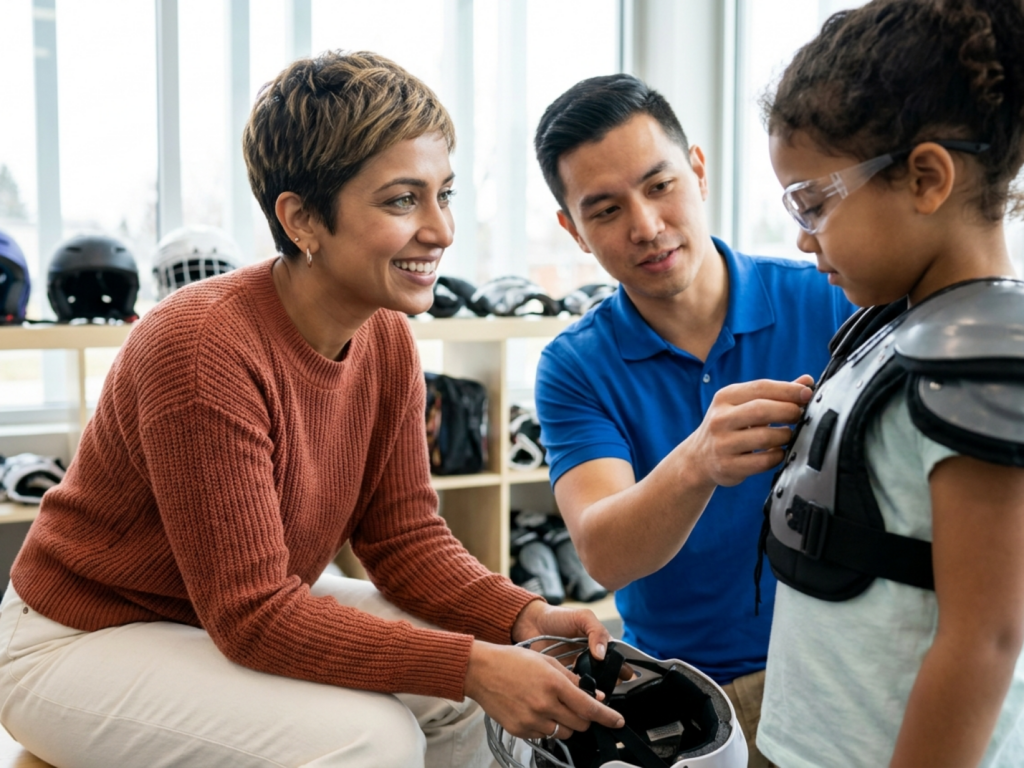
After putting equipment on, check whether it remains positioned during sport-specific movements. A helmet should sit level and stable, with its retention system adjusted according to the manufacturer’s directions. It should not rock substantially when the child moves the head. Shoulder, chest, hip, knee, and elbow pads should cover the intended areas without migrating or interfering with breathing and arm or leg motion. Straps should lie flat, close securely, and have no dangling ends that could catch.
Professional fitting is worthwhile for technically demanding or high-impact equipment. A trained helmet fitter, athletic trainer, coach, or qualified retailer may identify problems a quick household check misses. Recheck fit whenever the child grows, changes hairstyle or head covering, adds dental equipment, reports discomfort, or begins using a different model. Properly fitted protective gear is not a one-time purchase decision; it is an ongoing process.
Choose certified protection for the highest-risk body areas
For activities involving falls, collisions, or projectiles, look for equipment certified or approved by the relevant recognized safety organization and permitted by the sport’s rules. A certification mark is not a guarantee that injury cannot occur, but it indicates that the product was evaluated against a defined standard. Avoid relying on decorative helmets, bicycle helmets for contact sports, or recreational eyewear for fast-moving balls. A helmet designed for one activity may not provide appropriate coverage or impact performance in another.
Protective eyewear should be made for sports use, fit securely, and preserve peripheral vision. Regular glasses may break or dislodge during impact unless specifically designed and approved for the activity. Mouthguards can protect teeth and oral tissues in selected contact or collision settings; they should remain in place without constant biting or repeated adjustment. Children with braces or other dental appliances should ask a dentist or orthodontic professional which design is appropriate.
Research supports some preventive devices more strongly than others, and effectiveness may depend on the sport, injury mechanism, and correct use. For example, evidence exists for selected applications of mouthguards, ankle braces, and sports eye protection, but no device is universally protective. Treat marketing claims cautiously, especially promises that a product prevents concussion or all injuries. Ask whether the item reduces a specific, well-defined risk rather than expecting complete protection.
Footwear, clothing, and equipment that supports movement
Footwear should match the playing surface and movement demands. A running shoe, indoor court shoe, cleat, skate, and hiking shoe differ in traction, flexibility, cushioning, and support. Excessive or inappropriate traction can increase twisting forces, while worn soles may reduce grip. Shoes should fit the longer foot with enough room for the toes to move, but the heel should not slip substantially. Try them with the socks the child will use in sport and observe walking, stopping, and sport-specific movements.
Do not assume that maximum cushioning or rigid support is always better. Equipment should allow the movement required by the activity and should not cause pain, pressure points, blisters, numbness, or altered gait. Replace footwear when the sole is worn, the upper no longer holds the foot securely, or the child’s foot has outgrown it. Children may not notice gradual changes, so adults should check periodically.
Clothing should permit temperature regulation and unrestricted movement. Remove drawstrings or loose components that can catch on apparatus or opponents when rules or safety guidance call for it. In outdoor sports, consider visibility, weather, sun exposure, and cold conditions. Water bottles, bags, sticks, and personal accessories should be stored away from playing areas so they do not become trip or collision hazards.
Inspect, clean, and replace equipment systematically
Make a brief inspection part of every practice or game routine. Look for cracks, dents, broken fasteners, stretched straps, loose padding, damaged stitching, sharp edges, compressed foam, and changes in shape. Test closures and adjustment systems gently; do not continue using an item that cannot stay secure. Examine helmets after any substantial impact, even when the outside appears normal. Follow the manufacturer’s instructions about whether an impact requires replacement or professional assessment.
Clean equipment according to its care instructions. Sweat, moisture, and dirt can contribute to odor, material breakdown, skin irritation, and microbial growth. Allow items to dry completely before storage, but avoid heat or solvents that can degrade foam, plastics, adhesives, or protective coatings. Do not share mouthguards, hats, or items that contact mucous membranes unless they are designed to be safely disinfected and properly refitted.
Keep a simple replacement record for helmets, pads, footwear, and other safety-critical items. Replace equipment when it is damaged, no longer fits, has exceeded the manufacturer’s service guidance, or has been involved in an event that may compromise its structure. If a product is recalled, stop using it and follow the manufacturer or regulator’s instructions.
Buying new, secondhand, or customized gear safely
New equipment is not automatically safer, and secondhand equipment is not automatically unsafe, but safety-critical items require extra scrutiny. Before buying used gear, confirm the exact model, age, service history, certification status, and whether replacement parts are available. Avoid items with unknown impact history, missing labels, altered shells, damaged foam, or non-original fasteners. A used helmet with an uncertain history is generally a poor choice because internal damage may not be visible.
Be cautious with online listings that show only a staged photograph or make unsupported claims. Check the manufacturer’s fitting instructions and return policy before purchase. The child should try equipment on before the final decision whenever possible. For helmets, masks, guards, and braces, modifications such as drilling holes, cutting padding, painting with unapproved chemicals, or adding nonstandard attachments may affect structural integrity or certification.
Budget constraints are understandable. Ask the club, school, community center, healthcare team, or local sporting organization about loan programs, equipment libraries, fitting events, and financial assistance. Savings should not come from skipping a required safety item. If a family must prioritize, start with the equipment that protects against the activity’s most serious and likely hazards, then obtain guidance about acceptable alternatives.
Equipment works within a broader safety plan
Protective gear cannot compensate for unsafe rules, poor supervision, inadequate facilities, or excessive training load. Children need age-appropriate instruction in technique, falling, stopping, checking surroundings, and reporting equipment problems. Coaches should enforce rules consistently and remove damaged gear from use. Families can ask whether the organization has an emergency action plan, trained first-aid personnel, accessible communication, and a process for responding to suspected concussion or other serious injury.
Watch for problems that equipment cannot prevent, including persistent pain, fatigue, dehydration, heat illness, and overuse injuries in young athletes. A child should be encouraged to report symptoms without fear of losing playing time. Do not use pain, medication, or tighter equipment to conceal a problem and continue participation. A healthcare professional can advise on assessment and a safe return to activity when injury or illness is suspected.
Revisit the equipment plan at the start of every season and after growth, a change of sport, a new position, a major impact, or a change in health status. The most protective approach is child-centered: listen to the child, involve qualified adults, respect medical advice, and prioritize long-term enjoyment over immediate participation.
Safety warnings
- Do not use a helmet or other impact equipment after significant damage or an unknown impact history.
- Do not substitute recreational eyewear, an incorrectly rated helmet, or improvised padding for sport-specific protection.
- Stop participation and seek appropriate medical assessment for concerning symptoms after an impact or injury.
- Never alter certified equipment unless the manufacturer explicitly permits the modification.
- A child’s equipment should not be shared, adjusted, or cleaned in ways that compromise hygiene or fit.
Tools & Assistance
- Manufacturer sizing charts, fitting instructions, and recall notices
- A pre-practice inspection checklist for straps, shells, padding, closures, and footwear
- A qualified helmet fitter, athletic trainer, coach, dentist, orthodontist, or pediatric clinician
- The child’s school, club, community center, or sporting organization for equipment-lending and fitting programs
FAQ
Should I buy sports equipment with room to grow?
Choose a size that fits securely now, not one that is several sizes too large. Oversized helmets, pads, and footwear can move during play and may interfere with protection or movement. Recheck fit as the child grows.
Can one helmet be used for several sports?
Usually not without confirming that the helmet is certified and approved for each activity. Helmet design and testing vary by sport, so follow the manufacturer’s labeling and the governing organization’s rules.
When should a child replace a helmet?
Follow the manufacturer’s service guidance and replace it after significant impact, visible damage, failed adjustment components, or loss of proper fit. Ask a qualified fitter if the helmet’s condition is uncertain.
Are mouthguards necessary for every sport?
Requirements and potential benefits vary by sport and level of contact. A dentist, orthodontist, clinician, or governing body can advise on the appropriate type, especially for a child with braces or other dental appliances.
Sources
- Korey Stringer Institute, University of Connecticut — Protective Equipment
- Nemours KidsHealth — Sports & Exercise Safety
- Current Sports Medicine Reports — Demystifying Preventive Equipment in the Competitive Athlete
Disclaimer
This article provides general educational information and does not diagnose, treat, or replace advice from a qualified healthcare professional. Consult an appropriate clinician or sports-medicine professional about a child’s individual equipment, injury, or medical needs.













Please log in to leave a comment.