
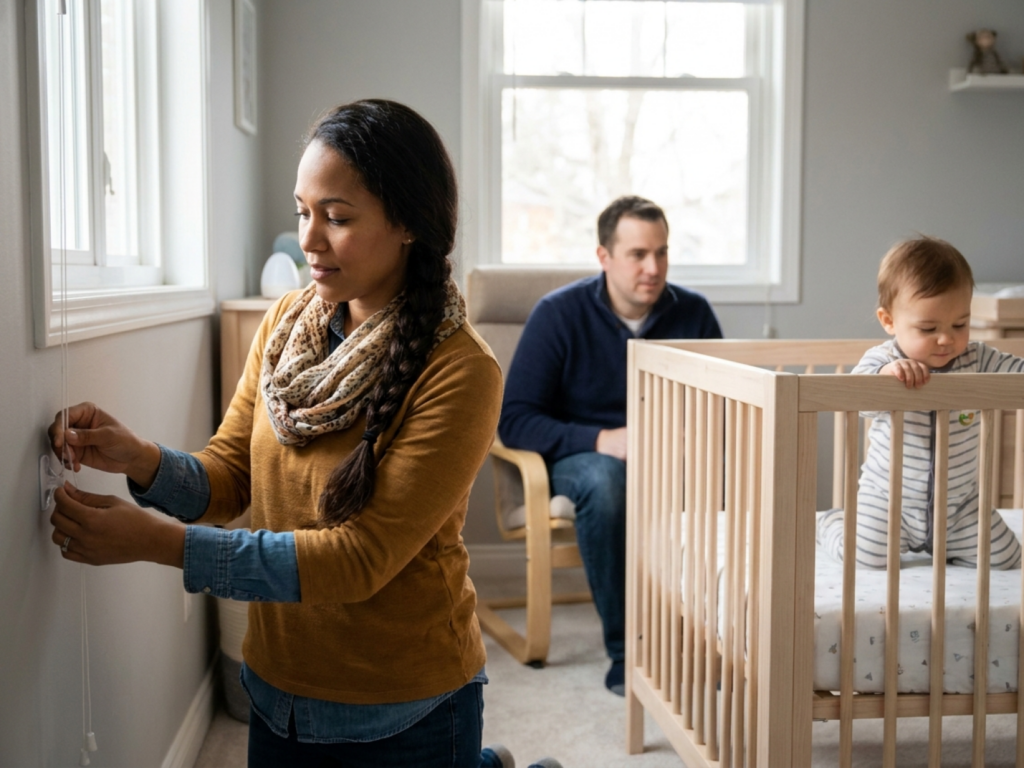
Intro
Blind cords and other window-covering cords are a serious, often overlooked hazard for babies and toddlers. A child can become entangled in a cord or loop while playing, standing, climbing, or sleeping near a window. Because strangulation can occur rapidly and silently, prevention depends on controlling the environment before a child has access to it.
This article explains how window-covering cords cause injury, which children and products are at greatest risk, how to inspect and modify a home, and what to do if a child may have experienced strangulation. Safety guidance should be adapted to the specific window coverings and layout of your home.
Highlights
Cord loops and accessible inner cords can create a rapid strangulation hazard for babies and toddlers.
Children under age 3 are particularly vulnerable because of their mobility, curiosity, and limited ability to recognize danger.
Keep all beds, cots, playpens, and furniture away from windows and blind cords.
Cordless or inaccessible window coverings are the most reliable prevention strategy.
Any child involved in a suspected strangulation event needs prompt medical assessment, even if the child initially appears well.
Why Blind Cords Are a Serious Hazard
Window-covering cords are a form of mechanical hazard that can cause neck compression when a child becomes caught in a loop or tangled in a freely hanging cord. Compression may obstruct the airway, impair venous return from the brain, reduce arterial blood flow, or trigger loss of consciousness. A child does not need to be fully suspended for a life-threatening injury to occur.
Public health authorities have reported deaths involving cords from blinds, shades, draperies, and other window coverings. The U.S. Consumer Product Safety Commission emphasizes that fatal strangulation can occur in a matter of moments. A child may be unable to call for help, and an adult in another room may not hear a struggle. This makes environmental prevention especially important.
A peer-reviewed analysis of pediatric window-cord strangulations in the United States identified a substantial number of fatal incidents among young children during the period studied from 1981 through 1995. The evidence helped establish window-covering cords as a recurring, preventable household danger rather than an isolated type of accident.
How Entanglement Happens
Several cord configurations can create risk. A continuous loop cord or chain can catch around a child’s neck. Two separate cords can form a loop when pulled together, and a long pull cord can become wrapped around the neck or another body part. Some blinds also contain inner cords that become accessible when a child pulls, manipulates, or presses against the slats.
Children may become entangled while reaching for a windowsill, climbing on a bed or chair, playing with a cord, or trying to look outside. A crawling or newly walking child can move into an area that previously seemed inaccessible. A child who becomes caught may instinctively pull harder, tightening the loop rather than releasing it.
Risk is not limited to bedrooms. Window coverings in living rooms, family rooms, kitchens, holiday accommodation, childcare settings, and hotel rooms may contain accessible cords. Temporary visits can be particularly challenging because caregivers may not know how a product works or may assume that a cord is harmless because it is positioned high on the wall.
Which Children Are Most Vulnerable
Children under age 3 are repeatedly identified as a high-risk group. Infants and toddlers are developing rapidly, so their reach, balance, climbing ability, and problem-solving behavior can change within days. They are also less able to understand that a cord can be dangerous or to escape from a tightening loop.
Babies who are not yet mobile can still be exposed if a cord hangs beside a cot, bassinet, playpen, changing area, or floor mattress. Once a baby begins rolling, pivoting, crawling, pulling to stand, or cruising along furniture, the effective safety boundary of a room changes. A cord that was previously several feet away may become reachable.
Children with developmental, motor, or communication differences may require individualized environmental planning. Fatigue, illness, or reduced supervision can also affect how quickly a caregiver notices a child near a window. These considerations do not imply that a child is reckless; they reflect normal pediatric development and the need for age-appropriate controls.
Inspecting the Home for Cord Hazards
Begin at the child’s eye level and examine every room the child can enter. Look beyond the visible pull cord. Check for loops, cords that can be pulled into loops, inner cords exposed through damaged slats, and cords that extend below the window covering or across nearby furniture.
- Identify every window covering, including blinds, shades, curtains, and corded decorative treatments.
- Measure the child’s possible reach from the floor, cot, bed, sofa, chair, changing table, and other climbable surfaces.
- Move furniture away from windows so it cannot be used as a step or launch point.
- Check whether a cord can be reached from a cot or playpen, including when the child is standing.
- Inspect cord cleats, tension devices, and other safety components for secure attachment and damage.
- Recheck the room whenever furniture is rearranged or the child acquires a new mobility skill.
Do not rely on a knot tied in a cord as a complete safety measure. A knot may loosen, remain accessible, or create another loop. Similarly, placing a cord behind a curtain may hide the hazard without preventing a child from reaching it.
Reducing Risk Through Design and Placement
The strongest prevention measure is to choose cordless window coverings or products designed so that operating cords and inner cords are inaccessible to children. When replacing a product, ask the retailer or installer specifically about child-safety design, continuous-loop requirements, tension devices, and current national or regional standards. Keep documentation for installed products in case a safety notice or recall is issued.
If corded coverings remain in use, install and maintain the manufacturer’s recommended safety devices exactly as directed. A tension device for a continuous loop should be securely attached so the loop cannot sag away from the wall. A cord cleat should be positioned well out of a child’s reach and used consistently to secure excess cord. These devices reduce risk but do not replace cordless design, careful placement, and supervision.
Keep sleeping and resting spaces away from windows and their coverings. This includes cots, bassinets, toddler beds, floor beds, playpens, and portable sleep spaces. The Health Service Executive specifically identifies cords and chains on window blinds, door blinds, and curtains as strangulation hazards, with looped cords of particular concern.
Include window coverings in a broader nursery cord management review. Electrical cables, monitor wires, charger leads, and curtain cords should all be considered separately because solving one type of cord hazard does not remove the others.
Supervision, Childcare, and Travel
Supervision is valuable but cannot reliably prevent a rapid strangulation event. Adults may need to answer a phone, attend to another child, prepare food, or briefly leave the room. The physical environment should therefore remain safe during ordinary interruptions, not only during focused playtime.
Tell every caregiver about window-cord hazards, including relatives, babysitters, childcare workers, and visitors who may supervise the child. Ask caregivers to check unfamiliar rooms before allowing a baby or toddler to play or sleep there. In hotels, rental properties, and other temporary accommodation, keep the child away from windows until cords have been secured or the sleeping and play area has been relocated.
During home renovations or moves, avoid placing boxes, chairs, or other temporary objects beneath windows. A room can become hazardous when furniture is repositioned for cleaning, decorating, or installation work. Treat any damaged or malfunctioning blind as a hazard and restrict access until it is repaired or replaced.
What to Do After a Possible Strangulation Event
Strangulation is a medical emergency when a child is unconscious, has difficulty breathing, has abnormal breathing, is blue or gray, is having a seizure, or cannot be awakened normally. Call the local emergency number immediately and follow the dispatcher’s instructions. If the child is unresponsive and not breathing normally, emergency personnel may guide you through cardiopulmonary resuscitation.
Even when the child seems to recover quickly, seek urgent medical advice after a suspected neck-compression event. Injury to the airway, blood vessels, brain, or soft tissues may not be obvious initially. Concerning symptoms can include hoarseness or a changed cry, noisy or difficult breathing, coughing, trouble swallowing, drooling, neck pain or swelling, weakness, confusion, unusual sleepiness, vomiting, headache, or behavior that is not typical for the child.
Do not delay emergency care while trying to determine exactly how long the child was entangled. If it can be done without delaying help, preserve information about what happened, including the type of window covering and the child’s observed symptoms. A healthcare professional should decide what assessment or monitoring is needed; caregivers should not attempt to diagnose the severity of a strangulation injury at home.
Urgent Safety Warnings
- Never place a cot, bed, bassinet, playpen, or changing table beside a window cord.
- A looped cord or chain can strangle a child rapidly and silently.
- Do not assume that a cord tied in a knot or hidden behind a curtain is safe.
- Restrict access to damaged, loose, or malfunctioning window coverings.
- Call emergency services for breathing difficulty, unresponsiveness, seizure, or abnormal color.
- Obtain urgent medical advice after any suspected neck-compression event, even if symptoms improve.
Tools & Assistance
- A whole-home window-covering cord inspection
- Cordless blinds or shades from a reputable retailer
- Manufacturer-approved tension devices and cord cleats
- A furniture and cot placement review
- Local emergency services and a pediatric healthcare professional
FAQ
Are all blind cords dangerous?
Any accessible loop, long pull cord, or exposed inner cord may create a strangulation hazard. Cordless products are generally the simplest way to eliminate operating-cord access, but existing coverings should also be assessed for design, installation, damage, and placement.
How far should a cot be from a window cord?
Place the cot and other child equipment well away from the entire window covering and any cord, including the area reachable when the child is standing. There is no substitute for removing access; use the room layout and the manufacturer’s safety guidance to determine a suitable location.
Can supervision prevent blind-cord strangulation?
Supervision helps, but it is not dependable protection because entanglement can occur quickly and quietly. Physical controls, cordless products, secure safety devices, and careful furniture placement are more reliable layers of prevention.
What should I do if my child was briefly caught in a cord?
If the child has any breathing difficulty, altered consciousness, abnormal color, seizure, or severe symptoms, call emergency services immediately. Even if the child appears well afterward, seek urgent medical advice because some injuries may be delayed or initially subtle.
Should I replace older blinds?
Older products may contain cord designs associated with strangulation risk. Ask the manufacturer, retailer, installer, or relevant product-safety authority whether the covering can be made safer. Replacement with a cordless or inaccessible-cord product may be the most dependable option.
Sources
- PubMed — Pediatric window-cord strangulations in the United States, 1981-1995
- U.S. Consumer Product Safety Commission — Window Covering Cords
- Health Service Executive — Strangulation risks for children
Disclaimer
This article provides general safety information and is not a diagnosis or substitute for medical advice. Consult emergency services or a qualified healthcare professional for any suspected strangulation event or concern about a child’s condition.















Please log in to leave a comment.