
Intro
School-age children often want more autonomy at night, while parents still need to protect sleep, safety, oral health, and next-day functioning. A bedtime routine can turn a stressful transition into a predictable sequence that helps the nervous system shift from alertness to sleep readiness.
This article explains practical, evidence-informed routines for children roughly 6–12 years old. It is not meant to diagnose sleep disorders or replace individualized care, especially when snoring, anxiety, pain, medication effects, neurodevelopmental differences, or daytime impairment are present.
Highlights
A consistent bedtime routine can support earlier bedtimes, shorter sleep onset latency, longer sleep duration, and fewer night wakings.
School-age children usually do best with a predictable 30–40 minute sequence that includes calming, adaptive activities and excludes screens.
Bedtime struggles are often improved by planning, parent-child connection, and gradual independence rather than punishment or last-minute negotiation.
Persistent snoring, breathing pauses, severe anxiety, restless legs, pain, or major daytime sleepiness should be discussed with a healthcare professional.
Why bedtime routines matter in school-age children
Bedtime routines are not just household rituals; they are behavioral and physiologic cues. Repeating the same steps in the same order helps a child’s brain predict what comes next. Predictability lowers cognitive load, reduces negotiation, and supports the transition from sympathetic arousal to parasympathetic settling. In practical terms, a child who knows that snack, bath, teeth, reading, and lights-out happen in that order is less likely to treat bedtime as an open-ended discussion.
Research in younger children shows that consistent bedtime routines are associated with earlier bedtimes, shorter sleep onset latency, longer nighttime sleep duration, and fewer night awakenings. Although school-age children are older, the same behavioral principles are highly relevant. Their sleep is still essential for attention, emotional regulation, learning consolidation, immune function, and growth-related physiology.
This age group also has new pressures: homework, extracurricular activities, social comparison, digital media, and more complex worries. A routine gives parents a structured way to protect sleep without making bedtime feel punitive. It can also strengthen child self-regulation skills because the child practices sequencing, hygiene, organization, and calming strategies every night.
A useful routine is not elaborate. In fact, the most effective routines are usually simple, warm, and repeatable. The goal is a calm runway toward sleep, not a perfect performance.
How much sleep and what timing should parents aim for
Many school-age children need a bedtime that allows enough sleep before a fixed wake time for school. Individual needs vary, but the practical anchor is next-day function: waking with reasonable ease, staying alert in class, regulating emotions, and not needing frequent catch-up sleep. If a child consistently struggles to wake, falls asleep in the car, has evening meltdowns, or shows worsening inattention, the sleep window may be too short or too fragmented.
Bedtime routines work best when they begin before the child is overtired. Overtired children may appear wired, impulsive, silly, oppositional, or tearful because sleep pressure and stress hormones can coexist. Starting the wind-down earlier prevents the routine from becoming a crisis-management exercise.
A common approach is to work backward. Choose the needed wake time, estimate the child’s sleep opportunity, then set lights-out. The routine itself should usually last about 30 minutes, sometimes up to 40 minutes if bathing or anxiety-management strategies are included. If the routine routinely expands to an hour or more, it may be functioning as avoidance, extra attention seeking, or parental reassurance cycling.
Weekends matter too. A little flexibility is normal and socially important, but large shifts in bedtime and wake time can create a “social jet lag” pattern by Monday morning. Families often do better with a stable wake time and modest weekend variation rather than a dramatically delayed schedule.
Core elements of an effective bedtime routine
A strong routine usually includes two to four calming activities performed in the same order. The sequence should begin with the household environment: dim lights, lower noise, reduce stimulating play, and turn off screens. Bright light and interactive media can delay melatonin signaling and maintain cortical arousal, especially when content is exciting, social, competitive, or emotionally charged.
Helpful bedtime elements may include:
- A small nutritious snack if the child is genuinely hungry, such as a simple protein-carbohydrate option. For broader meal planning, families may find a School age nutrition checklist useful.
- Bathing or washing up, particularly if it is calming rather than playful and prolonged.
- Brushing and flossing teeth, with age-appropriate supervision.
- Putting clothes, backpack, or school materials in place for the morning.
- Reading together or independent quiet reading.
- Brief conversation about the day, gratitude, or tomorrow’s plan.
- A consistent goodnight phrase, cuddle, or reassuring check-in.
Activities that commonly interfere include roughhousing, competitive games, emotionally intense conversations, scary media, late caffeine, and repeated requests for “one more” story, drink, or question. Parents do not need to be rigid, but the child should experience the order as reliable.
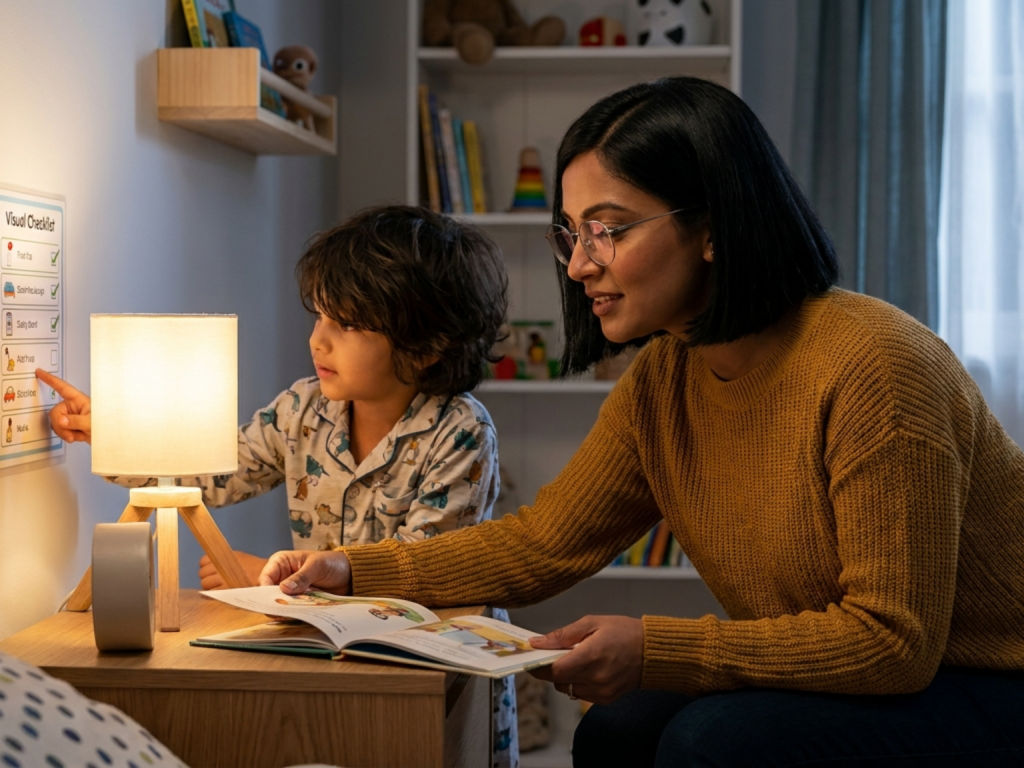
A visual checklist can be very effective for school-age children. It shifts the parent’s role from constant verbal prompting to supportive coaching: “What is next on your chart?” Over time, this supports independence and reduces conflict.
Screens, light, and the evening brain
Screen boundaries are one of the hardest parts of modern bedtime. Tablets, phones, gaming systems, streaming platforms, and social media are designed to keep attention engaged. For children, this can intensify bedtime resistance because stopping the activity feels like a loss, not a neutral transition.
A practical recommendation is to turn off screens at least one hour before bed. If that is not immediately possible, families can taper toward it: move devices out of bedrooms first, then establish a charging station outside sleeping areas, then replace screen time with a consistent low-stimulation activity. The key is not only blue light exposure but also emotional and cognitive activation. A child who has just lost a game, received a message, or watched suspenseful content may need longer to downshift.
Parents can reduce conflict by making the rule environmental rather than personal. For example: “Devices sleep in the kitchen at 7:30” is usually less provocative than repeated warnings. Pre-teens may benefit from a defined pre-sleep sequence: log off, plug in the device outside the bedroom, shower, read, lights out.
Some families need exceptions for medical devices, communication with a separated parent, or assistive technology. In those cases, the goal is to preserve function while minimizing interactive, stimulating content. If screen use is tightly linked to anxiety, family conflict, or school impairment, consider discussing it with the child’s clinician or a behavioral health professional.
Handling resistance, worry, and repeated call-backs
Bedtime resistance is not always defiance. It may reflect separation anxiety, fear of the dark, perfectionism about homework, hunger, discomfort, inconsistent limits, or a pattern in which delay reliably produces more parent attention. A compassionate response starts with curiosity, then structure.
For worries, schedule a brief “worry time” before the final steps of the routine, not after lights-out. Children can write worries in a notebook, draw them, or place them in a “tomorrow box.” Parents can validate feelings without entering endless reassurance loops: “That sounds uncomfortable, and we have a plan for tomorrow. Right now your job is resting.” Breathing exercises, progressive muscle relaxation, or guided imagery may help children who have physiologic hyperarousal.
For repeated call-backs, plan the essentials before lights-out: toilet, water, comfort object, question, and goodnight. Then keep responses brief and boring. A parent might say, “You are safe. It is sleep time. I will check on you in five minutes.” Scheduled checks can reduce anxiety while avoiding reinforcement of repeated demands.
Positive reinforcement for children often works better than punishment. Praise the specific behavior: “You followed your chart and stayed in bed after goodnight.” A simple morning reward, such as choosing breakfast music or earning points toward a family activity, can reinforce progress. If bedtime conflict is part of broader school-age behavior problems, families may need a more comprehensive behavior plan.
Building independence without withdrawing connection
School-age children are capable of increasing responsibility, but independence develops through practice. Bedtime is an ideal setting for gradual transfer of tasks: choosing pajamas, packing the bag, brushing teeth, setting out clothes, and checking the routine chart. Parents still provide supervision, warmth, and safety boundaries.
One useful method is “do, do together, watch, then check.” At first, the parent performs or closely guides a task. Next, parent and child do it together. Then the child does it while the parent watches. Finally, the parent checks the completed task. This approach is especially helpful for oral hygiene, room tidying, and morning preparation.
Connection should remain part of the routine. A child who receives predictable positive attention before lights-out may be less likely to seek it through delay. Ten minutes of reading or calm conversation can be more effective than thirty minutes of conflict. The tone matters: warm, low voice; minimal criticism; clear limits.
Children with attention differences, autism spectrum traits, sensory sensitivities, trauma histories, or anxiety may need more external structure and a slower progression toward independence. That is not failure. It is appropriate accommodation. Visual schedules, timers, sensory-friendly pajamas, white noise, or a predictable parent check may reduce arousal and improve cooperation.
When bedtime problems may signal a medical issue
Many bedtime challenges are behavioral and improve with consistency. However, some sleep problems need medical evaluation. Habitual snoring in children, gasping, witnessed breathing pauses, restless sleep with unusual positions, morning headaches, or significant daytime sleepiness can suggest sleep-disordered breathing and should be discussed with a pediatric clinician. Enlarged tonsils, allergic rhinitis, obesity, craniofacial anatomy, and neuromuscular conditions can influence risk.
Restless legs, repeated leg discomfort at night, or an urge to move may also disrupt sleep. Pain, eczema itching, poorly controlled asthma, reflux symptoms, medication effects, and nocturnal enuresis can make bedtime feel impossible. Mental health concerns, including anxiety and depression, may present as insomnia or repeated nighttime reassurance seeking.
A child sleep diary can help distinguish patterns. Track bedtime, lights-out, estimated sleep onset, night wakings, wake time, naps, caffeine, screens, exercise, mood, and symptoms for one to two weeks. Bring this information to a healthcare visit if sleep difficulties persist.
Seek professional advice sooner if sleep problems are worsening, causing school impairment, associated with breathing symptoms, or accompanied by significant behavioral changes. Families do not need to solve every sleep issue alone; pediatricians, dentists, allergists, behavioral sleep clinicians, and mental health professionals may each have a role depending on the pattern.
When to seek medical guidance
- Discuss habitual snoring, gasping, breathing pauses, or labored nighttime breathing with a pediatric clinician.
- Seek help if insomnia is associated with severe anxiety, panic, depression symptoms, or school refusal.
- Ask about evaluation if leg discomfort, pain, itching, asthma symptoms, reflux, or medication effects disrupt sleep.
- Get urgent care for concerning breathing difficulty, confusion, severe allergic symptoms, or other acute illness signs.
- Do not use sleep medications, supplements, or melatonin routinely without professional guidance.
Tools & Assistance
- Create a 30-minute visual bedtime checklist with the same steps each night.
- Use a household device-charging station outside bedrooms.
- Keep a one-to-two-week child sleep diary before a healthcare visit.
- Prepare morning items after dinner to reduce bedtime stress.
- Ask the pediatrician about persistent snoring, insomnia, anxiety, or daytime sleepiness.
FAQ
What is a good bedtime routine for a school-age child?
A simple sequence might include dimming lights, snack if needed, bath or wash-up, teeth brushing, preparing school items, reading, a brief goodnight connection, and lights-out. Keep the order consistent.
How long should the routine take?
About 30 minutes works for many families. Some children need closer to 40 minutes, but routines that regularly stretch much longer may need clearer boundaries.
Should children have screens before bed?
It is generally best to avoid screens for at least one hour before bedtime because light, interactivity, and emotional content can increase alertness and delay settling.
What if my child is anxious at bedtime?
Use a predictable routine, schedule worry-writing before lights-out, practice slow breathing, and keep reassurance brief. Persistent or impairing anxiety should be discussed with a healthcare or mental health professional.
Is melatonin a solution for bedtime resistance?
Melatonin is not a substitute for routine, sleep timing, and behavioral strategies. Use any supplement only after discussing risks, dosing, timing, and appropriateness with a qualified clinician.
Sources
- PubMed Central (National Institutes of Health) — Benefits of a bedtime routine in young children: Sleep, development, and behavior
- Sleep Foundation — Bedtime Routines for Children
- Raising Children Network — Positive bedtime routines: babies, children and teenagers
Disclaimer
This article is for general educational purposes only and is not a diagnosis or treatment plan. Consult a qualified healthcare professional for persistent sleep problems, breathing symptoms, anxiety, pain, medication questions, or individualized medical advice.

















Please log in to leave a comment.