
Intro
Preschool emotional challenges can be intense, confusing, and sometimes exhausting for families. Between about ages 3 and 5, children are rapidly building language, impulse control, social understanding, stress tolerance, and independence, but these skills mature unevenly. A child may seem articulate one moment and then collapse into tears, rage, clinginess, or refusal the next.
Highlights
Many preschool emotional challenges reflect immature self-regulation, not intentional misbehavior. Children often need adult co-regulation before they can use coping skills independently.
Patterns matter more than single episodes. Frequency, intensity, recovery time, triggers, and impairment at home or preschool help determine whether extra support is needed.
Responsive caregiving, predictable routines, and social-emotional learning can strengthen emotion regulation, problem-solving, and peer relationships.
Medical, developmental, sleep, sensory, language, hearing, and family stress factors can all affect a preschooler’s emotional behavior.
Seek professional guidance if emotional distress is persistent, severe, associated with regression or safety concerns, or interfering with daily life.
Understanding preschool emotions
Preschool emotional challenges arise during a period of major neurodevelopmental change. The prefrontal systems involved in inhibition, flexible thinking, planning, and emotional modulation are still immature, while the limbic and stress-response systems can react quickly to frustration, fear, fatigue, hunger, or overstimulation. This mismatch helps explain why a preschooler may understand a rule but still be unable to follow it when emotionally activated.
At this age, children commonly display a wide range of emotions, including joy, jealousy, fear, anger, embarrassment, affection, and sadness. They may become upset when routines change, when a preferred activity ends, or when they must share attention or toys. Many 3-year-olds can calm after a brief separation within several minutes when supported by familiar adults, but recovery time varies with temperament, sleep, stress exposure, language ability, and caregiver response.
It is helpful to distinguish emotional behavior from emotional capacity. A child who screams, hides, hits, or refuses may not yet have the working memory, verbal fluency, or autonomic regulation needed to pause and choose a more adaptive response. Adult co-regulation, such as calm tone, clear limits, validation, and predictable follow-through, provides an external regulatory scaffold while the child’s internal skills develop.
Common emotional patterns
Preschool emotional challenges often cluster into recognizable patterns. Preschool tantrums and emotional outbursts may occur when a child is overwhelmed by denied access, transitions, sensory input, or communication frustration. Tantrums are not automatically abnormal, but they deserve closer attention when they are very frequent, prolonged, injurious, or followed by unusually slow recovery.
Anxiety can appear as clinginess, repeated reassurance seeking, sleep resistance, stomachaches before preschool, avoidance of new situations, or distress during separation. Some fearfulness is developmentally expected, especially around unfamiliar adults, loud environments, medical visits, storms, animals, or darkness. Concern rises when avoidance consistently narrows the child’s life, prevents participation, or causes significant family disruption.
Anger and aggression may reflect limited impulse control rather than cruelty. A child may hit, bite, throw, or scream because the body reacts faster than language. Still, physical aggression requires immediate safety limits and skill-building. The goal is to stop harm while teaching replacement behaviors such as asking for space, using a help signal, naming feelings, or moving to a quiet area.
Withdrawal can be quieter but equally important. A preschooler who rarely plays, avoids peers, seems persistently sad, loses interest in previously enjoyed activities, or appears emotionally flat may need careful assessment. Listening problems in preschoolers can also look emotional when a child misses instructions, becomes frustrated, or appears oppositional because hearing, language processing, or attention is strained.
What can drive emotional difficulty
Emotional behavior is influenced by multiple interacting systems. Sleep deprivation is a common driver; insufficient or fragmented sleep reduces frustration tolerance and increases irritability. Hunger, constipation, pain, eczema flares, recurrent ear problems, medication effects, and acute illness may also lower a child’s regulatory capacity. When behavior changes abruptly, medical contributors should be considered.
Developmental differences can also shape emotional responses. Speech-language delays may cause intense frustration because the child cannot express needs or understand instructions. Sensory processing differences may make noise, clothing, crowded classrooms, food textures, or bright spaces feel physically overwhelming. Neurodevelopmental conditions can affect flexibility, transitions, social communication, attention, and impulse control. These possibilities do not mean a parent should self-diagnose; they mean persistent patterns deserve thoughtful developmental surveillance and screening.
Family and environmental stress matter as well. Moves, divorce, caregiver illness, financial strain, new siblings, bereavement, inconsistent routines, or exposure to conflict can increase emotional reactivity. Preschool children may not explain stress verbally; instead, they may regress in toileting, sleep, separation tolerance, or behavior. A trauma-informed lens asks not only what the child is doing, but what the child’s nervous system may be trying to manage.
Temperament is another factor. Some children are biologically more cautious, intense, persistent, sensitive, or slow to adapt. Temperament is not pathology, but a poor fit between the child’s temperament and adult expectations can amplify conflict. Defiance in preschool children may sometimes be a signal that instructions are too many, transitions are too abrupt, or the child lacks a workable way to regain control.
Supportive adult responses
The most useful adult response combines warmth with structure. Validation does not mean giving in; it means naming the emotional reality before setting or maintaining a boundary. For example, an adult might say, “You are angry that the blocks are closed. I will not let you throw them. We can stomp here or ask for help.” This approach links emotion language, safety, and an acceptable action.
Responsive caregiving is strongly associated with healthier social-emotional development. Preschoolers learn regulation through repeated experiences of being understood and safely contained. A calm adult voice, reduced verbal overload, visual cues, and predictable routines can lower the child’s physiological arousal. Long explanations during a meltdown often fail because the child’s receptive language and executive function are temporarily reduced.
Preschool behavior solutions are most effective when adults look for patterns. Consider what happens before the behavior, what the child does, and what happens afterward. If a child melts down every time play ends, the intervention may include a visual schedule, transition warnings, a choice between two next steps, and praise for small acts of cooperation. If a child hits to obtain a toy, adults can block hitting, help the child practice requesting a turn, and reinforce the replacement behavior immediately.
Consequences should be brief, related, and non-shaming. Preschoolers benefit more from practice than punishment. Repair can be simple: helping rebuild a knocked tower, bringing tissues, checking whether another child is okay, or trying the request again. Adults should avoid labeling the child as bad, manipulative, dramatic, or spoiled. Such labels can obscure the skill deficits and stressors that are driving the behavior.
Role of preschool and social-emotional learning
High-quality preschool environments can be protective when they offer predictable routines, emotionally attuned teachers, safe peer practice, and explicit teaching of social skills. Social-emotional learning, often called SEL, teaches children to recognize feelings, calm their bodies, solve problems, cooperate, and use respectful behavior. These are not abstract lessons for preschoolers; they are practiced through stories, play, puppets, songs, role-play, breathing exercises, and guided conflict resolution.
Research on early childhood SEL programs suggests measurable benefits. Studies of structured programs, including the Fun FRIENDS approach, report reductions in both externalizing behaviors, such as disruptive or aggressive behavior, and internalizing behaviors, such as anxious or withdrawn behavior. Other preschool SEL curriculum research describes improvements in emotional regulation, problem-solving, mental health indicators, and social relationships. The practical implication is that emotional skills can be taught systematically rather than expected to appear on their own.
Collaboration between families and educators is important. A child who struggles only at preschool may be responding to group demands, noise, transitions, peer conflict, or separation stress. A child who struggles only at home may be decompressing after a day of effort, reacting to sibling dynamics, or needing more predictable evening routines. Shared observation helps avoid blame and supports a consistent plan.
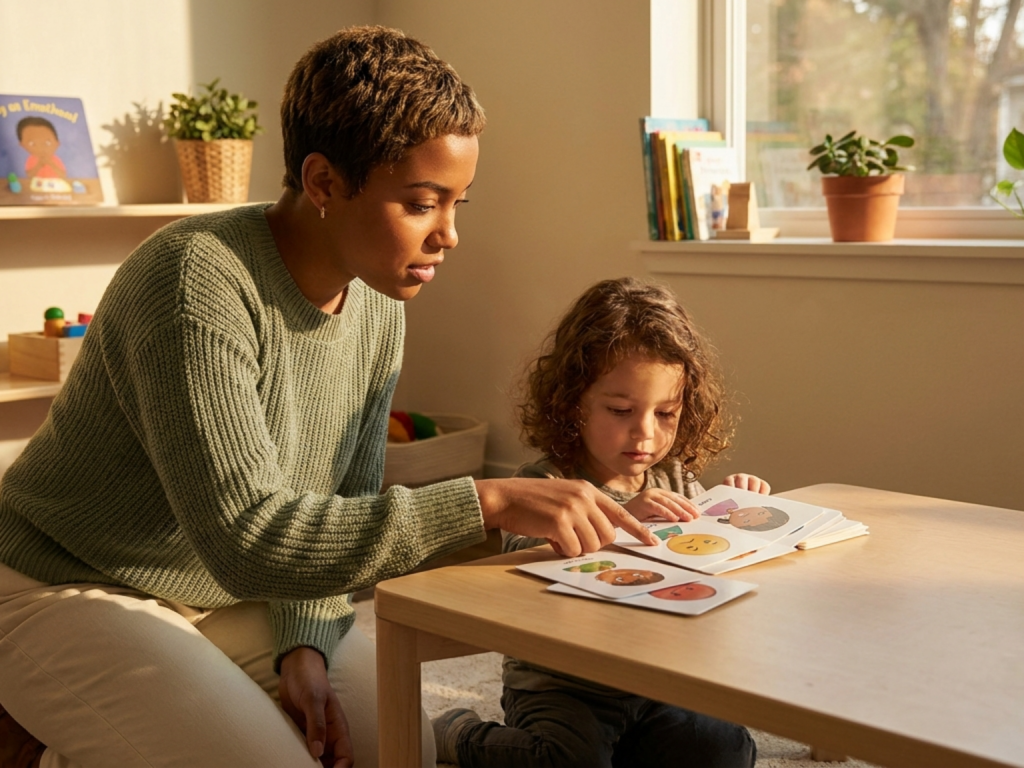
Useful school-based supports may include a visual daily schedule, a quiet regulation space, consistent transition songs, emotion picture cards, planned peer pairing, and teacher coaching before difficult moments. For some children, an early childhood mental health clinician, developmental-behavioral pediatrician consultation, occupational therapy evaluation, or speech-language assessment may be appropriate depending on the pattern of concerns.
When to seek professional help
Families do not need to wait for a crisis before asking for help. A pediatric clinician can review sleep, growth, medical history, hearing, vision, developmental milestones, family stressors, and safety concerns. If needed, they may recommend developmental screening, behavioral health referral, speech-language evaluation, occupational therapy assessment, or evidence-based parent-child therapy. The purpose is not to pathologize normal preschool intensity; it is to understand what support the child and family need.
Professional input is especially important when emotional challenges are persistent, escalating, or impairing daily functioning. Warning patterns include frequent aggression that injures others, self-injury, threats or actions that create safety concerns, severe separation distress that does not improve with support, prolonged inconsolable episodes, marked withdrawal, loss of language or social skills, major sleep disruption, or behavior that prevents preschool participation.
It is also appropriate to seek help when caregivers feel chronically overwhelmed, frightened of the child’s reactions, or unsure how to stay calm and consistent. Parent support is part of child treatment. Evidence-based approaches often focus on strengthening the caregiver-child relationship, improving adult responses to behavior, reducing coercive cycles, and teaching the child replacement skills. These interventions are collaborative and should be adapted to the family’s culture, stressors, and practical realities.
Medication is not the first or only answer for most preschool emotional challenges, and decisions about any medical or psychiatric treatment require individualized evaluation by qualified professionals. Families should be cautious with online checklists and informal labels. A careful clinical assessment considers duration, context, development, medical factors, and functional impairment before drawing conclusions.
Seek urgent guidance if
- A child is repeatedly harming self, other children, adults, or animals.
- There is sudden regression in language, toileting, social engagement, or motor skills.
- Emotional episodes are prolonged, severe, or followed by confusion, fainting, or possible seizure activity.
- The child shows persistent sadness, withdrawal, loss of interest, or extreme fear that interferes with daily life.
- Caregivers feel unable to keep the child or others safe.
Tools & Assistance
- Schedule a pediatric visit to review medical, sleep, developmental, and behavioral factors.
- Ask the preschool teacher for specific observations about triggers, duration, recovery, and peer interactions.
- Use a simple emotion chart or visual schedule to support transitions and feeling words.
- Consider parent-child behavioral support or early childhood mental health consultation when patterns persist.
- Request hearing, speech-language, or occupational therapy evaluation if communication or sensory issues seem relevant.
FAQ
Are tantrums normal in preschoolers?
Yes, tantrums can be developmentally common because emotion regulation and impulse control are still maturing. Concern increases when tantrums are very frequent, prolonged, injurious, or seriously impair home or preschool life.
Should I ignore big emotions?
Do not ignore distress or unsafe behavior. Stay calm, validate the feeling, set a clear safety limit, and teach a replacement behavior once the child is calmer.
Can preschool anxiety look like behavior problems?
Yes. Avoidance, clinginess, refusal, stomachaches, irritability, and meltdowns can all occur when a young child feels anxious but lacks the words to explain it.
When should a child be evaluated?
Seek evaluation when emotional patterns are persistent, escalating, unsafe, associated with regression, or interfering with sleep, learning, relationships, or preschool participation.
Do social-emotional learning programs help?
Research suggests that structured SEL programs can improve emotional regulation, coping, problem-solving, and social relationships in preschool children.
Sources
- National Institutes of Health (NIH) - PubMed Central — Enhancing social-emotional skills in early childhood
- Scientific Research Publishing (SCIRP) — Influence of Social Emotional Learning Curriculum on Preschoolers
- Virtual Lab School, University of Arkansas System — Social-Emotional Development: Preschool Children
Disclaimer
This article is for informational purposes only and does not replace medical, developmental, or mental health evaluation. Consult a qualified healthcare professional for concerns about a child’s behavior, safety, development, or emotional well-being.
















Please log in to leave a comment.