
Intro
Listening problems in preschoolers can be confusing and emotionally draining for families. A child may seem to hear perfectly when a favorite song plays, yet miss instructions, ignore questions, or struggle to follow a story. This does not automatically mean the child is being defiant or has a serious disorder.
Listening is more than detecting sound. It requires hearing, auditory discrimination, language comprehension, attention, working memory, and social understanding. Because several developmental systems are involved, persistent listening concerns deserve a careful, compassionate look rather than blame.
Highlights
Listening difficulties can arise from hearing issues, auditory processing, language delay, attention problems, or a combination of factors.
Preschool listening expectations vary by age, but frequent difficulty following familiar directions or understanding stories may warrant evaluation.
Observation across settings, hearing assessment, and speech-language evaluation are often more informative than one isolated test.
Supportive routines, visual cues, shorter instructions, and responsive conversation can help while professional guidance is being arranged.
What listening means in the preschool years
In preschoolers, listening is an active neurodevelopmental skill, not a passive act. A child must detect speech sounds, separate the speaker’s voice from background noise, recognize words, hold information in working memory, attach meaning, and decide how to respond. This is why a child may pass a basic hearing screen yet still struggle in a noisy classroom, during group story time, or when instructions contain several steps.
Listening comprehension refers to the ability to hear, understand, and act on spoken language. It is related to, but distinct from, expressive speech. Some children speak in long sentences but miss key details in what others say; others understand more than they can express. Research in at-risk preschoolers suggests that listening comprehension can be measured as a distinct language factor and may help predict later language growth.
Typical preschool expectations include orienting to a speaker, enjoying stories, answering simple questions, following familiar routines, and gradually managing two-step or multi-step directions. However, development is uneven. Fatigue, hunger, illness, emotional stress, bilingual language exposure, and unfamiliar vocabulary can temporarily reduce listening performance. The pattern over time matters more than a single difficult afternoon.
Signs that listening may be more than ordinary distraction
Many preschoolers appear not to listen when they are absorbed in play. Concern rises when listening difficulties are frequent, interfere with daily routines, or occur across more than one setting. Families and teachers may notice that the child watches other children before acting, needs repeated instructions, responds off-topic, or becomes frustrated during conversation.
Possible signs include:
- Frequently saying “what?” or seeming confused after simple questions.
- Difficulty following age-appropriate directions, especially when there are two steps.
- Poor response to name when not visually engaged, despite responding to preferred sounds.
- Misunderstanding similar-sounding words or missing parts of stories.
- Behavior that looks oppositional but improves when instructions are simplified or shown visually.
- Listening fatigue, irritability, or withdrawal in noisy places.
Listening problems may also appear as behavior concerns. A child who cannot process a group instruction may wander away, copy peers, or refuse a task. Another child may become anxious because the day feels unpredictable. These behaviors are real communication signals; they do not prove intent, laziness, or poor parenting.
Comparison with speech and language developmental milestones can be useful, but milestones are not diagnostic. If a child loses previously acquired listening or language skills, that is more concerning than slow but steady progress and should prompt timely medical advice.
Common causes and contributing factors
Listening difficulties rarely have only one possible explanation. Scientific work on children with listening concerns emphasizes that problems may arise from auditory processing, cognitive functions, language skills, or multiple stages at once. A thorough evaluation tries to separate these contributors rather than label every child with the same problem.
Hearing-related causes are important to rule out. Conductive hearing loss from recurrent otitis media with effusion, cerumen impaction, or eustachian tube dysfunction can make speech sound muffled or inconsistent. Sensorineural hearing loss may be mild, unilateral, or frequency-specific and therefore easy to miss at home. Even intermittent hearing reduction during a sensitive language-learning period can affect listening confidence.
Language-based causes include weaknesses in receptive vocabulary, grammar comprehension, narrative understanding, or phonological processing. A child may hear the words but not understand the sentence structure, time concepts, or vocabulary. Children exposed to more than one language should be assessed with cultural and linguistic care; bilingualism itself does not cause listening disorder, but limited familiarity with the language used in a setting can affect performance.
Cognitive and regulatory contributors include attention control, working memory, processing speed, sleep quality, sensory overload, and emotional stress. A preschooler with weak working memory may understand each word but forget the first part of a direction by the time the adult finishes speaking. Children with broader developmental differences may also show listening challenges as part of social communication, play, or adaptive skill differences.
When to seek professional assessment
It is reasonable to seek help when listening problems persist for several weeks, disrupt learning or safety, or are reported by both caregivers and educators. Assessment is especially important if there are concerns about speech clarity, limited vocabulary, delayed sentence development, regression, recurrent ear infections, family history of hearing loss, or poor response to environmental sounds.
A pediatric clinician can review medical history, ear symptoms, sleep, medication exposures, developmental history, and neurologic or behavioral concerns. An audiologist can perform age-appropriate hearing testing, which may include behavioral audiometry, tympanometry to assess middle-ear function, otoacoustic emissions, and other measures when indicated. Passing a newborn hearing screen does not rule out later hearing changes.
A speech-language pathologist evaluation may examine receptive language, expressive language, speech sound skills, play, social communication, and listening comprehension. In preschool settings, structured tools and teacher observations can identify children who may need extra language support. Research on preschool assessment suggests that listening comprehension measures can have practical value for predicting later language development when used appropriately.
Some children may need broader developmental surveillance and screening, particularly when listening concerns occur alongside motor delays, limited pretend play, repetitive behaviors, severe attention difficulties, or loss of skills. The goal is not to attach a label quickly, but to understand the child’s functional profile and plan support.
How listening difficulties are evaluated
A high-quality evaluation usually combines history, observation, standardized measures, and real-world reports. No single score explains every listening problem. Clinicians often ask what happens when the child is close to the speaker, when the room is quiet, when visual cues are provided, and when directions become longer or less familiar.
Useful information includes examples of misunderstood instructions, classroom behavior, story comprehension, response to name, ear infection history, sleep patterns, and languages heard or spoken at home. Video examples, if your clinician accepts them, may help show patterns that do not appear during a short appointment.
Testing may explore several processing stages: audibility, speech discrimination, receptive vocabulary, grammar, narrative comprehension, attention, and memory. This layered approach matters because two children can look similar in daily life but need different support. One child may primarily need treatment for fluctuating middle-ear problems; another may need language intervention; another may need environmental modifications for attention and noise sensitivity.
Families sometimes hear terms such as “auditory processing disorder.” In preschoolers, clinicians are cautious with this label because auditory, language, and attention systems are still developing and can be difficult to separate. Rather than focusing only on a diagnostic name, it is often more useful to ask: What listening tasks are hard? Under what conditions? What supports improve performance? What should be monitored over time?
Supportive strategies at home and preschool
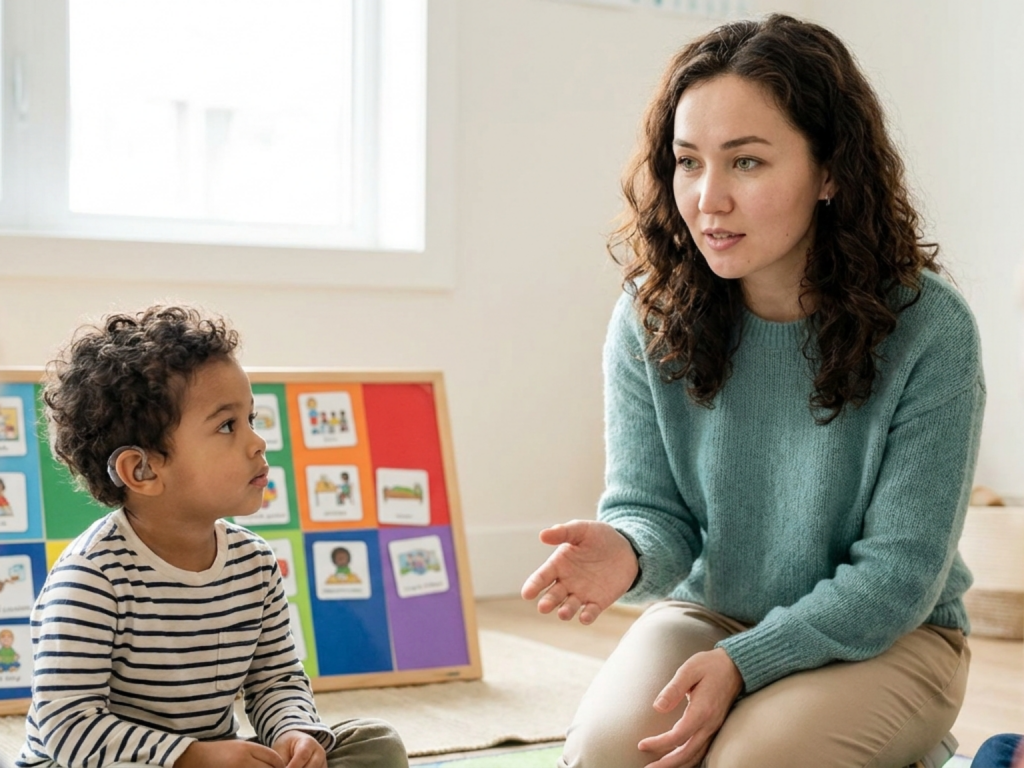
While waiting for assessment or intervention, adults can reduce listening load without lowering expectations. Get the child’s attention first, move close, use a calm voice, and give one instruction at a time. After the child succeeds, gradually increase complexity. This supports learning while preventing a cycle of repeated failure.
Helpful strategies include:
- Pair spoken directions with gestures, pictures, objects, or demonstration.
- Use short, specific sentences: “Put the cup on the table,” rather than a long explanation.
- Ask the child to show or tell what comes next, without turning it into a test.
- Reduce background noise during important instructions.
- Read interactively by pausing, naming pictures, asking simple questions, and retelling events.
- Praise effort and successful listening behaviors, such as looking, asking for help, or checking understanding.
Teachers can help by seating the child near the speaker, using predictable routines, previewing transitions, and providing visual schedules. These accommodations benefit many preschoolers, not only those with identified delays. If a child consistently needs extra support, documentation of what helps can guide referral and intervention planning.
Emotional safety is essential. Avoid shaming phrases such as “You never listen.” A more helpful phrase is, “That was a lot to remember. Let’s do the first part together.” Preschoolers learn listening through warm repetition, meaningful language, and adults who interpret difficulty as a need for support.
Outlook and early support
The outlook depends on the underlying contributors, severity, timing, and access to support. Some listening problems improve when hearing issues are treated, classroom noise is reduced, or instructions are adjusted. Others reflect broader receptive language or developmental needs and benefit from targeted early intervention, family coaching, and preschool collaboration.
Early support can protect more than vocabulary. Listening affects peer play, safety instructions, emotional regulation, and early literacy. A child who understands stories and conversation is better positioned to learn new words, follow routines, and participate socially. Because preschool brains are highly plastic, timely support can make a meaningful difference.
Parents do not need to know the exact cause before asking for help. A clear description such as “my child often does not understand directions unless I show them” is enough to begin a conversation with a pediatrician, audiologist, teacher, or speech-language professional. The most helpful approach is curious, systematic, and kind: observe patterns, rule out hearing issues, assess language and attention, and build supports around the child’s real needs.
Seek prompt medical advice if
- Your child loses previously acquired words, listening skills, or social responsiveness.
- There is poor response to loud or familiar sounds, especially after infancy.
- Listening problems follow head injury, meningitis, severe infection, or neurologic symptoms.
- Recurrent ear pain, drainage, fever, or suspected hearing loss is present.
- The child’s difficulty understanding speech creates safety risks or major distress.
Tools & Assistance
- Schedule a pediatric visit to discuss hearing, development, sleep, and behavior concerns.
- Request an age-appropriate audiology evaluation if listening concerns persist.
- Ask for a speech-language pathologist evaluation of receptive language and listening comprehension.
- Share written examples from home and preschool, including what supports help.
- Use visual routines, reduced background noise, and short step-by-step directions.
FAQ
Can a preschooler have listening problems with normal hearing?
Yes. Hearing is only one part of listening. Language comprehension, attention, working memory, auditory discrimination, and classroom noise can all affect how well a child understands speech.
Is ignoring instructions always a behavior problem?
No. What looks like refusal may reflect missed words, limited comprehension, overload, or difficulty remembering multiple steps. Persistent patterns should be assessed rather than punished.
Should my child have a hearing test even if they passed the newborn screen?
Often, yes. Hearing can change after infancy, and mild, intermittent, or one-sided hearing loss may not be obvious at home. An audiologist can advise on appropriate testing.
Do bilingual preschoolers commonly seem to have listening delays?
A child may understand less in a less familiar language, but bilingualism itself does not cause a disorder. Evaluation should consider all languages the child hears and uses.
What can I do today while waiting for appointments?
Use short directions, get close before speaking, reduce background noise, show what you mean, and confirm understanding gently. Keep notes about patterns and successful supports.
Sources
- National Center for Biotechnology Information (NCBI) / PubMed Central — Separating the Causes of Listening Difficulties in Children
- Taylor & Francis Online / Scandinavian Journal of Educational Research — Measuring Listening Comprehension and Predicting Language Development in At-Risk Preschoolers
- Experience Early Learning — How Children Develop Listening Skills
Disclaimer
This article is for informational purposes only and does not replace evaluation, diagnosis, or treatment by a qualified healthcare professional. Consult your child’s clinician, audiologist, or speech-language pathologist for individualized advice.














Please log in to leave a comment.