
Intro
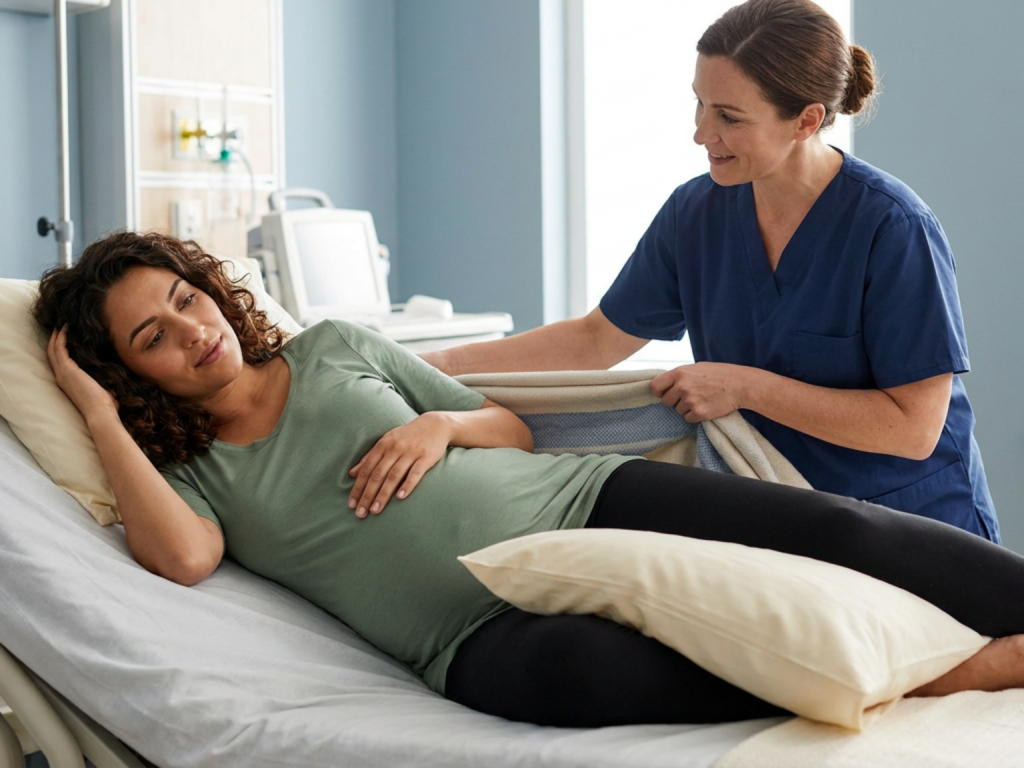
Side-lying is one of the most adaptable positions in labor. It can offer rest during a long first stage, reduce strain on the back and pelvis, and provide a calm, controlled option for the second stage of labor when the baby is descending and birth is approaching.
Highlights
Side-lying can help a laboring person rest without needing to lie flat on the back, which may improve comfort and maintain flexibility in labor positioning.
During pushing, a supported side-lying position may allow slower, more controlled descent of the presenting part, which is one reason it is associated with less perineal trauma in some evidence.
This position is especially useful when fatigue, epidural-related leg weakness, back pain, or the need for close fetal monitoring makes upright movement harder.
Side-lying is not a single rigid posture; pillows, peanut balls, partner support, and clinician assistance can all be used to adapt it safely.
Why side-lying matters in labor
Side-lying is often underestimated because it looks quiet compared with walking, lunging, kneeling, or squatting. Yet quiet does not mean passive. In labor, a side-lying position can reduce unnecessary muscular effort while still allowing the uterus to contract effectively and the baby to rotate and descend. For many people, it becomes a bridge between movement and rest: the body is not immobilized, but it is no longer carrying its full weight.
In the first stage of labor, side-lying may be used when contractions are frequent, sleep is needed, the birthing person is exhausted, or mobility is limited by an epidural, intravenous line, continuous monitoring, or clinical fatigue. Lying on the side with one or both knees bent, often supported by pillows under the belly and between the knees, can reduce tension in the hips and lower back. It also avoids the prolonged flat-on-the-back posture that many people find uncomfortable during labor.
In the second stage of labor, side-lying can be adapted for pushing and birth. This is clinically meaningful because the second stage of labor is not simply about forceful pushing; it also involves fetal descent, internal rotation, soft-tissue stretching, maternal oxygenation, and coordinated responses to contractions. A position that supports rest between contractions and controlled effort during contractions may be valuable, especially when the pushing stage is long or emotionally intense.
Resting side-lying before active pushing
Side-lying for rest is most often used during the first stage of labor or during a pause before active pushing begins. The position is usually set up with the birthing person lying on the left or right side, the lower leg slightly bent for stability, and the upper knee bent and supported. A pillow under the abdomen can decrease the pulling sensation on the uterine ligaments, while a pillow between the knees can keep the pelvis more neutral.
This can be especially helpful during a long labor when conserving energy becomes as important as coping with each contraction. Resting does not mean labor has stopped. The uterus continues its work, and the cervix may continue to dilate and efface. For some people, reduced adrenaline and lower muscular guarding can even make contractions feel more manageable.
Side-lying can also be changed subtly without fully getting out of bed. A nurse, midwife, doula, or partner may help adjust the top knee forward or backward, place a peanut ball between the thighs, or roll the pelvis slightly toward the mattress or ceiling. These small adjustments may change pressure in the pelvis and relieve back discomfort. If fetal monitoring is being used, clinicians can help find a side-lying arrangement that maintains a good tracing while preserving comfort.
Because every labor is different, the goal is not to stay on one side indefinitely. Some teams encourage switching sides periodically, especially when labor progress, fetal position, or maternal comfort suggests a change. The birthing person’s sensations are important clinical information: pressure, relief, nausea, urge to bear down, back pain, or hip strain may all guide whether the position should be maintained or modified.
Using side-lying during the pushing stage
In the pushing stage, the side-lying pushing position usually involves the birthing person lying on one side while the upper leg is supported by a partner, nurse, midwife, stirrup, or pillows. The upper hip may be flexed toward the abdomen, but it should not be forced beyond comfort. The lower leg provides stability, and the upper knee opens space through the pelvis while allowing the perineum to stretch gradually.
One reason this position is valued is that it can reduce the intensity of downward pressure compared with some upright or deeply flexed positions. Slower descent of the presenting part may give the perineal tissues more time to stretch. Evidence discussed in birth-position literature suggests that supported side-lying may be associated with reduced severe perineal trauma and lower rates of instrumental birth in some settings. This does not guarantee a tear-free birth, but it supports the idea that position can influence tissue loading and birth mechanics.
Side-lying can also support physiologic pushing. Instead of immediate, prolonged, closed-glottis pushing as soon as full dilation is identified, some people benefit from waiting until an involuntary urge to bear down becomes clear, if maternal and fetal conditions are reassuring. This is sometimes called laboring down or delayed pushing. It may be particularly relevant when an epidural reduces sensation or when the baby is still high in the pelvis at full dilation.
For many people, breathing during pushing changes in side-lying. Some use open-glottis pushing, releasing sound or air while bearing down, rather than holding the breath for a fixed count. Others use shorter, focused pushes with rest between efforts. The safest approach depends on fetal status, maternal condition, the type of analgesia, and the clinical team’s assessment.
Pelvic mechanics, fetal descent, and perineal support
Labor positions affect the relationship among the sacrum, pelvic outlet, fetal head, and soft tissues. In side-lying, the pelvis is asymmetrical rather than fully upright or fully supine. This asymmetry may help some babies rotate, particularly when the upper leg is supported in a way that creates space through the inlet or outlet. A peanut ball may be used with an epidural to maintain hip opening without requiring active leg strength.
Side-lying also limits direct pressure on the sacrum compared with lying flat on the back. When the sacrum has more freedom to move, pelvic diameters may be more accommodating during descent. This does not mean side-lying is always superior to upright positions; rather, it is one useful option within a larger toolkit of labor positioning.
Perineal support during birth can be integrated into side-lying more easily than many people expect. A clinician may be able to visualize the perineum, assess crowning, apply warm compresses if appropriate, and coach slower emergence of the head. The side-lying angle may make it easier for the birthing person to pause, pant, breathe, or reduce force when the head is stretching the perineum.
The position may also reduce the likelihood of someone being coached into forceful pushing when the body is not ready. Research and physiologic birth guidance increasingly emphasize self-determined positioning, variable second-stage length, and respect for the natural urge to push. If fetal heart rate, maternal blood pressure, bleeding, and progress are reassuring, the clinical team may have more room to support patience rather than urgency.
Who may benefit from side-lying
Side-lying can be useful in many labor contexts, but it is particularly appealing when the birthing person needs rest. Long early labor, a prolonged active phase, or a demanding transition can leave someone depleted before the baby is born. A position that allows the muscles of the legs, shoulders, jaw, and abdomen to soften between contractions may help preserve energy for the work of pushing stage and delivery.
People using epidural analgesia often find side-lying practical because leg strength and balance may be reduced. With staff support, the upper leg can be safely positioned without requiring standing or squatting. This can make side-lying a helpful option for those who want an alternative to giving birth on the back but cannot safely use unsupported upright positions.
Side-lying may also help when there is back labor, pelvic girdle pain, hip fatigue, or a need to reduce pressure on hemorrhoids or the tailbone. Some people feel less exposed in this position, which can matter emotionally during the vulnerability of the second stage. Feeling safer and less observed may reduce tension and improve the ability to follow bodily cues.
However, side-lying is not automatically best for everyone. If there are concerns such as nonreassuring fetal heart rate patterns, significant bleeding, shoulder dystocia risk requiring rapid maneuvers, severe maternal instability, or an urgent need for operative delivery, clinicians may recommend a different position. The key is flexibility: side-lying is an option to discuss and try when appropriate, not a rule to defend at all costs.
How to set up the position safely
A safe side-lying setup begins with alignment and support. The birthing person should be close enough to the edge of the bed for the clinician to assist if birth is near, but not so close that there is a fall risk. The lower shoulder, hip, and knee should be comfortable, and the head and neck should be supported without excessive flexion.
- Place a pillow behind the back if the person feels unstable or needs help staying on the side.
- Use a pillow or peanut ball between the knees to reduce hip strain and maintain pelvic opening.
- Support the upper leg with a person, stirrup, or pillow rather than forcing the knee upward.
- Keep the upper foot relaxed when possible, because unnecessary tension in the leg can travel into the pelvic floor.
- Adjust the angle of the torso if breathing, reflux, fetal monitoring, or comfort requires a change.
During pushing, communication matters. The birthing person can tell the team if the upper hip feels overstretched, if numbness occurs, or if the position no longer feels effective. Support people should avoid pulling the leg aggressively. Gentle, sustained support is usually preferable to high-force hip flexion.
If a baby is crowning, the team may ask for smaller pushes, pauses, panting, or breathing through a contraction. These instructions are not about withholding effort; they are often intended to allow controlled birth of the head and shoulders. In side-lying, this pacing can feel more intuitive because the body is already in a supported, less braced posture.
Working with your care team and birth preferences
If side-lying is important to you, it can be included in a birth preferences discussion before labor. Ask your obstetrician, midwife, or labor nurse how they support side-lying for rest, delayed pushing, and birth. Some units are very comfortable with side-lying birth; others may use it mainly for rest or fetal heart rate recovery. Knowing this ahead of time can reduce surprises.
It may help to use specific language: “I would like to try side-lying for rest if I become tired,” or “If mother and baby are stable, I would like the option of side-lying pushing.” This keeps the preference clear while acknowledging that clinical circumstances may change. A doula or support person can help remind the team of these preferences, especially if the birthing person is coping with intense sensations.
Side-lying also fits well with a broader approach to the Pushing stage and delivery overview: frequent reassessment, respect for maternal cues, attention to fetal station, and willingness to change positions when needed. No position should become a trap. If side-lying reduces pain, supports descent, and feels safe, it may be worth continuing. If it increases hip pain, slows progress in a concerning way, or interferes with monitoring or urgent care, it can be changed.
Ultimately, side-lying is not about achieving a perfect natural birth image. It is about giving the body another evidence-informed option: one that can provide rest, protect dignity, support physiologic pushing, and allow careful clinical observation. For many families, that combination is exactly what is needed in the powerful final hours before meeting the baby.
When to get clinical guidance promptly
- Ask your care team before changing position if fetal monitoring is concerning or continuous assessment is required.
- Report dizziness, shortness of breath, chest pain, heavy bleeding, or sudden severe pain immediately.
- Do not force the upper leg into extreme flexion, especially with epidural numbness or hip pain.
- If the urge to push occurs before full dilation is confirmed, call your clinician or nurse for assessment.
- Follow emergency positioning instructions if shoulder dystocia, fetal distress, or urgent operative birth is suspected.
Tools & Assistance
- Discuss side-lying birth preferences with your obstetrician or midwife before labor.
- Practice supported side-lying with pillows or a peanut ball during childbirth education or at home.
- Ask the labor nurse how to switch sides safely with monitors, IV lines, or epidural tubing.
- Use a doula or support person to help communicate comfort, fatigue, and position preferences.
- Request individualized guidance for pushing technique based on fetal status and your medical situation.
FAQ
Can I give birth in side-lying if I have an epidural?
Often, yes, with staff support. Because an epidural can reduce leg strength and sensation, the upper leg should be supported carefully and position changes should be supervised.
Does side-lying prevent tearing?
It cannot guarantee prevention, but some evidence suggests supported side-lying may reduce severe perineal trauma. Tissue stretch, fetal size and position, speed of birth, and prior history also matter.
Which side should I lie on during labor?
Either side may be used. The best side depends on comfort, fetal heart rate response, fetal position, monitoring quality, and clinical guidance.
Is side-lying slower than squatting or upright pushing?
Not necessarily. Some data suggest supported side-lying may shorten active pushing by a small average amount, but individual outcomes vary. Position should be reassessed based on comfort and progress.
Can I delay pushing while side-lying?
In some situations, yes. If the cervix is fully dilated and mother and baby are stable, clinicians may support waiting for a stronger natural urge to push, especially with an epidural.
Sources
- National Center for Biotechnology Information (PMC) — Healthy Birth Practice #5: Avoid Giving Birth on Your Back
- Mayo Clinic — Labor positions
- Evidence Based Birth — Evidence on: Birthing Positions
Disclaimer
This article is for informational purposes only and does not replace individualized medical advice. Always consult your obstetrician, midwife, or labor care team about safe positioning and pushing guidance for your situation.


















Please log in to leave a comment.