
Intro
Labor is dynamic, and the position that feels helpful at one point may feel very different an hour later. Hands-and-knees, upright, side-lying, squatting, kneeling, sitting, and semi-reclined positions can all have a place, depending on comfort, fetal position, monitoring needs, epidural use, fatigue, and clinical safety.
This article compares hands-and-knees with other common labor and pushing positions, with attention to pelvic mechanics, back labor, fetal oxygenation, occiput posterior fetal position, and practical decision-making. It is not about finding one universally “best” posture; it is about understanding options so you can work with your care team and your body.
Highlights
Hands-and-knees often helps back labor by reducing pressure on the sacrum and spine, especially when the fetus is occiput posterior.
Upright positions may use gravity and pelvic mobility to support descent, but they can be tiring and are not ideal for every clinical situation.
Side-lying is often a valuable compromise for rest, epidural analgesia, fetal monitoring, or when a slower, more controlled birth is preferred.
Back-lying or semi-reclined positions may be clinically useful, but prolonged flat supine positioning can reduce maternal comfort and may affect blood flow in some people.
Position choice should remain flexible and individualized, particularly if there are concerns about fetal heart rate, bleeding, epidural density, or operative birth planning.
Why position matters in labor
Labor position affects more than comfort. It can influence pelvic outlet shape, maternal blood flow, uterine alignment, fetal descent, pain perception, and access for clinical assessment. The pelvis is not a fixed ring; the sacrum, coccyx, pubic symphysis, and maternal soft tissues respond to posture, hip rotation, and weight-bearing. Small changes, such as leaning forward, widening the knees, or internally or externally rotating the thighs, can change how the fetal head meets the pelvic inlet, midpelvis, and outlet.
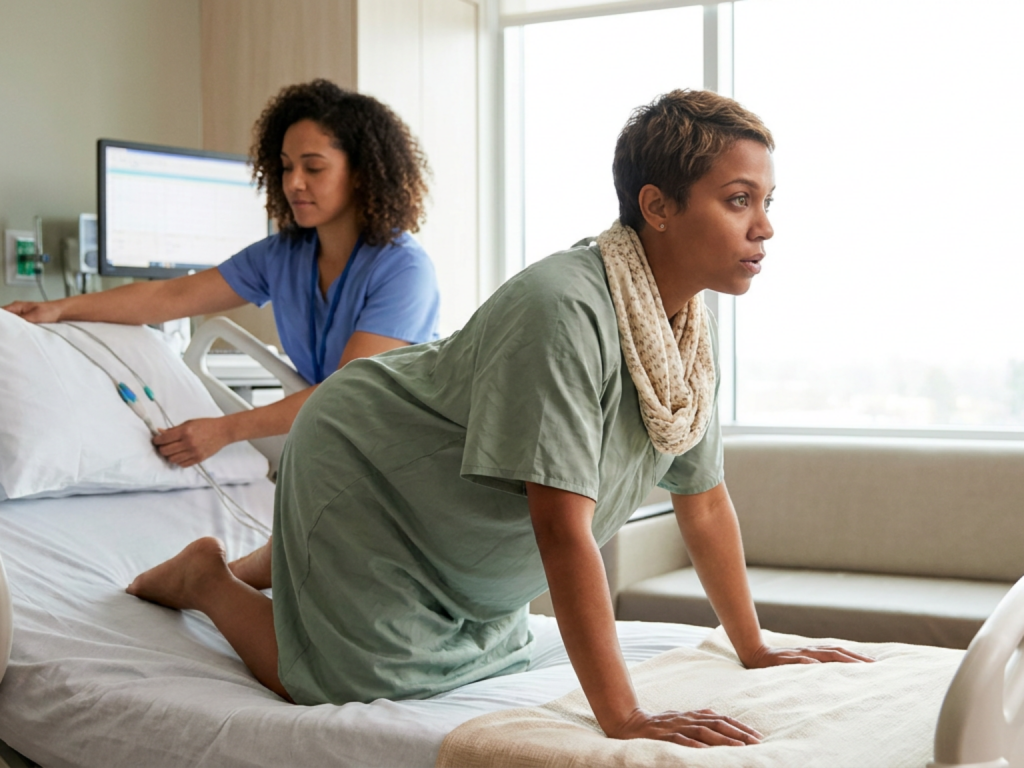
Hands-and-knees is one of several forward-leaning positions used in active labor and second stage. In this posture, the pregnant person supports weight through the hands or forearms and knees, with the abdomen suspended. This can reduce direct pressure on the lumbar spine and sacrum, which is why it is commonly suggested for back labor and fetal position concerns. It also allows gentle pelvic rocking during contractions, which may help the laboring person respond instinctively to pain and pressure.
Other positions offer different advantages. Standing and walking may enhance mobility and use gravity. Squatting may increase pelvic outlet dimensions but requires strength and support. Side-lying can provide rest and can be safer when balance, anesthesia, or fetal monitoring is a concern. Semi-reclined positions provide easy access for examinations and assisted birth but may put more pressure on the sacrum. The most useful strategy is usually not one static position, but changing positions during contractions as labor evolves.
Hands-and-knees: main benefits and mechanisms
The defining feature of hands-and-knees is forward inclination with the abdomen hanging away from the spine. This can decrease lumbar and sacral pressure, making it particularly attractive for intense posterior back pain. When the fetal occiput is posterior, the harder part of the fetal head may press toward the maternal sacrum, contributing to back labor and a slower, more uncomfortable labor pattern. Hands-and-knees can reduce that pressure even if it does not always rotate the fetus.
A randomized controlled trial of hands-and-knees positioning in labor for occipitoposterior fetal position found that the position significantly reduced persistent back pain and was acceptable to laboring women. The trial did not conclusively prove that hands-and-knees rotated the fetal head to occipitoanterior, but it showed favorable trends in outcomes such as operative delivery and Apgar scores. In practical terms, this supports hands-and-knees as a reasonable comfort and coping option, especially for back labor and fetal position concerns.
Hands-and-knees may also be useful because it frees the sacrum. In many reclined positions, the sacrum is pressed into the bed, limiting posterior movement as the fetal head descends. In hands-and-knees, the sacrum can move more freely, and the pelvis can rock, tilt, or sway. Some people find that this gives them a sense of control during contractions.
There are several variations. A person may rest on hands, forearms, a birth ball, pillows, or the raised head of the bed. Knees can be close together, wide apart, or asymmetrical, depending on comfort and clinical guidance. During pushing, hands-and-knees may help some people breathe the baby down gradually, while others may need more support under the chest, wrists, or knees to avoid fatigue.
How hands-and-knees compares with upright positions
Upright positions include standing, walking, slow dancing, lunging, sitting on a birth ball, supported kneeling, and squatting. Compared with hands-and-knees, these positions place the torso more vertical and may use gravity more directly to encourage fetal descent. Evidence summaries suggest that upright birthing positions are associated with less pain, fewer abnormal fetal heart rate patterns, and reduced need for vacuum or forceps compared with back-lying positions. Standing and squatting have also been associated with a shorter second stage in some evidence reviews.
Standing and walking are often helpful earlier in labor when contractions are manageable and the person has enough energy. They allow rhythmic movement, hip circles, and leaning into a partner, bed, wall, or counter. For some, walking helps labor feel productive. For others, especially during transition or intense back labor, standing can feel overwhelming or unstable.
Squatting during childbirth can widen the pelvic outlet and may intensify downward pressure. This can be beneficial when the fetus is low and pushing is effective. However, deep squatting is physically demanding, can increase perineal stretch quickly, and may not be suitable for people with dense epidural block, balance concerns, certain fetal heart rate concerns, or significant fatigue. Supported squats using a bar, partner, or bed may make the position more accessible.
Hands-and-knees sits between upright and resting positions. It is not as gravity-dependent as standing or squatting, but it provides mobility, sacral freedom, and relief from spinal pressure. For a person with occiput posterior fetal position and severe back pain, hands-and-knees may feel more tolerable than standing. For someone whose labor has slowed and who feels strong, upright positions during labor may be more energizing. Many people alternate between the two rather than choosing one exclusively.
How hands-and-knees compares with side-lying and semi-reclined positions
Side-lying is one of the most versatile labor positions. It can allow rest, reduce pressure on the vena cava compared with flat supine positioning, and support continuous fetal monitoring or epidural analgesia. A peanut ball or pillows between the knees may help maintain pelvic opening. Side-lying pushing position can also slow the speed of crowning, which may be desirable when the clinician is supporting gradual perineal stretching or monitoring fetal response.
Compared with hands-and-knees, side-lying generally requires less upper-body effort. This matters in long labors, after many hours of contractions, or when the person has wrist, shoulder, or knee discomfort. It may also be easier for clinicians to maintain fetal monitoring, adjust epidural tubing, or perform examinations. However, side-lying does not always provide the same immediate relief from back pressure that hands-and-knees can offer.
Semi-reclined positioning is common in many birth settings because it is familiar, provides clear access for the care team, and may feel secure to the laboring person. It may be appropriate for some epidural births, maternal exhaustion, operative vaginal delivery assessment, or situations requiring close observation. Still, prolonged semi-reclined or back-lying positions can concentrate pressure on the sacrum and may worsen back labor for some people.
Flat supine positioning deserves special caution. In late pregnancy, lying flat on the back can contribute to aorto-caval compression, where the pregnant uterus compresses major blood vessels and may reduce venous return and uteroplacental blood flow. Not everyone experiences symptoms, and clinical teams can tilt or reposition the body, but this is one reason many clinicians avoid prolonged flat back-lying labor positions when alternatives are feasible.
Fetal position, back labor, and rotation
Fetal position is a major reason hands-and-knees is discussed. In an occiput anterior position, the back of the fetal head faces the front of the maternal pelvis, which often aligns well for descent. In an occiput posterior fetal position, the back of the fetal head faces the maternal back. Many fetuses rotate during labor, but persistent fetal malposition in labor can be associated with longer labor, more back pain, and increased likelihood of operative vaginal or cesarean birth.
Hands-and-knees is often suggested because it changes the relationship between the uterus, fetus, and maternal spine. The abdomen hangs forward, and the fetal back may have more room to shift. Some clinicians also suggest pelvic rocking, abdominal sifting by trained support persons, lunges, asymmetrical kneeling, or side-lying release-type movements, depending on local practice and the person’s comfort. The evidence is strongest for pain relief rather than guaranteed fetal rotation.
This distinction is important and compassionate: if hands-and-knees does not rotate the baby, that does not mean the laboring person did anything wrong. Fetal rotation depends on fetal size, head flexion, pelvic shape, uterine contraction pattern, parity, epidural effects, and soft tissue resistance. Positioning is a tool, not a test of effort.
For back labor and fetal position concerns, a reasonable approach is to try hands-and-knees for several contractions, then reassess. Is the back pain less intense? Is the fetal heart rate reassuring? Is the person coping better? Does the position feel sustainable? If yes, it may be worth continuing or returning to later. If not, side-lying, supported kneeling, standing lean, or a lunge may be better.
Epidural, monitoring, and clinical limitations
Hands-and-knees is often possible with an epidural, but it depends on motor strength, sensation, blood pressure stability, fetal monitoring requirements, and unit protocols. A light or “walking” epidural may allow supported hands-and-knees on the bed with staff assistance. A dense block may make it unsafe because knees, hips, or arms may not support weight reliably. In that case, modified forward-leaning positions, exaggerated side-lying, or use of a peanut ball may offer some of the same pelvic benefits with less fall risk.
Continuous fetal monitoring can sometimes be maintained in hands-and-knees, especially with wireless monitors, internal monitoring when clinically indicated, or careful adjustment of external transducers. However, signal loss may occur. If there are fetal heart rate concerns, the care team may prioritize positions that optimize monitoring and fetal response. Sometimes hands-and-knees improves comfort and fetal status; other times left or right lateral positioning, IV fluids, blood pressure support after epidural, or other interventions may be needed.
Hands-and-knees may also be difficult with severe knee pain, wrist problems, shoulder instability, high body fatigue, certain IV or anesthesia equipment configurations, or immediate need for assisted birth maneuvers. None of these limitations means the position is “bad.” It simply means the safest position is context-dependent.
It is helpful to ask early in labor what movement options are available in that setting. People planning an epidural can ask about position changes after epidural analgesia, use of a peanut ball, wireless monitoring availability, and staff support for turning. People hoping to avoid epidural analgesia can still benefit from discussing safe movement during fetal monitoring, especially if induction medications or other risk factors make continuous monitoring likely.
Choosing positions during pushing
The second stage of labor introduces new considerations: fetal descent, maternal urge to push, pelvic outlet mechanics, perineal stretching, fetal heart rate, and clinician access. Hands-and-knees can be an excellent pushing position for some people, particularly when back pressure is intense or when they feel an instinctive need to lean forward. It may allow the sacrum to move and can reduce the feeling of being pinned to the bed.
Squatting can be powerful in second stage but may accelerate descent. This may be welcome when progress is slow and both parent and baby are tolerating labor well. It may be less ideal when crowning is very rapid, the perineum needs controlled support, or the person is too tired to maintain the position. Supported kneeling, with the torso upright and arms resting on a raised bed, can be a middle ground between squatting and hands-and-knees.
Side-lying pushing is often useful when the person needs rest, has an epidural, or benefits from slower crowning. Semi-reclined pushing may be appropriate when the care team needs rapid access, when the person feels most coordinated in that posture, or when operative vaginal delivery is being considered. Vacuum or forceps delivery, if needed, usually requires specific positioning for safety and access.
Rather than committing to one pushing posture, many teams use a sequence: side-lying for rest, hands-and-knees for back pressure, upright kneeling for stronger descent, then a position that allows safe birth of the head and shoulders. The best position is the one that supports maternal physiology while preserving fetal wellbeing and clinical safety.
Practical ways to use hands-and-knees safely
Hands-and-knees is most effective when it is supported, not forced. Padding under the knees, a stable surface under the hands or forearms, and help with tubing or monitors can make a major difference. The bed can be adjusted so the person leans over the raised head of the bed rather than bearing full weight on the wrists. A birth ball or stacked pillows can support the chest and reduce arm fatigue.
Many people try the position for a defined period, such as three to six contractions, and then reassess. During that time, the hips can remain still, rock forward and back, sway side to side, or make small circles. Some people prefer knees wide with feet closer together; others prefer a more neutral stance. If there is pelvic girdle pain, hip pain, or symphysis pubis dysfunction, wide or asymmetrical positions may need caution.
Communication is essential. Tell the nurse, midwife, or physician if you feel dizzy, numb, unstable, short of breath, or unable to support your weight. If fetal monitoring is difficult, ask whether a brief adjustment, wireless monitor, or alternative forward-leaning position is possible. If hands-and-knees feels emotionally vulnerable, that matters too; birth positions should support dignity as well as mechanics.
A flexible birth plan can name preferences without creating pressure. For example: “I would like help trying hands-and-knees for back labor if it is safe,” or “Please offer upright, side-lying, and forward-leaning options during labor.” This invites support while recognizing that labor sometimes requires adaptation. The goal is not perfect positioning; it is responsive, respectful care.
When to get clinical guidance before changing position
- Ask for help before moving if you have an epidural, leg numbness, dizziness, or low blood pressure.
- Call the care team promptly if fetal heart rate monitoring alarms, loses signal repeatedly, or staff have expressed concern.
- Avoid unsupported hands-and-knees if you feel weak, sedated, unstable, or unable to bear weight safely.
- Seek immediate assessment for heavy bleeding, severe abdominal pain between contractions, or sudden change in fetal movement before labor.
- Follow clinician guidance if operative vaginal birth, urgent cesarean evaluation, shoulder dystocia maneuvers, or other emergency care is being considered.
Tools & Assistance
- Ask your birth team which positions are available with your monitoring plan and pain relief choices.
- Use pillows, a birth ball, a raised bed, or a squat bar to modify positions safely.
- Practice supported hands-and-knees, side-lying, kneeling, and standing leans during late pregnancy if your clinician says movement is safe.
- Create a flexible birth preference note that asks staff to suggest position changes during active labor.
- Consider childbirth education or pelvic-floor physical therapy for individualized movement strategies.
FAQ
Is hands-and-knees better than lying on my back?
For many people, especially with back labor, hands-and-knees is more comfortable and reduces sacral pressure. However, back-lying or semi-reclined positions may be needed for specific assessments or interventions.
Can hands-and-knees turn a posterior baby?
It may help create room and reduce back pain, but evidence does not prove it reliably rotates every occiput posterior baby. Rotation depends on many fetal and maternal factors.
Can I use hands-and-knees with an epidural?
Sometimes. It depends on leg strength, sensation, blood pressure, monitoring, and staff support. Modified forward-leaning or side-lying positions may be safer with a dense block.
How long should I stay in one labor position?
There is no universal time. Many people reassess after several contractions, changing sooner if pain worsens, monitoring is difficult, or they feel unstable.
Which position is best for pushing?
The best pushing position depends on comfort, fetal descent, fetal heart rate, epidural effects, perineal control, and whether assisted birth might be needed. Flexibility is usually more useful than a fixed plan.
Sources
- PubMed (National Center for Biotechnology Information) — Randomized controlled trial of hands-and-knees positioning for occipitoposterior fetal position
- Mayo Clinic — Labor positions
- Evidence Based Birth — Evidence on: Birthing Positions
Disclaimer
This article is for informational purposes only and does not replace individualized medical advice. Discuss labor positions, fetal monitoring, pain relief, and safety concerns with your midwife, obstetrician, nurse, or other qualified healthcare professional.















Please log in to leave a comment.