
Intro
Standing and walking during labor can feel instinctive: many people naturally want to sway, lean, pace, or change direction as contractions build. These upright positions use gravity, mobility, and pelvic movement to support the physiologic work of labor while also giving the birthing person a sense of participation and control.
Highlights
Upright and ambulant positions in the first stage of labor are associated with shorter labor and may reduce the chance of cesarean birth compared with lying-down positions.
Standing and walking are not single fixed techniques; they can include swaying, leaning on a partner, using a wall or bed for support, slow pacing, and brief rest breaks.
Safety matters: mobility should be adapted to fetal monitoring needs, epidural analgesia, rupture of membranes, dizziness, bleeding, or any medical concern identified by the care team.
There is no one ideal position for every contraction. The most useful approach is usually flexible movement guided by comfort, labor progress, and clinical circumstances.
What standing and walking mean in labor
Upright positions in labor include any posture in which the torso is more vertical than horizontal: standing, walking, sitting, kneeling, lunging, squatting, or leaning forward over a support. This article focuses on standing and walking, two common forms of movement during the first stage of labor, when the cervix effaces and dilates and contractions become progressively stronger.
Standing in labor does not mean remaining rigidly upright. Many people stand with knees soft, hips loose, and upper body supported by a partner, bed, wall, counter, birth ball, or squat bar. Walking also does not need to be continuous exercise. It may mean slow pacing around the room, taking a few steps between contractions, circling the hips while holding a support, or walking to the bathroom and back. The goal is not athletic performance; it is comfort, pelvic mobility, and physiologic responsiveness.
These positions are most often discussed for the first stage of labor, especially early and active first stage labor. During the second stage, some people continue upright movement or transition to supported standing, kneeling, squatting, side-lying, or semi-reclining positions depending on fetal descent, energy, pain relief, and clinical guidance. Because labor is dynamic, upright movement is best understood as one option within a larger menu rather than a rule.
Why upright positions may help labor progress
The potential benefits of standing and walking are grounded in both mechanics and neurohormonal physiology. When a person is upright, gravity may help the fetal presenting part apply pressure to the cervix. That pressure can contribute to cervical dilation through local mechanical effects and through the Ferguson reflex, in which stretch receptors stimulate oxytocin release and stronger coordinated uterine contractions.
Upright posture may also improve the relationship between the fetus and pelvis. The pelvis is not a fixed ring; the sacrum, coccyx, and pelvic joints have small but meaningful mobility. Walking, swaying, and changing direction can encourage subtle changes in pelvic diameters and help the fetus rotate, flex the head, and descend. This is especially relevant when contractions are effective but progress feels slow, although position alone cannot correct every labor pattern.
Recumbent positions, particularly lying flat on the back, may contribute to aorto-caval compression in late pregnancy for some people. This occurs when the gravid uterus compresses major blood vessels, potentially reducing venous return and affecting maternal blood pressure and uteroplacental perfusion. Many clinicians therefore encourage lateral, tilted, semi-upright, or upright alternatives when appropriate.
Evidence summarized in a Cochrane review indicates that upright and ambulant positions during the first stage are associated with a shorter first stage, lower rates of cesarean birth, reduced epidural use, and no increase in adverse maternal or neonatal effects compared with recumbent positions. Other clinical literature similarly categorizes upright options such as standing, sitting, kneeling, squatting, and walking, and reports improved labor progress, reduced pain levels, and higher maternal satisfaction compared with lying-down postures.
Standing during contractions
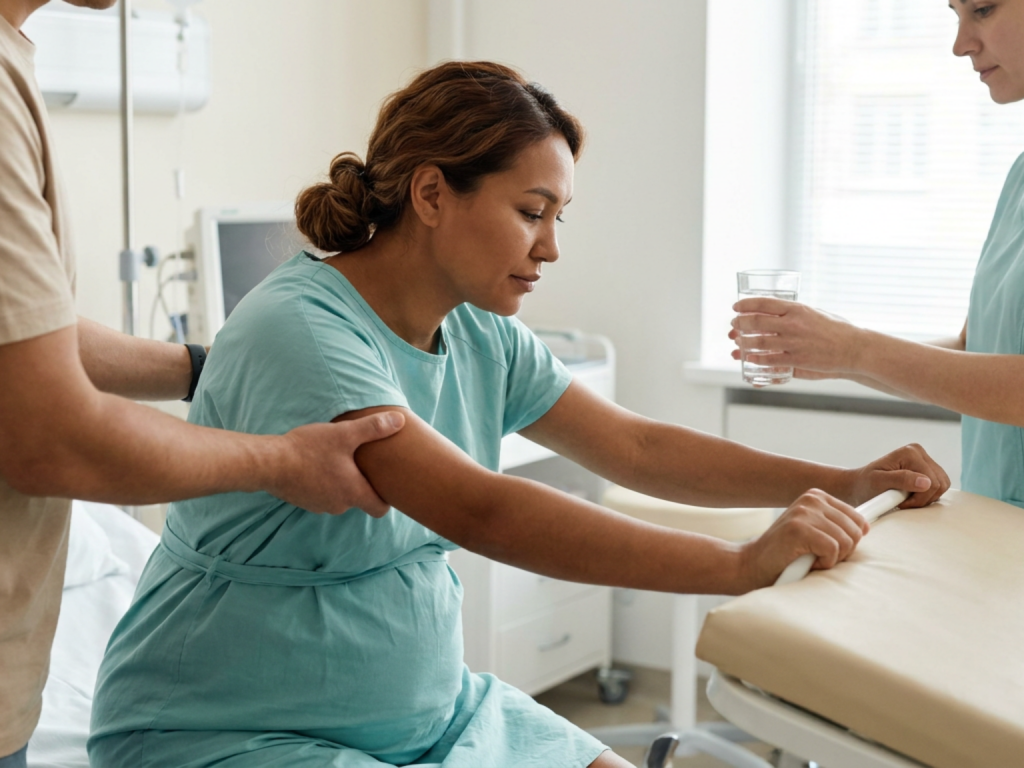
Standing can be especially useful when contractions are strong enough to require focus but the birthing person still wants to remain mobile. A supported standing position decreases the muscular effort needed to stay upright and lets the body release tension. For example, the person may stand facing a partner and hang the arms around the partner’s shoulders during a contraction, or lean forward onto a raised hospital bed with forearms supported. This forward-leaning stance can be helpful for back labor because it gives space for sacral movement and allows counterpressure on the lower back if desired.
Common standing variations include:
- Standing and swaying the hips slowly from side to side during contractions.
- Leaning forward onto a bed, wall, sink, or partner to reduce leg fatigue.
- Placing one foot on a low stool for a gentle lunge, if balance is secure and a clinician agrees.
- Using pelvic rocking during contractions to vary pressure and encourage fetal rotation.
- Standing under a warm shower if the birth setting permits and monitoring needs allow it.
Breathing and relaxation remain important. Some people tense the shoulders, jaw, or buttocks while standing through contractions, which can increase fatigue. A support person can remind them to soften the jaw, drop the shoulders, and bend the knees slightly. Nurses, midwives, doulas, and obstetric clinicians can help adjust height, support surfaces, and movement patterns to protect stability.
Standing is not always comfortable or safe for long periods. Dizziness, shaking, nausea, intense fatigue, heavy bleeding, concerning fetal heart rate patterns, or a request from the clinical team are reasons to sit, lie laterally, or be reassessed. The best position is the one that supports both comfort and safety in the moment.
Walking between contractions
Walking during labor is usually most effective when it is slow, purposeful, and adapted to the contraction pattern. In early labor, walking may help manage restlessness and encourage contractions to establish a rhythm. In active labor, the pattern may shift to a few steps between contractions, then stopping to lean, breathe, sway, or hold a partner when the contraction peaks. Changing positions during contractions can make walking more sustainable because the body is not forced to cope with every surge in the same way.
Walking can also support emotional coping. Movement may reduce the feeling of being confined to the bed, and it can give the birthing person a sense of agency. For some, pacing provides a rhythm for breathing. For others, walking becomes overstimulating, and stillness or side-lying feels better. Both responses are normal.
Practical walking strategies include:
- Walk in a clear, uncluttered path with non-slip footwear or bare feet if safe.
- Pause at each contraction and use a stable surface or partner for support.
- Keep IV lines, monitors, and tubing organized to prevent tripping.
- Use short loops in the room or hallway rather than long distances that increase fatigue.
- Alternate walking with rest, hydration if allowed, bathroom visits, and quiet breathing.
Walking is not a test of endurance. Labor already requires substantial metabolic work, and exhaustion can affect coping later. A balanced approach often works best: movement when it feels helpful, rest when the body asks for it, and reassessment when labor changes.
Pain, coping, and satisfaction
Labor pain has multiple components: uterine muscle activity, cervical dilation, pelvic pressure, tissue stretching, fatigue, fear, and prior pain experience. Upright positions may reduce pain for some people by changing pressure patterns, improving the sense of control, and allowing instinctive movement. Walking or standing may also make contractions feel more productive, even if they are still intense.
Forward-leaning labor positions can be particularly helpful when pain is concentrated in the lower back, sometimes called back labor. Leaning over a bed or partner while standing allows the sacrum to move and creates access for sacral counterpressure during contractions. Gentle hip circles, double-hip squeeze, warm compresses, and rhythmic breathing can be combined with upright positioning, depending on preferences and clinical context.
Maternal satisfaction is not determined only by birth outcome. Feeling listened to, being offered options, and having permission to move can shape the experience. Research on upright and recumbent positions has reported higher satisfaction among people using upright positions, likely reflecting both physiologic comfort and increased autonomy. However, satisfaction also depends on expectations, communication, pain relief access, and whether movement remains safe and feasible.
It is also valid not to want to stand or walk. Some people cope better in side-lying, hands-and-knees, sitting, or a supported semi-reclined posture. Others prefer neuraxial analgesia, which may limit independent ambulation depending on motor strength and institutional policy. Supportive care means offering choices without making anyone feel they have failed if they need rest, medication, or a different plan.
Safety considerations and when to modify movement
Standing and walking are generally considered safe for many low-risk labors, but they should be individualized. The clinical team may recommend modification based on maternal vital signs, fetal heart rate tracing, gestational age, bleeding, suspected infection, medication use, membrane status, presentation, or the need for continuous monitoring. A person with dizziness, faintness, significant anemia, hypertensive complications, or heavy sedation may need closer assistance or bed-based positions.
After rupture of membranes, many people can still move, but the care team may assess fetal presentation and station. If the presenting part is high or not well applied to the cervix, clinicians may be more cautious because of concerns such as umbilical cord prolapse, a rare but urgent event. If there is sudden severe pain, visible cord, abnormal fetal heart rate, or a feeling that something is wrong, immediate clinical attention is essential.
External fetal monitoring does not always require staying in bed. Many hospitals have telemetry or wireless monitoring, and even wired monitors may allow standing near the bed or limited movement. Safe movement during fetal monitoring depends on signal quality, tubing, staff availability, and the reason monitoring is being used. If continuous monitoring is medically indicated, ask what range of motion is possible rather than assuming bed rest is required.
Epidural analgesia requires special caution. Some epidurals produce minimal motor block, while others cause leg weakness, altered proprioception, or low blood pressure. Position changes after epidural analgesia should be guided by staff assessment of strength, sensation, blood pressure, and fetal status. In many settings, walking after an epidural is not permitted, but upright alternatives such as supported sitting, throne position, side-lying with a peanut ball, or assisted kneeling may still be options.
How to plan for upright movement in a birth setting
Planning does not mean predicting exactly how labor will unfold. It means creating conditions that make upright movement possible if it is safe and desired. During prenatal visits, consider asking whether the birth setting supports walking in labor, wireless monitoring, use of showers, birth balls, squat bars, or support from a doula. If induction is planned, ask how medications, IV lines, and monitoring may affect mobility.
In the hospital or birth center, tell the nurse or midwife that you would like to use upright positions during labor if appropriate. They can help raise the bed to the right height for leaning, secure monitor belts, arrange IV tubing, suggest safe paths, and identify when rest is advisable. A partner or support person can help by staying close during contractions, offering a steady arm, reminding the birthing person to empty the bladder, and watching for trip hazards.
Useful preparation includes practicing a few positions before labor begins. Rehearse leaning on a counter, slow dancing with a partner, swaying with bent knees, and stopping from a walk to breathe through a contraction. These rehearsals are not about mastering choreography; they build familiarity so the body has options under stress.
During labor, the plan should remain flexible. If standing feels good at 4 centimeters but overwhelming at 8 centimeters, change. If walking helps in early labor but becomes tiring later, rest. If the fetal heart rate tracing requires a different posture, collaborate with the team. Upright positions in active labor are valuable tools, not obligations, and the safest care respects both physiology and clinical judgment.
When to pause movement and call for help
- Do not continue walking if you feel faint, weak, unsteady, or short of breath.
- Call the care team promptly for heavy vaginal bleeding, severe constant pain, or a sudden change in fetal movement before hospital arrival.
- After epidural analgesia, do not stand or walk unless staff explicitly assess and assist you.
- If membranes rupture and you see or feel something like a cord, seek emergency help immediately.
- Follow clinical guidance if fetal monitoring, blood pressure changes, induction medications, or complications require modified positioning.
Tools & Assistance
- Discuss mobility preferences in a prenatal visit with your obstetrician or midwife.
- Ask the birth unit about wireless monitoring, showers, birth balls, and hallway walking policies.
- Practice supported standing, swaying, and leaning positions with your support person before labor.
- Use hospital staff, a doula, or childbirth educator to adapt positions safely during labor.
FAQ
Can standing or walking make labor faster?
Evidence suggests that upright and ambulant positions in the first stage can shorten labor compared with recumbent positions. Individual labor progress still depends on many factors, including contraction pattern, fetal position, parity, and medical circumstances.
Is it safe to walk after my water breaks?
Often it may be safe, but it depends on fetal presentation, station, fetal heart rate, and your overall situation. Ask your care team for individualized guidance, especially if the baby’s head is high or there are concerning symptoms.
Can I use upright positions with continuous fetal monitoring?
Sometimes yes. Wired or wireless monitoring may still allow standing, swaying, or limited walking if the signal remains adequate and the care team agrees.
What if I get an epidural?
Independent walking is often restricted after epidural analgesia because leg strength and balance may be affected. Staff can usually help with safe position changes in bed or supported upright alternatives.
Do I have to keep moving for upright positions to work?
No. Brief standing, swaying, leaning, or a few steps between contractions can be enough. Rest is also an important labor tool.
Sources
- Cochrane — Mothers' position during the first stage of labour
- National Institutes of Health / PubMed Central — Examining the impact of upright and recumbent positions on labor progress, duration of childbirth, pain, and maternal satisfaction
- Mayo Clinic — Labor positions
Disclaimer
This article is for informational purposes only and does not replace individualized medical care. Always consult your obstetrician, midwife, nurse, or other qualified healthcare professional about labor positioning and safety.
















Please log in to leave a comment.