
Intro
Labor is dynamic, and the position that helps at one moment may feel ineffective or even uncomfortable an hour later. Choosing the right position for labor is less about finding one perfect posture and more about having safe, evidence-informed options that support comfort, fetal descent, pelvic mobility, and clinical monitoring when needed.
For many birthing people, movement can restore a sense of agency during an intense physiologic process. Your care team can help you adapt positions to your medical situation, pain relief choices, fetal monitoring needs, and birth setting.
Highlights
No single labor position is best for everyone; comfort, safety, fetal status, and clinical context all matter.
Upright positions during labor may improve comfort, support uterine efficiency, and help the fetus align with the pelvis.
Supine positioning can be useful briefly for assessment, but prolonged flat-on-the-back labor may be less physiologic for many people.
Epidural analgesia, continuous monitoring, fatigue, or medical complications do not necessarily mean staying still; supported movement may still be possible.
The best plan is flexible: discuss preferences early, then adjust with your midwife, obstetrician, nurse, or doula during labor.
Why position matters in labor physiology
Labor position affects more than comfort. It changes how gravity, the uterus, the pelvis, the pelvic floor, and the fetus interact. During contractions, the uterus pulls upward and forward while the cervix dilates and the fetus descends. Positions that allow the pelvis to move can help the fetal head flex, rotate, and find the most favorable pathway through the pelvic inlet, midpelvis, and outlet.
Upright positions during labor, such as standing, walking, sitting, kneeling, or supported squatting, may improve the alignment between the uterus and birth canal. They can also make contractions feel more effective because the fetus applies pressure to the cervix in a more physiologic direction. Some evidence suggests upright postures are associated with shorter second-stage labor, less severe pain, fewer instrumental births, fewer fetal heart rate abnormalities, and reduced episiotomy rates compared with supine positions.
Position also influences maternal circulation. Lying flat on the back can allow the gravid uterus to compress the inferior vena cava and aorta, a phenomenon often called aorto-caval compression. This may reduce venous return, maternal blood pressure, uteroplacental perfusion, and fetal oxygenation in susceptible situations. Not everyone experiences this dramatically, but many hospitals and birth teams avoid prolonged flat supine positioning, especially in later labor.
At the same time, labor is individual. A person who feels dizzy upright, has dense neuraxial analgesia, needs close assessment, or is exhausted may benefit from side-lying or semi-reclined support. The goal is not to perform an idealized birth posture; it is to match positioning to physiology, safety, and the birthing person’s lived experience.
Early labor: conserve energy and keep mobility gentle
Early labor can last many hours, especially in a first birth. The cervix is beginning to soften, efface, and dilate, and contractions may be irregular or gradually intensifying. In this phase, choosing the right position often means balancing movement with rest. Overexertion early in labor can leave a person depleted when active labor begins.
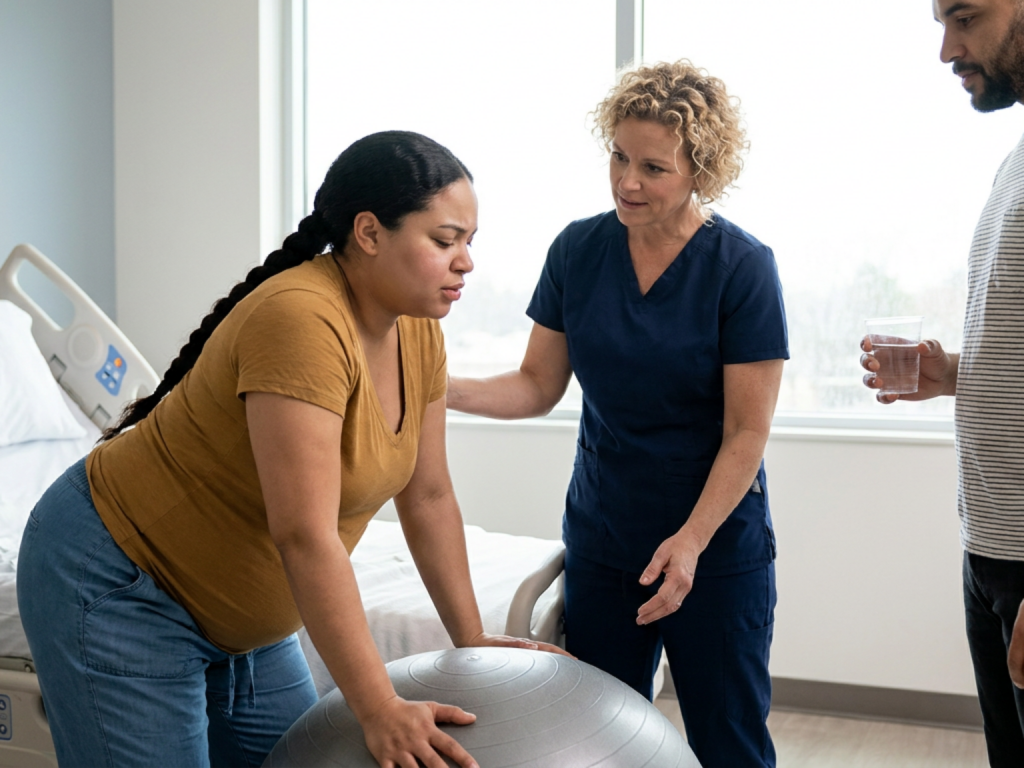
Walking, slow stair climbing, pelvic rocking, and swaying can be helpful when contractions are manageable and the membranes are intact or fluid is clear and the care team has no concerns. Sitting on a birth ball with the feet supported can encourage pelvic mobility while reducing strain. Leaning forward over a counter, bed, or partner may relieve low back pressure and help the abdomen hang freely.
Rest is also a valid labor strategy. Side-lying with pillows between the knees can reduce pelvic and sacral pressure while conserving energy. A semi-reclined position may be useful for napping between contractions, eating or drinking if permitted, or receiving intermittent fetal assessment. Some people alternate between 20 to 30 minutes of movement and 20 to 30 minutes of rest, although the timing should remain flexible.
Early labor is a good time to notice patterns: Does walking increase contraction regularity? Does side-lying calm an overstimulating contraction pattern? Does forward leaning reduce back labor? These observations can guide later decisions. If contractions become very painful early, bleeding occurs, fetal movement decreases, fluid is green or foul-smelling, or there are medical concerns, contact the maternity unit or clinician rather than relying on position changes alone.
Active labor: use gravity, asymmetry, and forward leaning
Active labor usually involves stronger, more regular contractions and more rapid cervical change. This is often when position becomes a central comfort measure. Many people instinctively prefer to be upright, leaning forward, or moving rhythmically. These choices are not simply emotional coping tools; they may help pelvic diameters change and encourage fetal rotation.
Forward-leaning labor positions can be especially useful when contractions are felt in the back or when the fetus is suspected to be occiput posterior, meaning the back of the fetal head is toward the birthing person’s spine. Leaning over the raised head of the bed, a birth ball, a chair, or a partner can reduce pressure on the sacrum. The hands-and-knees position for back labor may also allow the abdomen to hang forward, creating space for fetal repositioning and reducing spinal pressure.
Asymmetrical positions can be powerful in active labor. Examples include standing with one foot on a low stool, kneeling with one knee forward, side-lying with the upper leg supported, or lunging during contractions. These postures change the shape of the pelvic inlet and outlet, sometimes helping a baby navigate a tight angle or rotate more effectively. They should be done with stable support, especially if the birthing person is tired, dizzy, medicated, or connected to equipment.
Changing positions in active labor can also support emotional endurance. A position may work beautifully for several contractions, then become intolerable. That is normal. The nervous system, pelvic floor, fetal station, and contraction pattern are constantly changing. Rather than interpreting discomfort as failure, it can be a cue to try a new orientation: upright to side-lying, side-lying to hands-and-knees, standing to sitting, or leaning to kneeling.
Positions for back labor and pelvic pressure
Back labor often refers to intense pain in the lower back or sacrum during contractions. It can occur for many reasons, including fetal position, pelvic anatomy, muscle tension, or the way pain is referred through shared nerve pathways. Position changes cannot guarantee correction of fetal position, but they may reduce pain intensity and improve coping.
Hands-and-knees is a commonly used option. It shifts the uterus away from the spine, may reduce sacral pressure, and allows the pelvis to move freely. Rocking forward and back, circling the hips, or lowering the chest while keeping the hips elevated may feel helpful. Some people prefer a supported variation, such as leaning over a birth ball placed on the bed, which reduces wrist and shoulder fatigue.
Side-lying position during contractions can be restorative, especially when the birthing person is exhausted or has an epidural. Placing a peanut ball or pillows between the knees can keep the pelvis open while allowing rest. If the upper leg is supported higher than the lower leg, this may create an asymmetrical pelvic opening. The care team can help avoid excessive hip strain or nerve compression.
Sacral counterpressure during contractions is often paired with these positions. A partner, doula, nurse, or midwife applies firm pressure to the sacrum or lower back, usually with the heel of the hand, a fist, or a warm compress. Some people prefer double hip squeeze pressure, while others dislike touch during contractions. Consent and feedback matter; comfort measures should be adjusted continuously.
Warm water, if available and medically appropriate, may complement positioning by reducing muscle guarding. However, water immersion, showering, or tub use should follow facility policies and clinical guidance, particularly after membrane rupture, with epidural analgesia, or when continuous monitoring is recommended.
The second stage: pushing positions and pelvic outlet space
The second stage begins at complete cervical dilation and continues until birth. Pushing positions can influence maternal effort, fetal descent, perineal stretch, and the clinician’s access for assessment or assistance. Evidence and many professional recommendations support avoiding routine prolonged supine pushing when alternatives are safe and desired.
Supported squatting in labor can widen certain pelvic outlet dimensions and use gravity. It may be done with a squat bar, partner support, a birthing stool, or a sheet held for leverage. Because squatting can be physically demanding and may increase pressure quickly, it is often used for selected contractions rather than continuously. People with joint instability, significant fatigue, dense epidural block, dizziness, or certain fetal concerns may need a modified version.
Kneeling and all-fours positions can reduce sacral pressure and may give the birthing person more control over pushing intensity. These positions can be helpful when rapid descent causes intense perineal stretching, because the person may find it easier to breathe, pause, or use spontaneous pushing rather than prolonged closed-glottis pushing. They may also reduce the sense of being observed, which some people find emotionally protective.
Side-lying pushing is a useful option when rest, fetal monitoring, epidural analgesia, or blood pressure concerns make upright pushing difficult. It can allow the sacrum more mobility than flat supine positioning and may help slow a very fast crowning phase. A nurse, midwife, partner, or doula can support the upper leg while protecting the hip from over-flexion.
Semi-reclined pushing is common because it allows access for fetal heart rate assessment and perineal support. For some people it works well, especially if they feel stable and can curl around the uterus during contractions. If it becomes painful in the sacrum or ineffective for descent, small adjustments may help: tilt to one side, raise the head of the bed, lower one leg, or alternate with side-lying.
When monitoring, epidural analgesia, or IV therapy are needed
Medical equipment can change positioning options, but it does not always eliminate movement. Continuous fetal monitoring, IV fluids, antibiotics, oxytocin, blood pressure cuffs, or epidural analgesia may require additional planning. Ask the team what movement is safe rather than assuming bed rest is mandatory.
Mobility-compatible fetal monitoring may allow standing, swaying, sitting on a birth ball, or using the bathroom with assistance, depending on the device, signal quality, and clinical situation. If external monitors slip during movement, a nurse may need to reposition them. In some cases, internal monitoring or continuous bedside assessment is recommended; the reason should be explained whenever possible.
Position changes after epidural analgesia require careful support. With a light or mobile epidural, some facilities permit assisted standing or limited movement, but policies vary. With a dense block, independent standing is unsafe because leg strength, proprioception, and blood pressure may be impaired. Even then, frequent repositioning in bed can be beneficial. Options include left lateral, right lateral, exaggerated side-lying with a peanut ball, throne position, supported sitting, or hands-and-knees with multiple staff members if appropriate.
IV lines and medication infusions can usually be managed with attention to tubing, pump location, and fall prevention. People receiving magnesium sulfate, significant antihypertensives, or other medications that affect alertness or strength may need more restricted positioning. The key is shared decision-making: what is the clinical goal, what are the risks, and what alternatives preserve as much comfort and autonomy as possible?
How to choose in the moment
A practical approach is to ask three questions during labor: What sensation am I trying to change? What does the baby need clinically? What can be done safely in this setting? If the main sensation is back pressure, forward leaning, hands-and-knees, side-lying with leg support, or counterpressure may help. If the main issue is exhaustion, a restful lateral position may be wiser than walking. If contractions feel less effective, upright or asymmetrical positioning may be worth trying if mother and fetus are stable.
It can help to think in short trials. Try a position for three to five contractions, then reassess. If it improves coping, stay. If it worsens pain, causes dizziness, reduces fetal heart rate reassurance, or feels emotionally wrong, change. Labor preferences are valid even when they are difficult to explain. A position that looks effective to observers may not be the right choice for the person experiencing it.
Discuss preferences before labor, especially if you hope to avoid prolonged supine positioning, want access to a birth ball or squat bar, or plan to use epidural analgesia while still changing positions. A birth plan can state: “I would like support for movement and position changes as medically appropriate.” This keeps the request clear without making it rigid.
Partners and doulas can be helpful by offering options rather than instructions. Simple prompts such as “Would you like to lean forward?” or “Do you want pressure on your back?” preserve autonomy. Clinicians can support this by explaining when a position is recommended for fetal heart rate recovery, blood pressure management, perineal visualization, or operative birth preparation. The right position for labor is ultimately one that respects physiology, clinical safety, and the birthing person’s voice.
When position changes are not enough
- Seek immediate clinical guidance for heavy bleeding, severe headache, chest pain, fainting, seizure, or sudden shortness of breath.
- Report decreased fetal movement, concerning fetal heart rate patterns, or green or foul-smelling amniotic fluid promptly.
- Do not stand or walk unassisted after epidural analgesia unless your care team confirms it is safe.
- Change position and notify staff if lying flat causes dizziness, nausea, sweating, or a drop in blood pressure.
- Follow individualized advice for placenta previa, significant hypertension, preterm labor, fetal growth restriction, or other high-risk conditions.
Tools & Assistance
- Ask your maternity unit which positions, birth balls, peanut balls, squat bars, showers, or tubs are available.
- Practice several labor positions with your partner or doula before birth so they feel familiar.
- Include flexible position preferences in your birth plan and review them with your clinician.
- During labor, ask your nurse or midwife to suggest position changes based on fetal station, comfort, and monitoring.
- Use stable supports and assistance whenever you feel weak, dizzy, medicated, or connected to equipment.
FAQ
Is lying on my back always unsafe during labor?
Not always. Brief supine positioning may be useful for exams or procedures, but prolonged flat-on-the-back labor can be uncomfortable and may reduce circulation for some people. Ask about side-tilt, semi-reclined, or lateral alternatives.
Can I change positions with an epidural?
Often yes, but the type of movement depends on leg strength, blood pressure, facility policy, and clinical status. Many people can use supported side-lying, peanut ball, throne, or lateral positions in bed.
Which position is best for pushing?
There is no universal best position. Squatting, kneeling, side-lying, all-fours, and semi-reclined positions may each be appropriate depending on comfort, fetal status, epidural effect, and clinician access.
Do upright positions reduce labor pain?
Many people report less pain or more control when upright or leaning forward. Evidence suggests upright positions can reduce pain intensity compared with supine positions, but individual responses vary.
What if my care team asks me to change position suddenly?
Sometimes position changes are used to improve fetal heart rate, maternal blood pressure, or access for urgent care. You can ask for a brief explanation when feasible, but safety may require quick action.
Sources
- Evidence Based Birth — Evidence on: Birthing Positions
- National Center for Biotechnology Information / PubMed Central — Alternative Birthing Positions Compared to the Conventional Posture
- Mayo Clinic — Labor positions
Disclaimer
This article is for general educational purposes and does not replace individualized medical advice. Always consult your obstetrician, midwife, or maternity care team about safe labor positions for your situation.


















Please log in to leave a comment.