
Intro
A fever in a baby can be frightening, especially when your child is too young to explain how they feel. Fever itself is not an illness; it is a physiologic response, usually to infection, and it can occur with both mild viral illnesses and serious bacterial disease. The challenge for caregivers is knowing when a temperature can be watched with guidance and when it needs urgent medical assessment.
In babies, age matters. A temperature that might be less concerning in an older child can be dangerous in a newborn or young infant because their immune system is still immature and serious infections may initially show only subtle signs. This article explains the fever thresholds, red flags, and practical next steps that should prompt you to contact a pediatric clinician or seek emergency care.
Highlights
Any baby younger than 3 months with a temperature of 100.4°F or 38°C or higher needs prompt medical advice, and many guidelines advise urgent evaluation.
Fever becomes more concerning when it comes with poor feeding, lethargy, breathing difficulty, a non-blanching rash, dehydration, repeated vomiting, or unusual crying.
How your baby looks and behaves often matters as much as the number on the thermometer, especially in older babies.
Do not rely on touch alone to judge fever; use an appropriate thermometer and share the method and reading with a healthcare professional.
What counts as fever in a baby?
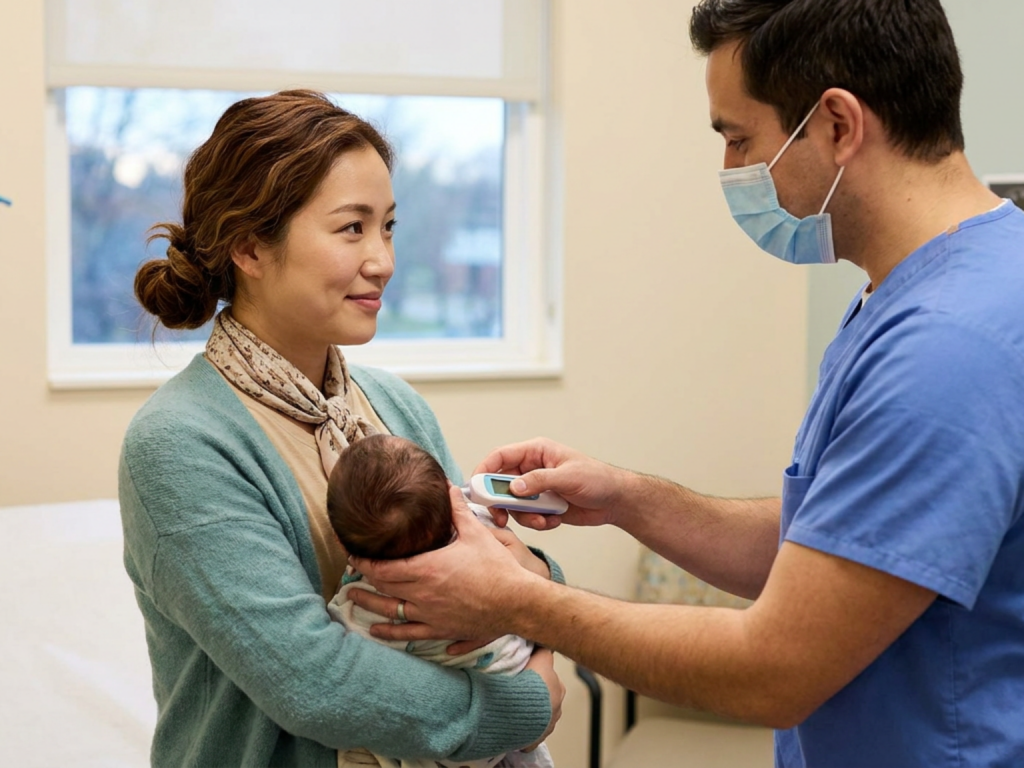
Fever is commonly defined as a body temperature of 100.4°F or 38°C or higher. In infants, the method of measurement matters. Rectal temperature is often considered the closest practical estimate of core body temperature in young babies, while forehead, ear, oral, and underarm readings can vary depending on technique, age, device quality, and environmental conditions.
If you call a clinician, try to report the exact number, the thermometer type, where you measured it, the time it was taken, and whether your baby had recently been bundled, bathed, crying hard, or sleeping in a warm room. Overheating from excessive layers can raise temperature, but a true fever still deserves careful attention, particularly in very young infants.
A warm forehead or flushed cheeks can alert you to check, but touch is not reliable enough to decide whether a baby has a fever. If you are unsure how to measure temperature safely for your baby’s age, ask your pediatric office for instructions before an illness occurs.
Why fever is riskier in newborns and young infants
Fever in young babies is taken seriously because newborns and early infants may not localize or contain infections as effectively as older children. Serious bacterial infections, urinary tract infections, bacteremia, meningitis, and pneumonia may begin with fever as the main or only early sign. A newborn can look only mildly unwell at first and then worsen quickly.
For babies younger than 3 months, a temperature of 100.4°F or 38°C or higher should prompt immediate medical contact. Many pediatric and emergency care resources recommend urgent evaluation for infants in this age group. For babies younger than 2 months, guidance is especially cautious: a rectal temperature above 100.4°F generally requires immediate emergency evaluation.
This does not mean every fever in a young infant is life-threatening. Many are caused by viruses. But clinicians often need to examine the baby, assess feeding and hydration, and sometimes perform tests to distinguish a routine infection from a dangerous one. It is not something caregivers are expected to sort out alone at home.
Temperature thresholds that should raise concern
The temperature number is only one part of the assessment, but certain thresholds are important. In a baby younger than 3 months, 100.4°F or 38°C or higher is the key threshold for urgent medical advice. In any child, very high fever, such as over 104°F or 40°C, is a reason to contact a healthcare professional promptly, especially if the baby appears ill or the fever is not coming down with appropriate care.
In babies older than 3 months, clinicians consider the temperature, duration of fever, vaccination status, medical history, and overall appearance. A baby who is alert, feeding, producing wet diapers, breathing comfortably, and consolable is usually less concerning than a baby with the same temperature who is difficult to wake, refusing fluids, breathing fast, or persistently vomiting.
Fever that lasts more than a day or two in a young baby, fever that returns after seeming to improve, or fever in a baby with a known immune problem, heart condition, prematurity history, or complex medical condition should be discussed with the baby’s healthcare team. If your instincts tell you something is wrong, it is appropriate to seek help even if the temperature is not extremely high.
Red flags: symptoms that can make fever dangerous
Some symptoms suggest that fever may be associated with a serious infection, dehydration, neurologic involvement, or respiratory distress. Seek urgent medical advice if fever occurs with any of the following:
- Difficulty breathing, grunting, bluish lips, pauses in breathing, chest retractions, or unusually fast breathing.
- Extreme sleepiness, limpness, poor responsiveness, confusion, or a baby who is difficult to wake.
- Poor feeding, fewer wet diapers than usual, very dry mouth, no tears when crying, sunken eyes, or other signs of dehydration.
- Persistent vomiting or diarrhea, repeated vomiting, green vomit, blood in stool or vomit, or inability to keep fluids down.
- A rash that does not fade when pressed, widespread purple spots, stiff neck, bulging soft spot, seizure, or a high-pitched or inconsolable cry.
Caregivers often worry about whether they are overreacting. With babies, it is safer to ask. A clinician would rather hear from you early than see a baby later after dehydration or breathing problems have progressed. When describing symptoms, include how long they have been present, whether they are worsening, and how your baby is behaving between fever spikes.
Dehydration and feeding: why they matter so much
Fever increases fluid needs. Babies also lose fluid through vomiting, diarrhea, sweating, and faster breathing. Because infants have relatively small fluid reserves, dehydration can develop more quickly than many caregivers expect.
Watch feeding patterns closely. A baby who takes slightly smaller feeds but remains alert and has regular wet diapers may be different from a baby who repeatedly refuses breast or bottle, falls asleep immediately when offered a feed, or has a weak suck. Track wet diapers, stool changes, tears, mouth moisture, and whether the soft spot appears more sunken than usual.
Do not force large volumes at once, especially if your baby is vomiting. Instead, contact a healthcare professional for individualized guidance. Young infants, babies with persistent vomiting or diarrhea, and babies with fewer wet diapers need prompt assessment. If your baby appears dehydrated, lethargic, or unable to keep fluids down, seek urgent care.
What to do while seeking medical advice
If your baby is younger than 3 months and has a temperature of 100.4°F or 38°C or higher, contact a clinician immediately or go to emergency care according to local guidance. Do not wait to see whether the fever goes away. If your baby is younger than 2 months with a rectal temperature above 100.4°F, emergency evaluation is generally recommended.
For an older baby who is otherwise stable, you can take practical supportive steps while you contact your pediatric office or monitor as advised. Keep the baby comfortably dressed, avoid overheating, and offer breast milk or formula more frequently if they are willing. Fever and baby sleep clothing can be tricky: choose light, safe layers rather than heavy bundling, and continue to follow safe sleep practices.
Do not give aspirin to babies or children. Do not use cold baths, alcohol rubs, or aggressive cooling. Fever medicine dosing depends on age, weight, medical history, and the specific medication, so use only clinician-approved guidance and the dosing device that comes with the medicine. If your baby is very young, has liver or kidney disease, is dehydrated, or is taking other medications, ask before giving any fever-reducing medicine.
When to use emergency care versus calling first
Go directly to emergency care or call emergency services if your baby has breathing difficulty, a seizure, blue or gray color, poor responsiveness, a non-blanching rash, signs of shock, severe dehydration, or you cannot safely transport the baby. Also seek immediate evaluation for a newborn or very young infant with fever according to the age thresholds above.
For less urgent but still concerning situations, an after-hours pediatric triage line can help you decide where to go and how quickly. Call if the fever is high, persistent, associated with worsening symptoms, or occurring in a baby with medical complexity. When to talk to pediatrician is not always obvious, and that uncertainty is exactly what pediatric triage systems are designed to help with.
Before calling, gather the temperature reading, your baby’s age in weeks or months, weight if known, symptoms, feeding history, wet diaper count, medications given, and any exposure to illness. Clear information helps the clinician assess risk more quickly.
Seek urgent help now if
- Your baby is younger than 3 months and has a temperature of 100.4°F or 38°C or higher.
- Your baby is younger than 2 months and has a rectal temperature above 100.4°F.
- Fever occurs with breathing difficulty, blue lips, limpness, poor responsiveness, or seizure.
- There are signs of dehydration, such as very few wet diapers, dry mouth, no tears, or inability to keep fluids down.
- Fever is accompanied by a non-blanching rash, stiff neck, bulging soft spot, or persistent inconsolable crying.
- The temperature is over 104°F or 40°C, or your baby looks seriously unwell at any temperature.
Tools & Assistance
- A reliable digital thermometer appropriate for your baby’s age
- Your pediatrician’s daytime number and after-hours pediatric triage line
- Local emergency services or the nearest pediatric emergency department
- A simple fever log with temperature, time, method, feeding, diapers, and medicines given
- Breast milk or formula offered in safe, small, frequent feeds while awaiting guidance
FAQ
Is fever always dangerous in babies?
No. Fever is often caused by common viral infections. However, fever in babies younger than 3 months can signal serious illness and needs prompt medical evaluation.
What temperature is an emergency for a newborn?
A rectal temperature above 100.4°F or 38°C in a baby younger than 2 months generally warrants immediate emergency evaluation.
Should I wake a sleeping baby to check for fever?
If your baby feels unusually hot, is very young, or has concerning symptoms, it is reasonable to check. If a young infant has a fever, seek medical advice immediately.
Can teething cause a dangerous fever?
Teething may cause mild discomfort or slight temperature changes, but a true fever of 100.4°F or 38°C or higher should not be dismissed as teething, especially in young infants.
What information should I give the doctor?
Share your baby’s exact age, temperature and measurement method, symptoms, feeding, wet diapers, medical history, vaccination status, and any medicines already given.
Sources
- Nemours KidsHealth — Fever (High Temperature) in Children
- Healthdirect Australia — Fever and high temperature in children and babies
- Children’s Hospital of Philadelphia — Fever in a Newborn
Disclaimer
This article is for informational purposes only and does not replace medical evaluation, diagnosis, or treatment. If your baby has a fever or concerning symptoms, contact a qualified healthcare professional or emergency service promptly.











Please log in to leave a comment.