
Intro
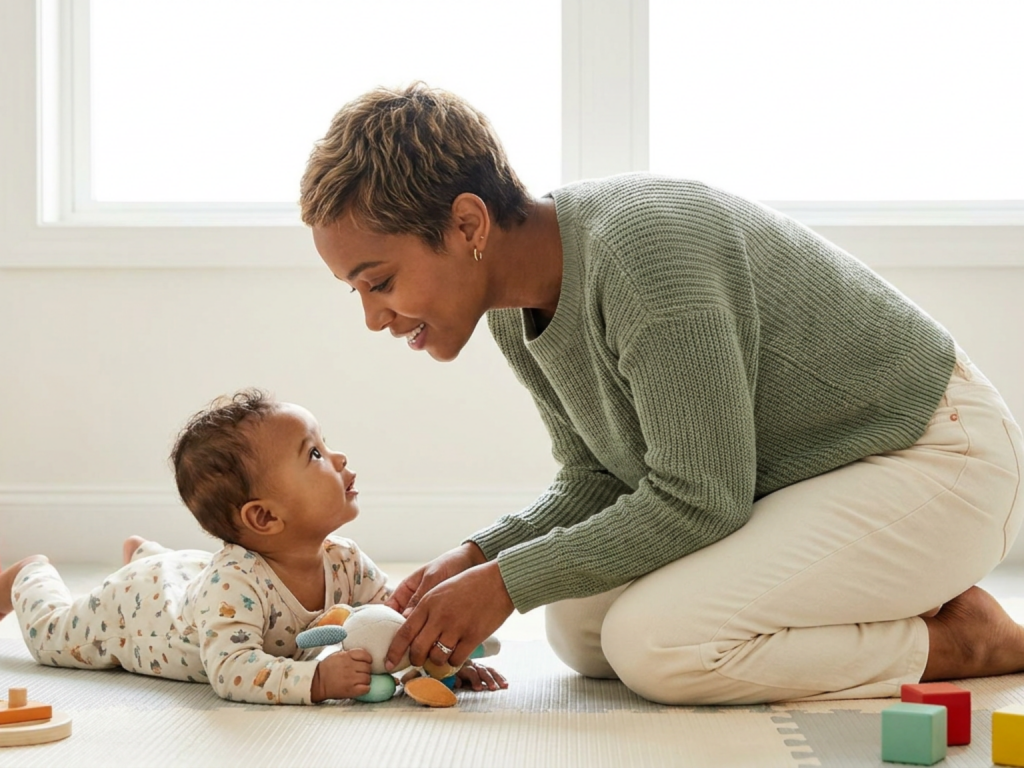
A baby’s first social world is small but biologically powerful. Long before a child can speak, they are learning through eye contact, touch, voice, facial expression, rhythm, and repeated moments of being noticed and answered. These early exchanges are not simply “cute” behaviors; they help shape attention, emotional regulation, early communication, and the foundations of later relationships.
Highlights
Babies interact from birth through gaze, crying, body movement, facial expression, feeding rhythms, and changes in alertness.
Responsive social interaction supports developing neural networks involved in attention, emotion regulation, cognition, and language.
Everyday moments such as talking, singing, reading, pausing for a baby’s response, and playful imitation can be developmentally meaningful.
Variation is common, but loss of previously acquired social or communication skills, persistent lack of response to sound, or marked feeding and alertness concerns should be discussed with a healthcare professional.
Interaction begins before words
Many parents wait for a first smile, a first laugh, or a first word as proof that their baby is “social.” In reality, infant social communication starts much earlier. A newborn may turn toward a familiar voice, settle with a caregiver’s smell or touch, widen their eyes when a face comes close, or cry in a way that reliably brings help. These are early infant communication cues, even though they do not yet look like conversation.
In the first weeks, interaction is often brief because newborns have limited stamina. A baby may look at a face for a few seconds, then look away, hiccup, yawn, fuss, or fall asleep. Looking away is not rejection; it is often self-regulation. The nervous system is managing light, sound, hunger, digestion, temperature, and social stimulation all at once.
As the months pass, social exchanges usually become more organized. Babies begin to hold eye contact longer, respond to voices with facial movement or cooing, and show pleasure when a caregiver repeats a sound or expression. This is the beginning of serve-and-return interaction: the baby sends a signal, the adult responds, and the baby experiences that communication has an effect.
How social interaction changes across the first year
Development is not a rigid timetable, and babies vary widely. Prematurity, illness, sensory differences, temperament, sleep, feeding challenges, and family stress can all influence how a baby engages. Still, broad patterns can help caregivers understand what they may be seeing.
- Newborn to 2 months: Babies often communicate through crying, gaze, rooting, body tension, relaxed posture, and changes in alertness. They may prefer human voices and faces, especially familiar ones.
- Around 2 to 4 months: Many babies show more social smiling, cooing, and pleasure during face-to-face interaction with babies. They may become animated when someone talks in a warm, rhythmic voice.
- Around 4 to 6 months: Babies may laugh, squeal, reach toward people, imitate simple sounds, and enjoy predictable games. They often become more active participants in play.
- Around 6 to 9 months: Many infants show clearer preferences for familiar caregivers, respond to their name inconsistently at first and then more reliably, and use gestures such as reaching or turning away.
- Around 9 to 12 months: Babies often use more intentional communication, such as pointing, showing objects, waving, clapping, or making sounds to get attention. Stranger wariness in infancy may also appear, reflecting growing recognition and attachment rather than “bad manners.”
These age ranges are approximate. A baby who is tired, hungry, overstimulated, recovering from illness, or in an unfamiliar environment may interact very differently from how they do at home when calm and rested.
Why interaction matters for the brain
Early social experience is closely linked with neurodevelopment. Scientific review evidence indicates that caregiver-infant social interactions are associated with infant and child neural responses, with links observed as early as three months after birth. The patterns of interaction matter: timing, emotional tone, reciprocity, and responsiveness all help shape functional connectivity networks involved in emotion regulation and cognition.
This does not mean every moment must be optimized. Babies do not need perfect adults; they need “good enough” repeated experiences of being noticed, soothed, and engaged. A caregiver who misses a cue, becomes tired, or needs to pause is not harming the baby. Repair is part of healthy interaction: the adult returns, reconnects, and the baby learns that small disruptions can be followed by safety.
From a developmental neuroscience perspective, repeated social exchanges help organize attention. When an adult’s face, voice, and gestures match what the baby is experiencing, the infant’s brain receives patterned input that is emotionally meaningful. Over time, these patterns support prediction: “When I make a sound, someone answers”; “When I am distressed, someone helps”; “When we look at the same toy, words describe it.”
Social play and language development
Language learning begins well before spoken words. Babies listen to rhythm, pitch, pauses, facial movements, and turn-taking. Research described by the University of Washington found that everyday social interactions with 5-month-old babies, particularly talking and playing socially, were associated with increased activity in brain regions involved in attention. That early brain activity predicted later language skills across toddlerhood.
For caregivers, the practical message is encouraging: ordinary interaction counts. You do not need expensive toys or a formal curriculum. Talking during diaper changes, naming body parts during dressing, singing while preparing a bottle, and pausing after a baby coos all build the structure of conversation.
Helpful strategies include:
- Narrate daily routines: “I’m washing your hands,” “Here comes your sock,” or “The water feels warm.”
- Imitate and expand: If the baby says “ba,” you might say “ba-ba” and smile, then wait.
- Read daily when possible: Board books, picture books, and even describing pictures for a few minutes can support shared attention.
- Sing and use rhythm: Songs make speech patterns easier for babies to notice and anticipate.
- Pause for response: A baby’s answer may be a blink, kick, sound, reach, or smile rather than a word.
The goal is not to quiz the baby. It is to create warm, repeated opportunities for the baby to connect sounds, faces, emotions, objects, and actions.
Interacting with siblings, relatives, and other babies
Babies benefit from a variety of safe, responsive relationships. A grandparent’s slower song, a sibling’s playful peekaboo, or a family friend’s gentle greeting can all offer different social rhythms. These interactions help babies learn that people vary in voice, facial expression, smell, movement, and emotional style.
With siblings, supervision is essential. Young children may love a baby intensely but lack impulse control. They may poke, squeeze, shout, offer unsafe objects, or become distressed when the baby cries. Adults can guide siblings with simple roles: “You can show the baby the rattle,” “Use a soft voice,” or “Let’s wait and see if the baby looks at you.”
Interaction with other babies can be interesting but is not the same as cooperative play. In the first year, babies may stare, touch, grab, vocalize, or cry in response to another infant. They are learning from proximity and sensory observation. Parallel presence, where babies are near each other but not truly playing together, is developmentally normal.
For babies who become overwhelmed in groups, reduce the intensity. Short visits, quieter rooms, fewer people at once, and predictable routines often help. A sensitive approach respects the baby’s nervous system rather than forcing sociability.
Temperament, sensory processing, and stranger wariness
Some babies beam at everyone; others study new people seriously before responding. Temperament influences how quickly a baby warms up, how intensely they react, and how much stimulation they can tolerate. A cautious baby is not necessarily delayed, and a highly social baby is not necessarily more advanced.
Sensory processing also affects social behavior. A baby who is sensitive to noise may turn away at gatherings. A baby with reflux, eczema, recurrent ear problems, feeding discomfort, or poor sleep may seem less socially available because their body is busy coping. Similarly, a baby who is hungry or overstimulated may cry when someone tries to play, even if they usually enjoy interaction.
Stranger wariness in infancy often emerges in the second half of the first year. It can be emotionally hard for relatives who feel rejected, but it is commonly a sign that the baby recognizes familiar caregivers and detects unfamiliar people. Gentle introductions help: let the baby stay in a caregiver’s arms, allow the unfamiliar person to speak softly from a short distance, and avoid passing the baby abruptly from one person to another.
When to ask for professional guidance
Parents often worry about whether their baby is interactive “enough.” It is appropriate to bring concerns to a pediatrician, family physician, health visitor, developmental specialist, audiologist, or speech-language pathologist, especially when concerns persist across settings and over time. Asking for help is not overreacting; it is a way to understand the baby’s needs early.
Professional guidance is particularly important if a baby does not seem to respond to sound, rarely makes eye contact when calm and alert, has very limited facial expression, does not show social smiling by the expected early months, has persistent feeding or breathing difficulty, or loses previously acquired skills. Developmental regression in babies should always be discussed promptly.
It is also important to consider caregiver wellbeing. Postpartum depression, anxiety, trauma, sleep deprivation, grief, and medical recovery can make interaction feel difficult. This is not a character flaw. Support for postpartum mental health and bonding can improve the wellbeing of both the caregiver and the baby. If a caregiver feels persistently detached, frightened, hopeless, or unable to respond safely to the baby, urgent support is warranted.
No article can determine whether an individual baby’s development is typical. Screening tools, hearing evaluation, vision assessment, growth review, neurological examination, and developmental history may all be relevant depending on the situation.
Simple ways to support healthy interaction
The most effective social support for babies is usually simple, repeated, and responsive. Try to notice what the baby is already doing and build from there. If the baby looks at a light, name it. If the baby kicks during a song, repeat the song. If the baby turns away, pause. This kind of parental emotional attunement teaches the baby that communication is shared rather than forced.
Practical approaches include:
- Hold the baby where they can see your face during calm alert periods.
- Use a warm, expressive voice, but watch for signs of overstimulation.
- Copy the baby’s sounds and facial expressions, then wait for another response.
- Describe what the baby is looking at instead of constantly redirecting attention.
- Offer quiet recovery time after visitors, errands, or noisy events.
- Invite trusted relatives to interact gently, one person at a time, when the baby is rested.
Healthy interaction is not constant entertainment. Babies also need sleep, quiet observation, feeding, and time to regulate. A balanced rhythm of engagement and rest supports both social development and family wellbeing.
Seek advice promptly if you notice
- Loss of social, movement, feeding, or communication skills previously present
- No clear response to loud sounds or familiar voices, or concerns about hearing
- Persistent lack of social smiling, eye contact, or engagement when the baby is calm and alert
- Breathing difficulty, poor feeding, poor weight gain, or extreme lethargy
- Caregiver feelings of hopelessness, fear of harming the baby, or inability to provide safe care
Tools & Assistance
- Keep a brief note of social behaviors, sounds, feeding, sleep, and situations that worry you
- Record a short video of typical interactions to show your pediatric clinician if appropriate
- Ask about hearing screening or audiology referral if response to sound is uncertain
- Use daily reading, singing, imitation, and turn-taking during ordinary routines
- Seek early intervention or developmental services if recommended by a healthcare professional
FAQ
Does my baby need to interact with many people to develop socially?
No. A few consistent, responsive caregivers can provide rich social input. Variety can be helpful, but safety, warmth, and responsiveness matter more than the number of people.
Is it normal for my baby to look away during play?
Yes. Looking away, yawning, fussing, or arching can be signs that a baby needs a pause. Respecting these cues supports self-regulation and trust.
Can screens replace social interaction?
Screens do not provide the same responsive back-and-forth timing as a live person. For infants, real-time human interaction is much more meaningful for early communication.
What if relatives say my baby is too shy?
Many babies need time to warm up, especially during stranger wariness. Gentle, gradual introductions are usually better than forcing the baby to be held or entertained.
When should I discuss social interaction concerns with a clinician?
Discuss concerns whenever they persist, feel unusual to you, or involve hearing, feeding, alertness, eye contact, social smiling, or loss of skills. Early guidance can be reassuring and useful.
Sources
- National Institutes of Health / PubMed Central — Infant social interactions and brain development: A systematic review
- University of Washington — Everyday social interactions predict language development in infants
- National Association for the Education of Young Children — Communicating with Baby: Tips and Milestones from Birth to Age 5
Disclaimer
This article is for general educational information and is not a diagnosis or treatment plan. Consult a qualified healthcare professional for concerns about your baby’s development, hearing, feeding, behavior, or safety.


















Please log in to leave a comment.