

Intro
Sensory development is the way a baby’s brain receives, organizes, and responds to information from the body and the environment. It includes the familiar senses of sight, hearing, touch, smell, and taste, as well as vestibular input for balance, proprioception for body awareness, and interoception for internal sensations such as hunger, fullness, discomfort, or fatigue.
For parents and caregivers, sensory growth can feel both magical and confusing. A newborn may calm at a familiar voice, turn toward a breast milk smell, startle at a loud sound, or prefer being held in a certain position. These responses are not random; they reflect a rapidly maturing nervous system. Babies develop at different rates, so sensory milestones are best understood as broad patterns rather than strict deadlines. If you are worried about your baby’s responses, feeding, hearing, vision, movement, or comfort, a pediatric clinician can help interpret what you are seeing.
Highlights
Babies are born with functioning senses, but the sensory pathways and brain networks that interpret input continue to mature across infancy.
Sensory development supports bonding, feeding, sleep regulation, movement, communication, play, and early learning.
Touch, motion, body awareness, vision, hearing, smell, taste, and interoception all interact; no single sense develops in isolation.
Responsive caregiving is more helpful than intense stimulation. Babies benefit from calm, varied, age-appropriate sensory experiences.
Persistent loss of skills, absent responses to sound or visual cues, extreme feeding difficulty, or marked distress with ordinary handling should be discussed with a healthcare professional.
What sensory development means
Sensory development is part of neurodevelopment: the growth and refinement of neural circuits that detect stimuli, transmit signals, and help the baby respond. A baby’s sensory receptors may detect light, sound, pressure, movement, flavor, odor, or internal body states, but the infant brain must learn how to prioritize and interpret this information. This is why a newborn may be easily startled, while an older infant can turn toward a sound, reach for a toy, and adjust posture at the same time.
Several sensory systems are especially important in infancy. The tactile system processes touch, pressure, temperature, and pain. The vestibular system, located in the inner ear, contributes to balance and movement detection. Proprioception comes from muscles and joints and tells the brain where the body is in space. Vision and hearing support social communication and exploration. Smell and taste influence feeding and familiarity. Interoception helps babies gradually organize internal cues, although caregivers still do much of this regulation for them.
Sensory development is closely linked with infant motor development. A baby who feels body position more clearly may become better able to lift the head, roll, sit, crawl, and reach. This connection is often described as sensory-motor development because sensation and movement continually shape one another.
Newborn senses: capable, but still maturing
Newborns are not sensory blank slates. They can hear, respond to touch, detect smells and tastes, and see nearby faces or objects, although visual clarity is limited at first. Many newborns prefer sweet tastes and may recognize familiar odors, including the smell of a parent or breast milk. They also tend to be comforted by warmth, gentle pressure, and rhythmic movement, especially when these are paired with a calm caregiver.
Hearing is functional at birth in most babies, which is why newborn hearing screening is an important public health tool. Babies may startle at loud sounds, quiet to a familiar voice, or turn toward sound as they mature. However, a baby’s response can vary with sleep state, hunger, illness, or environmental noise, so a single observation is not enough to judge hearing.
Vision develops more gradually. Newborns see best at close range, which conveniently matches the distance to a caregiver’s face during feeding or holding. Over the next months, babies improve in focus, tracking, contrast sensitivity, color perception, and depth perception. Early visual development supports social engagement as babies begin to study faces, follow movement, and coordinate looking with reaching.
How senses develop through the first 18 months
During the first months, babies often rely heavily on close sensory experiences: being held, hearing voices, smelling familiar caregivers, feeding, and watching nearby faces. Tummy time while awake and supervised helps babies experience pressure through the arms and chest, lift the head, and explore gravity. This supports both physical development in babies and sensory learning.
By mid-infancy, many babies become more active explorers. They bring hands to the mouth, grasp toys, roll, sit with support, and visually inspect objects. Mouthing is not just a habit; it is a normal way for infants to gather tactile and taste information. As reaching and postural control improve, sensory input becomes more varied. A toy can be seen, touched, shaken, heard, mouthed, dropped, and found again.
Later in the first year and into toddlerhood, sensory development becomes more integrated with mobility, problem-solving, and communication. Crawling, cruising, and walking offer rich vestibular and proprioceptive input. Babies learn that surfaces feel different, objects make different sounds, and caregivers respond to gestures, babbling, and facial expressions. This is one reason sensory growth is connected to How babies learn and understand: exploration, repetition, and responsive interaction help the brain build predictions about the world.
Developmental timing is variable. A Normal baby development timeline can be reassuring, but it should not be used to compare babies rigidly. Premature infants may be assessed using corrected age for some developmental expectations, and babies with medical complexity may need individualized guidance.
Supporting sensory development in everyday care
The best sensory support usually comes from ordinary caregiving done responsively. Babies do not need constant stimulation, flashing toys, or loud educational devices. In fact, overstimulation can make some infants fussy, shut down, arch, cry, or have difficulty feeding or sleeping. The goal is not to maximize input; it is to offer tolerable, meaningful experiences while watching the baby’s cues.
- Use gentle touch during feeding, diapering, bathing, and dressing, and pause if your baby seems overwhelmed.
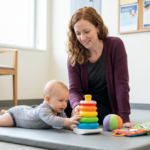
- Offer supervised tummy time while awake, starting with brief periods and gradually increasing as tolerated.
- Talk, sing, and read in a calm voice to support hearing, rhythm, attention, and early communication.
- Provide safe objects with varied textures, shapes, and sounds once your baby is developmentally ready to grasp and mouth them.
- Change positions during awake time, such as holding upright, side-lying play, or floor play, while following safe sleep guidance for naps and nighttime.
- Allow quiet breaks. Looking away, hiccupping, yawning, finger splaying, fussing, or stiffening can be signs that a baby needs less input.
Caregivers can also narrate sensations: “That water is warm,” “You heard the rattle,” or “You are pushing with your legs.” Babies will not understand every word at first, but consistent, warm language links sensation, emotion, and relationship.
Feeding, smell, taste, and interoception
Feeding is one of the most sensory-rich parts of infancy. It involves taste, smell, touch, sucking, swallowing, breathing coordination, posture, and internal sensations of hunger and fullness. Newborns often show preferences for sweet tastes, and familiar smells can be calming. Over time, babies learn patterns: hunger feels uncomfortable, feeding brings relief, and caregivers respond.
Interoception is the sense of internal body signals. In babies, it is immature and caregiver-supported. A young infant cannot reliably interpret or communicate hunger, reflux-like discomfort, fatigue, gas, overstimulation, or pain in a specific way. Crying, squirming, rooting, turning away, or changes in tone may have several possible meanings. This uncertainty can be stressful for families, especially when feeding is difficult.
If feeding is consistently painful, very prolonged, associated with coughing or choking, poor weight gain, frequent vomiting, color change, or marked distress, it deserves medical attention. A pediatrician, lactation consultant, speech-language pathologist, occupational therapist, or feeding team may be involved depending on the concern. Avoid changing formula, thickening feeds, restricting foods in a breastfeeding parent’s diet, or using supplements as treatment without professional advice.
Sensory differences and when to ask for help
Babies vary in sensory temperament. Some are highly alert and reactive; others are calmer or need more input to engage. A baby may dislike certain textures, startle easily, resist position changes, or become upset in noisy settings. These observations can be useful, but they do not by themselves diagnose a sensory processing disorder, autism, hearing loss, vision impairment, reflux, allergy, or neurologic condition.
Patterns matter more than isolated moments. Consider discussing concerns with a healthcare professional if your baby rarely responds to sound, does not visually track faces or objects as expected, has persistent asymmetry in movement or posture, seems unusually floppy or stiff, has extreme distress with ordinary handling, loses previously acquired skills, or has feeding problems that affect growth or safety. Trust your observations; parents often notice subtle changes early, and asking for assessment is not overreacting.
Evaluation may include developmental screening for babies, hearing testing, vision assessment, feeding evaluation, neurologic examination, or referral to early intervention services for infants. The aim is not to label a baby unnecessarily, but to identify treatable issues and support the family as early as possible.
A balanced way to think about milestones
Sensory milestones are best viewed as a range of emerging abilities rather than a checklist a baby must complete on schedule. The nervous system develops through biology, experience, sleep, nutrition, health, and relationships. Illness, prematurity, hospitalization, hearing or vision differences, and family stress can all influence how a baby engages with sensory input.
A supportive approach is to observe your baby in context. What helps them calm? Which sounds attract attention? Do they enjoy being rocked, or do they prefer stillness? Do they explore with both hands? Can they recover after a busy outing? These questions help caregivers adapt the environment without assuming something is wrong.
Most importantly, sensory development happens within relationship. A baby learns the world is manageable when caregivers notice cues, respond with warmth, and seek help when something feels off. You do not need to provide perfect stimulation. Safe, loving, responsive care is the foundation for sensory growth.
Seek medical advice promptly if you notice
- No startle or response to loud sounds, or concern that your baby does not hear voices.
- Poor visual attention, absent tracking, unusual eye movements, or concern about vision.
- Feeding with coughing, choking, color change, poor weight gain, or severe distress.
- Marked stiffness, floppiness, persistent asymmetry, or loss of previously acquired skills.
- Extreme irritability, lethargy, inconsolable crying, or a sudden change in responsiveness.
- Any caregiver concern that feels persistent, worsening, or difficult to explain.
Tools & Assistance
- Keep a brief diary of sensory concerns, including triggers, duration, feeding, sleep, and what helps.
- Ask your pediatrician about hearing, vision, feeding, or developmental screening if concerns persist.
- Use supervised floor play, tummy time, talking, singing, and gentle touch as daily sensory opportunities.
- Contact early intervention services for infants if development or regulation concerns are affecting daily life.
- Seek urgent care for breathing difficulty, color change, dehydration signs, seizure-like activity, or unusual lethargy.
FAQ
Can newborns really recognize a parent?
Newborns can respond to familiar voices, smells, touch, and close visual contact. Recognition strengthens through repeated caregiving interactions, especially feeding, holding, and soothing.
Is it possible to overstimulate a baby?
Yes. Some babies become fussy, avert their gaze, stiffen, cry, hiccup, yawn, or shut down when input is too intense. Reducing noise, light, handling, or activity can help.
Do sensory toys speed up development?
No toy is required to speed development. Safe, simple objects and responsive interaction are usually more valuable than highly stimulating toys with bright lights or loud sounds.
When should I worry about hearing or vision?
Ask a clinician if your baby does not respond to sound, does not visually engage or track as expected, has unusual eye movements, or if screening results were abnormal.
Are sensory sensitivities always a sign of a disorder?
No. Many babies have sensory preferences. Persistent, severe, or function-limiting patterns should be discussed with a healthcare professional rather than diagnosed at home.
Sources
- AboutKidsHealth — Sensory development and suggestions for babies: The first 18 months
- OpenStax — 3.3 Sensory Development in Infants and Toddlers
- Stanford Medicine Children's Health — Newborn Senses
Disclaimer
This article is for informational purposes only and does not replace medical evaluation, diagnosis, or treatment. Consult a qualified healthcare professional about concerns regarding your baby’s development, feeding, hearing, vision, or behavior.















Please log in to leave a comment.