
Intro
Cognitive development in babies is the gradual emergence of thinking, learning, memory, attention, problem-solving, and early communication. It begins long before a baby can speak. In the first year, the brain is rapidly organizing sensory information, strengthening neural connections, and learning that the world has patterns: faces return, voices soothe, objects can be explored, and actions can produce effects.
For parents and caregivers, this development can feel both fascinating and uncertain. One baby may study a toy quietly, while another learns by mouthing, banging, dropping, and crawling toward everything in sight. Variation is expected, but developmental observation matters. If you are concerned about your baby’s vision, hearing, social engagement, movement, feeding, or loss of skills, it is appropriate to speak with a pediatrician or qualified child development professional.
Highlights
Babies learn through repeated sensory and motor experiences, not through formal teaching.
Object permanence, cause-and-effect learning, attention, memory, and imitation are core cognitive achievements in infancy.
Responsive caregiving, safe exploration, language exposure, sleep, nutrition, and emotional security all support learning.
Developmental milestones are guides, not diagnostic rules; persistent concerns should be discussed with a healthcare professional.
What cognitive development means in infancy
Cognition refers to the mental processes involved in learning and understanding: attention, perception, memory, reasoning, problem-solving, language foundations, and social learning. In babies, these processes are closely linked with the body. A newborn cannot separate thinking from sensation and movement; looking, sucking, grasping, turning toward a sound, calming to a familiar voice, and later reaching or crawling are all part of early learning.
A clinically useful way to understand this period is Piaget’s sensorimotor stage, which describes infancy as a time when babies learn primarily through sensory input and motor action. This does not mean babies are passive. Even very young infants are active learners. They orient toward faces, prefer human voices, recognize familiar smells and sounds, and gradually build expectations from repeated experiences.
Brain development during this period is highly experience-dependent. Neural pathways are strengthened when a baby repeatedly encounters warm caregiving, language, touch, movement, visual contrast, and safe opportunities to explore. At the same time, babies need protection from overstimulation. The goal is not constant entertainment, but a predictable, responsive environment where curiosity can unfold.
From newborn awareness to early learning
In the first weeks, cognition is tightly tied to regulation. Newborns spend much of their energy feeding, sleeping, maintaining temperature, and responding to bodily sensations. Yet learning is already underway. A newborn may calm to a caregiver’s voice, turn toward a familiar smell, briefly focus on a face, or show early habituation, meaning a reduced response to a repeated stimulus.
Care routines are also learning opportunities. Feeding, diapering, bathing, and comforting teach a baby that sensations are followed by predictable caregiver responses. In the earliest period, routines such as skin-to-skin contact, feeding, sleep, and response to newborn hunger and tiredness cues help organize the baby’s state regulation. This regulatory foundation is important because attention and learning are easier when a baby is not overwhelmed, hungry, exhausted, or distressed.
Newborn sleep patterns first weeks can be irregular, and that irregularity can affect how alert or interactive a baby seems. A very sleepy baby may show fewer obvious cognitive behaviors simply because wakeful windows are short. Conversely, an overtired baby may appear fussy rather than curious. If sleepiness interferes with feeding, alertness, or weight gain, caregivers should seek medical advice rather than assuming it is only temperament.
The sensorimotor stage: learning by doing
During the sensorimotor stage, babies discover the world through repeated action. They look, listen, suck, mouth, grasp, shake, drop, kick, roll, and eventually crawl or cruise. These behaviors may look simple, but they are cognitively rich. When a baby shakes a rattle and hears a sound, the brain begins connecting action with outcome. When a caregiver reappears after leaving the room, the baby gradually learns continuity and trust.
Early cause-and-effect understanding often appears in playful ways. A baby may kick to move a hanging toy, bang a spoon to create noise, or drop food from a highchair and look for the caregiver’s reaction. This is not simply misbehavior. It is experimentation, although caregivers still need to set safe, calm boundaries.
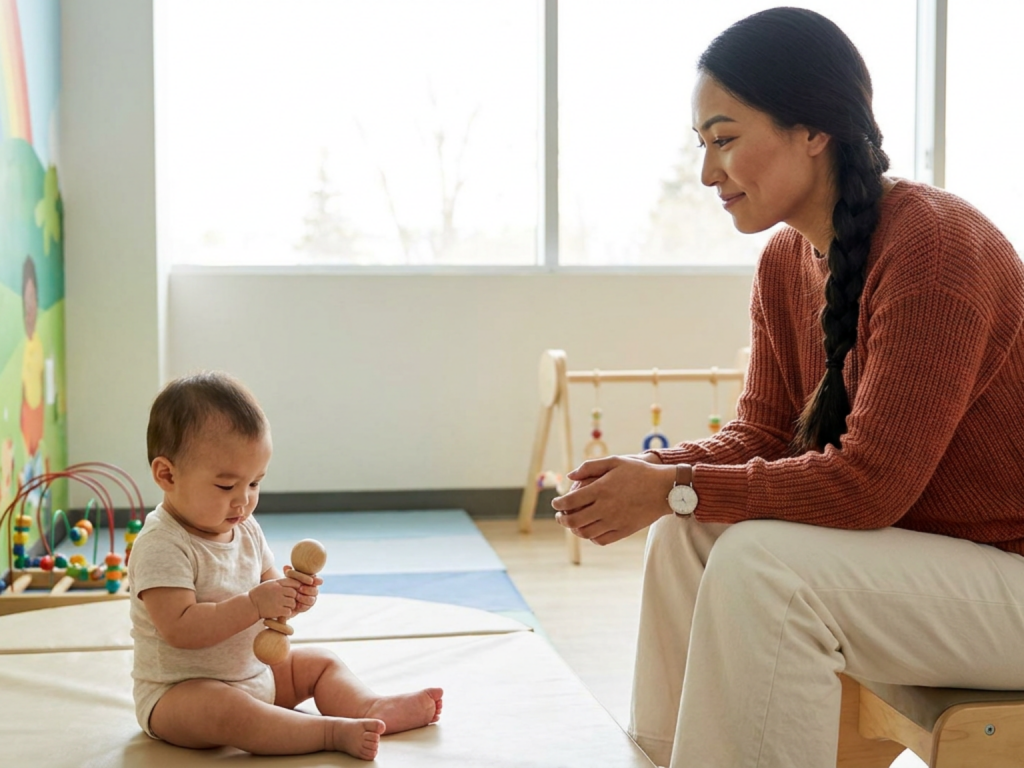
Imitation is another key cognitive tool. Babies learn by watching facial expressions, mouth movements, gestures, and emotional tone. A caregiver who smiles, pauses, waits for the baby’s response, and then repeats a sound is supporting early reciprocal communication. These back-and-forth exchanges are sometimes called serve-and-return interactions, and they help build attention, memory, social cognition, and language foundations.
Object permanence and memory
One of the best-known cognitive milestones in infancy is object permanence: the understanding that an object or person continues to exist even when out of sight. This develops gradually rather than appearing all at once. A younger baby may lose interest when a toy is hidden under a cloth. Later, the baby may search briefly. By the second half of the first year, many infants become more determined searchers and may protest when a caregiver leaves because they remember the caregiver and expect their return.
Object permanence is closely related to memory and attention. Games such as peekaboo are cognitively meaningful because they repeat disappearance and return in a safe, emotionally positive way. Hiding a toy partially under a cloth, then letting the baby uncover it, can also support this skill. The point is not to test the baby, but to offer repeated, low-pressure experiences.
Memory in infancy is often context-dependent. Babies may recognize familiar songs, routines, people, and places before they can demonstrate memory in adult-like ways. Repetition is helpful. A predictable bedtime phrase, a familiar feeding rhythm, or a repeated song during dressing can all become cognitive anchors.
What changes around 8 to 12 months
Between 8 and 12 months, many babies show more obvious problem-solving. They may explore objects by turning them over, transferring them between hands, banging them together, placing them into containers, or trying different actions to see what happens. They often become more intentional: reaching for a desired object, crawling toward a caregiver, pointing or gesturing, and repeating actions that get a response.
This age range can also bring stronger separation anxiety and stranger wariness. These behaviors can be emotionally hard for families, but they often reflect cognitive growth: the baby recognizes familiar people, remembers prior experiences, and distinguishes known from unfamiliar situations. A calm goodbye routine and consistent returns can help, while abrupt disappearances may increase distress for some babies.
Language comprehension also expands before expressive speech. A baby may respond to their name, understand simple words in routine contexts, or look toward a named person or object. Babbling becomes more varied and socially directed. Reading board books, naming everyday objects, describing actions, and pausing for the baby’s sounds all support cognitive and language development without requiring formal lessons.
Caregiving practices that support cognition
Research on infant development consistently points to the importance of the caregiving environment. Cognitive development is associated with opportunities for stimulation, interaction, and safe exploration. Stimulation does not need to be expensive or complicated. A caregiver’s face, voice, hands, household routines, safe objects, songs, and shared attention are powerful learning materials.
- Respond warmly: Comforting a crying baby and responding to cues supports regulation, which supports learning.
- Talk throughout the day: Narrate feeding, bathing, dressing, and walking. Babies learn patterns of sound before they understand full meanings.
- Offer safe exploration: Provide age-appropriate objects with different shapes, textures, and sounds, while preventing choking, falls, burns, and poisoning.
- Use repetition: Repeat songs, games, and routines. Repetition strengthens memory and prediction.
- Follow the baby’s attention: If the baby is looking at a spoon, name it and explore it together rather than redirecting constantly.
Caregivers should also protect sleep, nutrition, and medical care. Hearing and vision problems, untreated pain, feeding difficulties, iron deficiency, chronic illness, or high family stress can affect how a baby engages with the world. These issues deserve compassionate support, not blame.
Milestones, variation, and when to ask for help
Milestones are population-based guideposts, not pass-fail exams. Babies differ in temperament, opportunities for movement, birth history, medical conditions, prematurity, family language environment, and daily routines. A baby born prematurely may be assessed using corrected age for many developmental expectations, especially in the first two years.
It is reasonable to discuss concerns if a baby does not visually track, does not respond to sounds, rarely engages with caregivers, has persistent feeding difficulty, seems unusually floppy or stiff, does not use both sides of the body similarly, or loses previously acquired skills. Regression is especially important to report promptly. Caregivers should also seek help if they feel unable to cope with crying, sleep deprivation, or anxiety about development.
A pediatric visit may include history, physical examination, growth review, hearing or vision considerations, developmental screening, and referral when appropriate. The purpose is not to label a baby casually, but to identify whether support, therapy, medical evaluation, or closer monitoring could help. Early support can be valuable, and many referrals are precautionary rather than alarming.
When to seek medical advice
- Loss of previously acquired social, motor, language, or problem-solving skills
- No response to loud sounds or limited visual engagement with faces or objects
- Persistent feeding difficulty, poor weight gain, extreme sleepiness, or low alertness
- Marked stiffness, floppiness, asymmetry, or movement concerns
- Caregiver concern that something is not right, even if milestones seem unclear
Tools & Assistance
- Routine pediatric well-baby visits and developmental screening
- Hearing and vision evaluation when concerns arise
- Early intervention or infant developmental therapy referral if recommended
- Safe floor time with supervised exploration and age-appropriate toys
- Caregiver support for sleep deprivation, stress, or postpartum mental health concerns
FAQ
Can I teach my baby to be smarter with special toys or apps?
Special products are not necessary for healthy cognitive development. Responsive interaction, talking, reading, singing, safe movement, sleep, nutrition, and consistent care are more important than screens or expensive toys.
Is it normal for my baby to drop objects repeatedly?
Yes, repeated dropping can be a form of cause-and-effect learning. Keep the situation safe, set calm limits when needed, and offer acceptable objects for experimentation.
When does object permanence develop?
Object permanence develops gradually during infancy and often becomes more obvious in the second half of the first year. Babies may begin searching for hidden objects and may react strongly when caregivers leave.
Does speaking more than one language confuse babies?
No. Exposure to more than one language does not inherently confuse infants. Babies can learn patterns from multiple languages, although vocabulary may be distributed across languages as they grow.
Should I worry if my baby is not doing what another baby the same age does?
Not always. Normal variation is broad, but persistent concerns, loss of skills, or differences in hearing, vision, feeding, movement, or social engagement should be discussed with a pediatric professional.
Sources
- NCBI Bookshelf / National Library of Medicine — Cognitive Development
- American Academy of Pediatrics / HealthyChildren.org — Cognitive Development in Infants: 8 to 12 Months
- PubMed Central — Infant cognitive development and stimulating parenting practices in rural China: evidence from a cross-sectional survey
Disclaimer
This article is for general educational purposes only and is not a diagnosis or treatment plan. Always consult a pediatrician or qualified healthcare professional about concerns regarding your baby’s development or health.
















Please log in to leave a comment.