
Intro
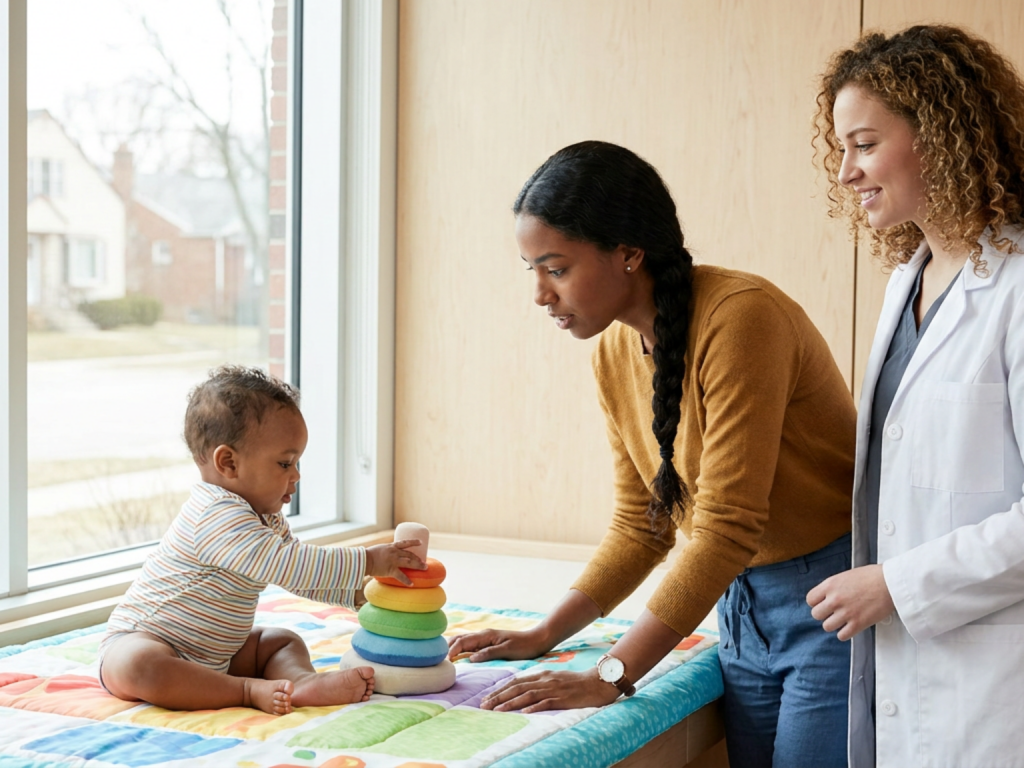
The first year of life is a period of extraordinary neurologic, motor, sensory, social, and emotional maturation. A baby’s brain forms new connections rapidly as they feed, sleep, cry, move, watch faces, hear language, and practice increasingly coordinated movements. Development is not a race: some babies roll early and talk later, while others are quiet observers before suddenly mastering several skills close together.
This guide explains baby development stages 0 to 12 months in a medically informed but parent-friendly way. It describes typical patterns, practical ways to support growth, and warning signs that should prompt a conversation with a pediatrician, family physician, health visitor, or early intervention professional. It cannot determine whether an individual baby is delayed, but it can help you observe development with confidence and compassion.
Highlights
Development in the first year is best viewed across domains: gross motor, fine motor, communication, cognition, social-emotional growth, feeding, sleep, and sensory regulation.
Milestones have normal ranges. A single missed skill does not automatically mean a disorder, but persistent loss of skills, poor feeding, abnormal tone, or lack of social engagement deserves medical attention.
Everyday interaction is therapeutic: responsive talking, floor time, tummy time while awake, reading, singing, cuddling, and safe opportunities to explore all support neural development.
The 12-month point is an important screening checkpoint because many babies are using gestures, exploring objects purposefully, pulling to stand, and communicating with sounds or early words.
How to understand infant milestones
Milestones are observable skills that reflect maturation of the nervous system, musculoskeletal strength, sensory processing, social learning, and environmental opportunity. Clinicians often group them into gross motor skills such as head control and standing, fine motor skills such as grasping, language and communication, cognitive skills such as problem-solving, and social-emotional abilities such as shared attention.
It is helpful to think in ranges rather than exact deadlines. Premature babies are often assessed by corrected age during infancy, meaning age is adjusted for weeks born before the due date. Medical history also matters: prolonged hospitalization, feeding difficulties, congenital conditions, sensory impairment, or significant illness can influence developmental trajectories.
Parents do not need to test a baby formally every day. Instead, observe patterns: Is your baby becoming more alert, more interactive, more symmetrical in movement, and more purposeful over time? Are feeding, sleep, and growth generally supporting energy for learning? Tools such as newborn diaper output tracking in the earliest weeks, routine well-child visits, and developmental screening questionnaires can make these observations more objective.
Birth to 3 months: regulation, connection, and early control
In the newborn period, the body is adapting to life outside the uterus. Reflexes such as rooting, sucking, grasping, Moro startle, and stepping movements are normal neurologic findings. Babies spend much of their time feeding and sleeping, and many families focus on newborn hunger and tiredness cues rather than a clock-based routine. Safe sleep habits for newborns are essential throughout this stage: babies should sleep on their backs on a firm, flat surface without loose bedding, pillows, or soft objects.
By 1 to 2 months, many babies briefly lift or turn the head during supervised tummy time, visually fix on faces, respond to sound, and show increasing periods of quiet alertness. Around 2 months, social smiling often emerges, a sign that visual processing, social motivation, and caregiver interaction are beginning to integrate. Babies may coo, make vowel-like sounds, and calm to familiar voices.
By 3 months, many infants hold the head steadier, bring hands toward the mouth, open and close the hands more deliberately, and track moving objects. They may enjoy face-to-face play, singing, and gentle routines. Skin-to-skin contact can still be soothing beyond the early newborn period and may support bonding, thermoregulation, and feeding comfort. If a baby is very floppy or very stiff, feeds poorly, does not respond to sound, rarely wakes for feeding, or shows little visual engagement, professional assessment is appropriate.
4 to 6 months: strength, reaching, and vocal play
Between 4 and 6 months, many babies become more physically organized. Head control improves, the upper body strengthens, and rolling may appear from tummy to back, back to tummy, or both. During supervised floor time, babies push through the forearms or hands, shift weight, kick actively, and may begin to pivot. Sitting usually starts with support and gradually becomes more independent as trunk control improves.
Fine motor development becomes more intentional. Babies reach for toys, bring objects to the mouth, grasp with the whole hand, and begin transferring objects between hands. Mouthing is a normal sensory and motor behavior, so caregivers should keep small objects, button batteries, magnets, plastic bags, and choking hazards out of reach.
Communication also expands. Many babies laugh, squeal, blow raspberries, and experiment with pitch and volume. They may turn toward a familiar voice and show pleasure when a caregiver responds. These sound games are early practice for speech and social reciprocity. Reading aloud, narrating daily care, and pausing for the baby’s sounds encourage back-and-forth interaction.
Some babies begin complementary foods around 6 months when they show developmental readiness, such as good head and neck control, ability to sit with support, interest in food, and reduced tongue-thrust reflex. Feeding decisions should be individualized with a healthcare professional, especially for babies born preterm or those with growth, swallowing, allergy, or medical concerns.
7 to 9 months: mobility, object permanence, and social preferences
From 7 to 9 months, babies often become increasingly mobile. Some crawl on hands and knees; others army crawl, roll, scoot, pivot, or move in a unique sequence. The exact style is less important than progressive strength, symmetry, and purposeful movement. Many babies sit without support, move in and out of sitting with help, bear weight through the legs when held, and reach while maintaining balance.
Cognitive development becomes easier to see. Object permanence, the understanding that people and objects continue to exist when out of sight, becomes stronger. A baby may look for a dropped toy, protest when a caregiver leaves, or enjoy peekaboo. Stranger anxiety and separation distress are common because the baby can now distinguish familiar from unfamiliar people more clearly.
Fine motor skills also advance. Babies rake small safe pieces of food toward themselves, bang two objects together, pass toys from hand to hand, and explore cause and effect. They may respond to their name, recognize common words, imitate sounds, and use more varied babbling such as repeated consonant-vowel patterns.
This stage is an important time for safety. Increased mobility means higher risk of falls, burns, choking, poisoning, and furniture tip-overs. Developmental support and injury prevention go together: provide safe floor space, supervise closely, avoid baby walkers, secure furniture, and keep medicines, cleaning products, cords, and hot liquids inaccessible.
10 to 12 months: purposeful exploration and early communication
By 10 to 12 months, many babies are highly purposeful explorers. They may pull to stand, cruise along furniture, move from sitting to crawling, lower themselves with improving control, or take supported steps. Some babies walk independently before their first birthday, while many healthy babies do not. What matters clinically is the pattern of increasing strength, coordination, and willingness to explore.
Hand skills become more refined. A neat pincer grasp, using the thumb and index finger to pick up small items, often appears near the end of the first year. Babies may place objects into containers, remove them, poke with one finger, turn pages with help, and use objects in functional ways such as bringing a cup toward the mouth. They also test cause and effect repeatedly, which can look like dropping the same spoon many times.
At around 12 months, many babies use gestures such as waving, reaching up to be picked up, pointing, or showing objects. They may understand simple directions with gestures, such as “come here” or “give it to me,” and may say “mama,” “dada,” or another specific word. The CDC and American Academy of Pediatrics describe 12-month milestones that include social games, imitation, purposeful object use, standing with support, and increasing communication through sounds, gestures, and early words.
If your baby is not doing a listed 12-month skill, try not to panic. Context matters, and developmental surveillance is designed to identify children who may benefit from closer evaluation or support. However, do not wait and see if you are worried about hearing, vision, loss of skills, feeding safety, very limited movement, or lack of social connection. Early evaluation can be reassuring when development is typical and very helpful when support is needed.
How caregivers can support development every day
Infant development is supported through responsive, repeated, emotionally safe interaction. Babies learn through relationships before they learn through instruction. Warm eye contact, predictable caregiving, and prompt responses to distress help build trust and support stress regulation.
- Offer supervised tummy time while awake, starting with short sessions and increasing as tolerated.
- Talk, sing, and read daily, using ordinary routines as language opportunities.
- Follow the baby’s attention by naming what they look at, touch, or vocalize about.
- Use safe toys with different shapes, sounds, and textures, avoiding choking hazards.
- Encourage movement on the floor rather than prolonged time in seats, swings, or carriers when the baby is awake.
- Maintain routine preventive care, immunizations, growth checks, and developmental screening visits.
Caregiver wellbeing also matters. Exhaustion, feeding stress, postpartum mood symptoms, and lack of support can make it harder to notice or enjoy developmental progress. Asking for help is not a failure; it is part of protecting both the baby and the family system.
When to seek medical advice
- Seek urgent care for poor feeding with dehydration signs, breathing difficulty, unusual lethargy, seizures, or a baby who is difficult to arouse.
- Contact a healthcare professional if your baby loses previously acquired skills at any age.
- Ask for evaluation if movements are very asymmetric, extremely floppy, unusually stiff, or the baby persistently uses one side much more than the other.
- Discuss concerns if your baby does not respond to sounds, does not make eye contact, or shows little interest in faces or interaction.
- At 12 months, seek guidance if your baby is not using gestures, not babbling, not bearing weight with support, or not looking for hidden objects.
- Trust your observations; parental concern is a valid reason to request developmental screening or referral.
Tools & Assistance
- Well-child visits with a pediatrician or family physician
- Standardized developmental screening questionnaires
- Hearing and vision assessment when concerns arise
- Early intervention or infant therapy services when referred
- A simple milestone journal with feeding, sleep, movement, and communication observations
FAQ
Should my baby meet every milestone exactly on time?
No. Milestones are ranges, not strict deadlines. A healthcare professional can interpret your baby’s pattern, medical history, corrected age if premature, and overall progress.
Is crawling required before walking?
Not always. Some babies crawl traditionally, while others scoot, roll, or move differently. Progressive, symmetrical movement and increasing strength are more important than one exact sequence.
How much should I practice skills with my baby?
Use short, playful opportunities during daily life rather than formal drills. Floor time, talking, reading, singing, and safe exploration are usually more valuable than intensive practice.
When should I worry about speech in the first year?
Concerns include no response to sound, very limited vocalizing, no babbling by later infancy, no gestures near 12 months, or loss of sounds previously used. Discuss these with your baby’s clinician.
Can screens help infant development?
Human interaction is far more developmentally useful in infancy. For babies under 18 months, expert guidance generally favors avoiding screen media except video chatting with supportive adult involvement.
Sources
- HealthyChildren.org / American Academy of Pediatrics — Developmental Milestones: 12 Months
- Centers for Disease Control and Prevention — Milestones by 1 Year
- University of Nebraska–Lincoln Extension — Ages and Stages: Infant (0-12 Months)
Disclaimer
This article is for general educational purposes only and is not a diagnosis or treatment plan. Always consult a qualified healthcare professional about concerns regarding your baby’s development, feeding, growth, or health.














Please log in to leave a comment.