
Intro
The transition from preschool to school age parenting is both exciting and emotionally complex. A child who once needed constant help with routines, play conflicts, toileting, and separation may now be entering a world of structured classrooms, longer attention demands, peer comparison, academic expectations, and new independence. Parents often feel proud and unsettled at the same time: the child is growing, but the parenting role is changing quickly.
Highlights
School entry is a developmental transition, not just a change in building or timetable. Children need emotional security, predictable routines, and adult coordination across home and school.
Parents remain central during the school-age years, but the focus shifts from direct management toward scaffolding independence, social problem-solving, and executive function.
Early communication with teachers can reduce stress, improve continuity, and help adults respond consistently to a child’s needs.
Regression, tiredness, emotional outbursts, and separation worries can be common during adjustment, but persistent or impairing concerns should be discussed with health or education professionals.
Understanding the developmental shift
Preschool parenting is often centered on hands-on co-regulation: helping a child calm down, transition between activities, practice toileting and dressing, and learn through play. School-age parenting still includes warmth and protection, but it increasingly asks parents to support planning, attention, frustration tolerance, peer relationships, and rule-following in larger groups.
Neurodevelopmentally, many children entering kindergarten or the first years of school are still developing executive function. This includes working memory, inhibitory control, cognitive flexibility, and the ability to persist through a difficult task. A child may understand a rule in the morning and still be unable to follow it when tired, hungry, overstimulated, or socially stressed. This is not automatically defiance; it may reflect a nervous system still learning self-management.
Helpful parenting at this stage combines developmentally appropriate expectations with patient repetition. Instead of assuming a school-age child should suddenly behave like a much older student, parents can ask: What skill is missing? Does my child need a visual cue, a shorter instruction, more sleep, a calmer morning routine, or practice asking for help?
Preparing without over-pressuring
School readiness is broader than knowing letters or numbers. It includes communication, curiosity, motor skills, self-care, emotional regulation, and the ability to participate in a group. Evidence-informed transition practices emphasize continuity between preschool, home, and elementary school, including sharing relevant information and aligning expectations where possible.
Parents can prepare children through ordinary daily routines:
- Practice opening lunch containers, using the bathroom independently, putting on outerwear, and packing a simple bag.
- Read together daily, but keep it relational and enjoyable rather than test-like.
- Play turn-taking games to build patience, impulse control, and flexible thinking.
- Visit the school building, playground, or bus stop if possible so the environment feels less unfamiliar.
- Create a simple morning and bedtime routine several weeks before school begins.
The goal is confidence, not performance. A child who feels emotionally safe is usually better able to learn. If preparation becomes tense, step back and return to connection: play, shared reading, outdoor movement, and predictable caregiving are powerful readiness supports.
Building the home-school relationship
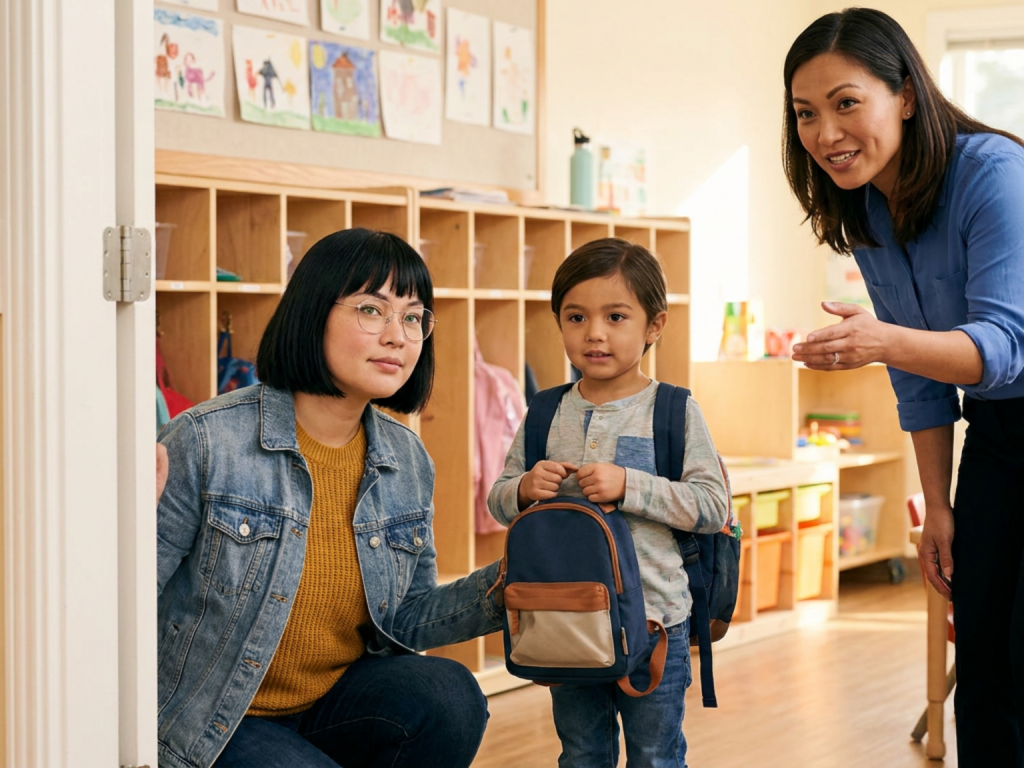
One of the strongest supports for the preschool-to-school transition is a coordinated relationship between family and school. Head Start transition guidance highlights the importance of family-school, child-school, program-school, and community-school connections. In practical terms, this means adults should not wait until a problem becomes large before communicating.
Parents can introduce their child to the teacher as a whole person: strengths, interests, communication style, sensory sensitivities, medical needs, cultural or language context, and what helps the child recover when upset. This is especially important for children with chronic health conditions, developmental differences, disabilities, trauma exposure, food allergies, or prior difficulty with separation.
A brief message may be enough: “My child loves building activities and responds well to a five-minute warning before transitions. They may become quiet when overwhelmed. Please let us know how we can reinforce classroom routines at home.” This kind of communication supports shared problem-solving rather than blame.
Active parent participation during early educational transitions has been associated with stronger family-teacher relationship-building and may reduce stress for young children. Parents do not need to be perfect advocates; they need to be steady partners who share information, listen, and follow up.
Emotional regulation and separation
Even children who loved preschool may struggle when school begins. The school day can be longer, louder, more structured, and socially demanding. Some children hold themselves together at school and then melt down at home. This “after-school restraint collapse” is not a formal diagnosis, but it is a familiar pattern: the child’s regulatory capacity is depleted, and the safest adult receives the emotional overflow.
Support begins with predictable connection. A calm goodbye ritual, a transitional object if permitted, and a consistent pick-up plan can help reduce separation stress. Avoid sneaking away; although it may prevent tears in the moment, it can increase vigilance later. A short, confident goodbye communicates safety: “I will come back after story time and playground. Your teacher will help you.”
After school, many children need decompression before questions. Instead of asking for a full report immediately, offer food, water, movement, quiet play, or closeness. Later, use specific prompts: “Who did you sit near at lunch?” or “What was one tricky part of the day?” Emotional labeling for children can also help: “Your body looks worn out. New routines take a lot of energy.”
Routines, sleep, nutrition, and sensory load
School adjustment is not only psychological; it is physiological. Sleep deprivation can worsen irritability, inattention, impulsivity, headaches, abdominal pain, and emotional reactivity. Regular sleep timing, a calming pre-bed routine, limited evening screens, and adequate morning time can significantly improve coping capacity.
Nutrition and hydration also matter. Some children eat less at school because lunch is rushed, the cafeteria is loud, containers are hard to open, or they are too distracted. Parents can troubleshoot by practicing lunch at home, choosing manageable foods, and asking staff what they observe if a child returns home ravenous or dysregulated.
Sensory load is another common issue. School environments may include bells, crowds, bright lights, scratchy uniforms, strong smells, and constant social proximity. A child who is sensory-sensitive may not have the language to explain this and may instead complain of stomachaches, refuse school, or become irritable. Parents should avoid assuming manipulation. Track patterns, discuss them with the teacher, and consult a pediatrician, occupational therapist, psychologist, or other qualified professional if concerns persist or impair daily functioning.
Discipline becomes skill-building
As children move into the school years, discipline works best when it teaches skills rather than simply punishing mistakes. School-age responsibility scaffolding means adults provide enough structure for success while gradually transferring ownership to the child. For example, instead of saying “You always forget your folder,” a parent might create a backpack checklist, practice it together, and then slowly reduce reminders.
Logical consequences for children can be useful when they are safe, respectful, and related to the behavior. If a child leaves art supplies uncapped, they help clean up and learn where supplies belong. If mornings are chaotic, the family may prepare clothes and bags the night before. Consequences should not involve humiliation, threats, or withdrawal of affection.
Conflict is inevitable during this transition. Parent-child repair after conflict is a major protective skill. A repair might sound like: “I was frustrated this morning and I raised my voice. I’m sorry. Tomorrow we’ll use the picture checklist and start five minutes earlier.” Repair does not remove boundaries; it models accountability and emotional regulation.
Supporting social development and peer challenges
School age brings more complex peer dynamics. Children may encounter exclusion, teasing, friendship triangles, competition, or pressure to conform. Parents often feel a strong urge to intervene immediately, especially when their child is hurt. Sometimes adult action is necessary, particularly if there is bullying, safety risk, discrimination, or repeated targeting. But many everyday conflicts also require coaching children through perspective-taking and problem-solving.
Ask open questions before giving advice: “What happened next?” “What did you want them to understand?” “What could you try tomorrow?” Role-play simple scripts such as “Can I have a turn?” “I don’t like that,” or “I’m going to play somewhere else.” For children with language delays, anxiety, autism spectrum traits, attention difficulties, or social communication challenges, more explicit coaching may be needed, ideally coordinated with professionals when appropriate.
Parents should also monitor digital exposure, even in early school age. Some children begin using tablets, games, or messaging platforms before they have the impulse control or social judgment to manage them independently. Clear family rules, co-viewing, and device-free sleep spaces can protect attention, mood, and rest.
When concerns need extra support
Adjustment takes time. Mild clinginess, fatigue, irritability, toileting accidents, sleep disruption, or school reluctance may occur during the first weeks. However, parents should seek guidance if symptoms are persistent, escalating, or impairing. Possible reasons include unrecognized learning difficulties, hearing or vision problems, sleep disorders, anxiety, neurodevelopmental differences, chronic medical issues, bullying, or a poor fit between the child’s needs and classroom supports.
Consult the child’s pediatrician or family doctor for medical concerns such as recurrent pain, marked fatigue, appetite change, sleep disturbance, toileting regression, or suspected sensory or developmental issues. Educational professionals can discuss classroom observations, support plans, and referral pathways. If a child already has an individualized education plan, disability support plan, therapy team, or medical action plan, transition meetings before school entry can help maintain continuity of services.
Parents should not have to navigate this alone. The most effective support often comes from a team: family, teacher, school nurse, pediatric clinician, mental health professional, early childhood program, and community resources working from shared information.
Seek timely help if you notice
- Persistent school refusal, panic, or distress that does not improve with supportive routines.
- Loss of previously established skills, such as toileting, speech, feeding, or sleep, especially if prolonged.
- Frequent headaches, abdominal pain, fatigue, appetite change, or other physical symptoms affecting attendance.
- Aggression, self-injury, statements about wanting to disappear, or any safety concern.
- Bullying, discrimination, or repeated social targeting that the school has not adequately addressed.
Tools & Assistance
- Schedule a brief transition conversation with the teacher before or early in the school year.
- Create a visual morning and evening routine with pictures or simple words.
- Keep a two-week log of sleep, meals, school reluctance, physical complaints, and emotional outbursts if concerns arise.
- Ask the pediatrician about hearing, vision, sleep, developmental, or mental health screening when adjustment seems unusually difficult.
- Use school-based supports such as the school nurse, counselor, special education team, or family liaison when available.
FAQ
How long does it usually take a child to adjust to school?
Many children settle over several weeks, but adjustment varies by temperament, prior group experience, sleep, health, and classroom fit. If distress is severe, persistent, or worsening, consult the teacher and a healthcare professional.
Should I teach reading and math before school starts?
You can support early literacy and numeracy through playful activities such as reading, counting, singing, sorting, and conversation. Avoid high-pressure drills unless specifically recommended by an educator or clinician.
What if my child behaves well at school but melts down at home?
This can happen when a child uses significant self-control during the school day and releases stress at home. Offer food, rest, movement, and calm connection before discussing behavior or homework.
How much should I communicate with the teacher?
Share essential information early and keep messages concise. Focus on patterns, supports that work, and collaborative questions rather than daily monitoring unless your child has specific health, developmental, or safety needs.
When should I request an evaluation?
Consider asking for professional guidance if your child has persistent difficulty with communication, attention, learning, motor skills, sensory tolerance, behavior, anxiety, or attendance. A pediatrician and school team can advise on appropriate next steps.
Sources
- HeadStart.gov — Transition to Kindergarten
- ECTA Center — Transition Practices from Preschool to Kindergarten
- PubMed Central — Transition to Preschool: Paving the Way for Preschool Teacher and Parent Partnerships
Disclaimer
This article is for educational purposes only and does not diagnose, treat, or replace individualized medical, developmental, or mental health advice. Consult a qualified healthcare professional or your child’s school team for concerns about your child.


















Please log in to leave a comment.