
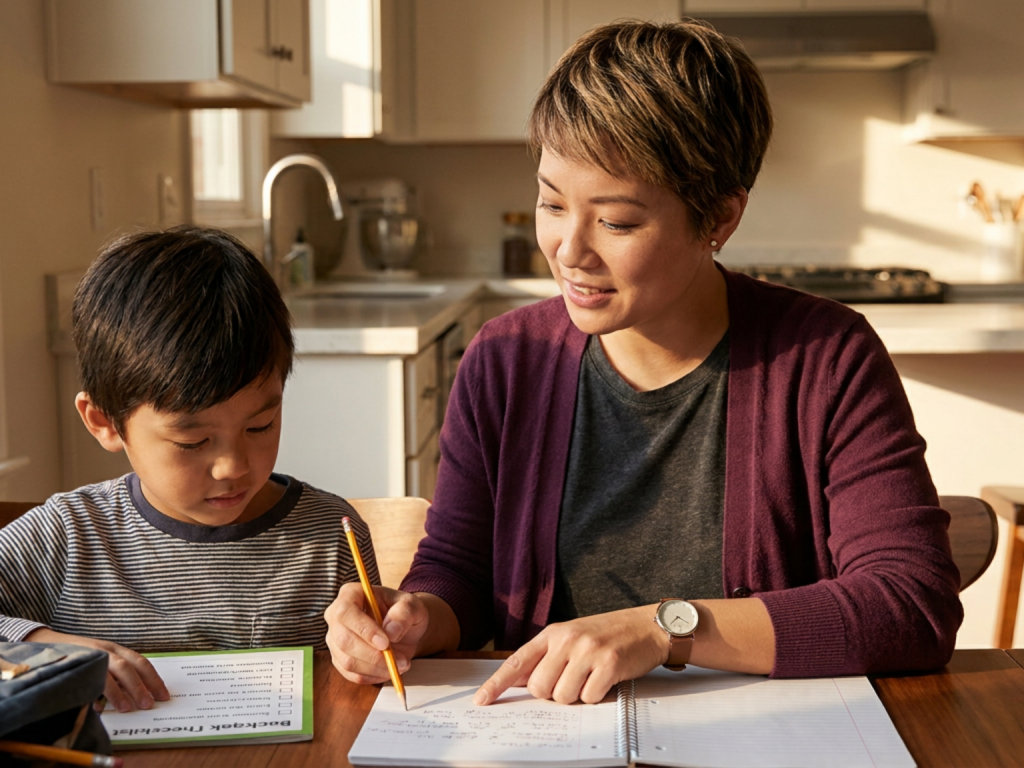
Intro
The school years can feel like a sudden widening of your child’s world. Teachers, peers, homework, sports, screens, friendships, sleep schedules, and early identity questions all begin to compete for attention. Many parents respond by focusing harder on grades, behavior, and achievement. That instinct is understandable, but school-age children often need something broader: steady connection, developmentally realistic expectations, routines, emotional coaching, and collaborative problem-solving.
This stage is not about becoming a perfect parent or controlling every outcome. It is about shifting from managing a young child’s environment to coaching a growing child’s skills. Evidence-informed parenting emphasizes responsive caregiving, consistent structure, positive discipline, parent-school partnership, and a home environment that supports learning without making performance the child’s entire identity.
Highlights
School-age parenting works best when parents shift from control to coaching: children need structure, but also chances to practice autonomy, planning, and recovery from mistakes.
Grades matter, but they are only one signal. Sleep, emotional regulation, friendships, curiosity, executive function, and physical health are equally important parts of school success.
Common mistakes include inconsistent discipline, overreacting to school problems, rescuing too quickly, comparing children, and treating behavior as defiance before considering stress, skill gaps, or unmet needs.
A strong home-school partnership can prevent small academic or behavioral concerns from becoming chronic patterns, especially when communication is respectful and specific.
The main shift: from doing for your child to coaching your child
In early childhood, parents often prevent problems by controlling the environment: choosing the schedule, limiting hazards, organizing belongings, and prompting nearly every transition. During the school years, that approach gradually becomes less effective. Children still need boundaries, but they also need repeated practice with planning, frustration tolerance, social negotiation, and self-advocacy.
A helpful question is: “What skill is my child still learning?” A forgotten worksheet may reflect weak organization, not laziness. Tears over homework may reflect fatigue, anxiety, perfectionism, a learning difficulty, or simply a task that is developmentally demanding. A rude tone after school may reflect depleted self-regulation after holding it together all day.
This does not mean ignoring behavior. It means pairing limits with skill-building. Instead of “You never remember anything,” try “Your backpack system is not working yet. Let’s make a checklist and practice it for two weeks.” This is the essence of authoritative parenting with clear expectations: warmth, predictable limits, and active teaching.
Focus less on grades alone and more on learning behaviors
Grades can provide useful information, but they are imperfect. They may reflect test-taking ability, classroom participation, missed assignments, teacher grading style, anxiety, illness, sleep deprivation, or the child’s access to support at home. When parents focus only on grades, children may learn to hide mistakes, avoid challenging work, or believe love is conditional on performance.
A more protective focus is the pattern behind the grade. Ask about effort, comprehension, study strategy, assignment completion, and emotional response to difficulty. Useful learning behaviors include reading stamina, asking for help, breaking tasks into steps, reviewing errors, and tolerating revision.
Try shifting conversations from outcomes to process:
- Instead of “Why did you get a B?” ask “Which part of the unit felt clear, and which part still feels confusing?”
- Instead of “You need to try harder,” ask “What study method did you use, and did it match the test?”
- Instead of “You are good at math,” say “You used a strategy and stayed with the problem.”
This approach supports intrinsic motivation and helps children see ability as something that can grow with practice, feedback, and support.
Routines are not rigid control; they are nervous-system support
Predictable routines are one of the most undervalued parenting tools during school years. Children’s brains are still developing executive functions: working memory, inhibitory control, planning, task initiation, and cognitive flexibility. A routine reduces the number of decisions a child must make when tired or overstimulated.
Useful routines include a consistent sleep-wake schedule, a predictable homework window, a backpack launch pad, screen-free wind-down time, and a morning sequence that is visible to the child. Visual schedules for children can be especially helpful when mornings or evenings repeatedly become conflict points.
Sleep deserves special attention. Insufficient sleep can mimic or worsen inattention, irritability, low frustration tolerance, headaches, somatic complaints, and academic difficulty. Parents do not need to manage sleep perfectly, but they should treat sleep as a core health behavior rather than a leftover activity after homework and screens.
Common mistake: confusing discipline with punishment
Discipline means teaching. Punishment may stop a behavior briefly, but it does not necessarily build the missing skill. School-age children benefit from clear rules, natural or logical consequences, and repair after conflict. Inconsistent discipline, harsh criticism, and consequences that are unrelated to the behavior can increase shame or power struggles without improving self-control.
For example, if a child lies about homework, the teaching goal is not only “make lying unpleasant.” The deeper goals are honesty, planning, and help-seeking. A logical response might include checking the assignment portal together, creating a short daily homework review, and practicing how to say, “I forgot and I need help fixing it.”
Effective consequences are usually immediate, proportionate, related to the behavior, and paired with a path back to trust. A child who misuses a tablet may need supervised use and a plan for earning independence back, not a vague month-long punishment that everyone forgets or resents.
Common mistake: rescuing too quickly or stepping back too far
Many loving parents swing between two extremes. One extreme is rescuing: emailing teachers before the child tries, replacing forgotten items repeatedly, completing projects, or removing every discomfort. The other extreme is premature independence: expecting a child to manage assignments, social conflict, time, and emotions without enough scaffolding.
The middle path is graduated support. If your child forgets lunch once, problem-solve. If it happens repeatedly, build a system. If a child has a peer conflict, coach possible words before intervening. If there are safety concerns, bullying, discrimination, self-harm statements, or significant distress, adult involvement should be prompt.
A practical framework is “I do, we do, you do.” First, demonstrate the skill. Then practice together. Finally, let the child try with check-ins. This model respects the child’s growing autonomy while acknowledging that executive function maturation continues throughout adolescence and into young adulthood.
Communication: fewer lectures, more accurate listening
School-age children are more likely to talk when they do not feel immediately judged, interrogated, or corrected. Parents often ask many questions after school because they care, but a tired child may experience this as pressure. Short, specific, low-intensity openings work better than rapid-fire questioning.
Try “What was one annoying part and one okay part of the day?” or “Do you want advice, help, or just listening?” Open-ended questions for difficult conversations can reduce defensiveness and give children practice naming feelings, needs, and choices.
When conflict happens, repair matters. Parent-child repair after conflict might sound like: “I was too sharp earlier. I still need the homework done, but I want to try again without yelling.” Repair does not remove limits; it models accountability. Children learn emotional regulation partly by experiencing adults who can calm down, revisit a problem, and reconnect.
Partnering with school without making the child feel monitored
Research-informed parenting guidance consistently supports parent engagement in education, including communication with teachers and reinforcement of learning at home. The goal is not surveillance; it is shared understanding. Teachers see the child in a peer and academic setting, while parents see sleep, appetite, mood, screen use, family stress, and homework behavior.
Contact teachers early when patterns emerge: repeated missing assignments, avoidance, frequent stomachaches before school, sudden grade decline, peer problems, or behavior reports. Keep communication specific and collaborative: “We are noticing homework takes two hours and ends in tears. What are you seeing in class?”
At the same time, avoid copying your child on every adult concern or discussing school problems as if they are character flaws. Children should know adults are working as a team, but they should not feel that every mistake becomes a public case conference.
Watch the whole child: body, mood, friendships, and stress
Academic performance is closely connected to physical and mental health. Vision problems, hearing difficulties, sleep-disordered breathing, chronic pain, constipation, medication effects, anxiety symptoms, depressive symptoms, attention problems, trauma exposure, and learning disorders can all affect school functioning. Parents should avoid diagnosing at home, but they can observe patterns and seek appropriate evaluation.
Red flags include persistent school refusal, marked personality change, loss of interest, frequent unexplained physical complaints, significant appetite or sleep changes, bullying concerns, regression, self-harm talk, or a sudden drop in functioning. In these situations, consult a pediatrician, family physician, school psychologist, licensed mental health professional, or other qualified clinician.
Friendships also deserve attention. School-age children are developing social cognition: perspective-taking, fairness, loyalty, conflict resolution, and group belonging. Instead of dismissing friendship pain as “drama,” help your child identify what happened, what they felt, what choices are available, and when adult help is needed.
Replace one-size-fits-all parenting with developmentally realistic expectations
Children in the same grade can differ widely in temperament, neurodevelopmental profile, language skills, sensory sensitivity, maturity, culture, family stress, and prior learning experiences. A strategy that works beautifully for one child may fail with another. High-quality parent education emphasizes building on family strengths and adapting guidance to the child’s developmental stage and context.
Developmentally realistic expectations reduce unnecessary conflict. A seven-year-old may need an adult nearby to start homework. A ten-year-old may manage homework but still need help studying for a cumulative test. A twelve-year-old may want privacy but still need supervision around sleep, online activity, and emotional health.
The question is not “Should I be strict or relaxed?” A better question is “What combination of warmth, structure, autonomy, and support does this child need right now?” That answer may change across the year, especially during transitions, illness, family stress, or puberty.
When to seek extra help
- A sudden or persistent decline in school functioning should be discussed with the school team and a healthcare professional.
- Frequent headaches, stomachaches, sleep problems, or fatigue can have medical or psychological contributors and should not be dismissed.
- Bullying, threats, self-harm statements, or fear of going to school require prompt adult intervention.
- If discipline repeatedly escalates into yelling, fear, or aggression, seek professional parenting support or family counseling.
- Concerns about attention, learning, mood, anxiety, or behavior should be evaluated by qualified professionals rather than diagnosed at home.
Tools & Assistance
- A weekly 10-minute parent-child school check-in focused on planning, not criticism
- A simple visual routine for mornings, homework, and bedtime
- Teacher communication using specific observations and collaborative questions
- Pediatric or mental health consultation when school struggles are persistent or impairing
- A family media plan that protects sleep, homework time, and emotional regulation
FAQ
Should parents help with homework every night?
Parents can support routines, clarify instructions, and encourage effort, but should avoid doing the work. If homework regularly requires heavy parent involvement, ask the teacher whether the workload, comprehension, or learning skills need adjustment.
How much should I worry about one bad grade?
One grade is usually a data point, not a crisis. Look for patterns: repeated difficulty in one subject, avoidance, emotional distress, missing assignments, or a sudden change from the child’s usual functioning.
What is the best consequence for school-age misbehavior?
The most useful consequences are related, proportionate, and paired with teaching. For example, misuse of a device may lead to supervised use and a plan to rebuild trust, rather than a long unrelated punishment.
When should I contact the teacher?
Contact the teacher when you notice a repeated pattern, such as homework battles, missing assignments, social distress, avoidance, or a mismatch between effort and results. Early, respectful communication is usually more effective than waiting for a crisis.
How can I encourage independence without abandoning my child?
Use graduated support: demonstrate the skill, practice together, then let your child try with check-ins. Independence develops through supported practice, not sudden withdrawal of help.
Sources
- NCBI Bookshelf / National Institutes of Health — Parenting Knowledge, Attitudes, and Practices
- National Academies of Sciences, Engineering, and Medicine — Parenting Matters: Supporting Parents of Children Ages 0-8
- University of Minnesota / Reach Up & Learn Families — Enhancing Child Outcomes through High-Quality Parent Education
Disclaimer
This article is for educational purposes only and does not replace medical, psychological, or educational evaluation. Consult qualified healthcare or school professionals for concerns about your child’s health, learning, mood, or behavior.
















Please log in to leave a comment.