

Intro
Managing everything as a parent without another adult consistently sharing the load can feel like running a household, a child-development program, a logistics center, and an emotional support system all at once. If you are doing this, the difficulty you feel is not a personal defect. Single parenting often compresses many roles into one person’s day: earning income, providing attachment security, handling illness, coordinating school or childcare, maintaining routines, and regulating your own stress physiology while helping your child regulate theirs.
The goal is not to become a perfect parent who never feels depleted. The goal is to create a sustainable system: predictable enough for children, flexible enough for real life, and protective enough for your physical and mental health. Research and pediatric guidance consistently emphasize support networks, routines, communication, self-care, financial planning, and timely professional help when stress becomes clinically concerning.
Highlights
You do not have to manage alone by relying only on willpower; practical systems and trusted support reduce cognitive and emotional load.
Stable routines for single parents help children feel safer and help adults make fewer decisions under stress.
Mental health strain, burnout, sleep deprivation, and financial pressure are common in solo caregiving and deserve proactive attention.
Children can help with age-appropriate tasks, but they should not become emotional partners or substitute adults.
Professional support is appropriate when distress, conflict, safety concerns, or child behavioral symptoms exceed what home strategies can manage.
Start with triage, not perfection
When one adult is responsible for nearly everything, the first skill is triage. In medicine, triage means sorting needs by urgency and risk. Parenting can use the same principle. Some tasks protect safety and health; others maintain stability; others are optional or can be delayed.
A helpful framework is to divide tasks into three categories. First are non-negotiables: safe supervision, food, essential medication, sleep opportunity, school attendance, urgent bills, and medical care. Second are stabilizers: laundry, predictable meals, homework support, transportation, and bedtime routines. Third are desirable but flexible tasks: perfect meals, spotless rooms, elaborate activities, and social expectations that drain more than they help.
On hard days, aim for a minimum viable household plan. That may mean simple food, clean-enough clothes, a safe bedtime, and one emotionally warm moment with your child. A child does not require a flawless home to develop well; they need safety, responsiveness, reasonable boundaries, and repair after conflict.
Build stable routines that reduce decision fatigue
Children’s nervous systems respond well to predictability. Stable routines for single parents are also protective for adults because they reduce the number of decisions required during high-stress periods. Routines do not need to be rigid. They should be visible, repeatable, and realistic.
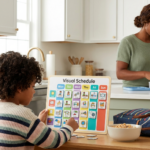
Consider creating routines around the highest-friction times of day: morning, after school or childcare, dinner, and bedtime. For example, a morning sequence might be: wake, bathroom, clothes, breakfast, backpack, shoes, leave. A bedtime sequence might include snack if needed, hygiene, school items prepared, reading or quiet time, lights out. Visual checklists can help younger children participate without constant verbal prompting.
Routines also support behavior because they externalize expectations. Instead of repeating, “Why aren’t you ready?” you can say, “Check the morning chart.” This reduces parent-child conflict and preserves your emotional energy. If routines repeatedly fail, simplify them rather than interpreting the failure as lack of discipline.
Create a support network before a crisis
Support is not a luxury in single parenting; it is a protective factor. The American Academy of Pediatrics encourages single parents to seek reliable support, use quality child care, and avoid trying to handle every demand alone. Support can come from relatives, friends, neighbors, school staff, faith communities, parent groups, social services, or paid providers when affordable.
Think in layers. Your inner circle may include one or two people who can help in an emergency. Your practical circle may include school staff, childcare providers, another parent for carpool backup, or a neighbor who can receive a package. Your professional circle may include your child’s pediatrician, your primary care clinician, a therapist, a social worker, or a financial counselor.
Ask for specific help rather than general rescue. Examples include: “Can you pick up my child this Thursday if I am late from work?” “Can you sit with the baby for 30 minutes while I shower?” “Can we exchange one freezer meal each week?” Specific requests reduce ambiguity and make it easier for others to say yes.
Protect your mental health as a clinical priority
Single parenting can expose a person to chronic stressors: sleep fragmentation, financial strain, social isolation, decision fatigue, and limited recovery time. Mental Health America notes that single parents may experience stress and burnout and may benefit from community support, accepting help, financial literacy, chores delegation, and professional mental health care when needed.
Scientific research also suggests that single mothers, compared with partnered mothers, report more stress, fatigue, and sadness during parenting time. Importantly, employment was associated with better emotional outcomes for many single mothers in the study, possibly because work can provide income, structure, identity, adult interaction, or psychological resources. This does not mean employment is simple or always protective; childcare access, workplace flexibility, health status, and economic context matter greatly.
Watch for signs that stress may be moving beyond ordinary fatigue: persistent insomnia, frequent panic symptoms, loss of pleasure, emotional numbness, irritability that feels uncontrollable, increased alcohol or substance use, hopelessness, intrusive thoughts, or feeling detached from your child. These symptoms do not mean you are a bad parent. They are signals to consult a healthcare professional, mental health clinician, or crisis service depending on severity.
Talk with children honestly, but keep adult burdens with adults
Children benefit from clear, age-appropriate communication with children about family changes, separations, death, deployment, incarceration, donor conception, or an absent parent. They do not need every adult detail. They need reassurance about safety, routines, and who will care for them.
For younger children, short explanations are usually best: “You live with me, and I will take care of you. The grown-up issues are not your fault.” Older children may ask more complex questions. Answer truthfully without making them your therapist, messenger, legal witness, or emotional partner.
Be alert to parentification risk in children. It is healthy for children to have chores and contribute to family life. It is not healthy for them to manage adult emotions, finances, custody conflict, or caregiving responsibilities that exceed their developmental capacity. A child can help set the table; a child should not feel responsible for whether the household survives emotionally.
Delegate chores without overloading your child
Delegating is not failure; it is family systems management. Children often gain competence and self-efficacy from predictable, age-appropriate responsibilities. The key is matching the task to the child’s developmental stage and avoiding adult-level pressure.
- Preschool children may put toys in bins, place clothes in a hamper, or help wipe a small spill.
- School-age children may pack part of their bag, feed a pet with supervision, sort laundry, or help prepare simple snacks.
- Adolescents may cook simple meals, manage their own school materials, help with younger siblings briefly, or contribute to household cleaning.
Use routines rather than repeated criticism. Say, “In our home, backpacks go by the door after homework,” instead of framing every task as a personal failure. Praise effort and consistency. If a child resists, consider whether the task is unclear, too large, poorly timed, or emotionally loaded.
Use childcare, school, and community systems strategically
Quality child care is not merely supervision; it can support social development, routine, learning, and parent employment. If cost is a barrier, ask about subsidies, sliding-scale programs, school-based care, community centers, or local social-service referrals. Your pediatrician’s office, school counselor, or local family resource center may know options in your area.
School collaboration for family stress can be very useful. You do not need to disclose private details, but a teacher or counselor can often help monitor behavior, academic changes, attendance issues, and emotional strain. A simple message such as, “Our family is going through a high-stress period; please let me know if you notice changes,” can open a supportive channel.
If your child has chronic medical needs, neurodevelopmental differences, anxiety, learning concerns, or behavioral difficulties, ask the pediatrician or school team what accommodations or referrals may be appropriate. Avoid self-diagnosing; focus on observed functioning: sleep, appetite, school performance, peer relationships, aggression, withdrawal, or somatic complaints.
Plan money and time with compassion, not shame
Financial stress is one of the most common pressures in solo caregiving. A simple budget can be a health intervention because it reduces uncertainty. Track essential expenses first: housing, food, utilities, transportation, medication, childcare, insurance, and debt obligations. Then identify irregular costs such as school fees, clothing, holidays, and medical copays.
If money feels unmanageable, consider speaking with a reputable financial counselor, social worker, benefits navigator, or community legal aid service. You may be eligible for food assistance, childcare subsidies, housing support, tax credits, health coverage programs, or child support enforcement resources, depending on your location and circumstances.
Time also needs budgeting. Schedule recovery in small units if large breaks are impossible: ten minutes of silence after bedtime, a walk during lunch, a phone call with another adult, or a planned early night. Respite care for solo parents can be informal or formal, but the principle is the same: a nervous system under continuous demand needs periods of reduced load.
Handle conflict with repair, not self-punishment
Every parent loses patience sometimes, especially under chronic stress. What matters is reducing harm and practicing repair after parent-child conflict. Repair teaches children that relationships can recover after rupture.
A repair statement can be brief: “I yelled earlier. That was scary and not okay. I was overwhelmed, but it was not your fault. I am going to take a breath next time.” This does not remove boundaries or excuse misbehavior; it models accountability and emotional regulation.
If yelling, harsh punishment, fear, or loss of control is becoming frequent, seek support early. Parenting coaching, therapy, pediatric guidance, or family support programs can help you build safer patterns. If you ever fear you may hurt yourself or your child, put physical distance between you and the immediate trigger if safe to do so, contact a trusted adult, and call emergency or crisis services in your area.
When to get urgent support
- Seek immediate help if you fear you may harm yourself, your child, or someone else.
- Contact a healthcare professional promptly for persistent depression, panic, insomnia, substance misuse, or hopelessness.
- Ask the pediatrician or a mental health clinician for guidance if your child shows severe withdrawal, aggression, self-harm talk, eating changes, or major sleep disruption.
- Use emergency services if there is violence, unsafe supervision, serious injury, overdose, or imminent danger.
- Do not rely on a child as your emotional counselor, crisis manager, or substitute co-parent.
Tools & Assistance
- Create a minimum viable household checklist for food, sleep, safety, school, and medication.
- Identify three support contacts: emergency backup, practical weekly help, and professional guidance.
- Use a visible morning and bedtime routine chart for children.
- Ask your pediatrician, school counselor, or local family resource center about childcare, respite, and family support programs.
- Schedule preventive care for yourself, including primary care and mental health support when stress is persistent.
FAQ
How can I manage everything when I have no reliable family nearby?
Start by building non-family support: school staff, childcare providers, parent groups, neighbors, community organizations, social services, and healthcare professionals. Ask for specific, limited help rather than waiting for a large rescue.
Is it okay for my child to do chores?
Yes, age-appropriate chores can build competence and reduce household stress. Avoid giving children adult responsibilities such as managing finances, mediating conflict, or caring for siblings for long periods without adult support.
What if I feel burned out but cannot take a break?
Use micro-recovery: brief quiet periods, simplified meals, earlier bedtime when possible, reduced nonessential tasks, and specific help requests. If burnout symptoms persist or include hopelessness, panic, or emotional numbness, consult a healthcare or mental health professional.
How much should I tell my child about the other parent or family situation?
Tell the truth in a developmentally appropriate way, focusing on safety, routine, and reassurance. Avoid adult details, blame-heavy explanations, or asking the child to carry messages or emotional burdens.
Can single parenting affect my child’s health?
Family stress can influence sleep, behavior, mood, school functioning, and somatic complaints, but supportive relationships and stable routines are strongly protective. Discuss concerns with your child’s pediatrician rather than trying to interpret symptoms alone.
Sources
- HealthyChildren.org, American Academy of Pediatrics — Single Parenting: Tips for When You're Raising Kids on Your Own
- Mental Health America — Mental health and the single parent
- PubMed Central, National Library of Medicine — Mothering Experiences: How Single-Parenthood and Employment Shape Mothers’ Feelings About Time With Children
Disclaimer
This article is for informational purposes only and does not replace medical, mental health, legal, or financial advice. Consult qualified professionals for concerns about your health, your child’s health, safety, or family circumstances.

















Please log in to leave a comment.