
Intro
Sibling conflict is one of the most common stress points in family life. Arguments over toys, privacy, screen time, parental attention, chores, or perceived unfairness can erupt quickly, especially when children are tired, hungry, overstimulated, or navigating developmental changes. For many families, these disagreements are not a sign that something is “wrong”; they are part of how children learn emotional regulation, negotiation, impulse control, empathy, and repair.
At the same time, conflict can become harmful when it is chronic, humiliating, physically aggressive, or one child consistently dominates or intimidates another. Parents and caregivers do not need to eliminate every disagreement. The goal is to create a family climate where children feel safe, clear limits are predictable, and conflicts become opportunities to practice respectful problem-solving rather than repeated cycles of blame and escalation.
Highlights
Sibling conflict is developmentally common, but it needs adult guidance when it becomes unsafe, coercive, or emotionally damaging.
A warm but firm parenting style, often called authoritative parenting, is associated with lower sibling conflict and supports better emotional regulation.
Fairness does not always mean identical treatment; children often need different supports based on age, temperament, developmental stage, and circumstances.
Parents are most effective when they set clear ground rules, reinforce cooperative behavior, and intervene early in patterns of aggression or humiliation.
If conflict is severe, persistent, or linked to anxiety, trauma, neurodevelopmental needs, or family stress, professional support can help.
Understand what sibling conflict is really about
Sibling arguments are often about more than the object or event that triggered them. A fight over a tablet may actually reflect competition for parental attention, fatigue after school, difficulty with transitions, or a child’s limited capacity for impulse inhibition. Younger children may lack the expressive language to say, “I feel left out,” while older children may convert embarrassment or jealousy into sarcasm, teasing, or withdrawal.
It helps to look for patterns rather than treating each fight as an isolated event. Ask yourself: Does conflict happen before dinner, during homework, in the car, when one child has a friend over, or when a parent is busy? Does one child often feel invaded, mocked, excluded, or blamed? Is the conflict mainly about scarce resources such as screens, toys, room space, or parental time?
Sibling rivalry can be normal, but the quality of the interaction matters. Mild arguing, negotiating, and occasional jealousy are different from persistent aggression, threats, cruelty, or a power imbalance in which one child appears fearful. When parents understand the underlying function of the conflict, they can respond with prevention and coaching instead of only punishment.
Create a warm but firm family structure
Research on parenting style and sibling conflict supports the value of authoritative parenting: high warmth combined with high structure. In practice, this means children experience caregivers as emotionally available, respectful, and responsive, while also knowing that limits are real and consistently enforced. This differs from harsh control, which may suppress behavior temporarily, and from permissiveness, which can leave children without enough structure to manage impulses.
A warm but firm approach might sound like: “I can see you are furious that your sister used the game first. I will not let you hit. We are going to pause and solve this safely.” This validates emotion without allowing harmful behavior. Children learn that feelings are acceptable, but aggression, humiliation, and intimidation are not.
Consistency is especially important. If hitting is ignored one day and punished severely the next, children may escalate because the boundary is unpredictable. Clear rules should be few, visible, and repeated often. Examples include: no hitting, no threats, no name-calling, ask before using another person’s belongings, and stop when someone says stop. These rules are most effective when adults model the same respectful communication they expect from children.
Prevent the most predictable conflicts
Prevention is not avoidance; it is environmental design. Children often cope better when expectations are concrete and routines reduce ambiguity. If siblings repeatedly fight over screen time, create a schedule. If they argue over belongings, define which items are personal, which are shared, and what permission is required. If mornings are chaotic, assign tasks and physical space ahead of time.
Useful prevention strategies include:
- Clarify ownership and sharing. Some items can be private, some shared, and some used only with permission. Forced sharing can increase resentment, especially when a child’s special object is involved.
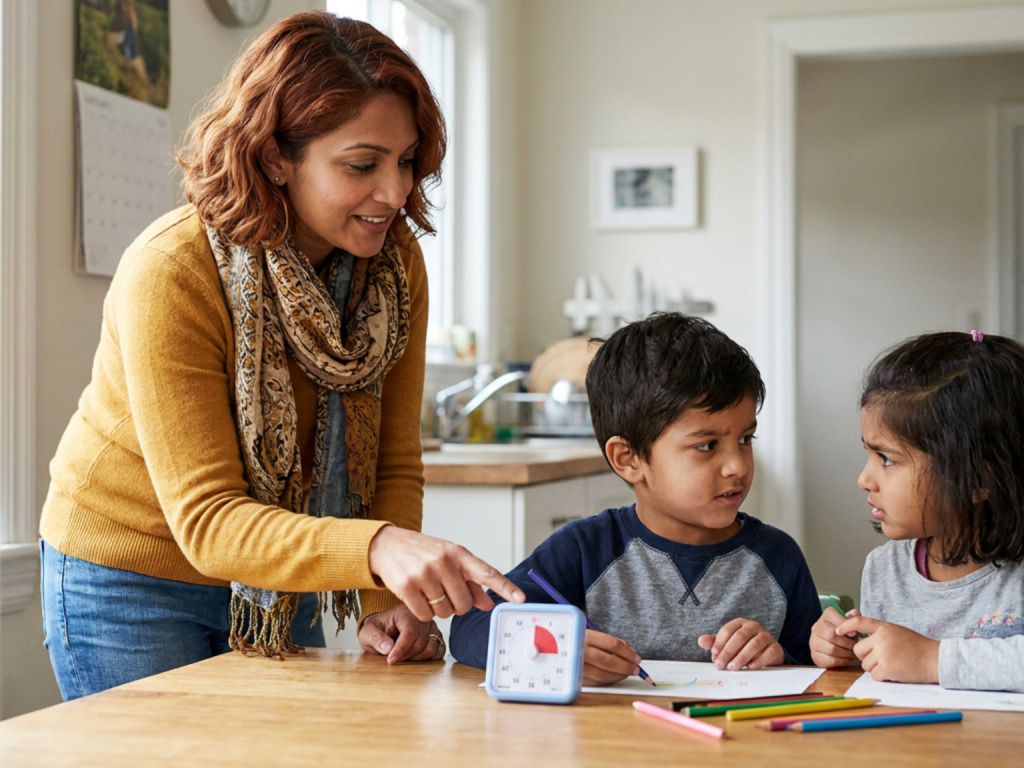
- Use schedules for scarce resources. Timers, calendars, and rotating turns reduce arguments about who is “first.”
- Plan for transitions. Give warnings before switching activities, leaving the house, or ending screen time.
- Protect individual attention. Even brief one-on-one time with each child can reduce attention-seeking conflict.
- Separate overstimulated children before escalation. Quiet time, parallel play, or separate workspaces can be restorative rather than punitive.
Many sibling conflicts intensify when children are physiologically dysregulated: hungry, sleep-deprived, overstimulated, or recovering from illness. Parents do not need to medicalize ordinary irritability, but it is useful to remember that the developing nervous system has limited regulatory capacity. Meeting basic needs can be a surprisingly effective conflict intervention.
Teach conflict skills, not just compliance
Children are not born knowing how to negotiate, apologize, compromise, or repair. These are learned social-emotional skills that require repetition. When parents only decide who is right and who is wrong, children may become dependent on adult judgment or compete to present the most persuasive case. When appropriate and safe, shift from referee to coach.
A simple coaching sequence is:
- Pause the behavior. “Stop. I will not let you grab or shout in his face.”
- Name the problem neutrally. “Two people want the same controller.”
- Give each child a brief turn to speak. Keep it short to prevent courtroom-style arguing.
- Reflect feelings and needs. “You wanted privacy. You wanted to be included.”
- Ask for solutions. “What are two safe options?”
- Choose and follow through. Use a timer, turn-taking plan, apology, or repair action.
For younger children, adults may need to supply the language: “Say, ‘I’m not done yet. You can have it when the timer beeps.’” For older children, coaching can include perspective-taking: “What do you think your brother thought was happening when you laughed?” The aim is not to force instant affection. It is to build behavioral alternatives to aggression, avoidance, or revenge.
Be careful with fairness, comparison, and labels
Many sibling conflicts are fueled by perceived unfairness. Children notice differences in privileges, responsibilities, praise, discipline, and parental time. Yet fairness is not always identical treatment. A toddler, a child with a learning difficulty, and an adolescent preparing for exams may need different limits and supports. The key is to communicate the principle: “Everyone gets what they need to be safe, respected, and able to grow.”
Avoid comparisons such as “Why can’t you be calm like your sister?” or “Your brother never complains about chores.” Comparisons can intensify shame and rivalry. Labels can do the same, even when they sound affectionate: “the responsible one,” “the difficult one,” “the baby,” or “the dramatic one.” These roles may become self-fulfilling and can harden sibling resentment.
Instead, describe specific behavior and expectations. Say, “You put your shoes away without being asked; that helped the morning go smoothly,” rather than “You’re the good child.” Say, “Throwing the marker is unsafe; you need to put it down,” rather than “You’re always the aggressive one.” Specific feedback supports change without making a child’s identity the problem.
Reinforce cooperation when it happens
Parents often intervene when siblings fight but stay quiet when they cooperate. From a behavioral perspective, attention is a powerful reinforcer. If children receive intense parental attention mainly during conflict, the family may unintentionally strengthen the conflict cycle. This does not mean ignoring dangerous behavior; it means deliberately noticing the behaviors you want to see more often.
Offer precise, immediate reinforcement: “You both waited for a turn without grabbing,” “You noticed she was upset and gave her space,” or “You solved that without yelling.” Praise effort, flexibility, and repair rather than only harmony. Siblings do not need to be best friends to practice respectful coexistence.
Shared positive experiences also matter. Low-pressure activities such as cooking, building, walking, caring for a pet, or completing a family project can create cooperative memories. Choose activities where children are not forced into direct competition and where roles can be matched to developmental ability. If one child consistently dominates, structure the task so each child has a meaningful, protected role.
Know when to intervene immediately
Some situations require prompt adult intervention rather than coaching from a distance. Physical aggression, threats, property destruction, intimidation, sexualized behavior, cruelty, or repeated targeting of a more vulnerable sibling should be taken seriously. Children may minimize harm because they fear punishment, loyalty conflicts, or not being believed. A child who appears unusually anxious, withdrawn, hypervigilant, or reluctant to be alone with a sibling may be signaling distress.
Separate children calmly and ensure immediate safety. Avoid lengthy lectures while emotions are high. Once everyone is regulated, gather information individually if needed. Focus on safety, accountability, and repair. Consequences should be related, proportionate, and predictable, such as loss of access to the misused object, supervised play, restitution for damage, or practicing the expected behavior.
If aggression is recurrent or severe, consider contributing factors without assuming a diagnosis. Sleep problems, anxiety, depression, trauma exposure, bullying, substance use in adolescents, neurodevelopmental differences such as ADHD or autism, learning difficulties, and family stress can all affect emotion regulation and conflict patterns. A pediatrician, child mental health clinician, or family therapist can help assess needs and recommend appropriate support.
Repair after conflict and protect the relationship
Repair is more than saying “sorry.” A rushed apology can become performative if the child does not understand the impact or know what to do differently next time. Repair may include returning an item, helping rebuild something broken, giving space, writing a note, making a plan for next time, or practicing a replacement phrase.
Parents can model repair too. If you shouted or took sides unfairly, a brief caregiver repair is powerful: “I was overwhelmed and I yelled. That was not the way I want to handle it. I’m going to try again.” This teaches accountability without collapsing parental authority.
It is also helpful to separate the sibling relationship from the conflict episode. You might say, “You had a hard conflict today, and we are going to work on safer ways to handle anger. You are both part of this family, and everyone deserves respect here.” This reduces shame while maintaining the boundary.
When sibling conflict may be unsafe
- One child seems afraid of, controlled by, or persistently targeted by a sibling.
- Conflicts include choking, weapons, repeated injury, threats, or destruction of property.
- There is sexualized behavior, coercion, humiliation, or secrecy between siblings.
- A child becomes withdrawn, highly anxious, sleep-disrupted, or reluctant to be at home.
- Parent strategies are not reducing escalation, or caregivers feel unable to keep children safe.
Tools & Assistance
- Create a written family rule list with no hitting, no threats, no name-calling, and clear privacy rules.
- Use timers, schedules, and turn-taking charts for screens, toys, bathrooms, and shared spaces.
- Set aside brief one-on-one time with each child to reduce competition for attention.
- Consult a pediatrician, child psychologist, family therapist, or school counselor if conflict is severe or persistent.
- Use calm separation spaces for regulation, not as shame-based isolation.
FAQ
Should parents let siblings work it out themselves?
Sometimes, if the conflict is mild and both children have similar power and skills. Intervene when there is aggression, intimidation, repeated targeting, or when children lack the developmental ability to resolve the problem safely.
Is it better to treat siblings exactly the same?
Not always. Fairness means each child receives developmentally appropriate support, limits, and attention. Explain differences calmly and avoid comparing children.
What should I do if one child is always blamed?
Look for family patterns and avoid fixed labels such as “the troublemaker.” Address specific behaviors, listen to each child separately when needed, and reinforce positive behavior from all siblings.
Do consequences help with sibling conflict?
Consequences can help when they are predictable, proportionate, and connected to the behavior. They work best alongside emotion coaching, prevention, and clear family rules.
When should we seek professional help?
Seek support if conflicts are physically unsafe, emotionally harmful, persistent despite consistent parenting strategies, or associated with major mood, sleep, school, trauma, or neurodevelopmental concerns.
Sources
- PubMed Central — Relationships between parenting style and sibling conflicts: A meta-analysis
- Child Mind Institute — How to Help Siblings Get Along
- University of New Hampshire — Sibling Rivalry & Conflict
Disclaimer
This article is for informational purposes only and does not replace medical, psychological, or safety advice. If sibling conflict involves injury, threats, coercion, trauma concerns, or significant emotional distress, consult a qualified healthcare professional or emergency service as appropriate.


















Please log in to leave a comment.