
Intro
Protective sports gear is designed to reduce injury risk, but it is not indestructible. Children’s equipment can deteriorate through ordinary use, repeated impacts, exposure to heat or moisture, washing, stretching, and changes in body size. A helmet, mouthguard, shin guard, shoulder pad, or pair of protective goggles may look acceptable while no longer providing the intended level of protection.
Replacement decisions are best based on the item’s condition, impact history, fit, certification, and manufacturer guidance rather than on appearance or a single universal time limit. When there is uncertainty—especially after a collision or fall—pause use and ask the coach, equipment specialist, sports medicine clinician, pediatrician, or manufacturer for advice.
Highlights
Replace a helmet after a significant impact, even if no crack or dent is visible.
A correct fit is a safety requirement; children may outgrow equipment before it looks worn.
Manufacturer replacement dates, certification requirements, and recall notices should be checked regularly.
Damage to shells, padding, straps, fasteners, lenses, or protective barriers is a reason to stop using the item until it has been assessed.
If a child may have a concussion or another injury, medical assessment takes priority over replacing equipment.
Why protective gear does not last indefinitely
Protective equipment functions by absorbing, dispersing, or resisting energy. Foam liners may compress, plastic shells may become brittle, elastic materials may lose tension, and stitching or fasteners may weaken. Sweat, ultraviolet exposure, temperature changes, cleaning products, and storage in a hot vehicle can also affect materials. These changes may be gradual and difficult to see.
There is no universal lifespan for all protective sports gear. Replacement should be guided by the manufacturer’s instructions, the item’s obsolescence or end-of-service date, damage, impact history, and fit. A lightly used item can still be unsuitable if it is past the manufacturer’s stated service period or no longer meets the relevant safety standard. Conversely, a newer item may need immediate replacement after a major impact.
For families, this means that “it still looks new” is not enough. Keep the product documentation, note when the item was purchased, and identify the applicable certification label or standard. If the instructions are missing, contact the manufacturer or a reputable sports-equipment retailer rather than guessing.
Replace equipment after an impact or collision
Impact history is one of the most important replacement triggers. A helmet should generally be removed from service after a significant impact, even when there is no visible damage. The internal structure can be compromised without an obvious crack, dent, or deformation. Do not allow a child to continue using an impact-involved helmet while waiting to see whether marks appear.
After a collision, fall, or projectile strike, place the item aside and record what happened: the approximate date, the type of impact, and whether the child was wearing it correctly. Follow the manufacturer’s replacement instructions. Some sports organizations or manufacturers may provide inspection or replacement programs, but an informal visual check cannot reliably restore an impacted helmet’s protective performance.
Other equipment also deserves careful assessment after forceful contact. Replace or professionally evaluate protective padding, chest protectors, shoulder pads, goalie equipment, face shields, goggles, and guards if the impact caused cracking, separation, deformation, loose components, or a loss of secure attachment. If the manufacturer states that an item is single-impact or single-use, follow that instruction even if it appears intact.
If a child develops headache, vomiting, confusion, unusual drowsiness, imbalance, visual disturbance, memory difficulty, or another concerning symptom after a head impact, remove the child from play and seek urgent medical guidance. Equipment replacement does not evaluate or treat a possible concussion.
Visible damage that should stop use
Before every practice or competition, inspect gear in good light. Damage does not need to be dramatic to matter. Stop using the item if you find:
- Cracks, splits, punctures, deep scratches, dents, or deformation in a hard shell
- Compressed, torn, detached, hardened, or missing padding
- Frayed straps, stretched elastic, broken buckles, loose rivets, or damaged stitching
- A face cage, lens, shield, or guard that is cracked, cloudy, severely scratched, or no longer securely attached
- Peeling protective coatings, exposed internal materials, corrosion, or sharp edges
- Parts that cannot be tightened, locked, or adjusted as intended
Do not repair safety-critical equipment with household glue, tape, staples, improvised straps, or unapproved replacement parts. These repairs can alter how force is distributed or prevent the item from releasing or staying in place as designed. Use only manufacturer-approved components, and replace the item when repair guidance is unavailable.
Odor or discoloration alone does not necessarily prove that an item is unsafe, but they may signal poor hygiene, moisture retention, or material breakdown. Clean equipment according to its care instructions and allow it to dry completely. Persistent deterioration, mold-like growth, or material changes should prompt replacement or professional advice.
Fit changes as children grow
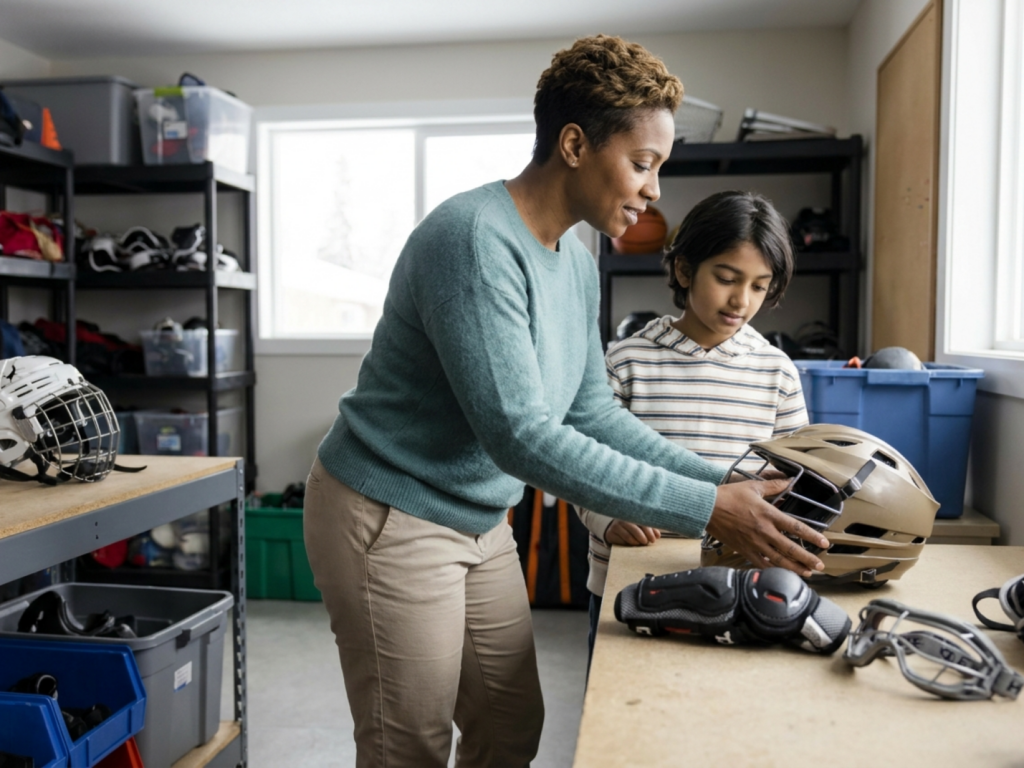
Children can outgrow protective equipment quickly, sometimes before parents notice obvious wear. A helmet that fitted correctly last season may now sit too high, shift during movement, fail to cover the intended area, or leave uncomfortable pressure points. Gloves, mouthguards, chest protectors, shin guards, goggles, and pads can also become too small as a child’s body proportions change.
Fit should be checked at the start of each season, after a noticeable growth spurt, and whenever the child reports discomfort or difficulty moving. The item should remain stable during normal sport-specific movements without causing pain, numbness, restricted breathing, impaired vision, or loss of range of motion. Straps and adjustment systems should have usable room remaining; an item forced to its tightest or loosest setting may not be appropriate.
Use properly fitted protective gear rather than relying on bulky clothing, extra padding, or “growing room.” Oversized equipment can shift during impact, while undersized equipment can leave vulnerable areas exposed. Have a coach, certified fitter, athletic trainer, or knowledgeable retailer check the fit when possible. A child’s preference for a particular color, brand, or familiar item is understandable, but comfort and correct coverage must take priority.
Fit also needs reassessment when the sport or playing position changes. A child moving from recreational participation to a more competitive level may face greater speed, contact, or equipment requirements. Review the current rules and the sport’s specific protective equipment before the new season begins.
Certification, standards, and manufacturer deadlines
Protective equipment is intended to meet defined performance requirements, but certification is not necessarily permanent. Standards can be updated, products can be recalled, and manufacturers may specify a replacement date, recertification process, or maximum service period. Some helmets and other equipment may remain eligible only if they continue to meet current requirements and have not exceeded the manufacturer’s stated date.
Check the label, model number, production date, and certification mark. Compare them with the rules of the child’s league, school, governing body, or competition. A used item from a friend or second-hand shop may be safe only if its complete history, impact history, parts, and certification status are known. If those details cannot be verified, replacement is often the more cautious choice.
Do not assume that a newer-looking product is automatically compliant. Look for safety notices and recalls, and ask the manufacturer whether the model remains approved for the intended sport. Certification organizations and sports bodies may have different requirements, so the relevant rule is the one governing the activity in which the child will participate.
Keep a simple equipment record with purchase dates, inspection dates, impact events, replacement deadlines, and notes about fit. This makes seasonal review easier and reduces the chance that an expired or damaged item is returned to a child’s gear bag.
A practical inspection routine for families
A brief, consistent routine can make replacement decisions less stressful. Inspect equipment before the first use of the season, after every substantial impact, and periodically during active participation. Ask the child what feels different: discomfort, slipping, pressure, restricted movement, poor visibility, or difficulty fastening the item may reveal a problem that an adult cannot see.
- Clean and dry the equipment so cracks, tears, and contamination are easier to identify.
- Check the outer shell, padding, straps, fasteners, seams, lenses, and adjustment points.
- Confirm that the item fits the child now and remains stable during realistic movements.
- Verify the certification label, model, manufacturer deadline, and league requirements.
- Ask whether the item has been involved in a collision, fall, dropped forcefully, or stored in damaging conditions.
- Remove questionable equipment from service, label it clearly, and obtain advice before donating or passing it to another child.
When replacing gear, involve the child in choosing an approved, comfortable option and teach them to report damage rather than hide it. Children may worry about missing practice, disappointing teammates, or losing an expensive item. A calm response—“we are checking whether it can still protect you”—supports honest communication and a stronger child-centered sports safety culture.
What to do when replacement is uncertain
When the evidence is unclear, the safest temporary decision is usually to pause use of the item until it has been assessed. Take clear photographs of damage, keep the model and serial information, and contact the manufacturer, league, certified equipment specialist, athletic trainer, or sports medicine service. Ask specific questions about the impact, service date, replacement parts, certification, and fit.
If the equipment was involved in a head impact, separate two decisions: whether the gear needs replacement and whether the child needs medical evaluation. A helmet cannot prevent every brain injury, and a normal-looking helmet does not rule out a concussion. Follow the child’s healthcare professional’s advice about assessment, observation, and return to activity. Seek emergency help for severe or rapidly worsening symptoms, loss of consciousness, repeated vomiting, seizure, neck pain with neurological symptoms, increasing confusion, or difficulty waking.
Replacing gear can be financially difficult, particularly when a child grows rapidly or participates in several sports. Ask the school, club, league, community center, or local sports organization about equipment libraries, subsidies, certified used-equipment programs, or seasonal exchanges. Cost concerns should be addressed through safe alternatives, not by continuing to use equipment with uncertain protection.
Stop play and seek advice when
- A helmet or other protective item has been involved in a significant impact.
- There is a crack, dent, tear, detached padding, broken strap, loose fastener, or sharp edge.
- The equipment no longer fits securely or leaves a protected area exposed.
- The certification mark, model, replacement date, or impact history cannot be verified.
- A child has possible concussion symptoms or other concerning symptoms after an injury.
- A repair would require improvised materials or unapproved parts.
Tools & Assistance
- A seasonal equipment inspection checklist
- The manufacturer’s care manual and replacement guidance
- A sports medicine clinician, pediatrician, athletic trainer, or certified equipment fitter
- The child’s coach, league, school athletics office, or governing body
- A labeled storage area for equipment removed from service
FAQ
Can a helmet be reused after a minor-looking fall?
Do not decide by appearance alone. Follow the helmet manufacturer’s impact guidance; a significant impact can require replacement even when there is no visible damage. When uncertain, remove it from use and seek expert advice.
Is there one replacement schedule for all children’s sports gear?
No. Lifespan varies by product, materials, use, impact history, fit, certification, and manufacturer instructions. Use the stated service or replacement deadline when one is provided.
Can a child use second-hand protective equipment?
Possibly, but only when the item’s age, impact history, parts, fit, condition, and certification can be verified. A second-hand helmet with an unknown history is a particular concern.
What if replacement gear is unaffordable?
Ask the school, club, league, community program, or retailer about equipment loans, subsidies, certified used gear, or exchanges. Do not improvise repairs or continue using equipment with uncertain protective performance.
Does new protective gear prevent concussion?
No protective equipment can eliminate all injury risk. A properly fitted, approved helmet or other gear may reduce certain risks, but suspected concussion in children requires removal from play and appropriate medical guidance.
Sources
- Government of Canada — Helmet safety
- National Federation of State High School Associations — Safety First: NOCSAE Strives for Rigorous Equipment Standards in Sports
- Health and Safety Authority — PPE FAQ Responses
Disclaimer
This article provides general educational information and does not diagnose, treat, or replace advice from a qualified healthcare professional or equipment specialist. Seek prompt medical care for concerning symptoms or injuries.














Please log in to leave a comment.