
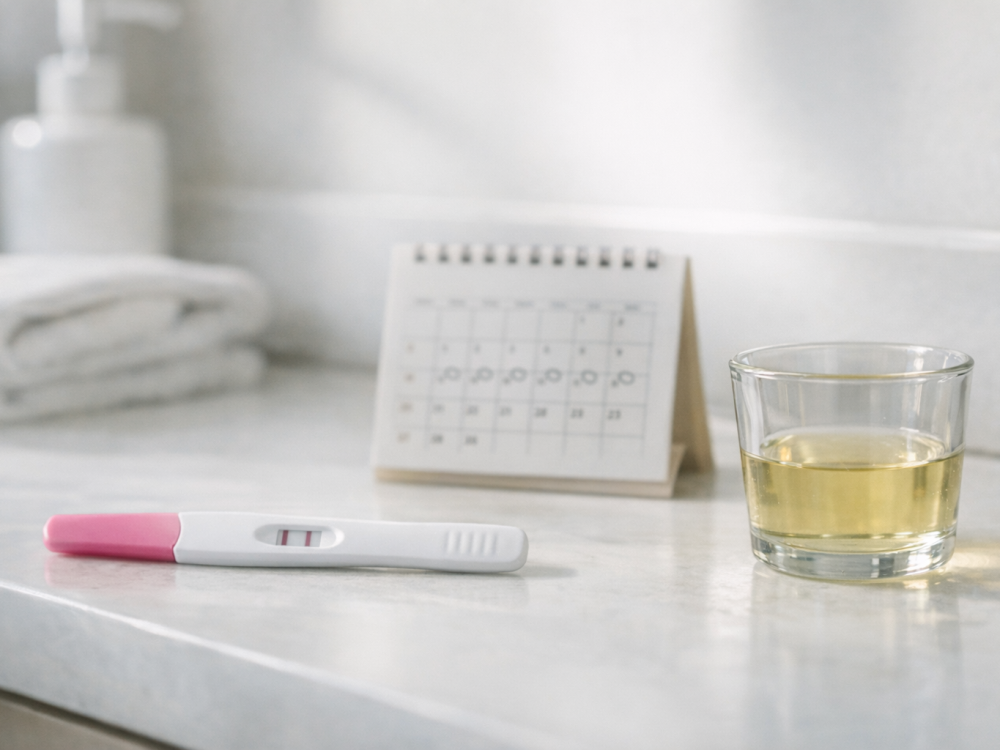
Intro
Ovulation predictor kits, often called OPKs, can make fertile-window timing feel more concrete by detecting a urinary rise in luteinizing hormone (LH). For many people trying to conceive, this is helpful because the LH surge usually occurs shortly before ovulation, giving a practical signal for when intercourse or insemination is most likely to align with egg release.
At the same time, OPKs are not perfect “ovulation confirmation” tests. They predict that ovulation may be approaching; they do not prove that an egg was released, that the egg is viable, or that pregnancy will occur. Learning when to start testing, how to follow the instructions consistently, and how to interpret faint, positive, invalid, or confusing results can reduce stress and help you use OPKs more effectively.
Highlights
OPKs detect the LH surge in urine, and ovulation often follows within about 24–36 hours, though individual timing can vary.
For most people with regular cycles, testing begins several days before the expected ovulation day; irregular cycles often require a wider testing window or clinician guidance.
A positive line-based OPK usually means the test line is as dark as or darker than the control line, not merely visible.
OPKs can be misleading in conditions associated with chronically elevated or fluctuating LH, including some cases of polycystic ovary syndrome.
OPKs are useful for timing conception attempts, but they are not reliable contraception and should not be used to avoid pregnancy.
What an OPK measures
Most predictor kits measure in urine. LH is produced by the pituitary gland and rises sharply in the late follicular phase of the ]]. This LH surge helps trigger final maturation of the dominant follicle and the release of an oocyte from the ovary.
In many cycles, occurs roughly within 24–36 hours after the LH surge is detected, although this is an estimate rather than a guarantee. Some people have a short LH surge that may be easy to miss if testing is infrequent; others have a prolonged surge with several days of positive tests. Digital fertility monitors may also track additional hormone patterns, such as metabolites, to estimate high-fertility and peak-fertility days.
It is important to distinguish prediction from confirmation. A positive OPK suggests that the hormonal signal for has occurred or is occurring. It does not confirm follicle rupture. Confirmation usually relies on other evidence, such as a sustained basal body rise, mid-luteal testing ordered by a clinician, or monitoring in fertility care.
When to start testing
The best starting day depends on your usual cycle length. A practical method is to estimate the likely window by looking at recent cycles. often occurs about 12–16 days before the next period, so people with a 28-day cycle may start testing around cycle day 10 or 11. Cycle day 1 is the first day of full menstrual bleeding, not spotting.
If your cycles are shorter, begin earlier. If they are longer, you may start later, but not so late that you miss an early LH surge. Many OPK instruction leaflets include a chart matching cycle length to the first testing day; following the specific kit’s chart is usually the safest approach because sensitivity and design vary between brands.
For irregular cycles, timing is more challenging. One option is to begin testing based on your shortest recent cycle, which reduces the chance of missing an early surge but uses more test strips. If cycles vary widely, are consistently shorter than about 21 days or longer than about 35–40 days, or periods are absent, OPKs may become frustrating and less informative. In those situations, a healthcare professional can help assess patterns and whether additional evaluation is appropriate.
How often and what time of day to test
Many people test once daily during the expected . If you have previously missed surges, have short surges, or are close to the expected day, testing twice daily may be useful: for example, late morning or early afternoon and again in the evening. The goal is consistency, not perfection.
Unlike many pregnancy tests, first-morning urine is not always ideal for OPKs, because the LH surge may begin later in the day and appear in urine after a delay. Many manufacturers suggest testing later in the morning or afternoon. However, instructions vary, so the kit leaflet should take priority.
- Try to test at a similar time each day during the testing window.
- Avoid excessive fluid intake for about 2 hours before testing, because dilute urine may reduce line intensity.
- If using a dip test, collect urine in a clean, dry container.
- Set a timer and read the result only within the manufacturer’s specified window.
- Do not compare dried tests hours later; evaporation and drying changes can mislead interpretation.
Step-by-step: urine-stream and dip-stick OPKs
OPKs come in several formats, including midstream sticks, dip strips, cassette tests, and digital readers. The exact method matters because over-soaking, under-soaking, reading too early, or reading too late can produce invalid or confusing results.
- Check the expiration date and make sure the packaging is intact.
- Wash your hands and read the instructions for your specific brand.
- For a midstream test, hold the absorbent tip in the urine stream for the stated number of seconds, or dip the tip into collected urine if the instructions allow.
- For a dip strip, immerse only to the indicated max line for the specified time, then place it flat on a clean surface.
- Wait the recommended number of minutes before reading the result.
- If using a digital test, insert the strip correctly into the reader and wait for the displayed symbol or result.
If no control line appears on a line-based test, or the digital reader shows an error, the result is invalid. Repeat with a new test, ideally using the same urine sample if still within the allowed time and stored appropriately, or test again later.
How to read line-based OPK results correctly
Line-based OPKs are a common source of confusion because they differ from pregnancy tests. On a pregnancy test, any true test line may be considered positive depending on the brand. On many OPKs, a faint test line is usually negative because low levels of LH can be present throughout the cycle.
For most line-based OPKs, the result is positive when the test line is as dark as or darker than the control line. If the test line is lighter than the control line, the result is usually negative, even if the line is clearly visible. Some brands use different thresholds, so the instruction leaflet remains the final reference.
- Negative: no test line, or a test line lighter than the control line.
- Positive: test line equal to or darker than the control line, suggesting an LH surge.
- Invalid: no control line, damaged strip, unreadable background, or result read outside the time window.
- Ambiguous: nearly equal lines, uneven dye, or inconsistent lighting; retest later the same day or the next day.
Good lighting can help. Many people photograph tests at the correct reading time to compare progression, but photos and app-based line readers are not medical devices unless specifically validated and regulated. Treat them as aids, not proof.
Digital OPKs and fertility monitors
Digital OPKs reduce some interpretation difficulties by displaying a symbol, word, or fertility level rather than requiring line comparison. Some identify only the LH surge, while others estimate a broader by detecting changes in estrogen-related hormones before the LH peak. This can be helpful for people who want clearer results or who find line comparison stressful.
Digital systems still have limitations. They must be used exactly as directed, often with brand-specific test sticks and a reader that tracks cycle data. Removing the test too early, inserting it incorrectly, or starting too late in the cycle can lead to errors or missed peak readings. Some digital monitors require several cycles to learn your pattern.
A “peak” result generally indicates that intercourse or insemination that day and the following day is well timed. A “high” result, if your monitor provides it, often reflects rising estrogen before the LH surge and may identify fertile days before the peak. Because sperm can survive for several days in fertile , these earlier high-fertility days can matter.
Using a positive OPK to time conception attempts
A positive OPK usually means the is open and may occur soon, often within about 24–36 hours. If you are trying to conceive through , many clinicians and resources suggest having on the day of the positive test and the next day. Intercourse in the day or two can also be effective because sperm may already be present in the reproductive tract when the oocyte is released.
For at-home insemination or clinically guided insemination, may differ depending on the protocol, sperm source, and medical guidance. If you are under care, follow the clinic’s instructions rather than general OPK advice.
It can be emotionally difficult when a perfectly timed cycle does not lead to pregnancy. Even with well-timed , pregnancy is not guaranteed in any single cycle. Age, sperm parameters, tubal factors, uterine factors, ovulatory function, endometriosis, medical conditions, medications, and chance all influence fecundability.
Why OPKs can be confusing or less reliable
OPKs perform best when LH has a distinct surge and cycles are reasonably predictable. They can be less reliable when LH is chronically elevated, surges repeatedly without ]], or rises below the test’s detection threshold. People with polycystic ovary syndrome may experience persistently higher LH or multiple apparent surges, which can lead to false-positive or hard-to-interpret results. Perimenopause, recent hormonal contraceptive discontinuation, breastfeeding, postpartum hormonal shifts, and some fertility medications may also affect interpretation.
Hydration and technique matter too. Dilute urine can produce a lighter line, while reading after the recommended window can make a result appear darker or create evaporation artifacts. Testing too late in the cycle may miss the surge entirely; testing only once daily may miss a brief surge.
If you repeatedly get no positive OPKs, positive tests for many days, bleeding is very irregular, or you have been trying to conceive without success, consider speaking with an obstetrician-gynecologist, reproductive endocrinologist, or other qualified clinician. Evaluation may include menstrual history, medication review, thyroid and prolactin testing, androgen assessment when indicated, ]] confirmation, semen analysis, and assessment of uterine or tubal factors.
Combining OPKs with other fertility signs
OPKs are most useful when interpreted in context. often becomes clearer, stretchier, and more slippery as estrogen rises before . This fertile-quality mucus supports sperm survival and may appear before a positive OPK. Basal ]] tracking, in contrast, is retrospective: a sustained rise suggests has increased after ]]]], but it does not help much for same-cycle timing unless you have established patterns over time.
Some people combine OPKs, observations, and cycle history to identify the more confidently. This can be empowering, but it can also become burdensome. If tracking increases anxiety, it is reasonable to simplify. Having intercourse every 1–2 days during the estimated can be an effective approach without daily intensive monitoring.
OPKs should not be used as contraception. Because sperm can survive before a positive OPK and ]] timing can shift, waiting for a negative result does not reliably identify “safe” days. If avoiding pregnancy is the goal, discuss evidence-based contraceptive options with a healthcare professional.
When to get medical guidance
- Seek urgent care for severe pelvic pain, fainting, heavy bleeding, or fever.
- Consult a clinician if cycles are absent, very irregular, or consistently outside the typical 21–35 day range.
- Ask for guidance if OPKs are positive for many days or never become positive across several cycles.
- If you are 35 or older, consider fertility evaluation after 6 months of trying; if younger than 35, after 12 months is commonly recommended.
- Get individualized advice sooner if you have known endometriosis, PCOS, prior pelvic infection, recurrent pregnancy loss, or a partner with known sperm concerns.
- Do not use OPKs to avoid pregnancy; they are not a reliable contraceptive method.
Tools & Assistance
- Cycle calendar or period-tracking app with manual OPK result entry
- Clean urine collection cups for dip-stick testing
- Basal body temperature thermometer for retrospective ovulation pattern tracking
- Appointment with an obstetrician-gynecologist or reproductive endocrinologist
- Semen analysis and fertility evaluation services when trying-to-conceive timelines warrant assessment
FAQ
Can I get pregnant if I have intercourse before a positive OPK?
Yes. Sperm can survive for several days in fertile cervical mucus, so intercourse in the days before ovulation can be well timed. A positive OPK helps identify that ovulation may be approaching soon.
Is a faint OPK line positive?
Usually no. On most line-based OPKs, the test line must be as dark as or darker than the control line. A faint line often reflects baseline LH and is typically negative.
How long after a positive OPK do I ovulate?
Ovulation often occurs within about 24–36 hours after the LH surge is detected, but timing varies. A positive OPK predicts possible ovulation; it does not confirm that ovulation occurred.
Why do I keep getting positive OPKs for several days?
Some people have longer LH surges, and some conditions can cause elevated or fluctuating LH. If this happens repeatedly or cycles are irregular, discuss it with a healthcare professional.
Should I test once or twice a day?
Once daily is enough for many people. Twice daily may help if your LH surge is short, your cycles are variable, or you have previously missed positive results.
Sources
- American Pregnancy Association — How to Use Ovulation Kits & Fertility Monitors
- WebMD — Using an Ovulation Test
- University of Iowa Health Care — Ovulation predictor kits (OPK)
Disclaimer
This article is for general educational purposes only and is not a substitute for personalized medical advice, diagnosis, or treatment. Consult a qualified healthcare professional about your cycle, fertility concerns, medications, or test results.
















Please log in to leave a comment.