
Intro
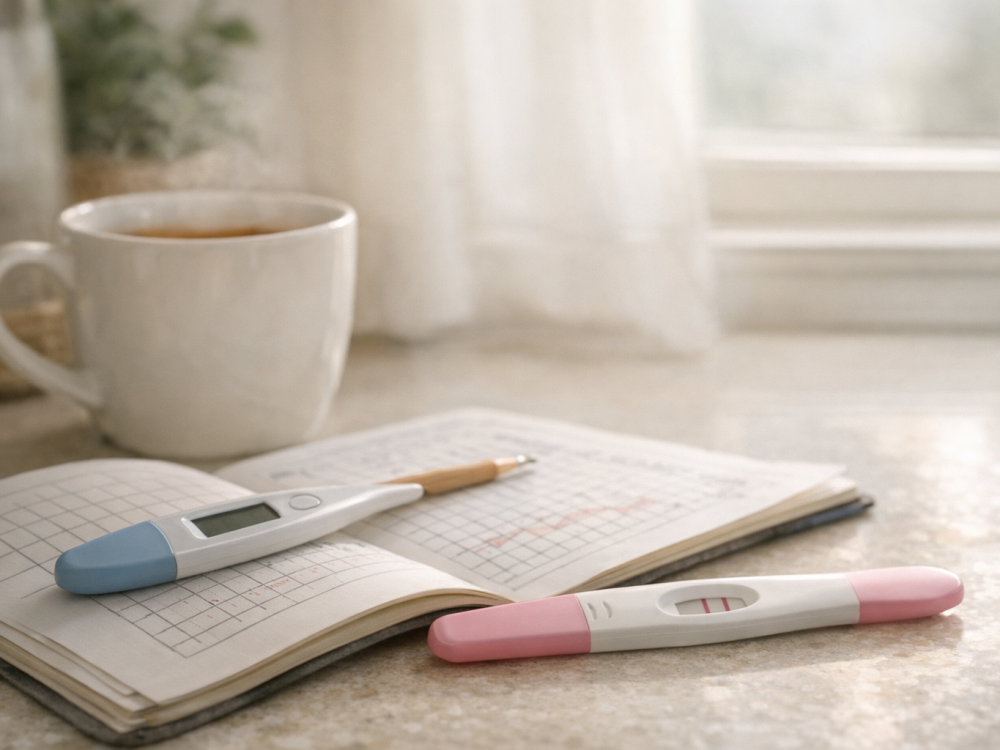
Fertility tracking means observing biological signals across the menstrual cycle to estimate the fertile window, identify likely ovulation, or confirm that ovulation has occurred. For people trying to conceive, avoid pregnancy, understand cycle health, or prepare for a medical appointment, tracking can turn vague cycle changes into more useful patterns.
It can also feel emotionally loaded. A missed surge, an unexpected temperature shift, or an irregular cycle may create anxiety, even when the finding is common and not necessarily abnormal. The most helpful approach is usually evidence-based, realistic, and matched to your goals, cycle regularity, and tolerance for daily monitoring.
Highlights
Fertility tracking is not one single method; it includes cervical mucus observation, basal body temperature, urinary hormone testing, calendar calculations, and digital devices.
Some methods predict the fertile window before ovulation, while others confirm ovulation only after it has likely happened.
Apps based only on cycle dates can be convenient but may be inaccurate when cycles vary, ovulation shifts, or postpartum and perimenopausal changes occur.
Combining complementary methods often gives a clearer picture than relying on one signal alone.
If cycles are very irregular, painful, absent, or associated with other concerning symptoms, a clinician can help evaluate whether medical assessment is needed.
What fertility tracking means
Fertility tracking is the practice of monitoring cycle-related signs that reflect changes in ovarian hormones, ]]]], and the reproductive tract. These signs may include menstrual bleeding dates, cervical mucus quality, basal body temperature, urinary luteinizing hormone, and sometimes urinary estrogen metabolites or progesterone metabolites. The aim is not to control ]] but to understand when it is most likely to occur and whether it appears to have occurred.
The is regulated by coordinated endocrine changes. Follicle-stimulating hormone supports follicular growth, estradiol rises as the dominant follicle develops, luteinizing hormone surges shortly before ]], and progesterone rises after during the luteal phase. Fertility tracking methods use these hormonal events indirectly or directly.
For conception, the key concept is the : the limited number of days when can lead to pregnancy. This window exists because sperm can survive for several days in fertile cervical mucus, while the oocyte remains viable for a much shorter time after . If you want a deeper explanation of timing, the are the physiologic foundation of most tracking methods.
How fertility tracking works biologically
Different tracking methods detect different parts of the ovulatory process. This distinction matters because a sign that predicts is useful for timing intercourse, while a sign that confirms may be more useful for understanding whether a cycle was likely ovulatory.
Predictive signs occur before ovulation. often becomes clearer, wetter, more slippery, and more stretchy as estradiol rises before ovulation. Urinary ovulation predictor kits detect the luteinizing hormone surge, which usually precedes ovulation. Some advanced tests also incorporate estrogen-related markers, which may identify a broader .
Confirmatory signs occur after ovulation. Basal typically rises after ovulation because progesterone has a thermogenic effect. Urinary pregnanediol glucuronide, a progesterone metabolite measured by some devices, can also support evidence that ovulation has occurred. These methods are helpful for pattern recognition, but they do not usually provide advance notice for intercourse in the same cycle.
Calendar-based prediction estimates future fertile days from past cycle lengths. It is simple, but ovulation does not always occur on the same cycle day, even in people with generally regular periods. Stress, illness, travel, breastfeeding, perimenopause, polycystic ovary syndrome, thyroid disease, weight change, and many other factors can shift ovulation timing.
Main fertility tracking methods
Most people use one or more of the following methods. Each has a different evidence base, workload, cost, and interpretation challenge.
- Menstrual calendar tracking: You record period start dates and cycle lengths. This can estimate likely fertile days in regular cycles but is less reliable when cycles vary. Calendar-only apps should be treated as predictions, not proof of .
- Cervical mucus observation: You observe the sensation and appearance of cervical fluid. Fertile-type mucus is often slippery, clear, stretchy, or lubricative. This method can identify the in real time, but it requires learning, consistency, and awareness that infections, semen, lubricants, antihistamines, and hormonal medications can alter observations.
- predictor kits: These urine tests detect the LH surge. A positive result suggests ovulation may occur soon, commonly within about 24 to 36 hours, although timing varies. They are useful for timing intercourse but may be harder to interpret in people with persistently elevated LH, irregular cycles, or polycystic ovary syndrome.
- Basal ]] tracking: You measure temperature after waking, before activity, using a consistent technique. A sustained temperature rise suggests progesterone exposure after ovulation. BBT is better for confirming ovulation retrospectively than predicting it in advance. Sleep disruption, alcohol, fever, shift work, and inconsistent timing can affect readings.
- Symptothermal methods: These combine cervical mucus, basal temperature, and sometimes cervical position or calendar rules. Combining signals can improve interpretation, particularly when used with structured instruction.
- Digital fertility monitors and wearable devices: These may use urinary hormones, skin temperature, heart rate, or algorithms. Some are helpful for trend detection, but accuracy depends on the biomarker, device validation, and how the algorithm handles irregular cycles.
Using tracking when trying to conceive
When the goal is pregnancy, tracking is most useful when it helps you place sperm in the reproductive tract before ]]. Waiting until after ]] is often too late for that cycle. For many couples, every 1 to 2 days during the is a practical strategy; tracking can help narrow that window if frequent is not realistic or if cycles are variable.
predictor kits can be especially convenient for timing. A positive LH test generally indicates that the is open, but it is not a guarantee that will occur. Cervical mucus can provide earlier warning because estrogen-related mucus changes may appear before the LH surge. Basal body can then help confirm afterward that the cycle pattern was consistent with .
It is important not to overinterpret a single cycle. An isolated late , unclear LH surge, or unusual temperature chart does not necessarily indicate infertility. Patterns over several cycles are usually more informative. If you are , it may also help to review and practical ways to , while remembering that conception remains probabilistic rather than fully controllable.
Using tracking to avoid pregnancy
Fertility awareness-based methods can also be used to avoid pregnancy by identifying fertile days and avoiding unprotected during that time. This requires more precision and consistency than tracking for conception, because a single misidentified fertile day may result in pregnancy.
Effectiveness varies widely depending on the method, instruction quality, cycle regularity, and adherence. Calendar-only methods are generally less robust than methods that incorporate real-time fertility signs. People using fertility awareness for contraception should consider formal instruction from a qualified educator and discuss suitability with a hehcare professional, especially after childbirth, while breastfeeding, after stopping hormonal contraception, during perimenopause, or when cycles are irregular.
Fertility tracking does not protect against sexually transmitted infections. Barrier protection may still be needed depending on partners and STI risk.
How to choose the right approach
The right method depends less on the most advanced technology and more on your goal, cycle pattern, budget, and ability to collect data consistently.
- If your main goal is timing intercourse: Consider cervical mucus tracking, ovulation predictor kits, or both. These provide information before ovulation, when timing matters most.
- If you want to confirm ovulation patterns: Basal body temperature or progesterone-metabolite testing may be useful, because they reflect post-ovulatory progesterone activity.
- If you have regular cycles and want a broad estimate: Calendar tracking may be a low-effort starting point, but it should not be the only method if precision is important.
- If you have irregular cycles: Real-time signs such as cervical mucus and urinary hormones are usually more informative than calendar predictions, but interpretation can be more complex.
- If daily tracking increases anxiety: A simpler approach, such as intercourse every 2 to 3 days across the mid-cycle period or using OPKs for a limited number of days, may be emotionally healthier.
- If you are using tracking as contraception: Choose a structured fertility awareness method with proper instruction rather than relying on a general period app.
Accuracy also depends on context. A person with predictable 28- to 30-day cycles may find a simple method adequate, while someone with variable cycles may need a combined approach. People doing shift work, waking frequently at night, or caring for an infant may find BBT difficult. Those who dislike urine testing may prefer mucus observation, while those who want clearer test results may prefer OPKs.
Common limitations and sources of confusion
Fertility tracking is useful, but it is not perfect. One common misconception is that a period always proves occurred. Some bleeding can occur without , and some ovulatory cycles have atypical luteal phase patterns. Another misconception is that an LH surge always guarantees egg release. Usually it is a good sign that is approaching, but LH patterns can be atypical.
Basal can also be misread. A rise suggests effect after ovulation, but the exact day of ovulation may be difficult to pinpoint. Similarly, ]] can be affected by arousal fluid, semen, vaginal medications, infections, hydration, and medications that dry secretions.
Apps deserve particular caution. Some apps use only past cycle dates to predict future ovulation; these are estimates. More sophisticated apps may incorporate hormones or temperature trends, but algorithms vary and may not be validated for every population. If you are making high-stakes decisions, such as avoiding pregnancy or timing fertility treatment, professional guidance is advisable. For more detail, learning can help separate suggestive signs from stronger evidence.
When to seek medical guidance
Fertility tracking can generate useful information to bring to a clinician, especially if you have several months of cycle dates, OPK results, mucus observations, or temperature charts. However, tracking should not replace evaluation when there are signs that medical input is appropriate.
Consider speaking with a healthcare professional if periods are absent, very irregular, very heavy, or associated with severe pain; if you have known endometriosis, polycystic ovary syndrome, thyroid disease, hyperprolactinemia, prior pelvic infection, recurrent pregnancy loss, or chemotherapy exposure; or if you have been without success for a clinically relevant period. Many guidelines recommend evaluation after 12 months of trying if under 35, after 6 months if 35 or older, and sooner when there are known risk factors, although individual circumstances vary.
Tracking may also be less straightforward after stopping hormonal contraception, during breastfeeding, postpartum, or in perimenopause. In these situations, professional advice can help distinguish normal transition patterns from issues that need assessment.
Important cautions
- A positive ovulation test suggests an LH surge; it does not prove that ovulation definitely occurred.
- Calendar-only predictions can be inaccurate when ovulation shifts, even in people with previously regular cycles.
- Do not use a general period app as contraception without understanding fertility awareness method rules and failure risks.
- Seek medical advice for absent periods, very irregular cycles, severe pelvic pain, unusually heavy bleeding, or repeated pregnancy loss.
- Fertility tracking can support care, but it should not delay medical evaluation when infertility risk factors are present.
Tools & Assistance
- Cycle diary with period dates, symptoms, and intercourse timing
- Urinary LH ovulation predictor kits or a validated fertility monitor
- Basal body temperature thermometer or validated wearable temperature device
- Consultation with an OB-GYN, reproductive endocrinologist, midwife, or trained fertility awareness educator
- Preconception visit to review medications, supplements, medical history, and timing questions
FAQ
Is fertility tracking the same as ovulation tracking?
Not exactly. Ovulation tracking focuses on identifying or confirming ovulation, while fertility tracking may include the broader fertile window, cervical mucus patterns, cycle length, and luteal phase signs.
Which method is best for getting pregnant?
For timing intercourse, methods that predict ovulation are most useful, such as cervical mucus observation and LH ovulation tests. BBT can help confirm ovulation afterward but is less useful for advance timing in the same cycle.
Can an app tell me exactly when I ovulate?
Usually no. Apps that rely only on past period dates estimate ovulation but cannot confirm it. Apps linked to hormone testing or temperature data may provide more individualized information, but they still have limitations.
How many cycles should I track before seeing a pattern?
Many people need at least 2 to 3 cycles to see useful trends, and longer may be needed if cycles are irregular. A single unusual chart is not necessarily meaningful.
Can fertility tracking diagnose infertility or hormonal disorders?
No. Tracking can reveal patterns that are worth discussing, but diagnosis requires clinical evaluation and, when appropriate, laboratory testing, imaging, or semen analysis.
Sources
- National Library of Medicine / PubMed Central — Current ovulation and luteal phase tracking methods and applications
- NHS — Ovulation tests
- MedlinePlus — Fertility awareness-based methods of family planning
Disclaimer
This article is for general educational purposes only and is not a diagnosis or treatment plan. Consult a qualified healthcare professional for personal advice about fertility, contraception, irregular cycles, or difficulty conceiving.














Please log in to leave a comment.