
Intro
Routines give children a dependable framework for everyday life: waking, eating, learning, playing, managing hygiene, connecting with caregivers, and sleeping. They can reduce the number of decisions a child must make and clarify what is expected, while still allowing room for flexibility, relationships, and rest.
Following routines is not a fixed skill that children either have or lack. Attention, language, executive function, temperament, sleep, health, stress, sensory needs, and developmental stage all influence performance. A supportive routine therefore evolves with the child rather than demanding that the child adapt to an unchanging schedule.
Highlights
Predictability supports children, but routines should remain flexible enough for illness, travel, family needs, and developmental variation.
Children usually need teaching, practice, prompts, and encouragement before they can complete routines independently.
Responsibilities should increase gradually as motor skills, language, judgment, and executive function mature.
Persistent or severe difficulty may warrant discussion with a pediatrician, especially when functioning, sleep, learning, or safety is affected.
Why routines help children develop
A routine is a repeated sequence that organizes activities and expectations. It may be highly predictable, such as brushing teeth before bed, or loosely structured, such as completing homework sometime after school and before leisure. Research synthesized in a systematic review suggests that family routines become more differentiated and structured as children grow, while continuing to support child and family functioning.
Predictability can reduce cognitive load. When a child knows that shoes come after socks, or that a short story follows toothbrushing, fewer mental resources are needed to determine what happens next. This does not eliminate opposition or emotional reactions, but it can make transitions more manageable. Consistent routines may also contribute to predictable routines and emotional regulation by giving children repeated opportunities to anticipate, wait, shift activities, and recover from small frustrations.
Routines are most effective when they combine structure with warm relationships. A calm caregiver, brief explanations, and realistic expectations communicate that limits are dependable without making the child feel rejected. The aim is not perfect compliance at every moment; it is gradually building participation, flexibility, and independence.
Build routines that children can understand
Begin with a small number of high-value routines rather than trying to organize every minute. Morning departure, mealtimes, medication administration when prescribed, homework, and bedtime are common priorities. Observe where the sequence breaks down: the child may understand the task but struggle to stop playing, remember several steps, tolerate sensory discomfort, or estimate how long preparation takes.
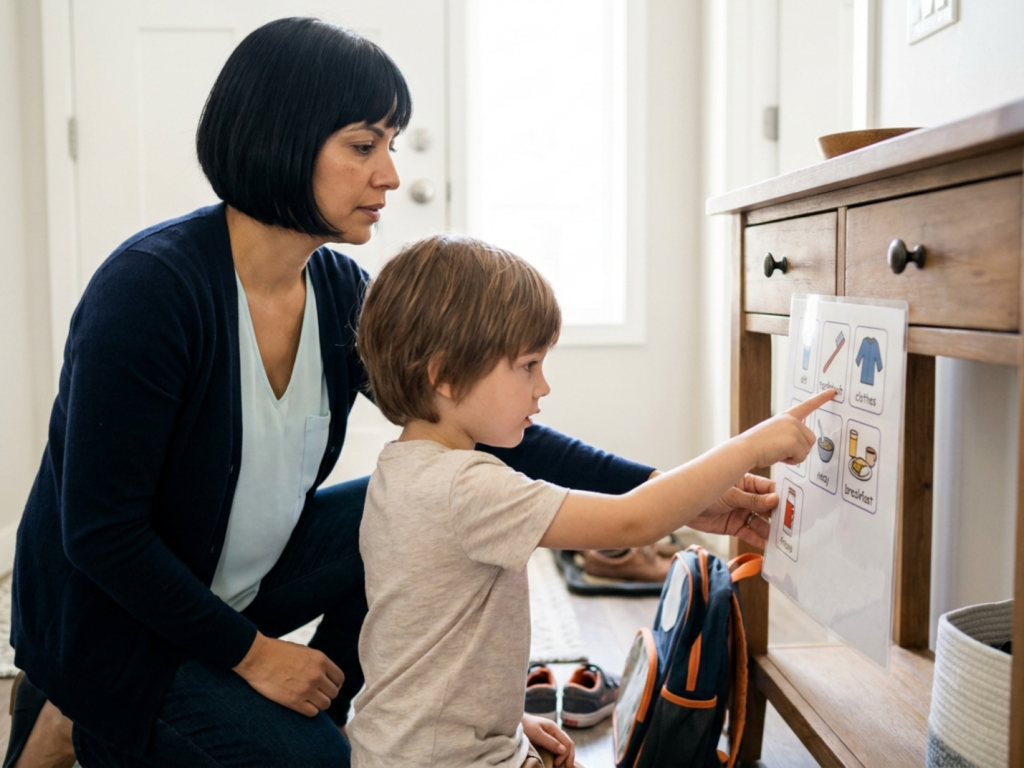
State the sequence in concrete language. “First put the cup in the sink, then choose a book” is usually easier to follow than “Get ready for bed.” Demonstrate unfamiliar tasks and practice them when nobody is rushed. A visual checklist for children can show two to five steps using words, drawings, photographs, or symbols. For younger children, point to each step; for older children, invite them to review or revise the checklist.
Use transition signals before an activity ends. A brief warning, timer, song, or consistent phrase can help the child shift attention. Offer limited choices within the routine, such as choosing between two shirts or selecting which of two tasks comes first. Choices support autonomy without turning the overall expectation into a negotiation.
Reinforce the behavior specifically: “You put your pajamas on after the reminder” identifies the action more effectively than general praise. If a child misses a step, provide the minimum prompt needed and return to the sequence. Repeatedly doing the entire task for the child may be efficient in the short term but can delay skill acquisition; repeated criticism may increase distress without improving executive functioning.
Adjust expectations from infancy through early childhood
Infants do not follow routines independently. Caregivers create anchors around feeding, sleep, interaction, and caregiving while responding to changing biological needs. Regular patterns can be helpful, but strict clock-based expectations are not appropriate for every infant. Growth, feeding requirements, illness, temperament, and medical advice must be considered. Safe sleep guidance and individualized recommendations from the child’s clinician take priority over a household schedule.
Toddlers benefit from short, repeated sequences and close adult support. Their language, inhibitory control, and time concepts are still developing, so a request may need to be paired with a gesture, picture, or physical proximity. Resistance is often strongest at transitions because the child is moving away from something rewarding. Offering connection first, naming the transition, and maintaining a simple limit can be more effective than lengthy reasoning.
Preschool children can participate in routines such as putting toys away, washing hands, dressing with assistance, and placing dishes in a designated location. Expectation should match developmental capacity: a child may complete one familiar step consistently but need help with fasteners, sequencing, fine-motor tasks, or time pressure. Break responsibilities into manageable units and allow extra time for practice.
For caregivers seeking a broader framework, a child daily routine by age can be viewed as a set of flexible developmental priorities rather than a universal timetable. Sleep, nutrition, play, language-rich interaction, movement, and emotional connection remain more important than making every day look identical.
Increase independence during the school years
School-age children can usually assume more responsibility, but independence develops unevenly. A child may pack a school bag reliably yet still need help initiating homework or remembering dental care. This reflects the complexity of executive function: initiation, working memory, planning, organization, sustained attention, and self-monitoring do not mature simultaneously.
Start with shared responsibility. Create a checklist together, place needed materials where they are easy to find, and establish a consistent location for school items. At first, the caregiver may provide reminders and review the completed sequence. Over time, fade prompts by waiting briefly, asking a cueing question, or having the child check the list independently. The goal is transfer of responsibility, not abrupt withdrawal of support.
Chores can teach contribution and routine participation when they are developmentally appropriate. Younger school-age children may sort laundry, feed a pet with supervision, clear dishes, or tidy a small area. Older children may prepare simple food, manage parts of personal laundry, or maintain a more complex household task. Safety, motor ability, comprehension, and supervision matter more than an exact age label. Responsibilities should not replace adequate sleep, schoolwork, play, or family connection.
Use collaborative problem-solving when a routine repeatedly fails. Ask what makes the task difficult, then test one change at a time: reducing steps, moving the task earlier, adding a visual cue, addressing hunger, or allowing a brief decompression period after school. This approach is particularly useful when after-school fatigue produces irritability or when demands accumulate across the day.
Support adolescents while preserving flexibility
Adolescents need increasing control over routines because self-management is a central developmental task. Caregivers can retain non-negotiable health and safety boundaries while involving the young person in decisions about timing, study strategies, chores, physical activity, and preparation for the next day. A routine imposed without consultation may provoke conflict; a routine designed collaboratively is more likely to be internalized.
Discuss the purpose of expectations rather than presenting them only as rules. For example, a consistent evening sequence may protect sleep opportunity, reduce morning stress, and support school attendance. Because circadian timing commonly shifts later during adolescence, conversations about sleep should acknowledge biology while still addressing practical constraints. A clinician can help evaluate persistent sleep concerns rather than caregivers attempting to treat them independently.
Adolescents may need systems that are less visible than a child’s picture chart: calendar reminders, recurring alarms, written weekly planning, organized storage, or a shared family schedule. Review the system periodically and remove supports that are no longer needed. At the same time, avoid interpreting every missed task as defiance. Stress, mood symptoms, learning differences, neurodevelopmental variation, sleep deprivation, pain, and family disruption can all affect routine performance.
Flexibility is an essential endpoint. Young people should learn how to adapt when transportation changes, school demands increase, plans shift, or illness interrupts the usual sequence. Practicing a “backup plan” teaches resilience more effectively than treating deviations as failures.
Respond to resistance and difficult transitions
Routine resistance is common, particularly when a preferred activity must stop. Keep the message brief, calm, and consistent: acknowledge the feeling, state the expectation, and offer the next manageable action. “You want to keep playing. It is time to wash hands; I will walk with you” combines empathy with a clear limit. Avoid escalating through repeated explanations, threats, or public humiliation.
When possible, connect before directing. Eye contact is not required, but physical proximity, a calm voice, and attention to the child’s sensory environment may improve engagement. Some children respond better to movement, visual information, or a first-then statement than to spoken instructions alone. If the child is dysregulated, prioritize safety and co-regulation; teaching can resume after arousal decreases.
Analyze patterns rather than judging character. Is resistance more likely when the child is hungry, sleep-deprived, hurried, overstimulated, or asked to complete too many steps? Is the routine associated with an unpleasant sensory experience, separation, pain, or fear? Adjusting the context may be more productive than increasing consequences.
For school-related difficulties, caregiver-school communication for routine problems can identify whether the challenge occurs across settings or only at home. Shared language, consistent prompts, and information about sleep or stress may prevent adults from drawing conflicting conclusions about the child.
Recognize when additional support is needed
Variation is expected, and occasional regression during illness, travel, family change, or developmental transitions is not necessarily concerning. Seek professional guidance when difficulties are persistent, markedly worsening, or significantly impair attendance, learning, sleep, eating, hygiene, relationships, or safety. Examples include inability to complete age-expected self-care despite consistent teaching, extreme distress with ordinary transitions, frequent dangerous impulsivity, or a major loss of previously acquired skills.
Assessment should be individualized and should not be based on routine behavior alone. A pediatrician may ask about development, hearing and vision, sleep, mood, attention, language, sensory processing, medications, family stressors, and the settings in which difficulties occur. Depending on the concern, referral to a psychologist, occupational therapist, speech-language pathologist, developmental specialist, or school support team may be appropriate.
Caregivers can prepare by recording the routine, the child’s exact response, antecedents, successful supports, duration, and functional impact. Avoid diagnosing from checklists or assuming that a single behavior identifies a disorder. Professional evaluation is especially important when there are safety concerns, suspected trauma, significant emotional distress, or developmental regression concerns.
Support should remain respectful throughout assessment. The objective is not to force conformity to an arbitrary schedule. It is to understand the child’s capacities and needs, modify environmental demands, teach practical skills, and protect participation in family, school, and community life.
When to seek professional advice
- Persistent routine difficulty substantially disrupts sleep, school attendance, self-care, or family functioning.
- A child loses previously acquired language, motor, social, or self-care skills.
- Transitions cause intense distress, aggression, panic, or unsafe behavior that caregivers cannot manage safely.
- Routine problems occur alongside suspected pain, breathing problems during sleep, nutritional concerns, mood changes, or significant developmental concerns.
- Caregivers feel overwhelmed or are relying on escalating punishment to obtain basic cooperation.
Tools & Assistance
- A two- to five-step visual routine card or checklist
- Timers, transition warnings, and first-then language
- A family calendar for shared responsibilities and schedule changes
- Brief observation notes tracking triggers, prompts, and successful strategies
- Pediatric, school-based, occupational therapy, psychology, or developmental consultation when indicated
FAQ
Should every part of a child’s day follow a strict schedule?
No. A predictable framework is useful, but children also need flexibility, free play, rest, and opportunities to adapt. Prioritize a few consistent anchors and adjust them for health, family circumstances, and developmental needs.
What should I do when my child refuses a familiar routine?
Check for fatigue, hunger, sensory discomfort, stress, or a difficult transition. Acknowledge the feeling, state one clear expectation, offer a small choice, and use the least amount of prompting needed to begin.
When should chores become part of a routine?
Children can participate in simple, supervised tasks when they have the relevant motor, language, and safety skills. Increase complexity gradually and focus on contribution and practice rather than perfection.
Are routine difficulties always behavioral?
No. Sleep disruption, pain, anxiety, learning differences, neurodevelopmental variation, sensory needs, stress, and environmental demands can all affect routine performance. Persistent problems deserve individualized professional consideration.
Sources
- Wiley — Routines and child development: A systematic review
- Centers for Disease Control and Prevention — Tips for Relying on Routines and Rules
- HealthyChildren.org / American Academy of Pediatrics — Age-Appropriate Chores for Children
Disclaimer
This article provides general educational information and is not a diagnosis or individualized medical advice. Consult a qualified healthcare professional for concerns about a child’s development, behavior, sleep, safety, or functioning.
















Please log in to leave a comment.