
Intro
Mornings can become a daily stress test for parents and children: sleep inertia, limited time, hunger, sensory discomfort, and competing priorities often converge before anyone has fully awakened. A well-designed routine cannot remove every delay or disagreement, but it can reduce the number of decisions a child must make and make transitions more predictable.
The most effective morning routine is flexible enough for real family life and consistent enough to provide structure. The goal is not perfect compliance. It is to support autonomy, emotional regulation, adequate nutrition, school readiness, and a calmer start while recognizing that children differ in age, temperament, sleep needs, health, and developmental profile.
Highlights
A predictable sequence can reduce cognitive load and support children’s self-regulation during a time of day when attention and flexibility may be limited.
Preparing clothing, school materials, food, and transportation details the night before protects the morning from avoidable decisions.
Visual schedules, advance warnings, and limited choices often improve cooperation more effectively than repeated commands.
A routine should be adapted to the child’s developmental stage, sensory needs, sleep quality, and family circumstances.
Persistent severe distress, fatigue, breathing problems during sleep, or major functional impairment warrants discussion with a qualified healthcare professional.
Start with a small, predictable sequence
Children generally manage mornings more easily when the order of events is stable. A routine acts as an external scaffold for executive function, the group of cognitive skills involved in working memory, inhibition, planning, and shifting attention. A systematic review of research on routines and child development found that consistent family routines are associated with aspects of children’s cognitive development, self-regulation, and executive functioning. These associations do not mean that a routine causes every positive outcome, but they support using predictable structure as a practical family tool.
Begin by identifying the minimum sequence required for a safe and punctual departure. For many children, this might be waking, using the toilet, dressing, eating or taking a packed breakfast, brushing teeth, collecting belongings, and leaving. Keep the sequence short at first. A routine with too many steps can overwhelm a tired child and create more opportunities for conflict.
Use the same broad order on most weekdays, while allowing reasonable variation for illness, appointments, weekends, or unusual school events. Consistency does not require rigid timing to the minute. The most useful anchors are often the order of activities and a few fixed points, such as wake-up, breakfast, and departure. Once the sequence is familiar, children can gradually take responsibility for parts of it.
Observe the routine for several days before changing it. Note where time is actually lost: waking, finding clothes, eating, toileting, toothbrushing, screen use, or locating school items. Fix the highest-impact problem first rather than redesigning the entire morning. This approach makes the routine easier to maintain and helps parents distinguish a planning problem from a child who needs additional support.
Prepare the evening before
Night-before preparation is one of the most reliable ways to reduce morning cognitive load. When adults and children are tired, searching for shoes, signing forms, or deciding what to wear can trigger avoidable delays. A brief evening reset can move these tasks out of the most time-pressured part of the day.
- Place school bags, required equipment, shoes, and outerwear in one consistent location.
- Check the next day’s schedule for sports clothing, library books, permission forms, or special transportation arrangements.
- Choose clothing in advance, with alternatives available for weather, toileting needs, or sensory comfort.
- Prepare a simple breakfast plan and make packed food where practical.
- Charge essential devices outside the child’s sleeping area when device use affects sleep or morning attention.
- Set out any prescribed medication only according to the established instructions from the child’s healthcare professional, and keep medicines secured from children.
Preparation should not become another lengthy household project. A five- to ten-minute reset may be sufficient. A child can participate by checking a picture-based list, placing their bag by the door, or selecting between two appropriate outfits. These small tasks build procedural memory and ownership without expecting a young child to manage adult responsibilities.
If bedtime is consistently too late for the child’s age and schedule, shifting it earlier gradually may be more sustainable than making a sudden change. Adequate sleep supports attention, mood, and morning functioning. Parents should discuss persistent sleep disruption, loud habitual snoring, gasping, unusual movements, or significant daytime sleepiness with a healthcare professional rather than assuming the problem is simply poor motivation.
Make the routine visible and transition-friendly
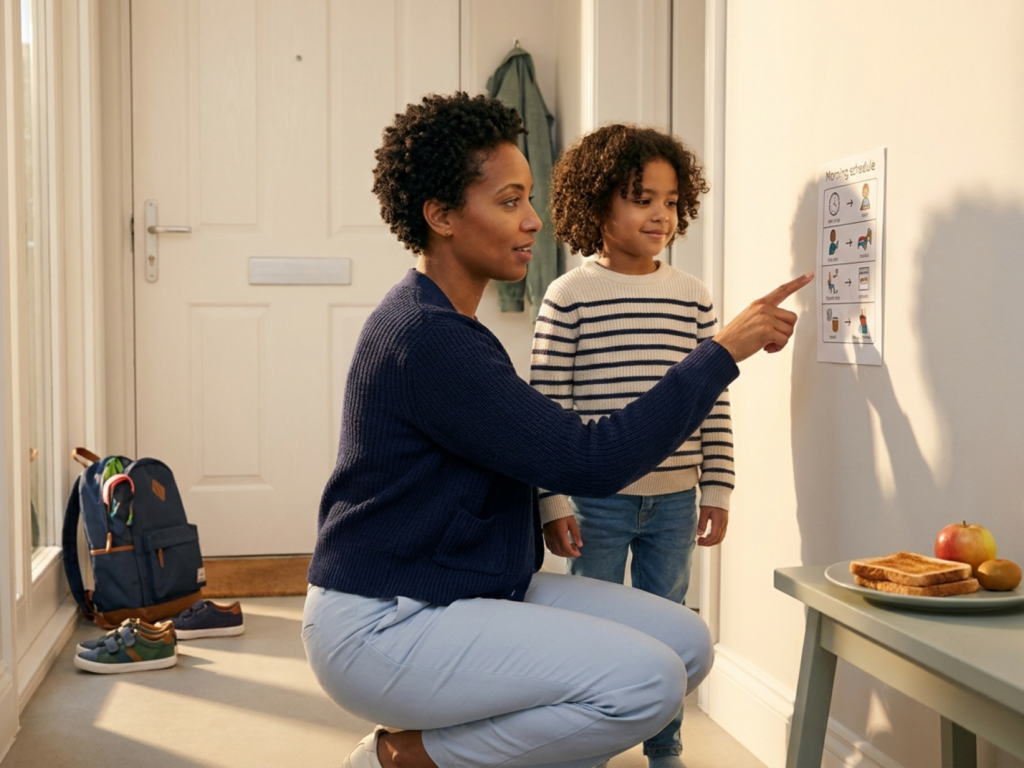
Verbal reminders are easy to miss when a child is sleepy, absorbed in play, anxious, or still developing receptive language and working memory. A visual schedule converts an abstract stream of instructions into a concrete sequence. For younger children, use photographs, simple drawings, or symbols. Older children may prefer written steps, a checklist, or a phone-based reminder managed with appropriate parental oversight.
Place the schedule where the child will use it, such as near the bed, bathroom, wardrobe, or breakfast area. It should show only the relevant steps and use language the child understands. A child can move a clip, turn over a card, or check off each completed task. The purpose is to reduce dependence on repeated adult prompting, not to create a system for monitoring or punishing the child.
Transitions deserve specific attention. Give an advance warning before ending a preferred activity, such as play, reading, or a brief age-appropriate media period. A calm warning followed by a second, shorter cue can help the child shift attention. Research on parent-child interaction during family routines supports strategies such as visual schedules, advance warnings, choices, and embedding preferred activities within routines.
Offer limited choices that preserve the non-negotiable goal: “Do you want the blue shirt or the green shirt?” or “Brush teeth before breakfast or immediately after?” Avoid presenting choices when there is no genuine choice, because this can increase distrust and negotiation. A preferred activity can also become part of the sequence: a favorite song while dressing, a short conversation during breakfast, or choosing the route to the bus stop. Keep preferred activities predictable and time-limited so they support transition rather than displace essential care.
Support hygiene, food, and sensory comfort
Morning care tasks are easier when the environment is organized around the child’s capabilities. Keep toiletries accessible but safe, use a stable step stool if appropriate, and make toothbrushing materials easy to identify. Children still need supervision or assistance with hygiene according to age and skill. Toothbrushing should follow advice from the child’s dental professional, including guidance about fluoride toothpaste and swallowing risk.
Breakfast does not need to be elaborate. Aim for a practical option that the child can tolerate and that fits the family’s schedule. Some children eat soon after waking; others have limited appetite and may manage a smaller portion followed by a snack later, depending on school policies and their individual nutritional needs. Repeatedly forcing food can intensify aversion and conflict. If a child has restricted intake, choking, swallowing difficulty, poor growth, gastrointestinal symptoms, or a very narrow range of accepted foods, seek assessment from a pediatric clinician or registered dietitian rather than using pressure-based feeding strategies.
Sensory factors can be medically and functionally important. Bright light, bathroom noise, toothpaste flavor, water temperature, clothing seams, or crowded exits may make a routine disproportionately difficult. Ask the child what feels uncomfortable and test one environmental adjustment at a time. Examples include softer clothing, a quieter bathroom, gradual exposure to grooming sensations, or allowing the child to dress before entering a busy shared space. These changes are accommodations, not indulgences, and can improve participation without lowering expectations for safety.
Keep urgent health needs separate from ordinary routine negotiations. Fever, breathing difficulty, repeated vomiting, altered alertness, acute pain, or signs of a serious allergic reaction require appropriate medical attention, not a behavior chart. Follow local emergency guidance for urgent symptoms and contact the child’s healthcare professional when uncertainty exists.
Respond to resistance with co-regulation
Morning resistance is often communication, not deliberate defiance. A child may be tired, hungry, worried about school, overwhelmed by sensory input, or frustrated by a task that exceeds current skills. Co-regulation means that the adult first provides calm external organization while the child’s capacity for self-regulation is still developing. This can include a steady voice, fewer words, physical proximity when welcomed, and one clear next step.
Use descriptive statements instead of a rapid series of commands: “Your socks are here; after socks, we put on shoes.” Acknowledge emotion without abandoning the boundary: “You do not want to leave, and leaving for school is still the plan. I will help you with the next step.” This separates the child’s feelings from the required action and reduces the pressure to argue about whether the feeling is valid.
When time allows, pause before escalating. Lower the number of questions, turn off competing media, and offer a brief choice. If the child becomes highly dysregulated, prioritize safety and connection, then return to the routine. Consequences delivered in anger may stop a behavior temporarily but can make future transitions more threatening. A calm review later is more useful: identify what happened, ask what made the step difficult, and change the environment or sequence if needed.
Parents also need a routine for their own regulation. Prepare a realistic departure buffer, divide tasks between caregivers when possible, and decide in advance which items can be omitted on a difficult morning. A child’s routine should not depend on one adult performing every task perfectly. Shared responsibility, predictable roles, and compassionate repair after conflict are protective for the whole family.
Adapt expectations by age and development
Infants and toddlers need adult-led routines with a few stable anchors rather than a long checklist. A caregiver may narrate the next step, use the same song or phrase, and offer two safe options. Preschool children can often follow a short picture schedule and complete familiar tasks with supervision. School-age children may manage a written checklist, prepare some belongings, and use a clock or timer with support. Older children and adolescents generally need increasing autonomy, while adults continue to protect sleep, safety, nutrition, and attendance expectations.
Developmental variation is normal. A child with attention-deficit/hyperactivity disorder, autism, developmental delay, anxiety, motor difficulties, sensory processing differences, or another health condition may need more external structure, more transition time, or individualized accommodations. Parents should avoid using a diagnosis as a label for every difficult morning, but they should also avoid interpreting persistent functional difficulty as laziness or poor character.
Measure success by function rather than appearance. Useful questions include: Can the child complete essential care with less prompting? Are conflicts shorter? Is departure more reliable? Does the child have enough time to eat, use the toilet, and transition safely? A routine that looks different from another family’s routine may be entirely appropriate if it meets the child’s needs.
Review the plan after changes in school schedule, household composition, transportation, sleep, illness, or developmental stage. Adjust one or two steps, explain the change ahead of time, and practice when no one is rushed. Flexibility is part of routine competence: children learn that structure provides support while circumstances can still be managed.
Recognize when extra help is needed
Most difficult mornings improve when families address sleep, preparation, transitions, and environmental demands. However, persistent or worsening problems deserve a broader assessment. Contact the child’s primary healthcare professional if morning functioning is accompanied by excessive daytime sleepiness, frequent headaches on waking, habitual loud snoring, gasping or pauses in breathing, restless sleep, recurrent abdominal pain, unexplained weight change, significant appetite concerns, or medication-related effects.
Consider discussing emotional or developmental concerns when the child has intense distress about school, repeated physical complaints before departure, panic-like symptoms, prolonged school avoidance, marked separation difficulty, regression in skills, or impairment across home and school settings. These signs do not establish a diagnosis. They indicate that a clinician, school counselor, psychologist, occupational therapist, speech-language pathologist, or other appropriately qualified professional may be able to clarify contributing factors and recommend support.
Bring concrete observations to an appointment: wake and bedtime patterns, estimated sleep duration, snoring or breathing observations, food and fluid intake, the exact point at which the routine breaks down, strategies already tried, and the effect on attendance or family functioning. Video or written tracking should respect the child’s privacy and should not delay urgent care.
Professional guidance is especially important when a child takes medication, has diabetes, epilepsy, asthma, food allergies, feeding difficulties, or another chronic condition that affects morning care. Follow the individualized plan supplied by the treating team. A general routine article cannot replace medical instructions, school health plans, or emergency action plans.
When to seek professional advice
- Seek urgent care for breathing difficulty, altered alertness, severe allergic symptoms, or other emergency signs.
- Discuss habitual snoring, gasping, witnessed pauses in breathing, or marked daytime sleepiness with a healthcare professional.
- Arrange assessment for persistent school avoidance, intense morning anxiety, or physical complaints that repeatedly interfere with attendance.
- Ask for clinical guidance when feeding difficulty, poor growth, choking, or restricted intake affects breakfast or overall nutrition.
- Follow individualized medication, diabetes, seizure, asthma, allergy, and school health plans rather than general routine advice.
Tools & Assistance
- A two-column night-before and morning checklist
- A picture schedule or written routine posted at the point of use
- A visual timer or clock for transition warnings
- A consistent launch area for bags, shoes, forms, and outerwear
- A brief log of sleep, morning barriers, and strategies tried to share with clinicians or school staff
FAQ
How long should a child’s morning routine be?
There is no universal duration. Build in enough time for waking, toileting, dressing, eating or accessing planned food, hygiene, and a safe departure without relying on constant rushing. Observe where time is actually spent and add a modest buffer for predictable delays.
What should parents do when a child refuses every step?
Reduce language, acknowledge the emotion, state the essential boundary, and offer one limited choice. Help with the next manageable action if appropriate. Review the pattern later, when calm, to identify sleep, sensory, anxiety, skill, or environmental factors rather than treating refusal as a complete explanation.
Should screens be allowed during the morning?
Families may make different choices, but screens can make transitions and time awareness harder for some children. If media routinely delays dressing, eating, or departure, remove it from the essential sequence and consider placing it after the required tasks or omitting it on school mornings.
What if my child does not want breakfast?
Avoid coercion and consider whether the child can manage a small, familiar option or a permitted later snack. Persistent restricted intake, choking, swallowing difficulty, gastrointestinal symptoms, or concerns about growth should be discussed with a pediatric clinician or registered dietitian.
Can a visual schedule help an older child?
Yes. The format can become less childish as autonomy increases: use a written checklist, calendar, alarm sequence, or shared planning app when appropriate. The child should participate in choosing the format and gradually assume responsibility for reviewing it.
Sources
- Wiley — Routines and child development: A systematic review
- PubMed Central — Transforming Parent-Child Interaction in Family Routines
- University of Georgia College of Agricultural and Environmental Sciences — Routines important for parents and children
Disclaimer
This article provides general educational information and is not a diagnosis or a substitute for individualized medical advice. Consult a qualified healthcare professional for concerns about your child’s symptoms, development, nutrition, sleep, medication, or safety.


















Please log in to leave a comment.