
Intro
Sports can support children’s cardiovascular fitness, bone health, coordination, confidence, friendships, and enjoyment of movement. Safe training is not about eliminating every risk or making practice feel clinical. It is about matching activity demands to a child’s age, development, experience, health status, and recovery capacity while creating a culture in which children can speak up when something feels wrong.
Parents, coaches, clinicians, and children all share responsibility. A thoughtful plan includes gradual progression, rest, hydration, appropriate equipment, evidence-informed warm-ups, environmental precautions, and clear responses to pain or illness. The recommendations below are general education rather than individualized medical advice.
Highlights
Training loads should increase gradually, with regular rest days and meaningful breaks between seasons.
A structured neuromuscular warm-up can prepare balance, landing mechanics, agility, strength, and coordination before vigorous activity.
Persistent or worsening pain, altered movement, concussion concerns, breathing difficulty, or heat-illness signs require prompt attention.
Sleep, hydration, nutrition, properly fitted equipment, and psychologically safe coaching are part of injury prevention.
Build training around the child, not only the sport
Children are not simply smaller adults. Their musculoskeletal, neuromuscular, thermoregulatory, and cognitive systems are still developing, and growth can temporarily alter coordination, flexibility, strength, and balance. Training should therefore reflect developmental readiness rather than an adult performance model or a fixed expectation based solely on chronological age.
Before a new season, discuss relevant medical history with the child’s healthcare professional, particularly asthma, cardiac symptoms, prior concussion, seizures, diabetes, joint instability, significant allergies, or previous fractures. The goal is not to exclude a child unnecessarily; it is to identify reasonable precautions, emergency information, and modifications when needed. Coaches should know how to access emergency contacts and health instructions while protecting the child’s privacy.
Ask whether the program is appropriate for the child’s current skill and conditioning level. A beginner entering an advanced group may need a slower ramp-up, additional instruction, or modified drills. Children should learn technique before intensity, and they should be allowed to progress when movement is controlled rather than pressured to compete through fatigue or fear of disappointing adults.
A safe program also protects emotional well-being. Humiliation, coercion, unsafe weight-control practices, and punishment through excessive exercise can undermine both health and participation. Encouragement should focus on effort, learning, teamwork, and listening to the body rather than equating toughness with ignoring pain.
Manage training load and recovery deliberately
Overuse problems often arise when repetitive stress exceeds the body’s ability to recover. The risk can increase with abrupt changes in duration, frequency, intensity, surface, equipment, or sport-specific repetition. A practical approach is to change one major training variable at a time and use gradual increases, especially after illness, injury, a long break, or a growth-related change in coordination.
Children generally need scheduled recovery, not merely time when a practice happens to be canceled. Include at least one complete rest day each week, and consider additional lighter days when school demands, travel, poor sleep, or competition schedules are substantial. A lighter day may involve gentle movement and skill work rather than repeated maximal efforts. Planned breaks between seasons can reduce cumulative load and preserve motivation.
Early specialization deserves careful consideration. Playing one sport year-round can increase repetitive exposure and reduce opportunities to develop varied movement skills. Many children benefit from participating in different activities across the year, provided the overall schedule remains manageable. If a child chooses one primary sport, vary drills, protect off-seasons, and monitor the total amount of organized and informal practice rather than counting only team sessions.
Keep a simple training and recovery record. Note practice duration, competitions, unusual intensity, sleep quality, illness, and pain during or after activity. This is not a tool for diagnosing an injury; it can help adults notice patterns and communicate clearly with a clinician. Persistent pain that changes technique, limits daily activity, or fails to improve with rest should not be normalized as ordinary training soreness.
Use warm-ups that prepare movement quality
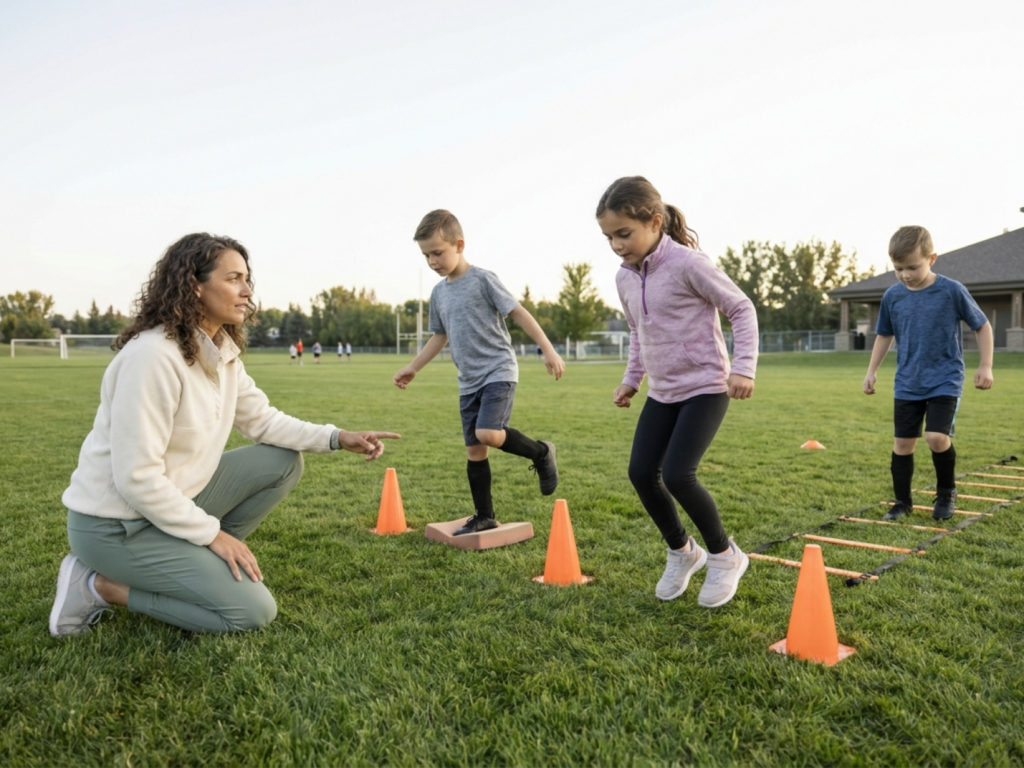
Children should not move directly from a sedentary state into maximal sprinting, jumping, throwing, or contact. A progressive warm-up can increase tissue temperature, rehearse sport-specific movement, and help the athlete focus. Begin with easy locomotion, then add dynamic mobility and controlled versions of the movements used in practice. Long, forceful static stretching is not a substitute for movement preparation before explosive activity.
Evidence summarized in a systematic review supports structured neuromuscular warm-ups in youth team sports. These programs commonly combine balance, agility, strength, deceleration, landing, and coordination exercises. Their value depends on regular implementation and appropriate coaching, not on performing a single routine occasionally. Coaches should teach quiet, controlled landings; alignment of the trunk, hip, knee, and foot; and gradual deceleration rather than simply demanding greater speed.
Warm-ups should be age-appropriate and engaging. Younger children may respond well to games that include hopping, skipping, changes of direction, and balance challenges. Older or more experienced athletes can use progressive strength and plyometric drills, but the number of repetitions and complexity should match technique and fatigue. Stop or simplify an exercise if form deteriorates, pain develops, or the child cannot follow instructions safely.
A cool-down can help transition from vigorous activity to rest, although it should not be presented as a guarantee against delayed soreness or injury. Easy movement, fluids, a snack when appropriate, and a calm check-in are often more useful than forcing stretches. Any persistent restriction in range of motion or altered gait warrants professional assessment rather than repeated stretching.
Make daily practice conditions safer
Preseason conditioning is safer when it begins before the first high-intensity competition rather than requiring an unprepared child to perform immediately at full demand. Early sessions can emphasize fundamental skills, aerobic conditioning, strength using age-appropriate resistance, and movement control. Supervision should be active enough to identify unsafe technique, excessive fatigue, dehydration, or distress.
Hydration during youth sports should be planned rather than left to thirst alone, especially in heat, humidity, or prolonged activity. Provide access to fluids and encourage regular drinking breaks. Children participating in longer or highly strenuous sessions may need individualized advice about nutrition and electrolyte replacement from a qualified healthcare professional. Avoid making unverified supplement or energy-drink recommendations; caffeine and stimulant-containing products are inappropriate for many children.
Sleep is a biological recovery requirement. Busy schedules should leave adequate opportunity for consistent, age-appropriate sleep, meals, homework, and unstructured time. A child who is repeatedly irritable, unusually fatigued, struggling academically, or losing interest in sport may be under-recovered, ill, stressed, or injured. These signs deserve a supportive conversation and, when persistent, professional guidance.
Inspect the playing area for holes, slippery surfaces, unsafe obstacles, poor lighting, and inadequate boundaries. Equipment should be appropriate for the sport, correctly sized, maintained, and properly fitted. Helmets, mouthguards, pads, footwear, and protective barriers do not eliminate risk, but they can reduce preventable exposure when used correctly. Coaches should also have a communication plan, first-aid supplies, access to emergency services, and a venue-specific emergency action plan.
Adapt for heat, cold, illness, and changing conditions
Environmental conditions can alter physiologic stress even when a practice seems routine. Heat, humidity, direct sun, poor air quality, altitude, cold, wind, and indoor ventilation may affect performance and safety. Programs should monitor conditions, provide shade or indoor alternatives when appropriate, schedule breaks, and avoid treating environmental modification as a test of toughness.
Children may be less able than adults to regulate body temperature during exertion. Teach them to report headache, dizziness, nausea, unusual weakness, confusion, chills, cramping, faintness, or a sudden change in behavior. A child with suspected heat illness should be removed from activity and evaluated promptly; confusion, collapse, seizure, or markedly abnormal behavior is an emergency requiring emergency medical services and rapid cooling according to local protocols.
Children should not train hard when they have fever, significant gastrointestinal symptoms, breathing difficulty, or an acute illness that affects energy and hydration. Return to activity should be gradual after illness and guided by symptoms and medical advice when the illness is significant or the child has a chronic condition. Asthma symptoms, chest discomfort, palpitations, or unexplained syncope during exercise require medical evaluation rather than simply increasing conditioning.
Cold-weather safety also requires planning. Use sport-appropriate layers that do not interfere with movement or protective equipment, monitor numbness and shivering, and provide warm breaks. Conditions may change during a session, so the responsible decision may be to shorten, modify, relocate, or cancel practice.
Respond early to pain, injury, and concussion concerns
Teach children that reporting pain is responsible behavior, not weakness. Stop an activity when pain is sudden, severe, localized, worsening, associated with swelling or instability, or causing a child to limp or change technique. A bruise or minor soreness may not require the same response as a deformity, inability to bear weight, or loss of function, but adults should avoid diagnosing the problem at the field.
Warning patterns for possible overuse include pain that returns with each practice, discomfort at rest or at night, declining performance, persistent stiffness, recurrent swelling, or pain near a growth plate. Children’s growth plates are areas of developing tissue that can be vulnerable to repetitive stress and acute injury. Because symptoms may be subtle, ongoing or activity-limiting pain should be discussed with a pediatrician or sports-medicine professional.
After a collision or blow to the head or body, remove the child from play if concussion is possible. Concerning features may include confusion, headache, dizziness, balance problems, nausea, sensitivity to light, slowed responses, memory difficulty, unusual behavior, or loss of consciousness. The child should not return to play the same day unless evaluated and cleared according to applicable medical and sporting protocols. Emergency care is needed for worsening headache, repeated vomiting, seizure, increasing drowsiness, weakness, neck pain, unequal pupils, or difficulty recognizing people or places.
Return to play after injury should be individualized and typically progresses from relative rest to light activity, sport-specific work, noncontact practice, full practice, and competition only when each step is tolerated and medical guidance supports progression. A child should not be pressured to conceal symptoms to preserve a place on the team.
Create a shared safety culture among adults and children
Safe training works best when expectations are explicit before the season begins. Parents can ask coaches how the program handles warm-ups, rest days, heat, illness, suspected concussion, equipment checks, emergency communication, and return to play. They can also clarify who is trained in first aid or cardiopulmonary resuscitation and how emergency medical services will be contacted.
Coaches should use consistent language: pain, dizziness, breathing difficulty, confusion, and feeling unwell should be reported immediately. Children need permission to stop without punishment, embarrassment, or loss of playing time. A brief check-in before and after practice can identify fatigue, stress, illness, or concerns that a child might otherwise hide.
Families should coordinate the full weekly schedule, including school physical education, strength sessions, tournaments, commuting, informal play, and other sports. A child’s total load may be invisible when each adult sees only one part. Communication between caregivers, coaches, trainers, and healthcare professionals is particularly important after injury or when symptoms recur.
The healthiest outcome is not simply fewer injuries. It is a child who learns sustainable movement habits, recognizes warning signals, respects recovery, and continues to view physical activity as a positive part of life. Supportive adults can protect both participation and long-term well-being by choosing patience over pressure and early evaluation over avoidable escalation.
Seek urgent help when
- A child collapses, has a seizure, or is confused after exercise or a collision.
- There is severe breathing difficulty, chest pain, fainting, or unexplained palpitations during activity.
- A suspected head injury causes worsening headache, repeated vomiting, unusual drowsiness, weakness, or behavior change.
- There is an obvious deformity, uncontrolled bleeding, inability to bear weight, or severe neck or back pain.
- Heat exposure is followed by confusion, collapse, or markedly abnormal behavior.
Tools & Assistance
- A weekly training and recovery log recording duration, competitions, sleep, illness, and pain patterns
- A preseason medical review with a pediatrician or qualified sports-medicine clinician when indicated
- A written emergency action plan with venue directions, emergency contacts, first-aid supplies, and concussion procedures
- A coach-parent checklist for warm-ups, rest days, hydration, equipment fit, environmental conditions, and symptom reporting
- A gradual return-to-activity plan coordinated with the child’s healthcare professional after significant injury or illness
FAQ
How many rest days should a child have from organized sports?
At least one complete rest day each week is a commonly cited baseline, with additional recovery or seasonal breaks based on total workload, age, sport, health, sleep, and symptoms. Individual advice may be needed.
Should children stretch before practice?
A dynamic warm-up that rehearses the planned movements is generally preferable before vigorous activity. Static stretching may have a role at other times, but it should not replace gradual movement preparation or be forced into painful positions.
Can a child play through soreness?
Mild, short-lived muscle soreness is different from focal, worsening, recurrent, or function-limiting pain. A child should stop and tell an adult about concerning pain, particularly when movement changes or symptoms persist.
When can a child return after a suspected concussion?
A suspected concussion requires removal from play and medical assessment. Return should be gradual and follow the advice of a qualified healthcare professional and the relevant sporting protocol; same-day return is generally not appropriate without proper evaluation and clearance.
Does playing several sports prevent all overuse injuries?
Sport variety may reduce repetitive exposure for some children, but it does not eliminate injury risk. Total weekly load, recovery, technique, equipment, growth, health conditions, and environmental factors still matter.
Sources
- HealthyChildren.org / American Academy of Pediatrics — Preventing Overuse Injuries in Young Athletes: AAP Policy and Guidance
- British Journal of Sports Medicine — Best practices for the dissemination and implementation of neuromuscular training injury prevention warm-ups in youth team sport: a systematic review
- Nationwide Children's Hospital — Sports Safety FAQs
Disclaimer
This article provides general educational information and is not a diagnosis, treatment plan, or substitute for individualized medical advice. Consult a qualified healthcare professional for concerns about a child’s symptoms, training, injury, illness, or return to sport.
















Please log in to leave a comment.