
Intro
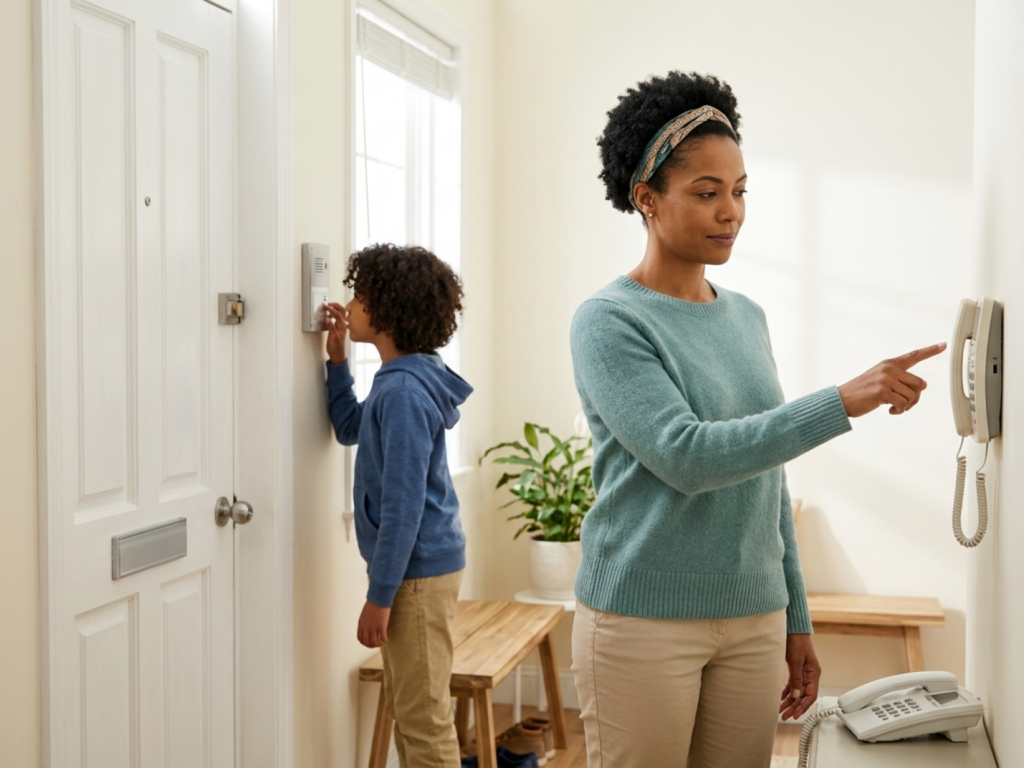
A doorbell or knock can create a sudden decision point for a child: someone is outside, the adult may be busy or absent, and the child may feel pressure to respond quickly. Teaching door safety gives children a calm, rehearsed procedure rather than asking them to rely on instinct or guess what an unfamiliar visitor wants.
The goal is not to make children fearful of neighbours, delivery workers, or other people. It is to establish predictable boundaries: keep the door secured, identify the visitor without opening it, involve a trusted adult, and seek help if anything feels unsafe. Instructions should be adapted to the child’s developmental level, communication abilities, home layout, and family circumstances.
Highlights
A child does not have to open the door simply because someone knocks or rings the bell.
Teach one consistent sequence: stop, stay behind the locked door, identify the visitor, and contact a trusted adult.
Role-play ordinary and unusual situations so the child can practise without the pressure of a real event.
A child who feels threatened should move away from the door, avoid confrontation, and contact a trusted adult or emergency services.
Begin with a simple, non-frightening safety rule
Children learn best when safety instructions are explicit, consistent, and easy to remember. A useful family rule is: “Do not open the door unless a trusted adult has said it is safe and is available to take over.” This rule can apply even when the visitor says they know the child, claims to be expected, or appears to need help. The child’s responsibility is not to investigate or solve the situation.
Explain that a locked door is a boundary, not an act of rudeness. The child may speak through the closed door, use an intercom, or ask an adult to come to the door. They should never disclose that they are home alone, provide names or personal information, announce when an adult will return, or explain the family’s schedule.
Use calm language such as, “You are allowed to wait and check first,” and, “You will not get in trouble for keeping the door closed.” This reassurance is important because children may otherwise open the door to appear polite or helpful. These rules are part of broader child personal safety skills and should be reviewed periodically rather than taught only once.
Teach the stop, check, and communicate sequence
Give the child a short sequence they can repeat under stress. First, stop what they are doing and move to a position where they cannot be reached through an open door. Second, check the visitor using the peephole, door camera, or another safe observation method, if available. Third, ask, “Who is there?” without confirming the child’s name or whether they are alone. Fourth, contact a parent, caregiver, or another designated trusted adult before taking any further action.
The door should remain locked while the child checks. A chain, security bar, or partially opened door may provide an additional barrier in some homes, but these devices should not replace a locked door or adult supervision. Children should not lean into the doorway, reach outside, accept objects through a gap, or step onto a porch or shared hallway to speak with someone.
Teach a neutral response for unexpected visitors: “Please wait outside. I need to get an adult.” If no adult is available, the child can say, “We cannot open the door,” and move away. They do not need to explain why. If the visitor asks the child to ignore the adult, keep a secret, or open the door urgently, that is a reason to end the conversation and seek help.
Practise common visitor scenarios
Role-play helps convert verbal instructions into an automatic response. Keep the first practices predictable and brief, then introduce variation. One adult can stand outside while another supports the child from inside. Practise a delivery worker leaving a parcel, a neighbour asking for an adult, a friend arriving unexpectedly, a maintenance worker, and a person the child recognizes but was not expecting.
Make the distinction between recognition and permission clear. Knowing someone does not automatically mean the child may let them in. The child should follow the family’s specific list of people who may enter, under specific conditions. For example, a caregiver may say that a named relative can enter only when the caregiver has confirmed it by telephone or through a prearranged code phrase. Avoid relying on appearance, uniforms, or confident behaviour as proof of identity.
Include practice for a visitor who says there is an emergency, asks to use the telephone, or claims that a parent sent them. A child can respond, “I cannot open the door. I will contact my adult.” If help is genuinely needed, the child can call emergency services or a trusted adult without allowing the person inside. Practise calling emergency services using the local emergency number, describing the address, and answering the dispatcher’s questions. Do not place a real emergency call during practice.
Set up the home environment to support the rule
Safety instructions are easier to follow when the environment reduces ambiguity. Keep exterior doors locked even when someone is expected, and check that locks, latches, peepholes, lighting, and door-entry systems work properly. Store a list of trusted adults and their telephone numbers where the child can reach it, while also teaching the child how to use a mobile or landline phone.
Decide where the child should go after contacting an adult. This might be a room away from the entryway, a neighbour’s home, or another prearranged safe location. If the home has a door camera or intercom, show the child how to use it without sharing access codes, alarm details, or private household information. Children should not remotely unlock the door for someone unless the family’s plan specifically allows it and a trusted adult has verified the visitor.
Include household members who may need adaptations. A child with hearing loss may need visual alerts; a child with mobility limitations may need an accessible communication method and a clearly defined safe area. Children with anxiety, developmental differences, or communication disabilities may benefit from a visual sequence, a written script, or repeated practice with a familiar professional. Individualized guidance from a caregiver and relevant clinician or therapist can help ensure the plan is realistic and does not increase distress.
Prepare for an unsafe or persistent visitor
Children need a specific escalation plan for situations that feel threatening. If a visitor bangs on the door, tries the handle, looks through windows, refuses to leave, follows the child’s instructions, or makes threats, the child should not argue or confront them. The child should move away from the entryway, avoid being visible through windows, and contact a trusted adult immediately.
If there is immediate danger, the child should call the local emergency number and state the home address first. They can say that someone is trying to enter or will not leave, then follow the dispatcher’s instructions. If speaking is unsafe, the child should use any locally available emergency text or silent-call option only if they have been taught how it works. A predetermined code word can tell a trusted adult that urgent help is needed.
Teach children that an alarm, loud voice, or escape to a prearranged safe place may be appropriate only as part of the family plan. They should never pursue a visitor, threaten them, or attempt to record the interaction if doing so could increase risk. After an event, provide reassurance, document relevant details when safe, and seek support from appropriate authorities or a healthcare professional if the child has persistent fear, sleep disruption, panic symptoms, or difficulty returning to normal activities.
Consider developmental readiness for being home alone
There is no single age at which every child is ready to answer the door or remain home alone. Readiness depends on judgment, communication, ability to follow a sequence, response to unexpected events, access to a reliable adult, and local legal or safeguarding requirements. A child who can recite a rule may still become overwhelmed when hearing an unfamiliar voice or seeing an unexpected person.
Start with supervised practice while an adult is nearby, then consider very brief periods when the child has demonstrated consistent performance. Review other essential skills at the same time: contacting a trusted adult, knowing the home address, responding to smoke or carbon-monoxide alarms, avoiding dangerous appliances, and leaving the home if instructed. A broader home-alone safety plan for children should include check-in times, prohibited activities, safe rooms or locations, and instructions for siblings or pets.
Do not use a child as a gatekeeper for adult visitors or ask them to manage deliveries, repair workers, or disputes. Siblings should have the same rules, and older children should not be given responsibilities beyond their developmental capacity. Reassess the plan after a move, change in household membership, new technology, a frightening incident, or a change in the child’s emotional or medical needs.
Use repetition while protecting confidence
Effective practice is brief, positive, and varied. Ask the child to demonstrate the sequence, then praise the specific behaviour: “You kept the door locked and called me before answering.” Avoid frightening stories, surprise tests, or pretending to be a threatening stranger without the child’s preparation and consent. The aim is skill acquisition, not a stress response.
Review the plan every few months and ask open questions: “What would you do if someone said they were a friend of mine?” “What if the person would not leave?” “Where would you go to call for help?” Correct misunderstandings immediately, especially the idea that a uniform, familiar voice, or urgent request automatically proves that a person is safe.
Children may feel embarrassed, guilty, or frightened after refusing to open the door. Reinforce that following the safety plan was appropriate. If the child develops persistent anxiety, avoidance, nightmares, somatic complaints, or functional impairment after a door-related incident, discuss those symptoms with a qualified healthcare professional. Support should be proportionate, compassionate, and focused on restoring the child’s sense of safety.
Safety warnings
- Never instruct a child to open the door to confirm a visitor’s identity.
- Do not ask a child to confront, threaten, follow, or physically restrain an unwanted visitor.
- A child should never disclose that they are alone, share household schedules, or reveal security information.
- If someone tries to enter, refuses to leave, or makes threats, the child should move away and contact a trusted adult or emergency services.
- Seek professional support if a frightening incident causes persistent anxiety, sleep problems, panic, or disruption of daily functioning.
Tools & Assistance
- A written family door-answering script placed near the telephone
- A current list of trusted adults, emergency contacts, and the home address
- A peephole, intercom, or door camera used with privacy-conscious rules
- Short, supervised role-play sessions using ordinary and unexpected visitor scenarios
- A home-alone safety plan reviewed after household or developmental changes
FAQ
Should children ever open the door for a delivery?
Only if a trusted adult has explicitly included that situation in the family plan and is available to supervise. Otherwise, the child can speak through the closed door and ask the delivery person to leave the item outside.
What should a child say when a visitor asks whether a parent is home?
The child can say, “I cannot open the door. I will contact an adult.” They should not say they are alone, describe when the parent will return, or provide other personal information.
What if the child recognizes the person outside?
Recognition is not the same as permission. The child should still keep the door locked and follow the agreed process for verifying unexpected visitors.
How can parents practise without making a child anxious?
Begin with calm, predictable role-play, explain the purpose beforehand, keep sessions short, and praise the child for following each step. Avoid surprise tests and threatening scenarios.
When should a child be allowed to answer the door alone?
Readiness is individual. Consider judgment, communication, emotional regulation, ability to contact help, and consistent use of the safety sequence rather than age alone. Follow local safeguarding guidance and seek professional advice when a child has significant anxiety or additional support needs.
Sources
- Santa Clara County Sheriff’s Office — Child safety tips
- Kidpower — Answering the Door And Staying Home Alone
- Vivint — 6 Tips for Teaching Your Children to Safely Answer the Door
Disclaimer
This article provides general educational information and is not a substitute for individualized medical, developmental, mental-health, legal, or emergency-safety advice. Consult a qualified healthcare professional or appropriate local service for concerns about a child’s anxiety, communication, development, or wellbeing.











Please log in to leave a comment.