
Intro
Allowing a child to stay home alone can be an important step toward independence, but it should be introduced thoughtfully rather than treated as a simple age milestone. Readiness depends on developmental maturity, judgment, emotional comfort, knowledge of the home, and the ability to follow safety instructions without continuous adult supervision.
A well-designed plan reduces hazards, provides clear responses to common emergencies, and gives the child reliable access to supportive adults. Begin with short, supervised practice periods, review the rules repeatedly, and adjust the plan as the child’s abilities and circumstances change.
Highlights
Readiness depends more on maturity, judgment, and comfort than on age alone.
Specific, rehearsed instructions are easier for children to use during stressful situations.
Environmental controls, such as locked medications and functioning alarms, are as important as verbal rules.
Children should know exactly when to contact a trusted adult and when to call emergency services.
Short trial periods allow families to identify gaps before extending home-alone time.
Assess readiness as a set of skills
There is no universally safe age at which every child can stay home alone. A more useful approach is to assess specific abilities. The child should generally be able to follow several-step instructions, recognize unsafe situations, use a telephone or approved communication device, and seek help when a problem exceeds their training. They also need enough emotional regulation to remain reasonably calm and take the next planned step.
Ask the child how they feel about staying alone, and listen without pressure. Fear, separation anxiety, impulsivity, difficulty remembering rules, or a tendency to hide mistakes may indicate that more preparation is needed. A child who is eager to demonstrate independence may still need additional practice. Consider the duration, time of day, neighborhood, distance from trusted adults, and whether younger siblings or pets will also be present.
Start with a brief trial while you remain nearby, such as taking a short walk or sitting in a nearby location. Check in at predetermined times, then gradually increase the duration only when the child consistently follows the plan. If there are concerns about anxiety, attention, learning, or behavior that affect safety, discuss them with the child’s pediatrician or another qualified healthcare professional.
Make the home environment safer before departure
Rules work best when the environment supports them. Complete a room-by-room safety checklist before the first trial. Secure medications, vitamins, alcohol, nicotine products, cannabis products, cleaning agents, pesticides, and other potentially toxic substances. Child-resistant packaging is not childproof, so storage should be locked, out of sight, and separate from food or drinks. Keep sharp tools, firearms, ammunition, and other dangerous equipment inaccessible according to established safety guidance.
Reduce preventable hazards by securing unstable furniture, keeping windows and balcony access appropriately restricted, and removing tripping hazards from walkways. Confirm that smoke and carbon monoxide alarms are installed and functioning, and explain what each alarm sounds like. Keep matches, lighters, candles, and portable heating devices unavailable unless a responsible adult has specifically taught and approved their use.
Decide which appliances are permitted. Many families prohibit cooking with a stove, using an oven, operating power tools, or handling electrical repairs while the child is alone. If food is needed, prepare safe options in advance. Review water-related hazards as well: children should not bathe, swim, or use a hot tub while unsupervised, and younger children should never be left responsible for another child near water.
Create simple communication and visitor rules
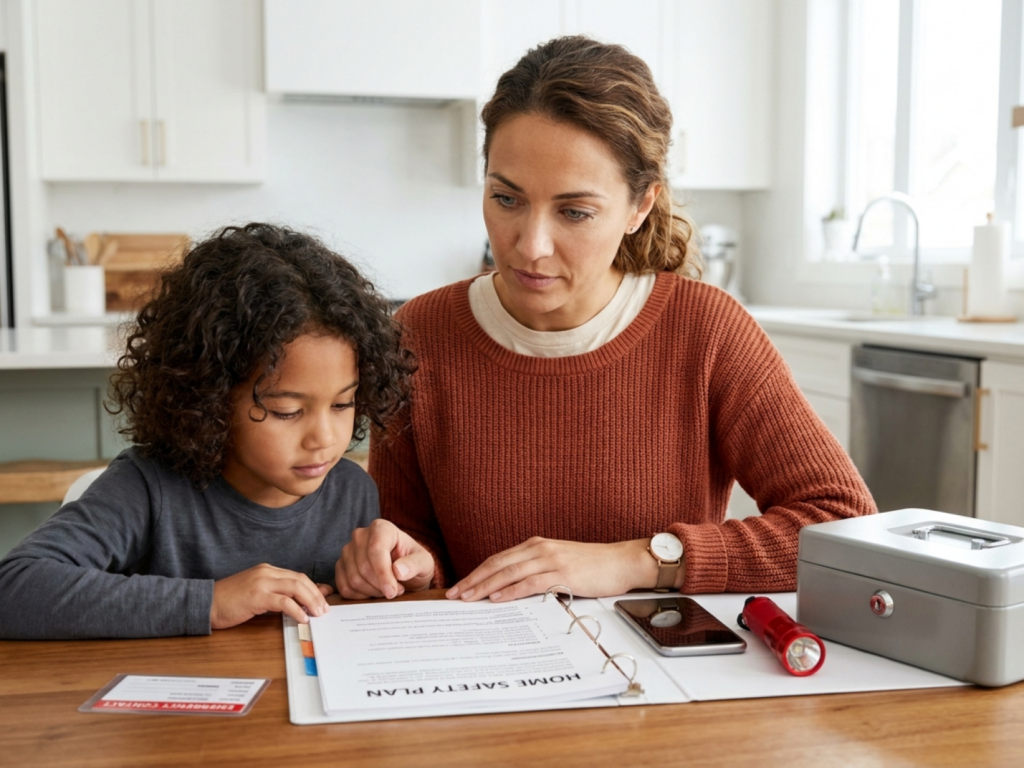
Write a home-alone safety plan for children and place it in a predictable location, such as beside the phone or on the refrigerator. Include the home address, the child’s full name, parent or caregiver numbers, at least two nearby trusted adults, and local emergency service information. Program approved numbers into the child’s device, but also provide a written copy in case the device is unavailable or uncharged.
Practice a short phone script: “My name is ____. I am at ____.” The child should be able to describe the problem, answer questions, and remain on the line until the operator or trusted adult says it is appropriate to disconnect. Teach the child not to give personal information to unknown callers. They can say, “The adult is unavailable. Please call back later,” without revealing that they are alone.
Set a firm rule that the door remains locked and is not opened for unexpected visitors, delivery workers, neighbors, or anyone claiming to know the family. The child should not announce that they are alone through the door, phone, messages, or social media. Establish an approved visitor list and a code word for situations in which a different adult must collect the child. Never ask a child to confront an intruder; they should move to a safer location and contact emergency services or a trusted adult.
Teach emergency response in a sequence
Children may remember a sequence more effectively than a long explanation. Teach them to pause, move away from immediate danger, contact the appropriate person, and follow instructions. A home-alone child should call 911 or the local emergency number for fire, suspected intrusion, an unresponsive person, severe bleeding, serious injury, trouble breathing, or another situation that appears immediately life-threatening. They should provide the address first if asked, because stress can make details difficult to recall.
For smoke or a fire alarm, the rule should be to leave immediately using the planned exit, stay low if smoke is present, and go to the designated meeting place. The child should not return inside, hide, or spend time collecting belongings. Practice the fire escape plan for children during daylight so they know more than one exit when possible. If a carbon monoxide alarm sounds, the child should leave the home and call emergency services from outside rather than searching for the source.
For a minor cut or illness, the child should use only supplies and actions already approved by the caregiver. They should not take medication, change a dose, or use another person’s prescription without explicit adult instructions. For a suspected poisoning, the child should move away from the substance, avoid inducing vomiting, and contact a caregiver and poison-control service or emergency services according to local guidance. Keep the product container available for responders when safe to do so.
Plan for everyday disruptions and special risks
Home-alone rules should cover problems that are not dramatic but can still become unsafe. If the power goes out, the child should remain indoors unless there is immediate danger, use a flashlight rather than candles, avoid elevators, and contact the caregiver. Establish whether the child may use a battery-powered device and where emergency lighting is stored. During severe weather, identify the safest interior location away from windows and explain how the caregiver will provide updates.
Pets require their own plan. A child may provide water or food if instructed, but should not separate animals during a fight, approach an injured or frightened animal, or allow a pet to run outside. The plan should also state whether friends may visit. A conservative rule is to prohibit visitors unless a caregiver has arranged and confirmed them in advance.
Consider transportation and neighborhood boundaries. Children should not leave the home to answer a door, retrieve a package, investigate a noise, or meet someone without authorization. If they must leave because of fire, smoke, a gas concern, or another immediate threat, they should go to the predetermined safe location and remain with a trusted adult or emergency responders. Include instructions for a lost key, a malfunctioning lock, or a caregiver who is late returning.
Rehearse skills without creating fear
Practice should be calm, brief, and realistic. Ask the child to locate the emergency contacts, demonstrate how to call a trusted adult, state the home address, identify exits, and explain where to go if an alarm sounds. Role-play a few scenarios, such as an unexpected visitor or a dropped glass, but avoid frightening simulations involving fake intruders, fire, or medical crises. The purpose is confidence and recall, not alarm.
After each trial, ask open questions: What felt easy? What felt confusing? Which rule was hard to remember? Review whether the child became hungry, tired, lonely, or distracted. These observations help determine whether the duration was appropriate. Reassess after changes such as moving homes, adding siblings, starting a new medication regimen in the household, acquiring a pet, or experiencing a stressful event.
Use positive reinforcement for reporting problems honestly. A child should understand that contacting an adult for help is responsible, even when the situation turns out to be minor. Avoid punishment for a good-faith emergency call or an honest mistake; instead, review what happened and refine the plan. Confidence grows when children know adults will respond predictably.
Review the plan with every caregiver
Consistency matters. Parents, relatives, babysitters, and other caregivers should agree on the same rules for doors, phones, appliances, medication, visitors, pets, and emergency services. Write down who is responsible for checking in, what to do if the child does not answer, and which nearby adult can provide immediate help. Keep the plan current when phone numbers, work schedules, addresses, or emergency contacts change.
Review privacy and digital safety alongside physical safety. The child should avoid posting that they are home alone, sharing the home address, sending photos that reveal the location, or responding to suspicious messages. Notifications can be distracting, so define when devices may be used and how the child should keep them charged and accessible.
If a child has a chronic medical condition, allergy, seizure disorder, behavioral health concern, or medication requirement, individualized planning may be necessary. Discuss home-alone readiness with the child’s pediatrician or relevant healthcare professional. They can help clarify whether the child can recognize warning signs, access an emergency plan, and obtain appropriate assistance without receiving unsafe medical instructions.
Know when home-alone care is not appropriate
Some circumstances call for direct adult supervision rather than additional rules. Postpone a trial if the child is ill, unusually distressed, sleep-deprived, injured, or responsible for a younger child whose needs exceed their skills. Avoid leaving children alone during predictable high-risk situations, such as severe weather, a neighborhood emergency, unsafe household conditions, or a period when a caregiver cannot reliably answer calls.
Age and maturity are especially important when the child would be alone overnight, expected to prepare meals, manage complex medications, supervise siblings, or travel independently. Local laws and school or childcare policies may also address minimum ages or supervision responsibilities. Check applicable local requirements instead of relying on general online advice.
Home-alone readiness is not a permanent label. A child may manage one hour in the daytime but not several hours after dark, or may be ready in a familiar home but not during a move or family crisis. Reassess regularly, keep the conversation supportive, and expand independence only when the child can demonstrate safe judgment in the actual conditions they will face.
Warnings that require immediate action
- Call 911 or the local emergency number for fire, smoke, suspected intrusion, serious injury, severe bleeding, breathing difficulty, or an unresponsive person.
- Never leave a child responsible for another child near a bathtub, pool, hot tub, or other water hazard.
- Do not ask a child to investigate smoke, gas odors, strange noises, or an unexpected visitor.
- Keep medications, toxic substances, firearms, ammunition, and hazardous tools locked and inaccessible.
- A child should not take medication, induce vomiting, or provide medical treatment beyond the caregiver-approved plan.
Tools & Assistance
- A printed home-alone safety plan with address, contacts, codes, exits, and check-in times
- Function-tested smoke and carbon monoxide alarms with an emergency-light location
- A charged phone or approved communication device and a written backup contact list
- A small, adult-approved first-aid supply and clearly labeled emergency information
- A local poison-control contact and local emergency-service number
FAQ
What age is appropriate for staying home alone?
There is no universal age cutoff. Consider maturity, judgment, emotional comfort, the length and timing of the absence, the home environment, and whether the child can respond appropriately to emergencies. Local laws may also apply.
How should we begin practicing?
Start with a brief period while you remain nearby, use scheduled check-ins, and review what happened afterward. Extend the time gradually only when the child consistently follows the safety plan.
Should my child answer the door or tell callers that they are alone?
No. Keep doors locked, do not reveal that no adult is present, and use a simple script for unknown callers. For unexpected visitors, the child should contact a trusted adult rather than opening the door.
When should a child call emergency services?
Teach the child to call 911 or the local emergency number for immediate danger, including fire, suspected intrusion, serious injury, severe bleeding, breathing difficulty, or an unresponsive person.
Should I ask our pediatrician about home-alone readiness?
Yes, particularly if the child has a medical, developmental, behavioral, or emotional concern that could affect safety. A pediatrician can help identify questions for an individualized plan.
Sources
- HealthyChildren.org / American Academy of Pediatrics — Safety at Home Alone: Information for Parents
- HealthyChildren.org / American Academy of Pediatrics — Is Your Child Ready to Stay Home Alone?
- MedlinePlus / National Library of Medicine — Child Safety
Disclaimer
This article provides general educational information and does not replace individualized medical, legal, or emergency advice. Consult your child’s pediatrician and follow local emergency and supervision requirements.















Please log in to leave a comment.