
Intro
Baths, paddling, pools, ponds, and even containers of water can be enjoyable parts of childhood, but they require deliberate safety planning. Drowning can happen rapidly and quietly, and a child may be unable to call for help once their airway is submerged. Young children are especially vulnerable because they have limited balance, immature judgment, and may not understand that shallow water can still be dangerous.
Effective prevention combines active adult supervision, barriers that limit access, age-appropriate teaching, and preparation for an emergency. The goal is not to make caregivers fearful or expect perfection. It is to build predictable routines that reduce distractions and make the safest action the easiest one.
Highlights
A child should remain within close, attentive reach whenever they are in or near bathwater.
Brief interruptions, phones, conversations, and household tasks can create dangerous supervision gaps.
Empty baths, buckets, paddling pools, and other containers immediately after use and restrict unsupervised access to water.
Learning pediatric CPR and first aid can help caregivers respond while emergency services are being contacted.
Why children need close supervision around water
Drowning is the process of experiencing respiratory impairment from submersion or immersion in liquid. It may occur in a bathtub, toilet, bucket, paddling pool, swimming pool, pond, or natural body of water. The World Health Organization identifies children as a higher-risk group, particularly when they are near water without active adult supervision. A child does not need to be unable to swim for an emergency to occur: slipping, becoming frightened, striking a surface, or inhaling water can all interfere with breathing.
Infants and toddlers are especially dependent on adults because they cannot reliably keep their faces above water, climb out, or recognize danger. Their center of gravity and motor coordination are still developing, so a small change in position can lead to submersion. They may also move quickly and silently toward water when a caregiver looks away.
Research on parental bathing practices has identified supervision gaps, including caregivers leaving infants or young toddlers unattended for short periods. These lapses can feel minor in the moment, but a short interruption is enough to change the outcome. A calm, consistent plan is more reliable than assuming a child will call, cry, or wait for help.
Create a safer bath routine
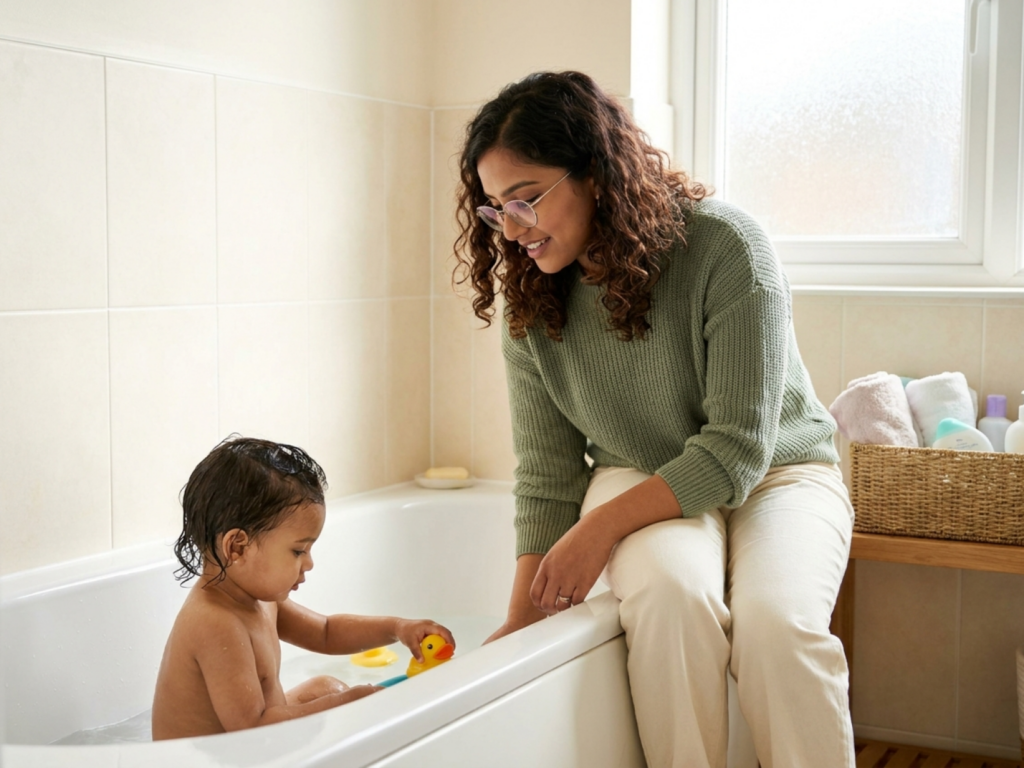
Prepare everything before placing a child in the bath. Gather soap, a towel, clean clothing, and any toys in advance so you do not need to leave the room. Check the water temperature with care and keep hot-water controls inaccessible to the child. A child can be injured by hot water even when there is no drowning event, and young skin is particularly susceptible to burns.
Stay close enough to maintain immediate physical control. For babies and children who are not steady sitters, this means supporting the child continuously rather than relying on a bath seat, ring, or other device. Such products do not replace an adult’s hands-on supervision. Never leave a child alone in the bathtub, even for a moment, and MedlinePlus advises not leaving children younger than six unattended in a bathtub or alone in a bathroom where water is present.
If you must answer the door, use the toilet, retrieve an item, or attend to another child, take the child with you or end the bath and remove the child first. Do not depend on an older sibling to supervise a younger child unless a responsible adult is also present and actively in charge. When bath time ends, drain the tub promptly and keep the bathroom door closed or otherwise restrict access when practical.
Make supervision active and distraction-resistant
Active supervision means watching and listening continuously, staying close, and giving the child your full attention. It is different from being somewhere in the home, checking periodically, or assuming that another adult is watching. Designate one specific adult as the supervisor rather than relying on vague shared responsibility. When responsibility changes, use a clear verbal handover so both adults know who is watching.
Put phones, tablets, books, and other distractions out of reach before water play begins. Avoid bathing a child while cooking, completing work, drinking alcohol, or managing a task that may demand your attention. If you are tired, unwell, or caring for several children, consider simplifying the routine and asking another trusted adult to help. Supportive planning is not a sign of failure; it recognizes that sustained vigilance is demanding.
Supervision should match the child’s behavior and the setting. A child who is mobile, impulsive, or fascinated by water may require closer positioning and stronger access controls than a child who consistently follows instructions. Even children who swim well need an attentive adult near water, because swimming skill does not eliminate the risks of fatigue, panic, injury, or unexpected conditions.
Reduce water hazards throughout the home
Bath safety is only one part of household water safety. After use, empty buckets, basins, paddling pools, and other containers and store them where children cannot access them. Keep toilet lids closed and consider a physical toilet lock if a young child is mobile and drawn to the bathroom. Do not leave a child alone in a bathroom containing water, including while a tub is filling or draining.
Use environmental controls as a second layer of protection. Keep bathroom doors closed when the room is not in use, secure access to laundry areas, and place containers of water out of reach. Check that caregivers, babysitters, relatives, and childcare providers understand the same rules. A child may be safe with one arrangement and exposed to a hazard in another home where supervision expectations differ.
For pools and outdoor water, barriers can delay access while an adult is responding to another need. Follow local safety requirements for fencing and gates, and keep rescue equipment appropriate to the setting accessible to adults. Barriers are not substitutes for supervision, but they reduce the chance that a child can reach water unnoticed. Consider a broader room-by-room safety checklist when reviewing the home, because water hazards often coexist with slips, falls, and chemical risks.
Teach skills without creating false reassurance
Children can learn simple, repeated rules: ask before approaching water, never enter water alone, keep feet on the floor in the bathroom, and follow the supervising adult’s instructions immediately. Use language that is concrete and suited to the child’s comprehension. Rehearse what to do if a toy falls into water: stop, move away, and call an adult rather than leaning or climbing to retrieve it.
Formal swimming and water-safety training may improve a child’s skills, but lessons do not make a child drown-proof. Training should complement, not replace, barriers and constant close supervision near water. Children may forget skills under stress, become exhausted, or encounter water conditions they have not practiced in. A properly fitted life jacket may be necessary for boating or other activities, but it is not a reason to leave a child unattended.
Older children can help with simple safety tasks, such as bringing a towel or reminding a caregiver to drain a paddling pool, but they should not carry primary responsibility for supervising an infant or young child. Explain that calling an adult is safer than attempting a rescue. Adults should also learn pediatric CPR and first aid through a recognized course, with refresher training according to the course provider’s guidance.
Plan for visitors, childcare, and changing circumstances
Water safety often becomes more difficult during visits, holidays, celebrations, and shared childcare. More adults can create the impression that someone else is watching, while noise and conversation make it harder to notice a child moving away. Before water play begins, identify the supervising adult, define the area that must remain in view, and agree on when responsibility will be transferred.
Tell babysitters and relatives the rules explicitly rather than assuming they know your routine. Explain that a child must not be left alone in the bathtub or bathroom with water present, that phones should remain unused during supervision, and that the child must be taken along if the supervising adult leaves. If a child visits another home, ask about access to pools, ponds, tubs, and containers of water and confirm who will supervise.
Review the plan when circumstances change. Illness, medication effects, fatigue, unfamiliar surroundings, developmental changes, and multiple children can alter risk. If you feel unable to maintain close supervision, end the activity and move the child to a dry, secure area. Prevention is often a series of small decisions made before the emergency begins.
What to do after a slip or submersion
If a child falls into water or is found submerged, prioritize immediate safety. Remove the child from the water if you can do so without placing yourself at unnecessary risk, call emergency services, and follow the dispatcher’s instructions. If the child is not breathing normally or is unresponsive, a trained responder may need to begin resuscitation while help is on the way. Pediatric CPR and first aid training can help caregivers act promptly, but do not delay contacting emergency services to search for instructions or equipment.
A child who appears to recover still warrants careful medical attention after a submersion event. Water inhalation and respiratory complications may not be obvious immediately, and an apparently well child can deteriorate. Seek urgent professional assessment and report exactly what happened, including the estimated duration of submersion, whether breathing was abnormal, and any resuscitation provided.
Afterward, avoid blame. Review the sequence with the adults involved, identify the supervision gap or environmental hazard, and change the routine. A debrief can include moving supplies closer to the bath, adding a door barrier, arranging formal supervision handovers, or enrolling caregivers in a resuscitation course. If you are worried about a child’s breathing, alertness, behavior, or physical condition, obtain urgent medical advice rather than relying on online information.
Urgent water-safety warnings
- Never leave an infant or young child unattended in a bath or bathroom containing water.
- Do not rely on bath seats, flotation devices, swimming ability, or an older sibling as the only protection.
- If a child is submerged, call emergency services and follow instructions immediately.
- Seek urgent medical assessment after a submersion event, even if the child initially seems well.
- Keep phones and other distractions away during active supervision.
Tools & Assistance
- A pre-bath checklist for towels, clothing, toiletries, and safe water temperature
- A written supervision handover rule for parents, relatives, and babysitters
- A home review of bathrooms, buckets, toilets, pools, and outdoor water access
- A recognized pediatric CPR and first-aid course
- Local emergency services and a healthcare professional for post-submersion advice
FAQ
Can I leave my child in the bath while I quickly get a towel?
No. Prepare supplies before the bath begins. If you must leave, take the child with you or end the bath and remove the child first.
Is a bath seat safe enough for a baby?
No bath seat replaces hands-on adult supervision. A baby can slip, tip, or become submerged quickly, so remain within immediate reach throughout the bath.
Does swimming ability prevent drowning?
No. Swimming lessons may build useful skills, but fatigue, panic, injury, and unfamiliar water can still create danger. Active supervision and barriers remain necessary.
Should a child see a healthcare professional after being briefly underwater?
Seek urgent professional advice after any submersion event, especially if breathing, alertness, coughing, or behavior is abnormal. A child who appears recovered may still need assessment.
Sources
- World Health Organization — Drowning
- MedlinePlus, U.S. National Library of Medicine — Bathroom safety - children
- PubMed — Parental survey of beliefs and practices about bathing and toddler supervision in the bathtub
Disclaimer
This article provides general educational information and does not replace individualized medical advice, emergency guidance, or professional CPR training. Contact emergency services for an active water emergency and consult a qualified healthcare professional about a child’s condition.
















Please log in to leave a comment.