
Intro
Travel with a baby can be deeply worthwhile, but it often asks caregivers to make many small decisions while tired and outside familiar routines. Delays, unfamiliar sleep spaces, feeding logistics, weather shifts, and exposure to illness can feel overwhelming even when you have prepared carefully.
A flexible plan centered on safety, hydration, rest, and early response to concerning symptoms can make travel more manageable. This guide offers practical, medically informed ways to reduce common stresses while recognizing when individualized advice from your baby's healthcare professional is needed.
Highlights
A realistic travel plan includes backup time, familiar care items, and a clear response plan for illness or delays.
For babies, hydration, feeding safety, temperature regulation, and secure transport take priority over maintaining a perfect schedule.
Seek prompt medical guidance for warning signs such as breathing difficulty, poor feeding with fewer wet diapers, unusual sleepiness, or a fever in a young infant.
Prepare a flexible baby travel care plan
Start with a plan that supports decisions when circumstances change, rather than a rigid timetable that becomes stressful at the first delay. Before booking or leaving, consider your baby’s age, medical history, current feeding method, immunization status, medications, and destination. Babies born prematurely or those with cardiopulmonary, neurologic, feeding, or immune concerns may need individualized travel advice. Contact the pediatric clinician well before departure when a trip involves flying, high altitude, international travel, prolonged transit, or limited access to care.
Keep essential health information readily available: clinician contact details, allergies, medication names and doses, insurance information, and the location of appropriate medical services at the destination. Carry medications in original labeled containers and bring enough for the full trip plus a reasonable delay buffer. Ask a pharmacist or clinician how to store temperature-sensitive medicines and what to do if refrigeration is unavailable.
Plan the journey in stages. Build in time for feeds, diaper changes, settling, and safe breaks; delays are less disruptive when the schedule contains margin. Confirm airline, rail, rental vehicle, and accommodation policies in advance. For road travel, use a properly installed rear-facing car seat appropriate for your baby’s current size and follow its manufacturer instructions. A baby should not travel unrestrained in an adult’s arms in a moving vehicle.
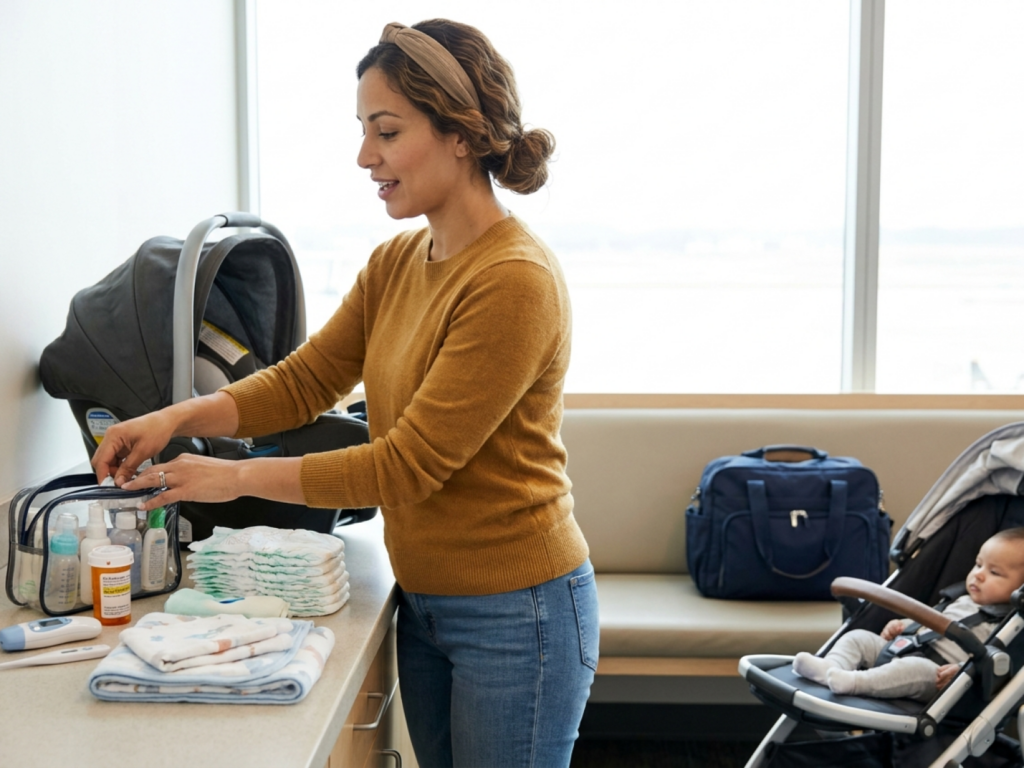
- Pack a small, accessible care kit for transit rather than relying on checked baggage.
- Include diapers, wipes, a changing barrier, extra clothing, familiar comfort items, feeding supplies, and any prescribed medicines.
- Bring more supplies than the ideal travel duration suggests, especially when weather or connections may disrupt plans.
Protect feeding, hydration, and routine
Travel can change the timing and environment of feeds, but the central aim is responsive feeding: offer breast milk, formula, or age-appropriate food based on your baby’s usual cues rather than trying to force a schedule. Frequent transitions can make babies feed more often for comfort, while fatigue or overstimulation can temporarily reduce interest. Observe overall intake, alertness, wet diapers, and behavior rather than judging one difficult feed in isolation.
Safe milk handling during travel deserves advance attention. Clean hands before preparing feeds whenever possible, use safe water appropriate to the destination, and follow the formula manufacturer’s preparation and storage instructions. Prepared formula and expressed milk can become unsafe if held at unsuitable temperatures for too long. A cooler with ice packs may help during transit, but it does not replace careful attention to storage time and temperature. When access to safe water is uncertain, obtain destination-specific advice before travel.
For breastfed babies, travel may mean more frequent feeds and a need for a private, calm space when possible. For families using expressed milk or formula, organizing supplies into portions can reduce errors when tired. The topic of Managing feeding schedule travel is especially relevant when time zones, long transit days, or disrupted naps affect usual patterns. Avoid introducing unfamiliar foods immediately before or during a demanding travel day when feasible, because a reaction or gastrointestinal upset is harder to interpret away from home.
Babies can dehydrate more quickly than adults. In hot conditions, vomiting, diarrhea, fever, and poor intake raise concern. Breast milk or formula remains the main fluid source for young infants; consult the baby’s clinician before offering additional fluids, particularly for infants under six months.
Make transit safer and more comfortable
Secure transport is a safety intervention, not merely a convenience. In cars, use the rear-facing car seat correctly on every trip, including short airport or destination transfers. On an aircraft, an airline-approved child restraint system used according to airline guidance can offer a more secure option for an infant who has a separate seat. Check requirements directly with the carrier before departure, since policies vary.
Pressure changes during takeoff and landing may cause temporary ear discomfort. Swallowing can help equalize middle-ear pressure, so feeding or offering a pacifier at these times may be useful when it fits your baby’s usual care. Do not force feeding if the baby is distressed, sleepy, or unable to coordinate sucking safely. If ear pain, drainage, fever, or persistent inconsolability occurs, seek medical advice, as travel discomfort should not be assumed to be the sole explanation.
Motion sickness is less common in young infants than in older children, but nausea, vomiting, heat, hunger, and fatigue can all make travel unpleasant. Provide fresh air when practical, avoid overheating, and stop safely for breaks on road trips. Do not give over-the-counter motion-sickness medicines to a baby unless a clinician has specifically recommended a product and dose.
For sleep, recreate familiar cues without compromising safety. A flat, firm, separate sleep surface that meets applicable safety standards is preferable. Car seats, strollers, swings, and inclined devices are transport equipment, not routine sleep spaces. When a baby falls asleep in one, move them to an appropriate sleep surface as soon as practical and safe to do so.
Manage heat, altitude, and unfamiliar environments
Babies regulate body temperature less effectively than older children and adults. Heat, direct sun, heavy clothing, and poorly ventilated vehicles can quickly cause distress. Dress the baby in light, removable layers, use shade and air circulation, and take breaks in cooled indoor spaces during hot weather. Never leave a baby alone in a parked vehicle, even briefly. Check the chest or back rather than hands and feet alone when assessing warmth, because extremities may feel cool without indicating low body temperature.
Watch for heat-related illness, which can include unusual fussiness, lethargy, flushed skin, vomiting, poor feeding, or fewer wet diapers. These signs are nonspecific, so do not attempt to diagnose the cause while continuing strenuous travel. Move to a cooler setting, offer usual feeds if the baby is able to drink, and obtain medical advice promptly if symptoms are persistent, severe, or accompanied by reduced responsiveness.
High-altitude destinations can present additional challenges because oxygen availability decreases as elevation rises. A gradual ascent may be easier to tolerate than rapid elevation change, but suitability depends on the individual baby and destination. Families of babies with lung, heart, blood, or prematurity-related conditions should obtain clinician advice before travel. Seek urgent assessment for breathing difficulty, bluish coloration, marked lethargy, repeated vomiting, or behavior that is significantly different from baseline.
New settings also create practical risks. Inspect the sleep area for gaps, cords, unstable furniture, and loose bedding. Keep medicines, batteries, cleaning products, and small objects secured. Use insect precautions suited to the baby’s age and destination, and ask a clinician about recommended prevention measures for regions with insect-borne disease.
Lower infection and food-related risks
Travel brings close contact with other people, shared surfaces, and food or water systems that may differ from home. Hand hygiene remains one of the most practical protections: clean caregivers’ hands before feeding, preparing formula, handling pacifiers, and after diaper changes. Soap and safe water are preferred when visibly soiled; an alcohol-based hand sanitizer can be useful when hands are not visibly dirty and a sink is unavailable. Store sanitizer out of a child’s reach.
For babies who are not exclusively breastfed, water safety can be a central planning issue. Use water that is known to be safe for infant feeding, and avoid making assumptions based only on a hotel, restaurant, or airport setting. Follow local public-health guidance and ask the pediatric clinician or travel-health service about destination-specific concerns. Breastfeeding may simplify some exposure pathways, but caregivers should still use careful hygiene for their own food and water.
Older babies eating solids need familiar, safely prepared foods. Avoid raw or undercooked animal products, unpasteurized foods, foods held at uncertain temperatures, and produce that cannot be washed with safe water. Refrigerate perishable items promptly and discard food that has been left out too long. Diarrhea or vomiting can have multiple causes, but the immediate concern in a baby is often hydration and clinical assessment rather than identifying the cause independently.
Keep routine immunizations up to date, and discuss travel-specific vaccines or preventive measures early because some need time before departure. Avoid crowded indoor settings when feasible if a baby is medically vulnerable, but do not let infection worries turn every outing into an impossible standard. Focus on the measures that are both effective and sustainable.
Respond calmly to stress, delays, and warning signs
Caregiver stress is not a minor issue; it affects attention, decision-making, and the ability to respond patiently to an unsettled baby. Travel rarely goes exactly as planned, so use simple strategies that preserve capacity: eat regularly, drink water, share tasks when another trusted adult is present, and choose the next necessary action rather than trying to solve the entire day. Brief breathing exercises, a quieter space, and realistic expectations can reduce escalation during a delay or difficult transit period.
Babies often respond to unfamiliar stimulation with crying, fragmented sleep, clinginess, or temporary changes in feeding. These changes may be expected, but they should not obscure signs of illness. Make a written note of feeds, wet diapers, vomiting, stool changes, temperature if measured, and medicines given when a baby seems unwell. This record is useful to both caregivers and clinicians and can reduce confusion when care is handed over.
Have a threshold for changing plans. It is reasonable to postpone an activity, leave a hot or crowded environment, or seek care when the baby’s condition is not reassuring. Contact a healthcare professional for guidance when you are uncertain, particularly for a young infant. Emergency evaluation is warranted for severe breathing difficulty, blue or gray lips or skin, a seizure, unresponsiveness, signs of significant dehydration, persistent vomiting, or a fever in an infant under three months. Follow local emergency procedures at the destination.
On arrival home, return gradually to familiar sleep and feeding cues. A few unsettled days do not mean the routine has been lost. Gentle consistency, adequate rest, and follow-up with the baby’s clinician when symptoms persist can help the family recover from the trip.
When to seek urgent help
- Seek emergency care for trouble breathing, blue or gray coloration, a seizure, or unresponsiveness.
- A fever in an infant younger than three months requires prompt medical assessment.
- Get urgent advice for markedly fewer wet diapers, inability to keep feeds down, or signs of dehydration.
- Do not use adult or over-the-counter travel medicines for a baby without clinician-specific guidance.
- Seek care when a baby's behavior is significantly different from baseline or a caregiver feels something is seriously wrong.
Tools & Assistance
- Pediatric clinician or travel-health clinic before departure
- Destination emergency number and nearby pediatric care location
- Written feeding and medication log
- Thermometer and compact baby care kit
- Airline or transport provider child-restraint guidance
FAQ
Should I keep my baby's usual schedule exactly while traveling?
Aim for familiar feeding and sleep cues, but allow flexibility for transit, time zones, and the baby's cues. Safety, adequate feeding, and rest matter more than exact timing.
How can I help with ear discomfort during a flight?
Swallowing during takeoff and landing may help, so a usual feed or pacifier can be considered when appropriate. Ask a clinician about persistent ear symptoms or illness before flying.
When is vomiting during travel concerning?
Repeated vomiting, poor feeding, fewer wet diapers, unusual sleepiness, blood in vomit or stool, breathing concerns, or fever needs prompt medical advice or urgent evaluation depending on severity.
Can babies sleep in a car seat during a long journey?
A car seat is essential for safe vehicle travel but is not a routine sleep environment. Transfer the baby to a firm, flat, separate sleep surface as soon as practical and safe.
Sources
- Mayo Clinic — Preventing Travel-Related Illnesses
- MedlinePlus — Traveler's Health
- MedlinePlus — Learn to manage stress
Disclaimer
This article provides general educational information and is not a substitute for medical advice, diagnosis, or treatment. Consult your baby's healthcare professional for individualized travel guidance or urgent symptoms.














Please log in to leave a comment.