
Intro
Flying with a baby in the United States involves two separate questions: what an airline permits and what is safest for the child. Policies can differ by carrier, route, age, ticket type, and whether the baby travels on an adult's lap or in a separately purchased seat. Newborn age, medical stability, documentation, and the use of an approved child restraint may also affect the booking.
Caregivers often feel pressure to anticipate every possible problem. A practical approach is to confirm the airline's current rules before booking, obtain individualized advice from the baby's healthcare professional when appropriate, and plan the journey around safe restraint, feeding, hydration, and access to essential supplies.
Highlights
A baby under 2 may be allowed to travel on an accompanying adult's lap, but the FAA identifies an approved child restraint system as the safest place for a child on an airplane.
Newborn policies are not identical. Some airlines restrict travel during the first several days of life or request medical documentation for very young infants.
A separately purchased seat is generally required when the child will not travel as a lap infant or has reached the airline's age limit for lap travel.
Confirm infant rules directly with the operating airline because codeshare flights, international segments, and connecting itineraries can involve additional requirements.
Start with the baby's age and travel status
Most U.S. airline infant policies distinguish between a lap infant younger than 2 years and a child who occupies a paid seat. The under-2 threshold is important, but it does not by itself answer every booking question. The airline may require the infant to be added to the reservation even when no separate seat is purchased, and the rules may vary for domestic and international travel.
Before paying for tickets, ask the airline to confirm the baby’s status for every flight segment. This is especially important when an itinerary includes a codeshare, a regional partner, or a carrier change. The operating airline may apply its own procedures for seat assignment, boarding, documentation, and child restraints.
Once a child reaches the airline’s stated age limit for lap travel, a separate seat is required. A separate seat may also be the preferred choice for a younger baby because it allows use of an approved restraint throughout the flight. The FAA states that the safest place for a child under 2 is in an approved child restraint system rather than on an adult’s lap. This safety recommendation is distinct from what an airline legally permits.
Understand newborn restrictions before booking
Very young newborns require special attention because airline policies may set a minimum age for air travel. American Airlines and Delta Air Lines both publish rules addressing newborn travel, including restrictions or medical documentation for infants in the first days of life. Delta specifically addresses babies younger than 7 days, while American Airlines provides guidance for very young newborns and may require a physician-completed form in applicable circumstances.
Do not assume that a baby who appears well meets an airline’s minimum-age policy. Confirm the exact requirement with the carrier, including whether documentation must be submitted before travel, carried to the airport, or completed on an airline-specific form. Ask whether the rule applies to both the outbound and return flights if the infant will be a different age on the return journey.
Medical readiness is a separate consideration. A healthcare professional can help assess issues such as prematurity, recent hospitalization, respiratory disease, anemia, congenital heart disease, feeding difficulty, or postoperative recovery. The airline’s permission to board does not replace individualized clinical advice. For medically complex infants, ask whether travel timing, supplemental equipment, medication transport, or an emergency plan needs specific review.
Choose the safest seat and restraint option
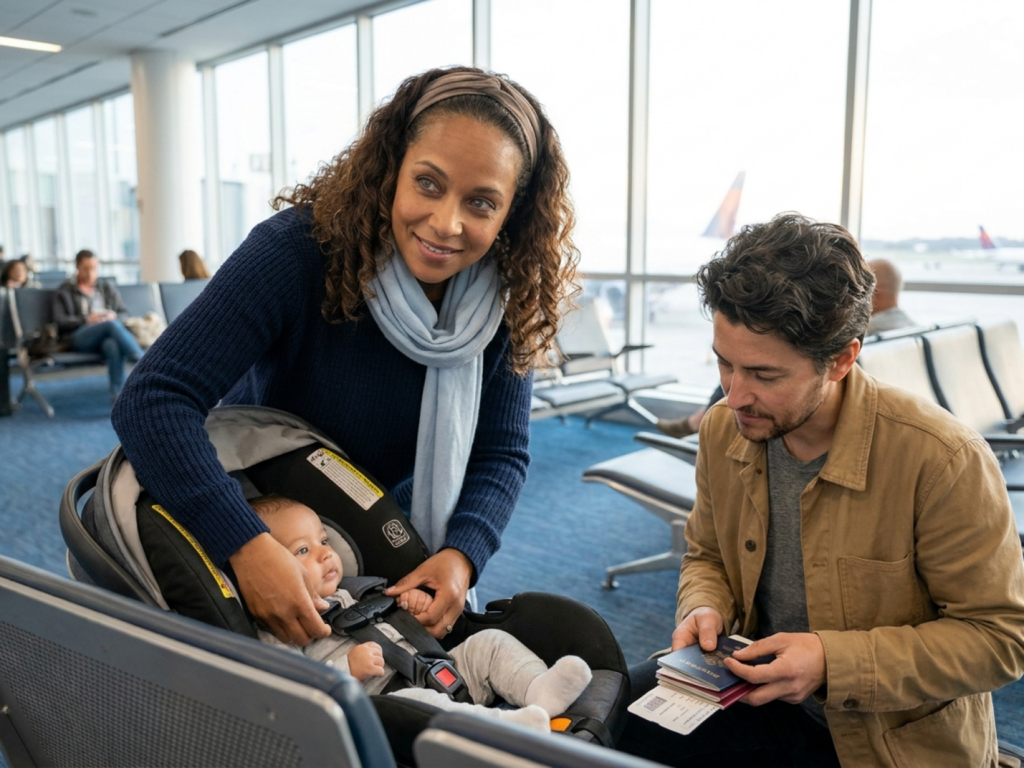
An adult’s lap may be permitted for a baby under 2, but it is not the safest location during turbulence, an abrupt deceleration, or an emergency. The FAA recommends an approved child restraint system. A properly used restraint keeps the baby’s body secured to the aircraft seat and reduces dependence on an adult’s ability to hold the child during unexpected movement.
If you purchase a seat, verify before departure that the car seat or other restraint is approved for use on an aircraft. Look for the required labeling and follow both the restraint manufacturer’s instructions and the airline’s policies. Some restraints may be too wide for particular seats, and an airline may direct caregivers to use a window seat or another location that does not obstruct evacuation. Ask the carrier about acceptable seat positions before arriving at the airport.
Use the restraint exactly as designed. Do not improvise with a carrier, blanket, feeding pillow, or adult seat belt around the baby. Never place a rear-facing restraint in a seat with an active front air bag when the aircraft or ground vehicle instructions prohibit it. After landing, continue to use an appropriate rear-facing restraint in any rental car, taxi, or private vehicle where required.
For a broader review of airline-approved child restraint systems and safe infant restraint in transit, caregivers can use a dedicated travel safety resource alongside the FAA guidance.
Prepare documents, tickets, and airport logistics
Infants need to be correctly associated with the reservation even when they do not occupy their own seat. During booking or check-in, confirm that the baby’s name, date of birth, and travel status are recorded correctly. Ask the airline what identification or proof of age it may request, particularly for a newborn or a child close to the second-birthday cutoff. Documentation rules can differ by carrier and route.
Build extra time into the airport plan. A baby may need an unplanned feeding, diaper change, clothing change, or calming break. Keep essential supplies in the cabin bag rather than checked luggage. A practical kit may include diapers, wipes, spare clothing, feeding supplies, a small number of familiar comfort items, and any clinically necessary equipment. Pack supplies for delays as well as the scheduled flight, while following current airport security rules for liquids, breast milk, formula, and medical items.
Contact the airline before the travel day if you need assistance with a stroller, car seat, bassinet, mobility equipment, or family boarding. Policies for gate-checking and cabin storage can vary. Ask where the stroller or car seat will be returned and whether a connection changes the process. Clear instructions reduce the chance that essential equipment is separated from you during a connection.
Plan for feeding, ear pressure, and comfort
Cabin pressure changes are most noticeable during ascent and descent. Sucking and swallowing can help equalize pressure in the middle ear, so some caregivers offer breastfeeding, a bottle, or a pacifier during these phases when the baby is awake and willing. Do not force feeding, and do not use food or liquid as a substitute for restraint compliance. A healthcare professional can provide individualized advice if the baby has active ear disease, recent ear surgery, significant nasal obstruction, or another condition that may affect pressure tolerance.
Keep feeding supplies organized and use the method the baby already tolerates. Avoid introducing a new formula, bottle system, or feeding schedule immediately before travel unless advised by the baby’s clinician. For babies receiving expressed milk or formula, plan how supplies will be stored and prepared safely during the journey. Hand hygiene remains important before feeding and after diaper changes, particularly in crowded travel environments.
Babies may sleep differently in an unfamiliar setting. Dress the child in comfortable layers, monitor for overheating, and avoid loose items that could interfere with the restraint. Never cover the baby’s face or obstruct breathing to reduce noise or stimulation. If the infant becomes difficult to arouse, develops breathing difficulty, has cyanosis, or appears acutely unwell, seek urgent medical help rather than treating the issue as ordinary travel fussiness.
Use a health-focused preflight checklist
Travel readiness depends on more than the airline’s age rule. Before departure, review the itinerary, destination, duration, access to medical care, and the baby’s birth and medical history. Families planning travel with premature infants or babies with cardiopulmonary disease should ask the appropriate healthcare professional whether cabin altitude, reduced oxygen partial pressure, infection exposure, or limited access to care creates additional concern.
Ask what symptoms should prompt postponement or urgent evaluation. Fever in a young infant, increased work of breathing, poor feeding, repeated vomiting, unusual lethargy, and signs of dehydration deserve clinical attention. Do not diagnose the cause of these symptoms during travel or rely on an airline rule as medical clearance. Carry a concise medication and medical history record when relevant, and keep prescribed treatments in their original labeled containers. Do not give a sedating medication to make the baby sleep unless the baby’s healthcare professional has specifically instructed you to do so.
A written plan can help the accompanying adults divide responsibilities. One person can manage documents and communication with airline staff while another monitors the baby and handles feeding or diapering. For practical guidance on travel readiness for infants and ear pressure during infant flying, review these topics with the child’s clinician and the airline before finalizing the trip.
When to pause and seek advice
- Do not fly a newborn who is below the airline's minimum age or lacks required medical documentation.
- Seek professional advice before travel if the baby was premature, recently hospitalized, or has respiratory, cardiac, neurologic, feeding, or other significant medical concerns.
- Urgently seek medical care for breathing difficulty, blue or gray discoloration, marked lethargy, persistent vomiting, or poor perfusion.
- Do not use an unapproved restraint, hold the baby in place with an adult seat belt, or administer sedating medication without individualized clinical instruction.
- Recheck the rules before each segment because airline, route, aircraft, and codeshare requirements may differ.
Tools & Assistance
- The operating airline's infant-travel and special-assistance desk
- FAA guidance on approved child restraint systems
- The baby's pediatrician, family physician, or relevant specialist
- A certified child passenger safety technician for vehicle-seat installation
- A written travel checklist covering documents, feeding supplies, medical items, and emergency contacts
FAQ
Can a baby under 2 fly on an adult's lap?
Many U.S. airlines permit an infant under 2 to travel on an accompanying adult's lap, subject to the carrier's booking and route rules. The FAA identifies an approved child restraint system as the safest option.
Does a baby need a ticket if traveling on a lap?
The infant generally must be added to the reservation even when a separate seat is not purchased. Ask the airline about fares, taxes, documentation, and check-in requirements for the specific itinerary.
Can a newborn fly during the first week of life?
Some airlines restrict very young newborns or require medical documentation. Delta addresses infants younger than 7 days, and American Airlines also publishes newborn requirements. Confirm the current rule directly with the operating carrier.
Is a car seat allowed on an airplane?
An airline-approved child restraint may be used when the infant has a separately purchased seat and the restraint meets applicable requirements. Confirm labeling, seat location, size, and installation instructions with the airline before travel.
Should a baby feed during takeoff and landing?
Sucking and swallowing may help some babies tolerate pressure changes, so feeding or a pacifier can be offered when appropriate. Do not force feeding, and seek clinical advice for relevant ear or airway conditions.
Sources
- Federal Aviation Administration — Kids' Corner
- American Airlines — Traveling with children and infants
- Delta Air Lines — Infant Air Travel
Disclaimer
This article provides general informational guidance and is not medical advice or a substitute for evaluation by a qualified healthcare professional. Airline policies can change; confirm current requirements with the operating carrier and seek individualized clinical advice for your baby.
















Please log in to leave a comment.