
Intro
Flying internationally with an infant requires more planning than a short domestic trip, but careful preparation can make the journey safer and more manageable. The most important questions concern your baby’s age, birth history, medical stability, travel destination, feeding plan, infection exposure, transportation arrangements, and access to medical care abroad.
Most healthy, full-term infants can usually fly after the first few weeks of life, although policies differ between airlines and countries. Infants born prematurely or those with cardiac, pulmonary, or other medical conditions may need individualized advice or medical clearance. Discuss the itinerary with your child’s healthcare professional well before departure, especially when travel involves long flights, multiple connections, high altitude, extreme climate, or limited healthcare access.
Highlights
Ask your baby’s healthcare professional whether the timing and destination are appropriate, particularly after a premature birth or with heart or lung disease.
A government-approved child restraint system used in an airplane seat provides more protection than holding an infant on a caregiver’s lap during turbulence.
Plan feeding, diapering, medication transport, sleep, and ground transportation for the entire itinerary, including delays and unexpected overnight stays.
Reduce infection exposure through hand hygiene, vaccination planning, sensible crowd avoidance, and prompt attention to concerning illness.
Check airline, immigration, passport, visa, and destination-country requirements well before departure.
Assess whether your infant is ready to fly
There is no single age that is appropriate for every infant or every itinerary. The Mayo Clinic notes that air travel is typically safe for most healthy, full-term infants after the first few weeks, while common medical guidance advises avoiding air travel during the first week after birth. A peer-reviewed review also states that babies younger than seven days generally should not fly. Airlines may impose their own minimum-age rules or request a physician’s letter, so confirm the policy directly with the carrier.
Timing deserves additional consideration when a baby was born prematurely. Prematurity can affect respiratory reserve, feeding endurance, temperature regulation, and vulnerability to infection. Infants with chronic lung disease, congenital heart disease, recent respiratory illness, anemia, or other significant medical concerns may require a pre-travel assessment. Depending on the clinical situation, a healthcare professional may consider oxygenation, current symptoms, treatment needs, and the flight environment before offering advice or clearance.
Arrange the appointment early enough to address routine immunizations, destination-specific vaccines, malaria or other infection risks when relevant, and any documentation required for travel. Bring a concise medical summary, medication list, allergy information, and emergency contacts. Do not begin, stop, or alter a medicine solely because of travel without professional guidance.
Use an appropriate restraint and seating plan
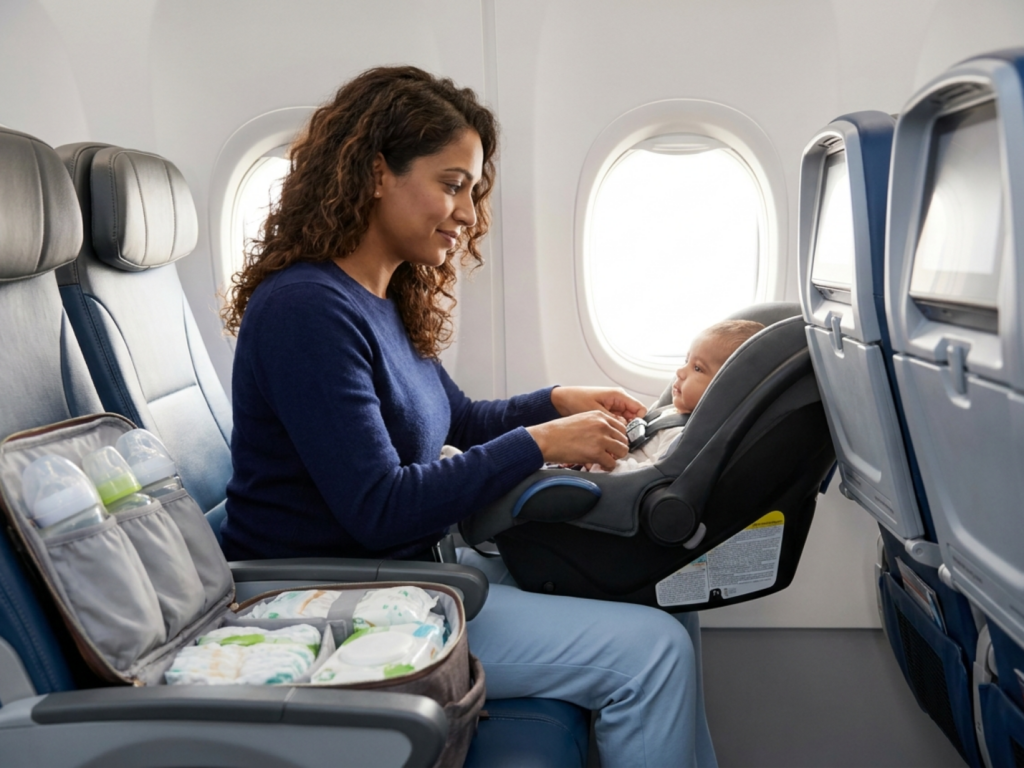
Holding an infant in your arms is not a reliable protection strategy during severe turbulence, sudden braking, or an evacuation. The CDC recommends using a government-approved child restraint system when possible. A properly installed, airline-approved rear-facing infant car seat or other approved restraint allows the baby to remain secured in a dedicated airplane seat throughout the flight.
Before booking, ask the airline which restraint systems are accepted, whether the seat must display a certification label, and whether there are restrictions concerning location or installation. Some carriers require the restraint to be placed in a window seat or another position that does not obstruct access to the aisle. Confirm whether the aircraft and connection flights have compatible seating arrangements. If you plan to use a car seat at the destination, verify that it meets the relevant local requirements and can be installed correctly in the ground vehicle.
Do not place an infant in an overhead compartment, on a tray table, or in an improvised carrier during taxi, takeoff, landing, or turbulence. An infant should not sleep unattended in a stroller or car seat outside the situations for which that equipment is designed. When the baby is not restrained for a necessary caregiving activity, maintain close physical supervision and follow crew instructions.
Prepare feeding, hydration, and ear-pressure care
Cabin pressure changes during ascent and descent can cause ear discomfort because the middle ear must equalize with the surrounding air pressure. Sucking and swallowing may help some infants, so feeding or offering a pacifier during takeoff and especially descent can be useful if the baby is awake and willing. Do not force a feed, and avoid delaying urgent safety procedures to continue feeding. If your infant has an ear infection, significant nasal congestion, or a recent ear procedure, ask a healthcare professional whether flying should be postponed.
Pack more breast milk, formula, water for preparation when appropriate, diapers, and feeding supplies than the scheduled travel time requires. International delays, missed connections, security screening, and lost baggage can substantially extend the journey. Use a feeding method and preparation process that you have already practiced. For powdered formula, follow the product instructions and local water-safety advice; do not dilute formula or substitute ingredients. Expressed breast milk and prepared feeds require appropriate storage and handling, so use insulated containers and clarify airport security rules before departure.
Young infants have limited physiologic reserves. Continue normal feeding patterns as much as practical and monitor wet diapers, alertness, and feeding ability. Breastfeeding, formula, or complementary foods should be managed according to the infant’s age and usual clinical plan. Do not give water, oral rehydration products, herbal preparations, or other fluids to a young infant unless advised by a qualified healthcare professional.
Build an infection and illness-prevention plan
Airports and aircraft involve close contact with many travelers, and international destinations may have different circulating infections. Review the destination’s entry requirements and health recommendations with a clinician or travel-medicine service. Bring the infant’s immunization record and confirm whether routine vaccines should be given early or whether additional vaccines are relevant to the destination. Some vaccines have age limitations, so destination planning should happen well in advance.
Hand hygiene is one of the most practical protective measures. Caregivers should clean their hands before feeding, after diaper changes, and after contact with frequently touched surfaces. Carry enough diapers, wipes, and disposal bags for delays. Clean feeding equipment according to the manufacturer’s instructions and avoid sharing utensils, pacifiers, or bottles. A well-fitting mask may be appropriate for an adult caregiver in some settings, but masks are not suitable for every infant; ask a healthcare professional about age-appropriate infection-control measures.
Consider the destination’s climate, altitude, air quality, insect exposure, food and water conditions, and availability of urgent pediatric care. Infants can deteriorate more quickly than adults with respiratory or gastrointestinal illness. Seek medical evaluation for breathing difficulty, bluish or gray coloration, persistent vomiting, inability to feed, markedly reduced urination, unusual lethargy, a seizure, or a fever in an infant for whom fever requires urgent assessment under local medical guidance.
Organize documents, supplies, and the itinerary
International travel with an infant involves administrative requirements as well as medical planning. Check passport validity, visas, transit permissions, birth certificates or consent documents, airline infant-ticket rules, and destination entry requirements. Keep original documents secure and carry accessible copies in separate locations. Travel insurance should include medical care for the infant, emergency transport when appropriate, and coverage for pre-existing conditions if applicable; read exclusions rather than assuming coverage.
Divide supplies between carry-on bags so one lost or delayed bag does not contain every essential item. A practical cabin kit may include feeding supplies, diapers, wipes, spare clothing, a changing pad, approved medications in original packaging, a thermometer, medical records, and comfort items. Pack medications according to professional instructions and carry dosing information based on the infant’s current weight if a clinician has provided it. Avoid relying on a medication purchased abroad when the formulation, concentration, or labeling may differ.
Allow extra time for security screening, boarding, feeding, and diaper changes. Aisle access can simplify caregiving, but the infant’s approved restraint must be installed where the airline permits. Plan how you will transfer between terminals, collect checked equipment, and reach the final accommodation. During ground travel, use an appropriate rear-facing restraint rather than holding the baby in a vehicle.
Protect sleep and comfort during the journey
Travel can disrupt circadian rhythm, naps, and feeding intervals. A flexible plan is more realistic than trying to reproduce the home schedule exactly. Keep familiar sleep cues, provide routine feeds, and use layers so the infant does not become overheated or chilled. Cabin air may feel dry, but dryness alone does not justify giving extra fluids or using products that have not been recommended for the baby.
When the infant is sleeping outside the airplane seat, use a firm, flat, safe infant sleep surface at the accommodation. Do not use an adult bed, sofa, recliner, or loosely arranged pillows as a substitute. Inspect a provided crib or bassinet before use, and ask about its weight and size limits. Airplane bassinets and in-flight carrycots have specific restrictions and are generally not substitutes for an approved restraint during phases of flight when the crew requires the baby to be secured.
Caregivers also need a plan for fatigue. Share responsibilities when possible, drink fluids, eat regularly, and identify who will manage documents, luggage, and the infant during connections. If the baby becomes inconsolable, pause to assess basic needs such as feeding, diapering, temperature, pain, and overstimulation. Ask the cabin crew for operational assistance, but remember that crew members cannot provide individualized medical diagnosis or treatment.
Know when to postpone or seek help
A pre-flight assessment is especially important if the infant has a current fever, significant cough, wheezing, increased work of breathing, repeated vomiting or diarrhea, poor feeding, dehydration concerns, or a recent hospitalization. The question is not simply whether the baby can tolerate the flight; it is whether the child can safely manage the entire journey and whether appropriate care will be available if symptoms worsen.
During travel, seek urgent medical help for respiratory distress, apnea, cyanosis, a seizure, severe allergic symptoms, altered responsiveness, persistent inability to feed, or signs of significant dehydration. For a very young infant, any fever should be discussed promptly with a healthcare professional because age-specific evaluation thresholds matter. A baby who is difficult to wake, has substantially fewer wet diapers, or is persistently vomiting also needs prompt assessment.
After arrival, allow time for observation and recovery before beginning a demanding schedule. Contact a clinician if the infant develops fever, respiratory symptoms, diarrhea, rash, unusual sleepiness, feeding difficulty, or other concerning changes, especially after exposure to a destination-specific infection risk. Keep the travel history, dates, locations, vaccinations, and potential exposures available for the evaluating professional.
Seek medical advice promptly
- Infants younger than seven days or those who have not yet reached the airline’s minimum travel age
- Premature infants or babies with heart, lung, neurologic, or other significant medical conditions
- Current fever, breathing difficulty, persistent vomiting, diarrhea, or poor feeding before departure
- Markedly reduced urination, unusual lethargy, or inability to keep feeds down
- A seizure, bluish coloration, apnea, severe allergic reaction, or altered responsiveness during travel
Tools & Assistance
- Pre-travel pediatric or travel-medicine appointment
- Airline policy page and customer-service contact for infant seating and restraint rules
- Destination-country health authority and consular document guidance
- Travel insurance policy with pediatric emergency-care details
- Written infant medical summary, medication list, and emergency contacts
FAQ
How old should an infant be before flying internationally?
Many healthy, full-term infants can fly after the first few weeks, but airlines set their own minimum ages. Babies younger than seven days generally should not fly, and a healthcare professional should assess premature infants or babies with medical conditions.
Can I hold my infant on my lap during the flight?
Lap-held infants are not protected adequately during severe turbulence or sudden aircraft movement. When possible, use a government-approved, airline-accepted child restraint system in a dedicated seat and confirm the installation rules with the airline.
Should I feed my baby during takeoff and landing?
Sucking and swallowing may help relieve ear-pressure discomfort, particularly during descent. Offer a normal feed or pacifier if the infant is awake and willing, but do not force feeding or delay required safety procedures.
What should I pack in the cabin?
Pack more feeds, diapers, wipes, clothing, and essential supplies than the planned travel time requires. Keep documents, medical records, approved medications in original packaging, and feeding equipment accessible in carry-on luggage.
When should international travel be postponed?
Discuss postponement with a healthcare professional if the infant has fever, significant respiratory symptoms, repeated vomiting or diarrhea, poor feeding, dehydration concerns, or a recent hospitalization. The decision depends on the infant’s condition and the itinerary.
Sources
- Centers for Disease Control and Prevention (CDC) — Traveling Safely with Infants and Children
- Mayo Clinic — Air travel with infant: Is it safe?
- PubMed Central — Air travel and children
Disclaimer
This article provides general educational information and is not a diagnosis or a substitute for individualized medical advice. Consult your infant’s healthcare professional and follow airline and destination-country requirements before international travel.














Please log in to leave a comment.